30 Debrief Questions and 3 Templates for Better Team Sessions
What a debrief actually is, 30 ready-to-use debrief questions grouped by purpose, and three copy-paste templates for project, workshop, and crisis debriefs.
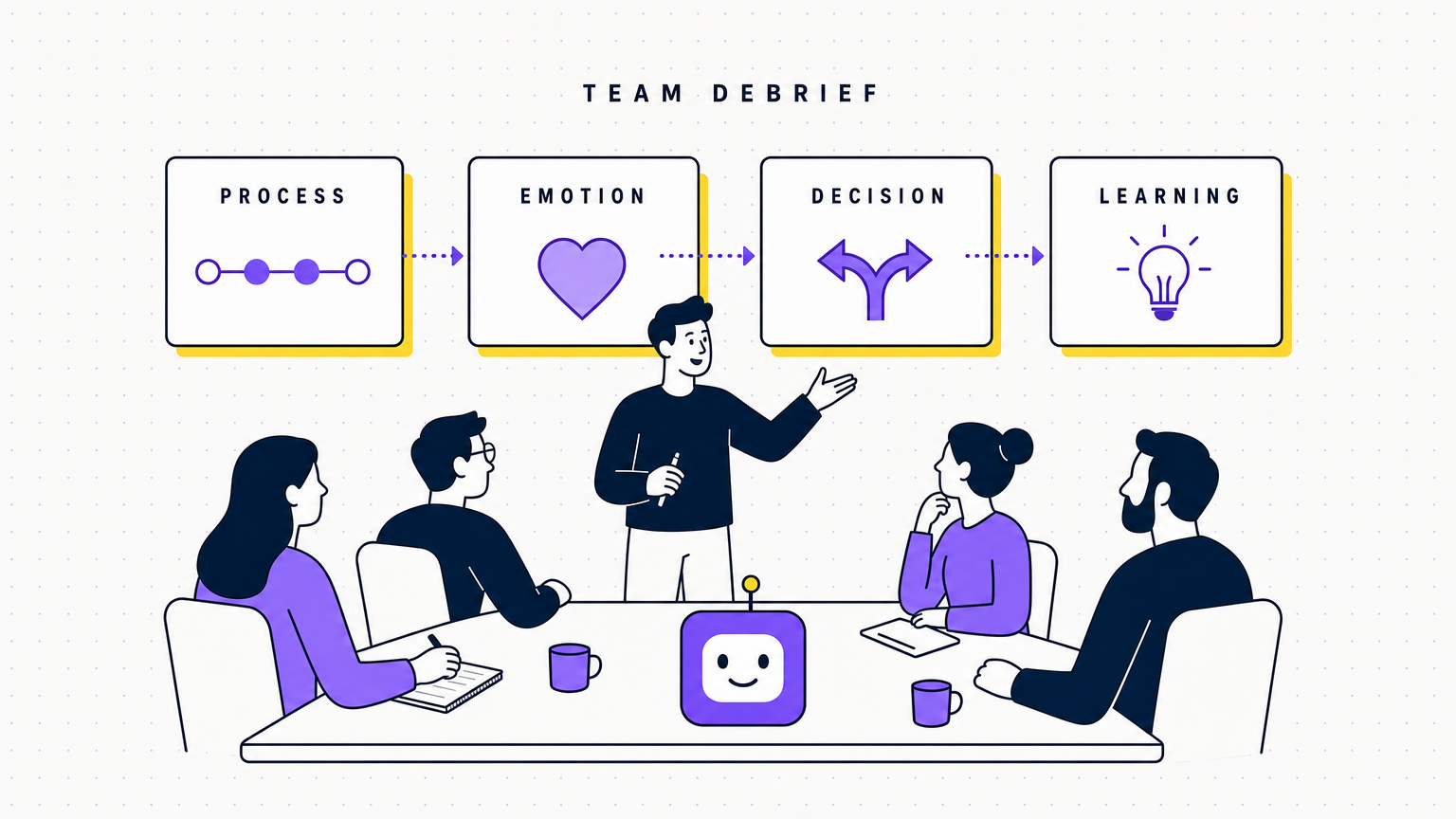
A debrief is a short, structured conversation a team holds after an event to work out what happened, why it happened, and what to carry into the next one. The questions you ask are the whole game. Ask vague ones and you get a polite recap nobody acts on. Ask the right ones, in the right order, and the same half hour turns a finished project into a set of lessons the team can actually use. This guide gives you 30 debrief questions grouped by what they surface, three copy-paste templates for the most common situations, and the established frameworks to slot them into.
If you want the deeper background on the method itself, our guide to how to run an after-action review covers the origins, the evidence, and the facilitation mechanics. This page is the practical companion: the actual questions and templates you can take into a session today.
The short answer
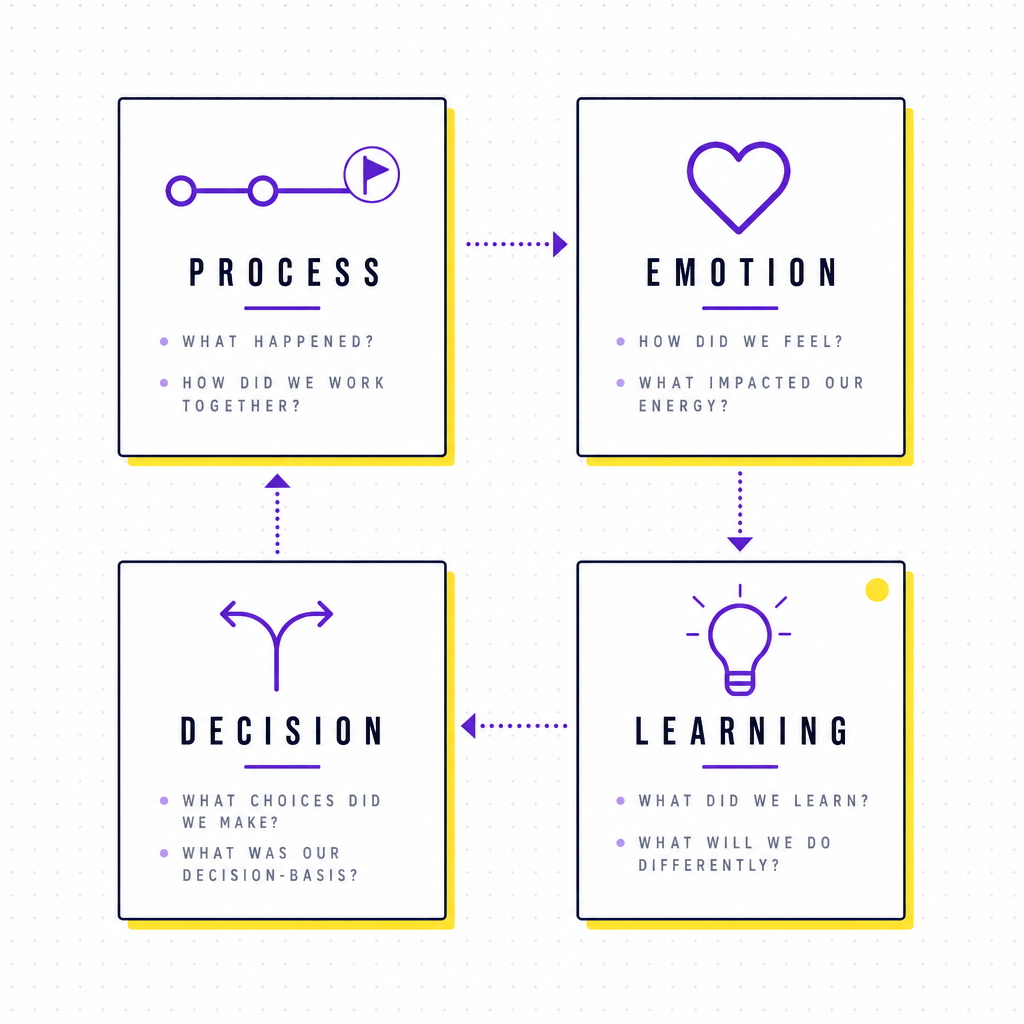
A good debrief moves through four kinds of question, in this order: what happened, how it felt, why we made the calls we did, and what we change. The order matters as much as the questions. You agree on the facts before you let interpretation in, and you understand the decision before you reach for a fix.
| Question group | What it surfaces | Roughly how much time |
|---|---|---|
| Process: what happened | An agreed, factual timeline | 30% |
| Emotional: how it felt | Morale, friction, stress carried out of the event | 15% |
| Decision: why we chose what we chose | The reasoning behind the key calls | 25% |
| Learning: what we change | Specific, owned actions for next time | 30% |
Skip the emotional layer and people quietly carry the friction into the next project. Skip the decision layer and you fix symptoms instead of causes. The 30 questions below are sorted into these four groups so you can build a debrief that covers all of them.
What does “debrief” mean?
The word comes from military and aviation practice, where crews are questioned immediately after a mission or flight to extract what happened while memory is still sharp. In a workplace setting a debrief is a facilitated discussion that converts a shared experience into shared learning. It is a learning method, not a performance review, and the moment it starts grading individuals people stop telling the truth.
A debrief overlaps with a few neighbours that get used interchangeably. An after-action review is the most portable version, built around four questions on the gap between intended and actual results. A retrospective is the debrief adapted for recurring software sprints, run on a fixed cadence. A post-mortem is the version run after something went wrong, with a heavier focus on root cause. A hotwash is the quick, informal debrief held on the spot, immediately after an exercise or incident, before anyone leaves the room. They share the same engine. Reconstruct what happened, diagnose why, decide what changes.
Do debriefs actually work?
Yes, and the evidence is stronger than for most management habits. The foundational meta-analysis by Tannenbaum and Cerasoli, published in Human Factors in 2013, pooled results across 46 samples and found that teams and individuals who debriefed outperformed those who did not by roughly 20 to 25 per cent, an effect size of about d = 0.67. The effect held across military, medical, and laboratory settings, and whether the session was led by a facilitator or the team itself. For the fuller evidence base, including the larger after-action-review meta-analysis, see the after-action review guide.
The catch is that the benefit depends almost entirely on how the session is run. A debrief with no psychological safety, no honest emotional check, or no owned actions at the end produces a tidy document and no change. That is what the questions and templates below are designed to prevent.
How to design a good debrief question
Three rules separate questions that open people up from questions that shut them down.
First, lead with open questions. A closed question (“Did the launch go well?”) invites a yes or a defensive no. An open one (“What stood out to you about how the launch went?”) invites an account. Usability and survey research has consistently found that open questions surface information the asker did not know to look for, while closed questions only confirm what you already suspected. Save the closed, specific questions for when you need to pin down a detail.
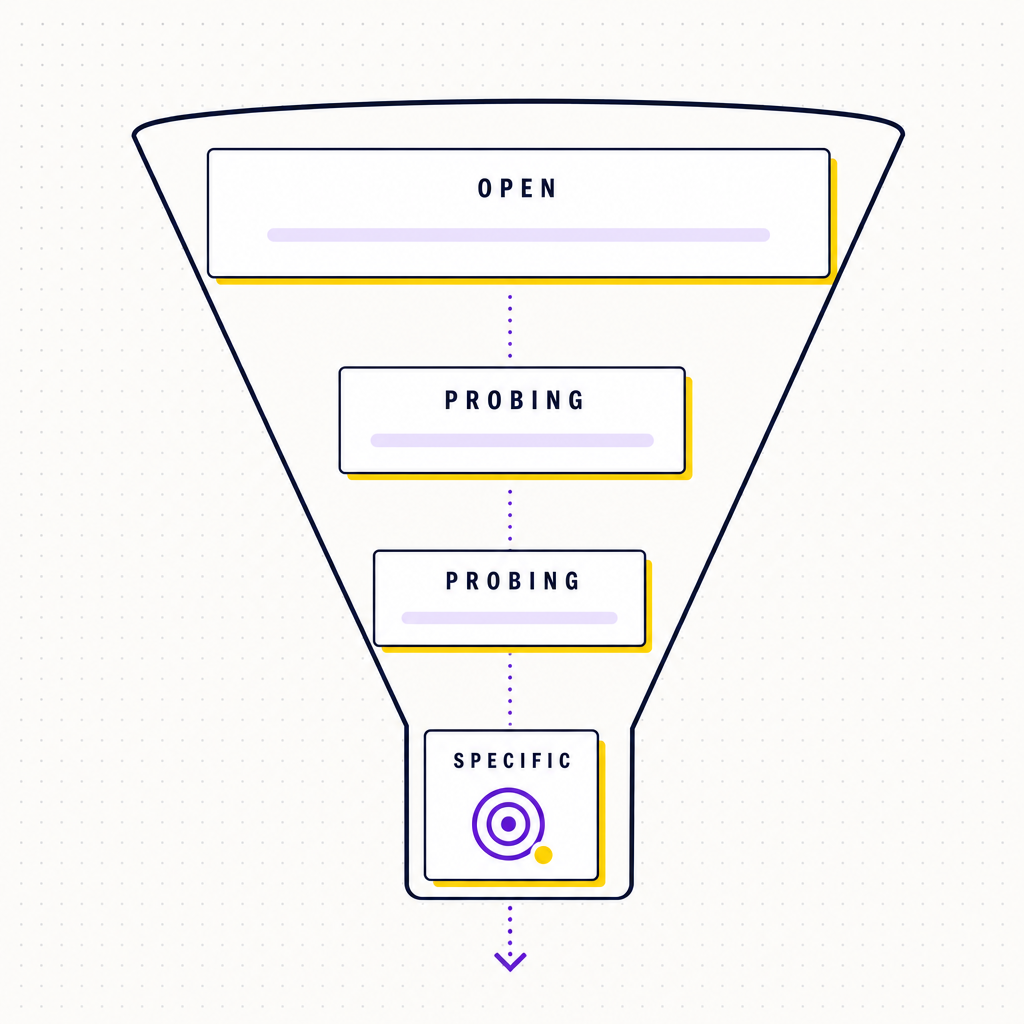
Second, sequence from wide to narrow. The funnel technique starts broad to get people talking, then narrows towards the specific decision or moment you care about. Opening with the most pointed question (“Why did the deploy fail?”) puts people on the defensive before they have warmed up. Opening wide (“Walk me through the day from your seat”) builds the shared timeline that makes the pointed question easy to answer later.
Third, frame everything as blameless. Attach the question to the process, the system, or the decision, never the person. “What made that call feel right at the time?” surfaces the reasoning. “Why did you make that call?” surfaces a flinch. The first is how you learn; the second is how you teach people to hide.
30 debrief questions, grouped by purpose
Pick six to ten of these per session rather than marching through all thirty. Match the selection to the event and the time you have.
Process: what actually happened
These build the agreed, factual timeline. Resist the urge to explain anything yet.
- Walk me through what happened, from your point of view, start to finish.
- What did we set out to do, and what did we actually do?
- Where did the plan and reality first part ways?
- What went exactly as expected?
- Which moments felt like turning points, looking back?
- What information did we have at each key step, and what were we missing?
- What did we do that we had not planned to do?
- If someone outside the team watched a recording, what would they notice that we might gloss over?
Emotional: how it felt
These surface the morale, friction, and stress people carry out of an event. Keep them voluntary, and never push anyone to disclose more than they want to.
- How are you feeling now that it is over?
- Which part of this was the most draining, and which gave you energy?
- Was there a moment you felt genuinely stuck or unsupported?
- When did the team feel most in sync? When did it feel most strained?
- Is there anything you wanted to say during the event but did not?
- What would you want a teammate to understand about your experience of this?
Decision: why we chose what we chose
These examine reasoning, not outcomes. A good decision can have a bad outcome and a bad decision a lucky one, so judge the call by what was known at the time.
- What made that decision feel like the right one in the moment?
- What were we optimising for when we made that choice?
- What options did we consider and set aside, and why?
- What assumption were we relying on that turned out to be wrong?
- Where did we have to choose between speed and certainty, and how did we choose?
- If you had to make the same call again with the same information, would you?
- What signal did we have early that we did not act on?
Learning: what we change
These convert the diagnosis into commitments. Every answer here should be specific enough to assign to a person.
- What is the one thing we should keep doing, deliberately, next time?
- What is the one thing we should stop doing?
- What should we start doing that we did not do this time?
- What would have made the biggest difference if we had it in place from the start?
- What did we learn that the rest of the organisation should know?
- What needs to change in our process, and who owns that change?
- How will we know, next time, whether the change worked?
- What is the smallest experiment we could run before the next round?
- If we only fix one thing from today, what should it be?
Three copy-paste debrief templates
Each template below is a complete agenda you can drop into a doc or a meeting invite. Swap in the relevant questions from the bank above.
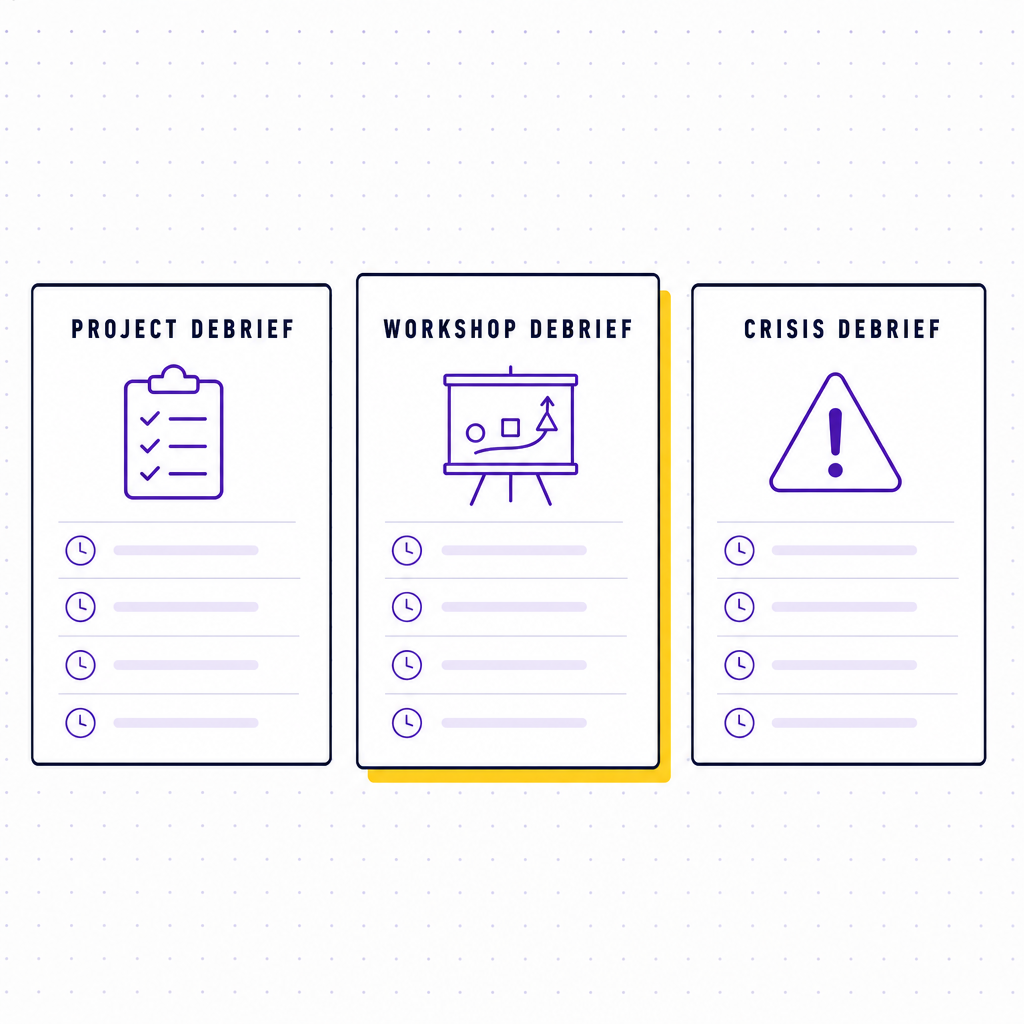
1. Project debrief template
Use this at the end of a project or a major phase. Plan for 45 to 60 minutes.
PROJECT DEBRIEF: [project name]
Date: ____   Facilitator: ____   Note-taker: ____

Ground rule (read aloud): we assume everyone did their best with what
they knew at the time. We examine the process, not the people.

1. What we set out to do (5 min)
   - Restate the original goal, scope, and success criteria.

2. What actually happened (15 min)  [Process questions: 1, 2, 3]
   - Build a shared timeline on screen. Facts only, no interpretation.

3. How it felt (5 min)  [Emotional questions: 9, 12]
   - Quick round. Everyone speaks once.

4. The key decisions (15 min)  [Decision questions: 15, 17, 18]
   - Pick the two or three calls that shaped the outcome. Examine the
     reasoning behind each.

5. What we change (15 min)  [Learning questions: 22, 23, 24, 27]
   - Convert into a Start / Stop / Continue list.

6. Owned actions (5 min)
   - Each action gets a name, a verb, and a date. No action without an owner.
2. Workshop or training debrief template
Use this after a workshop, offsite, or training session, with the facilitators and ideally a few participants. Plan for 30 to 45 minutes.
WORKSHOP DEBRIEF: [session name]
Date: ____   Facilitator: ____

1. Plus / Delta (10 min)
   - Plus: what worked and should stay.
   - Delta: what we would change next time.
   - Capture both columns visibly as people call them out.

2. The participant experience (10 min)  [Emotional questions: 10, 13]
   - Where did energy peak and dip? Where did people disengage?

3. The design decisions (10 min)  [Decision questions: 16, 19]
   - Did the structure, timing, and exercises do what we intended?

4. Changes for the next run (10 min)  [Learning questions: 24, 28, 29]
   - One experiment to try next time, with a way to tell if it worked.
3. Crisis or incident debrief template
Use this after an incident, outage, or high-stress event. Run it within a day or two, while memory is fresh, but give people a beat to decompress first. Plan for 45 to 90 minutes.
INCIDENT DEBRIEF: [incident name]
Date: ____   Facilitator (neutral, not involved in the incident): ____

Ground rule (read aloud): this is a learning review, not a search for
fault. Nothing said here goes into anyone's performance record.

1. The timeline (20 min)  [Process questions: 1, 5, 6]
   - Reconstruct the sequence minute by minute. Agree on it before moving on.

2. The human side (10 min)  [Emotional questions: 9, 11]
   - Voluntary. How are people doing? Who needs support, not analysis?

3. The decisions under pressure (20 min)  [Decision questions: 15, 20, 21]
   - What was known at each decision point? Judge calls on what was visible
     then, not on hindsight.

4. Systemic causes and changes (20 min)  [Learning questions: 25, 26, 27, 30]
   - Push past the first plausible cause to the conditions that allowed it.
A note on the crisis version. Routine operational debriefs are different from formal psychological trauma processing. Systematic reviews have warned that forcing trauma-exposed people into a single mandatory psychological debrief, the model once known as Critical Incident Stress Debriefing, can in some cases worsen post-traumatic symptoms rather than help. So keep the emotional check voluntary, and route anyone carrying real trauma to specialist support rather than handling it in an operational review.
Pick a framework to hang your questions on
The question groups map cleanly onto the established debrief frameworks. Choose the one that fits the moment.
| Framework | Best for | The shape |
|---|---|---|
| Plus / Delta | Fast, low-ceremony reviews | What worked (plus), what to change (delta) |
| Start / Stop / Continue | Behaviour-change debriefs | Three columns of owned actions |
| 4 Ls | Team retrospectives | Liked, learned, lacked, longed for |
| Gibbs Reflective Cycle | Individual or learning-heavy debriefs | Description, feelings, evaluation, analysis, conclusion, action plan |
| GAS | Healthcare and simulation | Gather, analyse, summarise |
| AAR four questions | Any one-off event | Expected, actual, why, sustain or improve |
Notice that Gibbs is the only common framework that builds in the emotional layer explicitly, with a dedicated Feelings stage. That is exactly the layer most operational debriefs skip, which is why borrowing that one stage is worth doing even when you run a different model.
Running debriefs remotely
Distributed teams need a heavier facilitation hand than a room does. On video, dominant voices monopolise more easily and quieter people disappear more completely. Two habits help. Use a turn-passing method, where the current speaker explicitly hands to the next person, so participation does not default to the loudest. And gather the factual timeline asynchronously before the call, in a shared doc or whiteboard, so the live time goes to the emotional and decision layers that actually need everyone present.
This is also where AI assistance is moving fastest. Through 2025 and 2026, tools that transcribe a session and draft a structured summary have taken the note-taking load off facilitators, and in healthcare, research-grade systems have started generating objective observation reports to anchor the human-led discussion. The consistent finding is that these belong in the preparation layer. They are good at reconstructing what happened and bad at reading the room, so the judgement, the empathy, and the protection of safety stay with the human facilitator.
The mistakes that waste a debrief
Most debriefs that change nothing fail in one of four ways.
The first is running one without psychological safety. If people fear that candour will be used against them, they share a sanitised version and you diagnose the wrong causes. The concept comes from Amy Edmondson’s research, and it is the strongest single predictor of whether a debrief surfaces the truth.
The second is the blame game, where the conversation drifts from what failed to who failed. The aviation safety literature has long shown that punishing people for honest mistakes teaches them to hide the next one, which is the opposite of what a debrief is for.
The third is skipping the emotional layer entirely. A review that only asks about technical execution leaves people carrying unspoken friction and stress into the next round, and over time that erodes the team faster than any process gap.
The fourth is ending without owned actions. A list of improvements with no names, verbs, or dates produces zero change. The follow-through is the entire point.
Why this matters for L&D, HR, and coaches
If you are responsible for how an organisation learns, the debrief is one of the cheapest high-return habits you can build. It turns experience into a compounding asset instead of a lesson the team keeps re-learning at full price. Industry estimates of training return on investment vary widely and should be treated as directional rather than precise, but the underlying mechanism is not in doubt: teams that reflect systematically reduce rework, surface skills gaps earlier, and retain people who feel heard.
The reason most teams do not get the benefit is rarely the template. It is that the debrief either never happens, runs as a blame session, or ends without owned actions. Your job, as the person enabling it, is to make the habit routine, protect the safety it depends on, and hold the team to the follow-through.
The reconstruct-what-happened step is also where debriefs quietly break, because it relies on memory, and memory rewrites the story within days. Team Building Bot is built for that gap. It joins your online sessions, listens for the moments that shaped the outcome, and hands you a Key Moments report so the team can skip the slow reconstruction and spend the meeting on why. You can see what those reports look like on the reports overview.
FAQ
What is a debrief? A debrief is a structured conversation a team holds after an event to reconstruct what happened, understand why, and decide what to change. It is a learning method, not a performance review, and it works best when people feel safe enough to be honest about what went wrong.
What questions should I ask in a debrief? Cover four kinds of question in order: what happened (the factual timeline), how it felt (morale and friction), why we made the decisions we did (the reasoning behind key calls), and what we change (specific, owned actions). Pick six to ten questions across these groups rather than asking everything.
What is the difference between a debrief and a retrospective? A retrospective is a debrief adapted for recurring software sprints, run on a fixed cadence and usually owned by the team. A debrief is the broader term for any post-event learning conversation, including one-off projects, workshops, and incidents. Both reconstruct what happened, diagnose why, and decide what changes.
How long should a debrief take? Match the length to the event. A quick workshop debrief can run 30 to 45 minutes, a project debrief 45 to 60, and a major incident review 45 to 90. A hard timebox forces the team to prioritise and keeps the discussion from drifting.
Should a debrief include emotions? Yes, with care. Skipping the emotional layer leaves people carrying unspoken friction into the next round. Keep emotional questions voluntary, and for genuinely traumatic incidents route people to specialist support rather than processing trauma in an operational debrief.
Who should facilitate a debrief? Someone neutral, who works the process rather than offering their own verdict. For incident reviews especially, the facilitator should not be someone whose own decisions are under examination, so the conversation stays about learning rather than self-defence.
Sources
- Debrief effectiveness meta-analysis: Tannenbaum, S. I., & Cerasoli, C. P. (2013). Do team and individual debriefs enhance performance? A meta-analysis. Human Factors, 55(1), 231–245. PubMed · research summary (Safety Insights) · citation report (scite).
- Debrief frameworks and reflective models, the GAS framework, and theory-based debriefing methods: GAS debriefing framework (ResearchGate) · theory-based debriefing methods (Montgomery College) · more than one way to debrief, a critical review (Case Western) · debriefing guide (WVU STEPS).
- Gibbs Reflective Cycle: Gibbs reflective cycle (University of Edinburgh) · Gibbs reflective cycle template (TSW Training) · Gibbs reflective cycle (Leadership360).
- 4 Ls and Start / Stop / Continue formats: 4Ls retrospective (Parabol) · 4Ls retrospective (Retrium) · 4Ls retrospective (GroupMap) · start stop continue method (SIGMA) · start stop continue (Tempo) · start stop continue template (monday.com).
- Question design, open vs closed and the funnel sequence: open-ended questions (Nielsen Norman Group) · closed vs open-ended questions (SurveyMonkey) · open vs closed questions in survey design (Teacup Lab) · funnel questions (Indeed) · question funnel for tough conversations (Cadence Leadership) · effective questioning (CPD Online).
- Psychological safety, blame, and learning from failure: Punishing People or Learning from Failure (FAA Safety) · framing for psychological safety (Leading Sapiens) · the SAFETY model and psychological safety (PsychSafety) · the art and value of debriefing (Manu Sharma).
- The emotional layer and the caution on Critical Incident Stress Debriefing: neglect of the emotional layer in debriefs (PMC10080145) · emotional well-being and debriefing (PMC11614593) · CISD overview (US Army Corps of Engineers) · systematic review of psychological debriefing (PubMed) · psychological debriefing review (MDPI, IJERPH).
- Failure modes, follow-through, and the L&D case: debriefing techniques (Crisis Prevention Institute) · project debrief for L&D managers (eLearning Industry) · the ROI of corporate learning (eLearning Industry) · L&D metrics and ROI (360Learning) · ROI and business outcomes (Udemy Business).
- Remote facilitation and AI-assisted debriefing (2024–2026): remote meeting best practices (Teamcamp) · virtual team kickoff facilitation (Herrmann) · generative AI in simulation debriefings, Team-FIRST (PMC12924402) · DebriefAI · AI productivity and meeting tools (RingCentral).
Walk into your next debrief with the timeline already done
Team Building Bot joins your online session, listens for the moments that shaped the outcome, and hands you a Key Moments report so the team can skip the slow reconstruction and spend the debrief on why. Free during beta.
No spam, no credit card. Unsubscribe any time.