How to Run a Pre-Mortem Meeting (Before the Project Fails)
A pre-mortem assumes your project has already failed, then works backwards to find out why. Here is the evidence it works and a 60-minute way to run one.
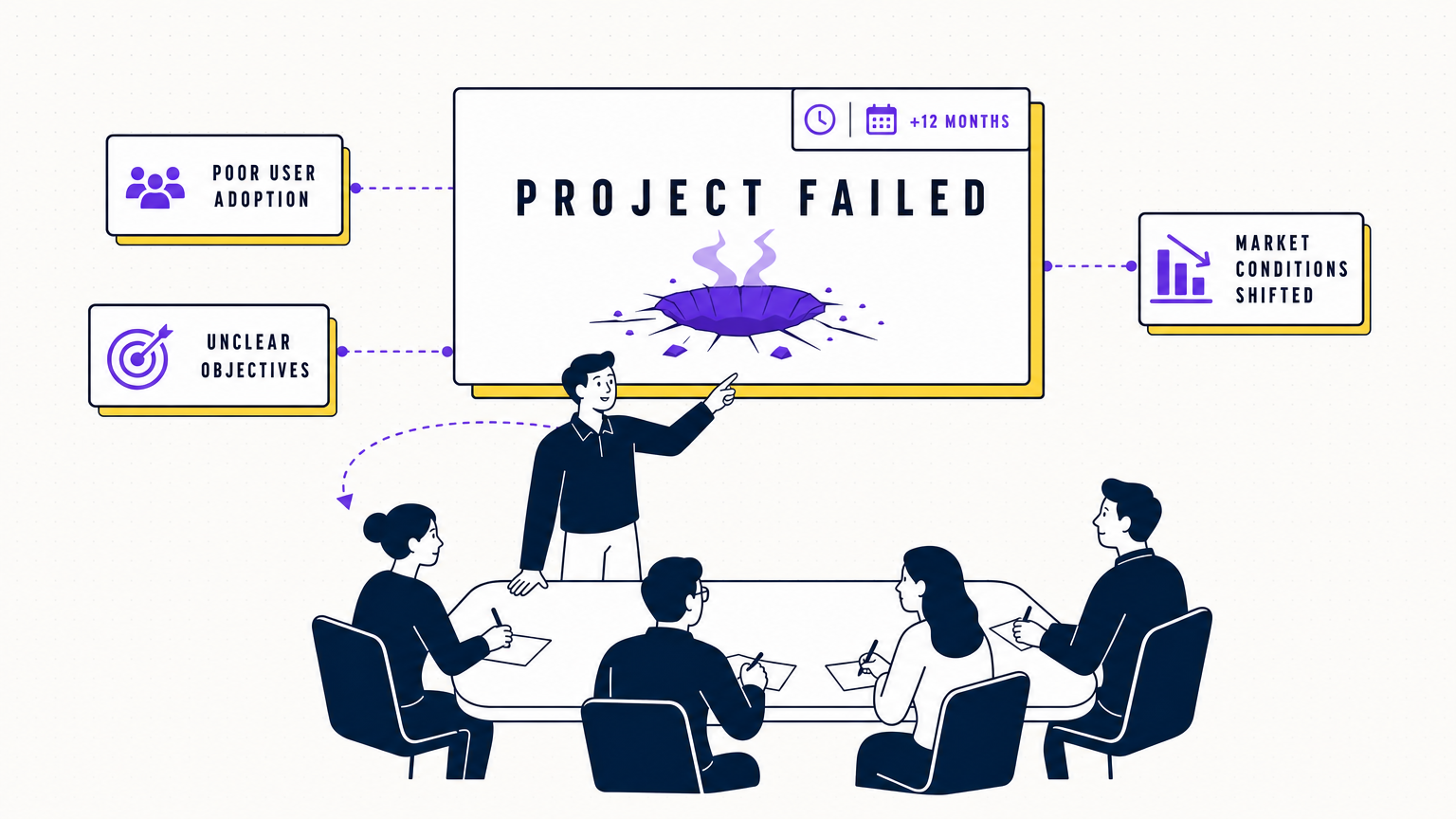
A pre-mortem is a meeting you hold at the start of a project where the team assumes the project has already failed, then works backwards to explain why. It flips the usual risk question on its head. Instead of asking what might go wrong, which people answer with vague, safe abstractions, you state as fact that the project is a smoking crater and ask the team to tell you exactly how it got there. The change in grammar, from “could” to “did”, does something measurable to how people think, and it is one of the cheapest planning tools with real evidence behind it.
This guide covers what a pre-mortem actually is, the cognitive science that makes it work, how it differs from a post-mortem and an after-action review, and a step-by-step way to facilitate one in about sixty minutes. It also covers the part most teams get wrong: the difference between a genuine pre-mortem and a theatrical risk-listing session that surfaces nothing anyone did not already know.
The short answer
A pre-mortem, sometimes called a pre-mortem analysis, is a structured exercise run before a project kicks off. The facilitator asks the team to imagine themselves a year in the future, looking back at a project that failed completely, and to write down every reason it failed. The technique was formalised by cognitive psychologist Gary Klein in a 2007 Harvard Business Review article, and it works because of a quirk of memory called prospective hindsight: people are roughly 30 per cent better at naming the causes of an outcome when they treat it as something that has already happened rather than something that might.
| Pre-mortem | Post-mortem | After-action review | |
|---|---|---|---|
| When | Before kickoff | After the project ends | During, at milestones |
| Question | Why did it fail? (imagined) | Why did it fail? (real) | Expected vs actual, so far |
| Goal | Prevent the failure | Capture lessons for next time | Adapt while you still can |
The value is not in the list of risks. It is in what you do with them. A pre-mortem that ends without a single change to the plan was a conversation, not a planning tool.
What is a pre-mortem?
The name borrows from medicine. A post-mortem examines a body to work out the cause of death, which, as Klein has pointed out, helps everyone except the patient. A pre-mortem moves that examination to before the project is alive enough to die, when the cost of changing course is close to zero.
The mechanics are simple. You gather the people who will deliver the project, tell them to assume it has already failed badly, and ask each of them, working alone first, to write down the reasons. Then you pool the reasons, prioritise them, and adjust the plan to defend against the most dangerous ones. The whole thing fits in an hour. What makes it work is not the structure, which looks like any other brainstorm, but the framing, which is the opposite of one.
Most kickoff meetings run on optimism. The plan is fresh, the budget is approved, and nobody wants to be the person who pours cold water on a project everyone just committed to. A traditional risk assessment asks the room to fight that optimism using the same hopeful brain that produced it, and the result is a register full of generic worries like “shifting priorities” that protect nobody’s ego and predict nothing useful. The pre-mortem sidesteps the problem by changing what you are asking people to do.
Why it works: prospective hindsight
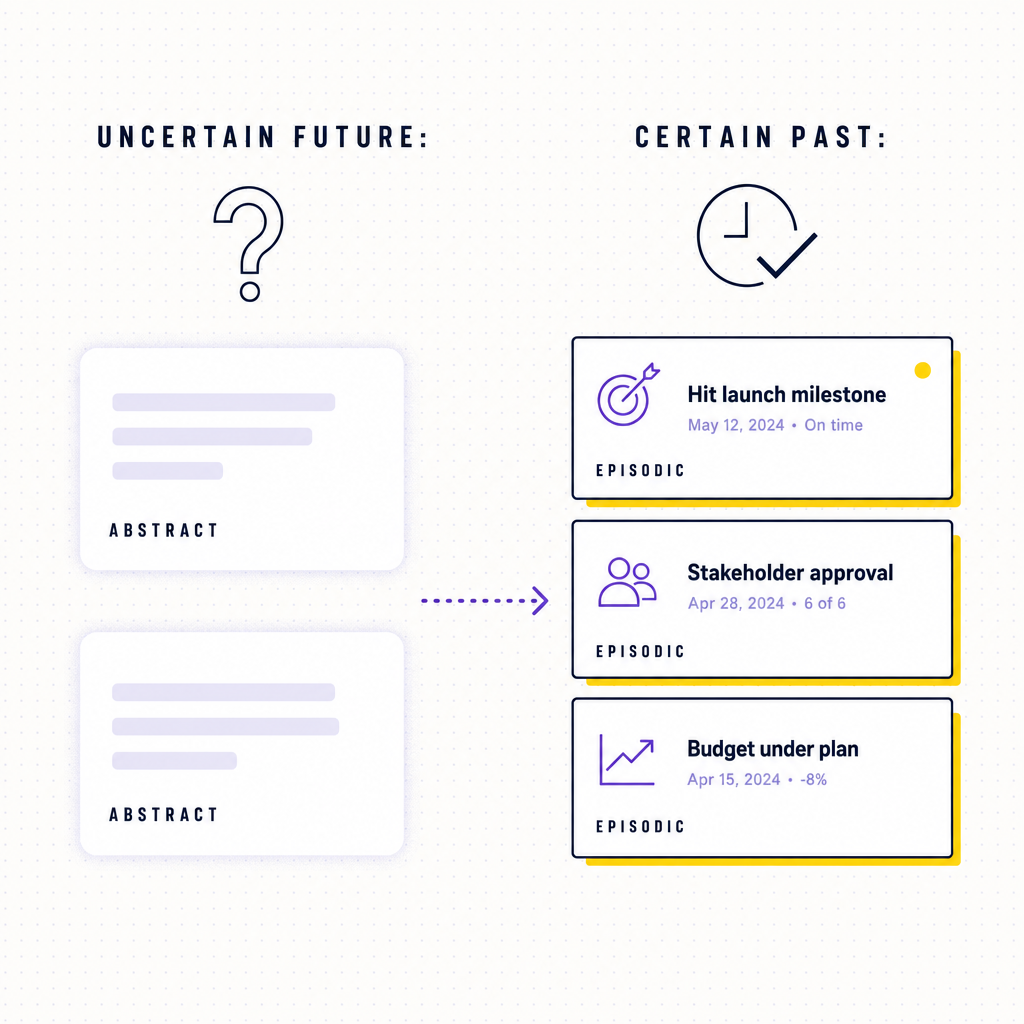
The engine behind the pre-mortem is a 1989 study by Deborah Mitchell, J. Edward Russo, and Nancy Pennington, published in the Journal of Behavioral Decision Making under the title “Back to the Future: Temporal Perspective in the Explanation of Events”. Across two experiments with MBA students and paid participants, the researchers manipulated two things: whether an event was framed as future or past, and whether its outcome was framed as uncertain or certain. They found that imagining an event had already happened, what they called prospective hindsight, increased people’s ability to correctly identify reasons for the outcome by about 30 per cent.
The more interesting finding was why. The improvement was not because people simply tried harder when the outcome was certain. It was that they thought differently. Faced with an uncertain future, people generate abstract reasons, broad categories of risk with no handle to grip. Told the outcome is a settled fact, they generate episodic reasons, concrete chains of events. Instead of “market challenges”, a participant working in prospective hindsight writes “a key supplier went bankrupt in the third quarter and we had no second source”. Putting the failure in the past tense frees the brain from judging whether the risk is real and lets it spend that energy describing how the disaster unfolded.
This sits on top of a stack of well-documented biases. The planning fallacy, named by Daniel Kahneman and Amos Tversky in 1979, is the reliable human tendency to underestimate how long things take and how much they cost, because planners take an “inside view” of their own intentions and ignore the base rates of how similar projects actually fared. Kahneman later endorsed the pre-mortem in Thinking, Fast and Slow as a low-cost, high-payoff way to fight exactly this. Layered on that is the social problem: in a normal meeting, junior staff and experts stay quiet rather than challenge a senior leader’s pet plan, a dynamic the research calls the “mum effect”. The pre-mortem gives everyone licence to describe failure, which makes dissent the assignment rather than an act of disloyalty.
There is harder evidence than the original 1989 study. In 2010, Veinott, Klein, and Wiggins ran 178 participants through an evaluation of a complex H1N1 pandemic response plan, comparing the pre-mortem against standard pros-and-cons analysis and a weaknesses-only critique. The pre-mortem produced the largest reduction in dangerous overconfidence of any method tested, because it combined two mechanisms at once: it forced attention onto failure, and it stipulated that the failure was certain. That is the combination the abstract-versus-episodic finding predicts.
Pre-mortem vs post-mortem vs after-action review
These three tools share the autopsy metaphor and get muddled constantly, but they sit at different points in a project’s life and do different jobs.
A post-mortem happens after a project ends or dies. Its goal is to capture what went wrong and turn it into institutional knowledge for next time. It is useful, but it arrives after the money is spent and the deadline is missed, and it is vulnerable to hindsight bias, where the outcome looks inevitable in retrospect, and to defensive blame-shifting, where the meeting becomes about who is at fault.
An after-action review sits in the middle of the work. Developed by the US Army, it runs at intervals, after a sprint or a milestone, and compares what the team expected with what actually happened so it can adapt while there is still time to adapt. It is excellent for tactical course-correction, but it is still looking at events that have already occurred, and it cannot save a team from a strategy that was flawed from the start. Our guide to running an after-action review covers that method in full.
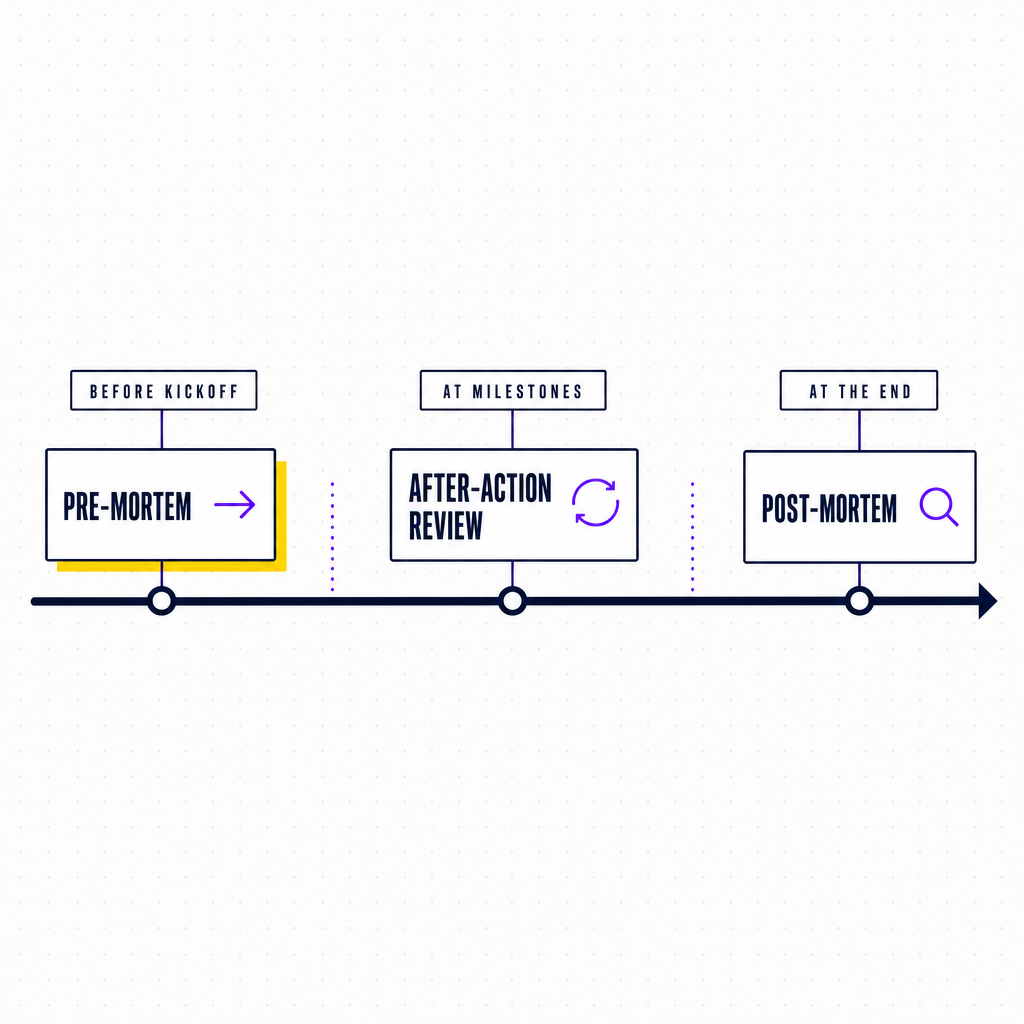
The pre-mortem is the only one of the three that is purely forward-looking. It runs before the team is emotionally locked into an approach, which is precisely when changing the plan is cheapest. The three are complementary, not competing. A well-run team will pre-mortem at the start, review at the milestones, and post-mortem at the end, and feed each one into the next.
How to run a pre-mortem in 60 minutes
A pre-mortem is easy to describe and easy to ruin. The failure mode is what facilitators call theatrical risk-listing, where the team recites generic, low-stakes risks to look diligent without naming anything that threatens the plan. The structure below is built to prevent that. It runs in four phases and works for a project team, an agile squad, or a corporate transformation kickoff.
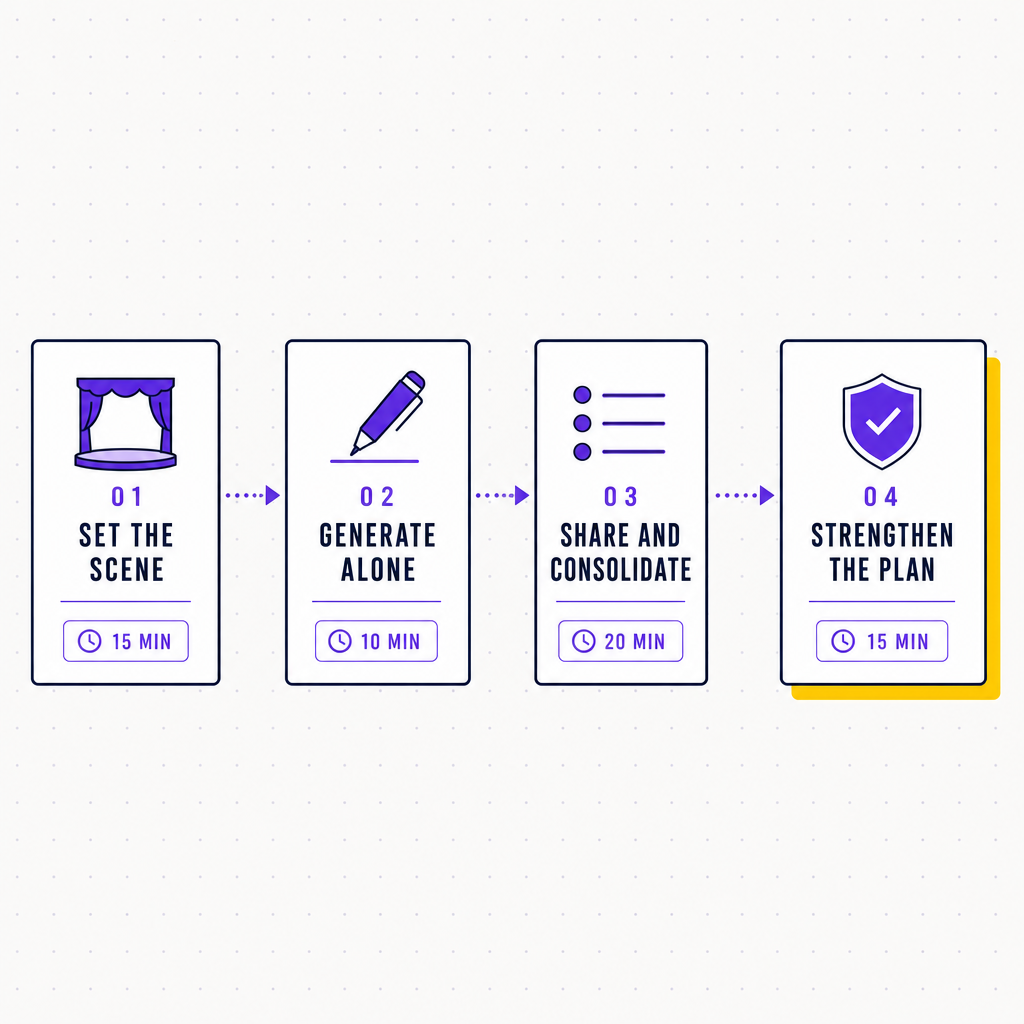
Phase 1: Set the scene (15 minutes)
Get the right people in the room first. Five to fifteen is the workable range, and the mix matters more than the number. Engineering, design, legal, and operations carry entirely different blind spots, and a room of people from one function will only find that function’s risks. Run quickly through the plan so everyone shares the same picture of scope and milestones.
Then handle the seniority problem before it sinks the session. If the project sponsor’s presence will make people guard their words, either leave them out of the generation phase or contract with them explicitly to stay silent and listen. Executive defensiveness is the single most common thing that kills a pre-mortem, because the moment a leader explains why a failure is impossible, the room learns that honesty is unwelcome.
Now deliver the prompt, and deliver it with total certainty. Not “imagine this could fail” but “it is twelve months from now, we launched, and this project failed completely. The budget is gone, we missed every deadline, and the thing we built does not work. It has failed. Your job is to tell me how.” The past tense is the whole trick. Keep the room in it.
Phase 2: Generate reasons alone (10 minutes)
Give everyone ten minutes of silence to write down every reason the project failed. Silence is not a nicety here, it is the mechanism. The moment someone says the first reason out loud, the room anchors on it and the range of ideas narrows. Writing first also gives the quiet people, the introverts and the junior staff and the one person who has been worried since the start, a way to commit their concern to paper before the senior voices fill the air.
Push for specifics. “Poor communication” is a non-answer. “The client’s only decision-maker went on leave in week six and approvals stalled for a month” is a risk you can actually defend against. The goal of this phase is concrete, mechanical stories of failure, not categories.
Phase 3: Share and consolidate (20 minutes)
Go round the room and ask each person to read one reason from their list. Capture it on a board, move to the next person, and keep cycling until every distinct reason is up. One rule, enforced hard: nobody debates, defends the plan, or starts solving. The only job in this phase is extraction. If a leader interrupts to argue that a scenario is impossible, you have just taught everyone else to stop sharing, and the rest of the list dies in people’s heads.
Phase 4: Strengthen the plan (15 minutes)
Now break the spell and come back to the present. Cluster the reasons into themes and have the team vote on the ones that are most likely, most damaging, or both, the show-stoppers. For each of those, do one concrete thing: change the plan, assign an owner to watch the risk, or set an early-warning tripwire that tells you the failure is starting. If the meeting ends without a single change to the project charter, the backlog, or the resourcing, it was an interesting hour that achieved nothing. The point of a pre-mortem is the edit it makes to the plan.
Genuine pre-mortem vs theatrical risk-listing
The difference between a pre-mortem that works and one that wastes an hour comes down to a few specific things, and they are all about discipline rather than cleverness.
The first is tense. The benefit lives entirely in the past tense. The moment the facilitator lets the room drift back into “what could go wrong”, the cognitive mechanism switches off and you are back to ordinary, abstract brainstorming. Hold the failure as a fact for the whole generation phase.
The second is specificity. A genuine pre-mortem produces episodic reasons with names, dates, and mechanisms. A theatrical one produces a risk register of nouns: “scope creep”, “resourcing”, “stakeholder alignment”. If the reasons on your board would fit any project in the company, you have not run a pre-mortem yet.
The third is safety. The technique depends on people being willing to describe failures that implicate the plan, the leadership, or themselves. That only happens in a room with enough psychological safety to make the admission survivable. If your organisation does not have that baseline, the pre-mortem will surface the same sanitised risks as everything else, and the fix is the culture, not the meeting.
One more boundary worth knowing. The pre-mortem deliberately focuses only on failure, and it should stay that way. Research from Gabriele Oettingen’s lab at New York University suggests that vividly imagining success can quietly sap the motivation to do the work, because the brain registers the win as already banked. That is a good reason to resist the temptation to “balance” the session with a hopeful counterpart and to keep the hour pointed squarely at the crater.
Where it is being used now
Over the last couple of years the pre-mortem has spread well beyond classic project management. In software, engineering teams have folded it into design reviews, assuming a proposed architecture has already caused a production outage and hunting for the exact technical fault, which doubles as a low-risk way for junior engineers to learn how a system breaks. In the startup world, venture investors increasingly push founders to run pre-mortems to find the existential risks that will actually decide whether the company lives, stripping away the optimism that the industry runs on. And in healthcare and health-tech, where a failed project can mean harmed patients rather than just lost money, teams use pre-mortems to surface risks around data bias, compliance, and clinical safety before any code or protocol is locked in.
The common thread is environments where failure is expensive and optimism is structural. That describes most ambitious projects, which is why the technique travels so well.
Why this matters for L&D, HR, and coaches
If you are responsible for how teams in an organisation work and learn, the pre-mortem is worth more than its hour. The 2026 Blanchard HR Trends Survey put employee engagement, psychological safety, and managing organisational change near the top of the challenges L&D leaders are wrestling with. The pre-mortem is a concrete, teachable habit that pushes on all three at once. It gives managers a repeatable way to make dissent normal, to flatten hierarchy for an hour, and to turn the vague goal of “a safe team culture” into a specific behaviour people practise at every kickoff.
It also reframes facilitation in language the business already respects. Teaching a manager to run a pre-mortem is not a soft-skills nicety, it is risk management, and it produces a visible change to a real plan. For an L&D function under pressure to show that what it does moves business outcomes, that is a useful thing to be able to point at.
The hard part, in practice, is that the quality of a pre-mortem depends on hearing the quiet signals, the hesitation, the person who half-raises a concern and then drops it, the topic the room keeps steering around. Those are exactly the moments a busy facilitator misses while trying to run the meeting. Team Building Bot is built for that gap. It joins your online kickoff, listens for where the team stalls or talks past each other, and produces a Key Moments report you can bring straight into the pre-mortem so the conversation starts from evidence rather than memory. You can see what those reports look like on the reports overview.
FAQ
What is a pre-mortem meeting? A pre-mortem is a meeting held at the start of a project where the team imagines the project has already failed and works backwards to identify why. It was formalised by Gary Klein in a 2007 Harvard Business Review article and is used to surface hidden risks before any money or time is committed.
How is a pre-mortem different from a post-mortem? A post-mortem happens after a project ends and examines a real failure to capture lessons for next time. A pre-mortem happens before the project starts and examines an imagined failure to prevent it. The pre-mortem can still change the outcome, whereas the post-mortem only informs future projects.
Does the pre-mortem technique actually work? The evidence is good. A 1989 study by Mitchell, Russo, and Pennington found that imagining an outcome as already certain, called prospective hindsight, improved people’s ability to identify its causes by about 30 per cent. A 2010 study by Veinott, Klein, and Wiggins with 178 participants found the pre-mortem reduced overconfidence more than standard critique methods.
How long should a pre-mortem take? About sixty minutes for a typical project. A workable split is fifteen minutes to set the scene and deliver the failure prompt, ten minutes of silent individual writing, twenty minutes to share and consolidate the reasons, and fifteen minutes to prioritise and change the plan.
Who should attend a pre-mortem? Five to fifteen people who will actually deliver the project, drawn from different functions so the room covers different blind spots. If a senior sponsor’s presence will stop people speaking honestly, either leave them out of the idea-generation phase or ask them to stay silent and listen.
What is the difference between a pre-mortem and a risk assessment? A traditional risk assessment asks what might go wrong, which tends to produce abstract, generic risks. A pre-mortem assumes the failure has already happened and asks how, which produces concrete, specific reasons. The difference in framing is what makes the pre-mortem surface risks an ordinary assessment misses.
How do you stop a pre-mortem becoming a generic risk list? Hold the room in the past tense, push every reason towards a specific mechanism with names and dates, protect the psychological safety that lets people name real failures, and finish by changing the actual plan. If the meeting ends without an edit to the plan, it did not do its job.
Sources
- Klein, G. (2007). Performing a Project Premortem. Harvard Business Review. Article PDF (USC mirror) · Article PDF (SE.edu mirror) · overview and worked explanation (Ness Labs).
- Mitchell, D. J., Russo, J. E., & Pennington, N. (1989). Back to the Future: Temporal Perspective in the Explanation of Events. Journal of Behavioral Decision Making, 2(1), 25–38. Paper (ResearchGate). The ~30% prospective-hindsight figure is also reported in Ness Labs and the UK Government behavioural-biases literature review.
- Veinott, B., Klein, G., & Wiggins, S. (2010). Evaluating the Effectiveness of the PreMortem Technique on Plan Confidence. 7th International ISCRAM Conference. Conference paper PDF · summary (Cognitive Bias Lab).
- Planning fallacy and Kahneman’s endorsement of the pre-mortem: UK Government behavioural-biases literature review · How to improve strategic planning through a premortem (Forbes) · the planning fallacy in practice (Medium).
- Pre-mortem vs post-mortem vs after-action review: Premortems and postmortems (Redbooth) · Post-mortem vs after-action review (Brett Pinegar) · Use a pre-mortem to identify project risks (Mountain Goat Software) · Project post-mortem tips (Asana).
- Facilitation architecture and the 60-minute structure: How to run a project premortem in 6 steps (Wudpecker) · Mastering project pre-mortems (Mad Devs) · The premortem, NHS Strategy Unit guide (PDF) · Premortem (Asana) · Why a pre-mortem and how to run one (Ashmann) · Pre-mortem workshop (Kit Hindin).
- Theatrical risk-listing, leadership defensiveness, and the tense rule: When leadership blocks your pre-mortem (Scrum.org) · The pre-mortem, the most underrated leadership tool (Medium) · Pre-mortem (DirectorPM) · Your product’s autopsy before launch (Elegant Hack).
- The motivation trap in visualising success (Oettingen): The premortem method (Strategic Decision Solutions) · Pre-mortems in bidding (BidCraft) · Imagining a future (Enterprise Risk).
- Sector applications in agile, startups, and healthcare (2024–2026): Pre-mortem at PayPal, “Poke my design” (PayPal Tech, Medium) · How pre-mortems increase startup success (Notion Capital) · SAFE-AI agile framework for healthcare AI (PMC) · implementation premortem in a public-health intervention (PMC).
- L&D and HR context for 2026: Five big challenges facing HR and L&D leaders in 2026 (Blanchard) · Future-proofing L&D, 7 critical trends for 2026 (Training Industry) · The three pressures reshaping L&D in 2026 (HR Heads).
Catch the failure signals in your kickoff, not your post-mortem
Team Building Bot joins your online project kickoff, listens for the moments where the team hesitates or talks past each other, and hands you a Key Moments report you can feed straight into the pre-mortem. Free during beta.
No spam, no credit card. Unsubscribe any time.