How to Run an After-Action Review: A Complete Guide
What an after-action review is, the four questions at its core, the evidence it works, and how to run one without it turning into a blame session.
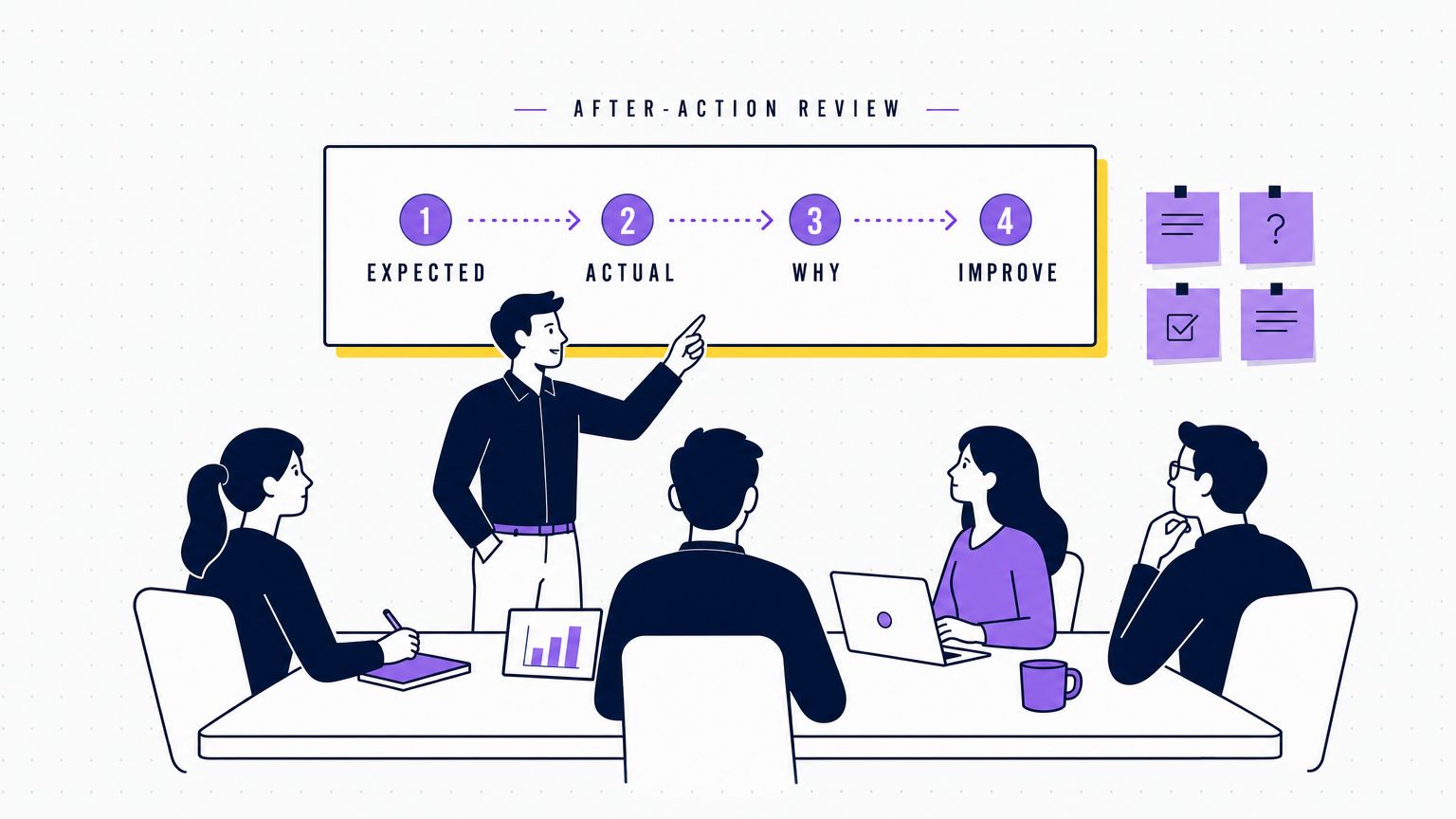
An after-action review is a short, structured discussion a team holds after an event to work out what was supposed to happen, what actually happened, why the two differed, and what to do differently next time. It started in the US Army in the early 1980s and has since spread into hospitals, software teams, fire services, and boardrooms, for one simple reason. When it is run well, it works. The largest meta-analysis on the method, covering 61 studies, found that teams who reviewed their own performance improved by an effect size of about 0.79, which puts a good debrief among the most powerful learning interventions an organisation can run.
This guide covers what an after-action review actually is, where it came from, the four questions that hold it together, the evidence that it changes performance, and a step-by-step way to facilitate one. It also covers the part most teams get wrong: the review only works inside a culture where people can name a mistake without paying for it.
The short answer
An after-action review (AAR), sometimes called a debrief, is a facilitated conversation that compares intended results with actual results and converts the gap into specific, owned actions. It runs through four questions: what was expected, what happened, why was there a difference, and what will we sustain or improve. Run it as soon after the event as you can, keep it focused on process rather than people, and leave the room with named owners and deadlines.
The reason to bother is evidence, not tradition. Across decades of research in the military, healthcare, and corporate settings, structured debriefs reliably lift team and individual performance by roughly 20 to 25 per cent over teams that skip the step. The single biggest predictor of whether yours pays off is not the template you use. It is whether people feel safe enough to tell the truth.
| The four AAR questions | What it surfaces |
|---|---|
| What did we expect to happen? | The plan, the intent, the standard you were aiming for |
| What actually happened? | An agreed, factual timeline before opinion enters |
| Why was there a difference? | Root cause: a skill gap, or an alignment and systems gap |
| What do we sustain or improve? | Specific behaviours to repeat, specific things to change |
If you read nothing else, hold those four questions and the order they come in. Everything below is detail on how to run them so the meeting produces change instead of a tidy document nobody opens again.
What is an after-action review?
An after-action review is a learning method, not a performance appraisal. The distinction matters. An appraisal judges a person against a standard; an AAR examines an event to improve the next one. The moment a review starts grading individuals, people stop volunteering the information that makes it useful.
Most organisations run the method in two modes. A formal AAR is planned in advance, needs a dedicated facilitator, and is reserved for major projects, training exercises, or significant incidents. It pulls in data, timelines, and cross-functional stakeholders, and can run up to two hours. An informal AAR is lightweight and immediate: a fifteen-minute huddle at the end of a shift or a sprint, run on the spot, with little preparation. Both follow the same four questions. They differ only in scope and ceremony.
The method belongs to a wider family of structured reflection that includes the agile retrospective, the project post-mortem, and the medical simulation debrief. They share a common spine. Reconstruct what happened, diagnose why, and decide what changes. The AAR is the version with the cleanest question set and the longest evidence trail, which is why it travels so well between fields.
This page is the hub for our after-action review cluster. For the broader context of how individual differences shape these conversations, the Big Five personality traits guide explains why some people dominate a debrief and others go quiet, and what to do about it.
Where the after-action review came from
The AAR was formalised by the US Army in the early 1980s, largely at the National Training Center at Fort Irwin, California, where units fought simulated battles and needed a way to learn from them fast. The Army’s Training and Doctrine Command (TRADOC) codified the practice, and the 1993 field guide TC 25-20, A Leader’s Guide to After-Action Reviews, turned it into doctrine that every soldier would recognise.
What made the military version distinctive was the deliberate flattening of rank during the review. A junior soldier could describe what a senior officer did without consequence, because the conversation was ring-fenced as learning. That cultural design, more than the four questions, is what the method’s civilian adopters most often fail to copy. The US Army Research Institute’s foundational report on the process, by Morrison and Meliza in 1999, set out the theory behind why this works: rapid, candid, evidence-based feedback close to the event accelerates how quickly a team corrects itself.
From there it spread. Healthcare adopted it for simulation training and real clinical debriefs. Wildland fire services, emergency management, and public health built it into incident response; the World Health Organization publishes AAR toolkits for reviewing health emergencies. Software teams reshaped it into the agile retrospective. The vocabulary shifts between fields, but the engine is the same one the Army built.
The four questions at the core
Every after-action review runs through the same four questions, and the order is not negotiable. You establish the facts before you allow interpretation, and you diagnose the cause before you reach for a fix.
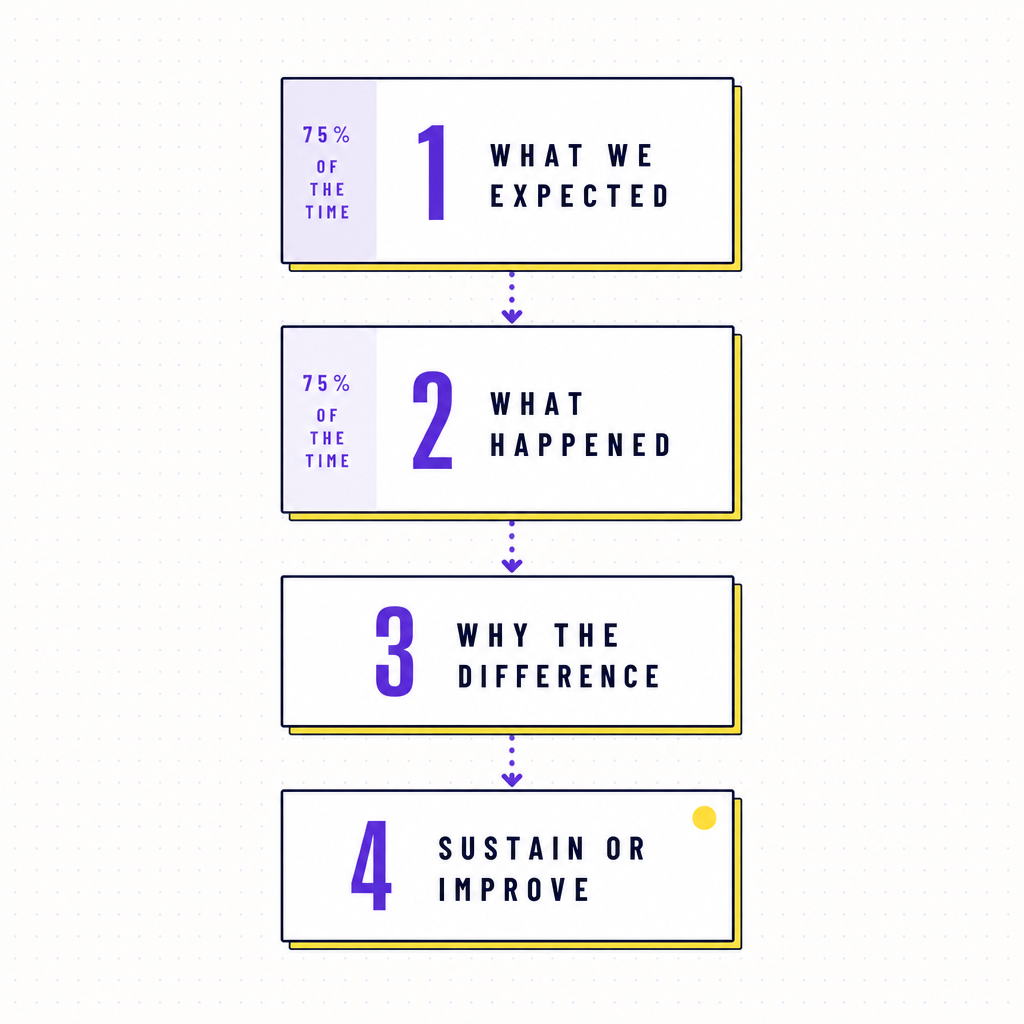
- What did we expect to happen? Start with intent. Restate the plan, the objective, or the standard the team was working towards. This anchors the discussion in a shared reference point, so the gap you find later is a gap against something specific.
- What actually happened? Build an objective, chronological timeline. This is where you resist the urge to explain. The goal is an account everyone in the room agrees on before anyone argues about why.
- Why was there a difference? Now diagnose. The most useful distinction here is between a skill gap, where someone lacked the competence or training, and an alignment gap, where the instructions were unclear, the system broke, or the resources were not there. The two call for completely different responses.
- What will we sustain or improve? Convert the diagnosis into commitments. Name the behaviours that produced good outcomes so you can repeat them deliberately, and name the specific changes for next time.
Experienced facilitators and the military models recommend spending up to 75 per cent of the meeting on the first two questions, the what. Teams have a strong pull towards jumping to solutions, and a facilitator’s main job early on is to hold them in the timeline long enough that the real causes surface. Build the chronology carefully and the answer to “why” often becomes obvious. Rush it, and you solve the wrong problem.
Does it actually work? The evidence
Yes, and the evidence is unusually strong for a management practice. The headline finding comes from Keiser and Arthur’s 2021 meta-analysis in the Journal of Applied Psychology, which pooled 61 studies and found that conducting an after-action review improved performance with an overall effect size of d ≈ 0.79. In plain terms, that is a large effect, larger than many of the training methods organisations spend heavily on.
It builds on the foundational debrief meta-analysis by Tannenbaum and Cerasoli, published in Human Factors in 2013. Across 46 samples, they found that teams and individuals who debriefed outperformed those who did not by roughly 20 to 25 per cent, an effect size of about d = 0.67. Their analysis also showed the effect held across settings, from military to medical to laboratory, and whether the debrief was led by a facilitator or the team itself.
Healthcare offers the deepest evidence base, because simulation debriefing has been studied for years. McGaghie and colleagues, writing in Academic Medicine in 2011, found that simulation-based medical education paired with structured debriefing and deliberate practice produced an effect size of around 0.71 against traditional clinical training. Systematic reviews of debriefing in nursing and crisis-resource-management simulations have repeatedly found that the debrief, not the simulation itself, is where most of the learning happens. A 2021 randomised controlled trial even found that peer-led debriefs could match instructor-led ones for some outcomes, which matters for teams without a trained facilitator on hand.
Two caveats keep the evidence honest. First, the effect depends heavily on how the review is run; a follow-up meta-analysis by Keiser and Arthur on task and training characteristics showed that quality of facilitation and the type of feedback moderate the result substantially. Second, almost none of this research measures the corporate boardroom AAR directly; the strongest data comes from military and clinical settings, and the corporate case rests on transfer from those fields rather than its own large trials.
How to run an after-action review, step by step
A good AAR has more structure than it looks from the outside. Here is the sequence that holds it together.
1. Prepare before anyone walks in
The facilitator’s pre-work is to gather the objective record: the timeline, the metrics, the logs, the deliverables. You want the facts on the table before opinions arrive, so the meeting argues about meaning rather than about what happened. Decide who needs to be there. For anything cross-functional, that means front-line contributors and the people who set the direction, in the same room.
2. Set the timebox to the event
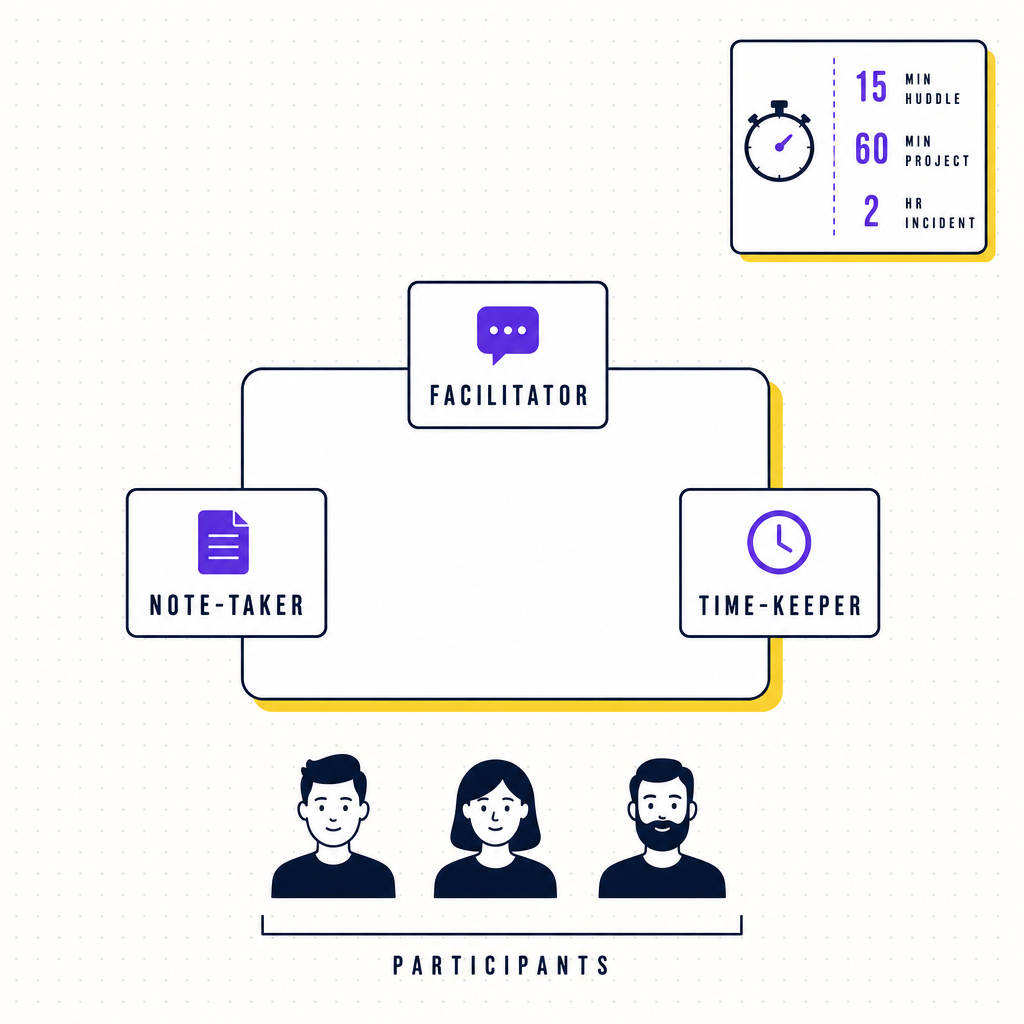
Match the length to the scope. A daily shift or sprint huddle needs fifteen minutes. A standard project phase warrants forty-five to sixty. A major incident or a multi-month programme can justify up to two hours, but rarely more. A hard timebox forces the group to prioritise and keeps the discussion off tangents.
3. Assign the roles
In an effective review, no one person holds two roles at once. You want a facilitator who stays neutral and works the process rather than offering their own verdict, a note-taker who builds the visible timeline and records the commitments, and a timekeeper who guards the agenda. Everyone else participates as an equal, regardless of their title outside the room.
4. Open with the ground rules
Set the container explicitly. Many teams borrow the retrospective Prime Directive, which asks everyone to assume that each person did the best they could with the knowledge, skills, and resources they had at the time. State plainly that the review attacks processes, not people, and that nothing said in the room will be used in a performance review. These rules sound soft. They are the load-bearing part.
5. Work the four questions in order
Run expected, actual, why, and sustain-or-improve, in that sequence, holding most of the time in the first two. Use the timeline on the wall as the shared object everyone points at. When the diagnosis arrives, push it past the first plausible answer to the actual root cause.
6. Close with owned actions
End every AAR with a short list of changes, each with a named owner, a specific verb, and a deadline. An action item without an owner is a wish. This is the step that separates a review that changes the next project from one that produced a nice document and nothing else.
After-action review vs retrospective vs post-mortem
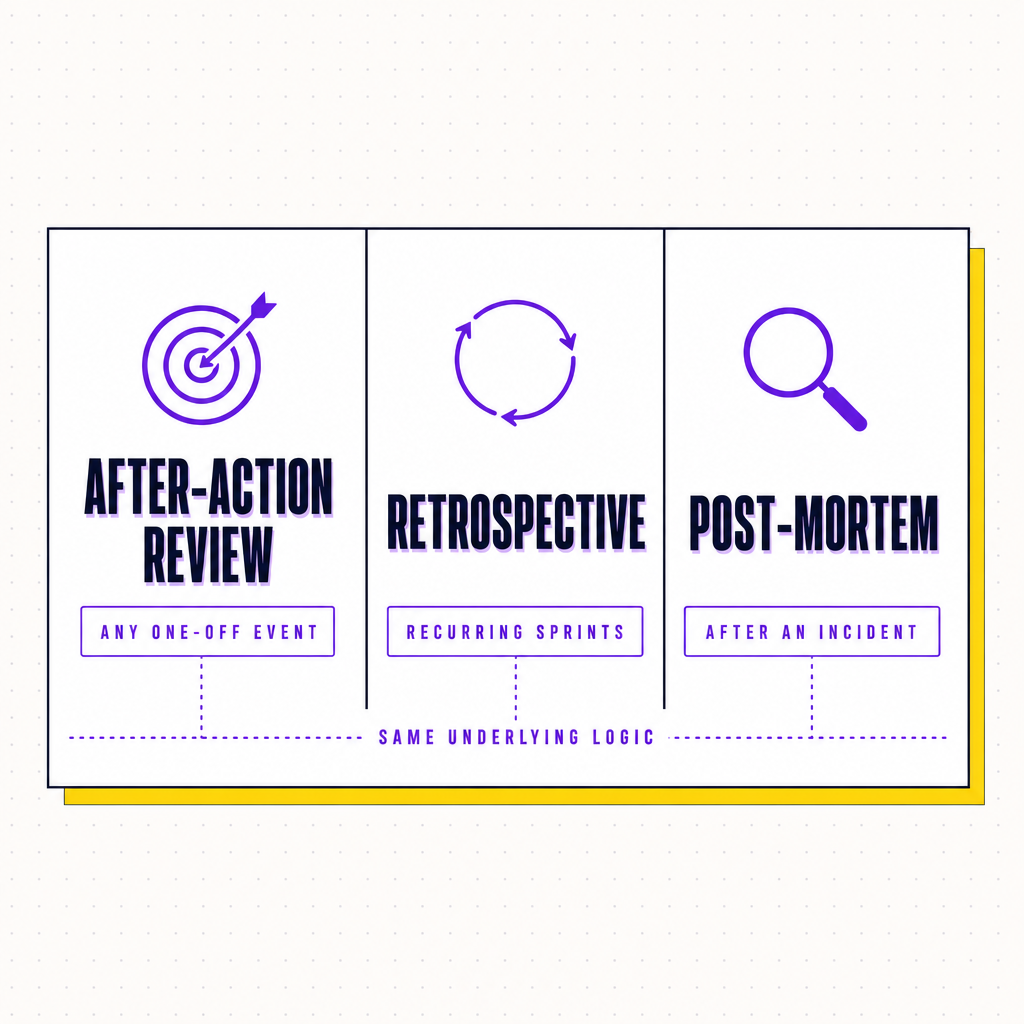
These three get used interchangeably, but the differences are worth knowing. An after-action review is the broadest and most portable; it works for any event, planned or unplanned, and keeps a tight focus on the gap between intent and outcome. An agile retrospective is the AAR adapted for recurring software sprints, run on a fixed cadence and usually owned by the team itself rather than an outside facilitator. A post-mortem, or incident review, is the version run after something went wrong, with a heavier emphasis on root-cause analysis and prevention.
The practical rule: use a retrospective for routine, repeating cycles; a post-mortem when an incident demands a deep causal dig; and an AAR as your default for one-off projects, workshops, exercises, and milestones where you want the full intent-to-outcome comparison. All three share the same DNA, so a team fluent in one can pick up the others quickly.
The three pitfalls that kill an AAR
When reviews fail to change anything, they almost always fall into one of three traps.
The first is the blame game, where the conversation drifts from what failed to who failed. This is the fastest way to destroy a review, because the moment people sense the meeting is hunting for someone to carry the fault, they stop sharing the information that makes diagnosis possible. Worse, they learn to hide errors in future.
The second is praise without diagnosis. When the team is asked what to sustain, it is easy to offer vague warmth, such as “the team really gelled”. If you cannot name the specific behaviour or decision that produced the win, you cannot repeat it on purpose. Good outcomes deserve the same root-cause rigour as bad ones.
The third is unassigned actions. A review that ends with a list of improvements but no owners, verbs, or dates produces zero structural change. The follow-through is the entire point, and it lives or dies on individual accountability.
Psychological safety is the precondition, not a nice-to-have
Every facilitation technique in this guide assumes one thing: that people will say what actually happened. They only do that when the team has psychological safety, the shared belief that you can admit a mistake, ask a naive question, or challenge a senior person without being punished for it. The concept comes from Amy Edmondson’s research at Harvard, and it is the strongest single predictor of whether a debrief surfaces the truth or a sanitised version of it.
The catch is that running a candid review is exactly the kind of moment where safety gets tested. Kolbe and colleagues, in a widely cited 2020 paper, describe managing psychological safety in debriefings as a “dynamic balancing act”: the facilitator has to push for honesty about failures while protecting the people being honest, and repair the relationship quickly when candour stings. Safety is not a setting you switch on once. It is something the facilitator actively maintains, minute by minute, especially when the conversation gets uncomfortable.
This is also where personality enters. In any group, some people will fill the silence and others will hold back, and a review that only hears the confident voices misses half the picture. Drawing out the quieter contributors is a core facilitation skill, and it is easier when you understand the behavioural patterns a team brings into the room.
What is changing: AI-assisted debriefing
The most active area of development right now is using AI to support the facilitator, not replace them. Through 2025 and 2026, hospitals including University Hospital Zurich have piloted large language models to transcribe high-fidelity simulations in real time and generate structured teamwork reports against frameworks like Team-FIRST. Expert debriefers in these trials reported that the AI caught fleeting micro-interactions a cognitively overloaded human facilitator would miss, and surfaced illustrative quotes that sharpened the conversation.
The limits are equally clear. Current systems still struggle with attributing speech to the right person, tend towards generic behavioural interpretations, and are blind to the non-verbal cues, the body language and the tension in the room, that a human facilitator reads instinctively. The consensus emerging from these early studies is that AI belongs in the preparation and analysis layer, taking the friction out of reconstructing what happened, so the human can spend the meeting on the part that needs judgement and empathy. Treat these as promising pilots, not settled practice.
Why this matters for L&D, HR, and coaches
If you are responsible for how an organisation learns, the after-action review is one of the highest-return habits you can build. It is cheap, it is fast, and the evidence that it improves performance is among the strongest in applied psychology. It turns experience into a compounding asset rather than a series of lessons the organisation keeps re-learning at full price.
The reason most teams do not get the benefit is not that they lack a template. It is that the review either never happens, gets run as a blame session, or ends without owned actions. Your job, as the person enabling it, is to make the habit routine, protect the psychological safety it depends on, and hold the team to the follow-through.
This is also where the reconstruct-what-happened step usually breaks down, because it relies on memory, and memory rewrites the story within days. Team Building Bot is built for that gap. It joins your online sessions, listens for the moments that shaped the outcome, and produces a Key Moments report that gives you an evidence-based timeline before the review even starts. That lets the team skip the slow, error-prone reconstruction and spend the meeting on the question that matters: why. You can see what those reports look like on the reports overview.
FAQ
What is an after-action review? An after-action review is a structured team discussion held after an event to compare what was expected with what actually happened, work out why they differed, and decide what to sustain or improve. It originated in the US Army and is now used across healthcare, software, emergency response, and business as a core team-learning method.
What are the four questions in an after-action review? The four questions are: what did we expect to happen, what actually happened, why was there a difference, and what will we sustain or improve. You work them in that order, spending most of the meeting on the first two so the facts are agreed before the team diagnoses causes or proposes changes.
How long should an after-action review take? Match the length to the event. A daily shift or sprint huddle needs around fifteen minutes, a standard project phase forty-five to sixty minutes, and a major incident or multi-month programme up to two hours. A hard timebox forces the team to prioritise and prevents the discussion from drifting.
What is the difference between an after-action review and a retrospective? They are close cousins. A retrospective is the after-action review adapted for recurring software sprints, run on a fixed cadence and usually owned by the team. An after-action review is broader and works for any one-off event, keeping a tighter focus on the gap between intended and actual results. Both use the same underlying logic.
Does an after-action review actually improve performance? Yes. Keiser and Arthur’s 2021 meta-analysis of 61 studies found AARs improved performance with a large effect size of about d = 0.79, and Tannenbaum and Cerasoli’s 2013 meta-analysis found debriefing teams outperformed others by roughly 20 to 25 per cent. The size of the benefit depends heavily on how well the review is facilitated.
Why do after-action reviews fail? They fail for three main reasons: the conversation turns into blame and people stop telling the truth, the team praises success without naming the specific behaviour that caused it, or the review ends with improvements that have no owner or deadline. All three are facilitation failures, and all three are preventable.
What is the role of psychological safety in an after-action review? Psychological safety is the precondition for an honest review. People only describe what really happened when they believe they can admit a mistake or challenge a leader without punishment. Without it, the review hears a sanitised version of events and diagnoses the wrong causes, so the facilitator’s first job is to protect that safety throughout.
Sources
- Keiser, N. L., & Arthur, W., Jr. (2021). A meta-analysis of the effectiveness of the after-action review (or debrief) and factors that influence its effectiveness. Journal of Applied Psychology, 106(7), 1007–1032. PubMed · Ovid abstract · companion meta-analysis on task and training characteristics (ResearchGate).
- Tannenbaum, S. I., & Cerasoli, C. P. (2013). Do team and individual debriefs enhance performance? A meta-analysis. Human Factors, 55(1), 231–245. SAGE · PubMed · full text PDF (CEBMa).
- US Army origins, doctrine, and the foundational theory of the AAR process: Morrison & Meliza (1999), Foundations of the After Action Review Process (DTIC) · Current Practice and Theoretical Foundations of the AAR (ResearchGate) · AAR technical report (DTIC ADA463410) · AAR technical report (DTIC ADA544543) · homeland security AAR doctrine (HSDL).
- Definition, structure, and practical guides to running an AAR: After-action reviews: a simple tool (Wharton Executive Education) · After-action review guide (Creately) · AAR template guide (Gridfox) · After-action review (BetterEvaluation) · After-action review (Indeed UK) · AAR template (Asana) · Facilitate an after-action review (Extraordinary Team) · After-action reviews explained (Tivazo) · How an AAR benefits business transformation (alliantgroup).
- Facilitation mechanics, the 75% rule, roles, and ground rules: From evaluation to facilitation: the 2026 AAR (Medium) · The 5 questions Navy SEALs use to learn (Evan Hickok) · Formal vs informal AAR doctrine (PowerDMS) · Facilitator roles (Indeed UK) · Facilitation rules to live by (BA Times) · WHO generic AAR facilitator briefing agenda.
- Evidence base: debriefing and simulation meta-analyses and reviews: McGaghie et al. (2011), simulation-based medical education with deliberate practice (PubMed) · debriefing and learning outcomes meta-analysis (PMC3102783) · debriefing methods and learning outcomes in nursing simulation (ResearchGate) · debriefing for technology-enhanced simulation (PubMed) · peer-led versus instructor-led debriefing RCT (ResearchGate) · debriefing with good judgment (ResearchGate) · 6 models for debriefing in nursing education (NursingCenter).
- AAR versus agile retrospective and post-mortem: Agile retrospectives (Notion) · Agile retrospective (The Project Group) · Retrospectives 101 for non-developers (Software Dev Tools) · Iteration retrospective facilitation (PMI Disciplined Agile) · 7 retrospective facilitation good practices (Ben Linders) · Mistakes in agile retrospectives (TestRail) · Retrospectives practice kit (OpenView).
- Psychological safety in debriefings: Kolbe et al., Managing psychological safety in debriefings: a dynamic balancing act (Semantic Scholar) · same paper (ResearchGate) · debrief practices that support psychological safety (WomenTech) · rebuilding psychological safety when it is broken (PsychSafety) · repairing psychological safety after it is broken (Calm Collective).
- Recent developments, AI-assisted debriefing (2025–2026): Generative AI in simulation debriefings using the Team-FIRST framework (PMC12924402) · Generative AI in simulation debriefings, Team-FIRST (ResearchGate) · AI-facilitated debriefing pilot study (ResearchGate).
Turn your next session into a ready-made after-action review
Team Building Bot joins your online workshop or project debrief, listens for the moments that mattered, and produces a Key Moments report you can drop straight into the 'what happened' phase of an AAR. Free during beta.
No spam, no credit card. Unsubscribe any time.