The Big Five Personality Traits Explained: A Guide to the OCEAN Model
A pillar guide to the Big Five (OCEAN) personality model: history, the five traits with examples, validity evidence, and what it predicts at work.
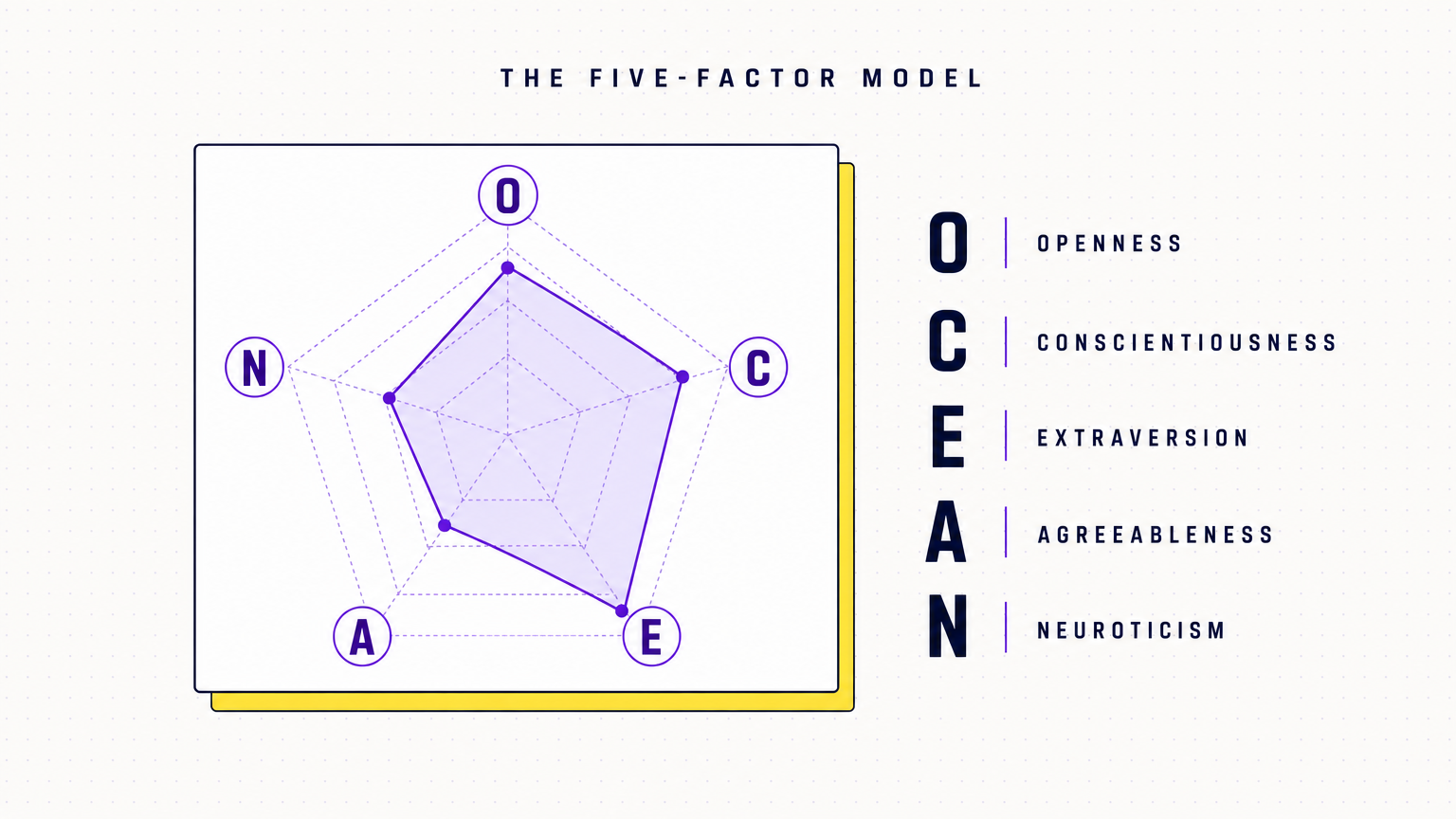
If you are picking a personality framework to anchor a leadership programme, a team workshop, or a hiring process, the Big Five is the model with the cleanest evidence base. It is also the only one most academic and industrial-organisational psychologists take seriously. Type-based tools like MBTI and DISC remain commercially popular, but the peer-reviewed literature on validity, reliability, heritability, and workplace prediction has been built around the Big Five for over three decades.
This guide walks through what the Big Five actually is, where it came from, how each trait shows up at work, what the meta-analyses say it predicts, and where the model has limits. It is written for L&D, HR, coaches, and facilitators who want to use the model in real sessions, not just describe it on a slide.
The short answer
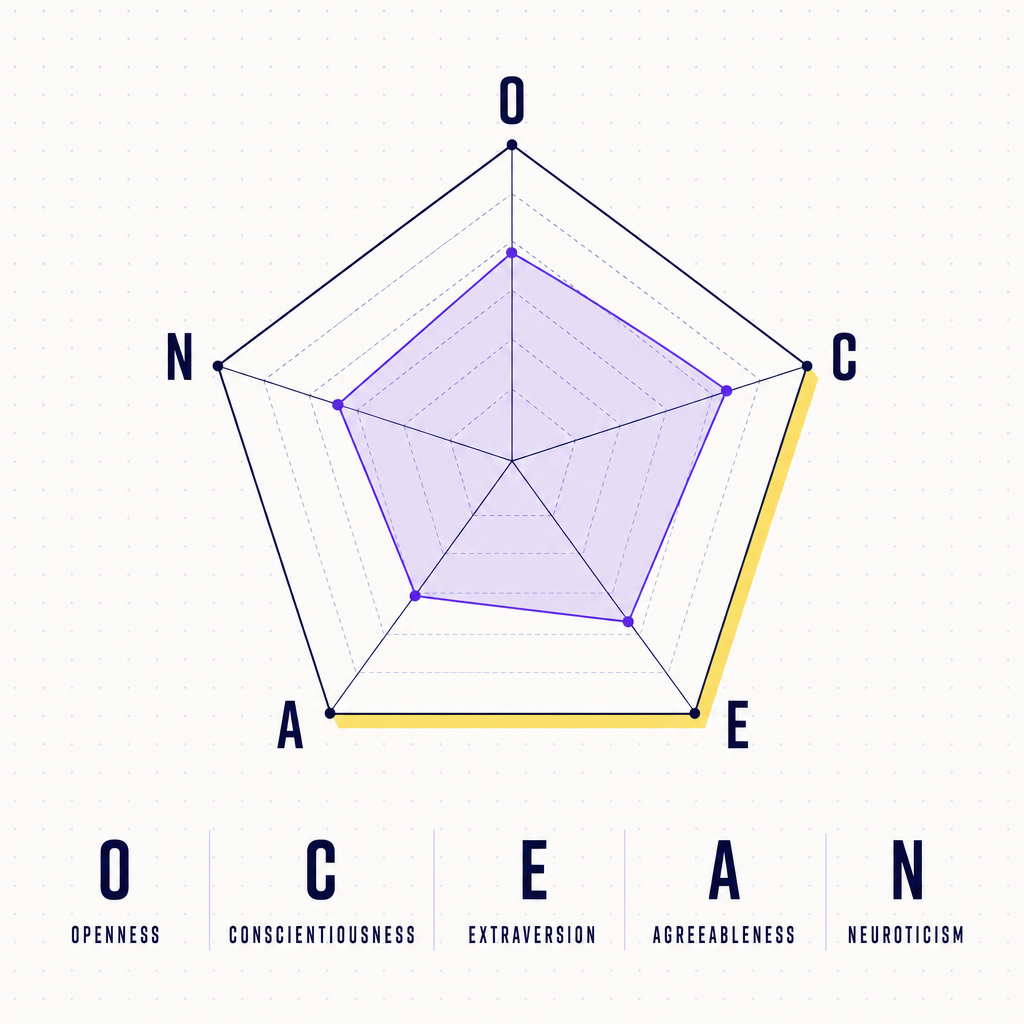
The Big Five, sometimes called the Five-Factor Model (FFM) or the OCEAN model, describes human personality along five broad, continuous dimensions: Openness to experience, Conscientiousness, Extraversion, Agreeableness, and Neuroticism (often reverse-scored as Emotional Stability). Every adult sits somewhere on each of those five dimensions, not in a box.
The model emerged from decades of statistical work on personality-descriptive adjectives in natural language, was operationalised in the 1980s and 1990s by Costa and McCrae through the NEO-PI-R inventory, and has been validated across more than 50 countries. Meta-analyses on job performance, leadership emergence, team composition, and counterproductive behaviour all use the Big Five as the underlying framework.
| Trait | What it captures | High score, in one sentence |
|---|---|---|
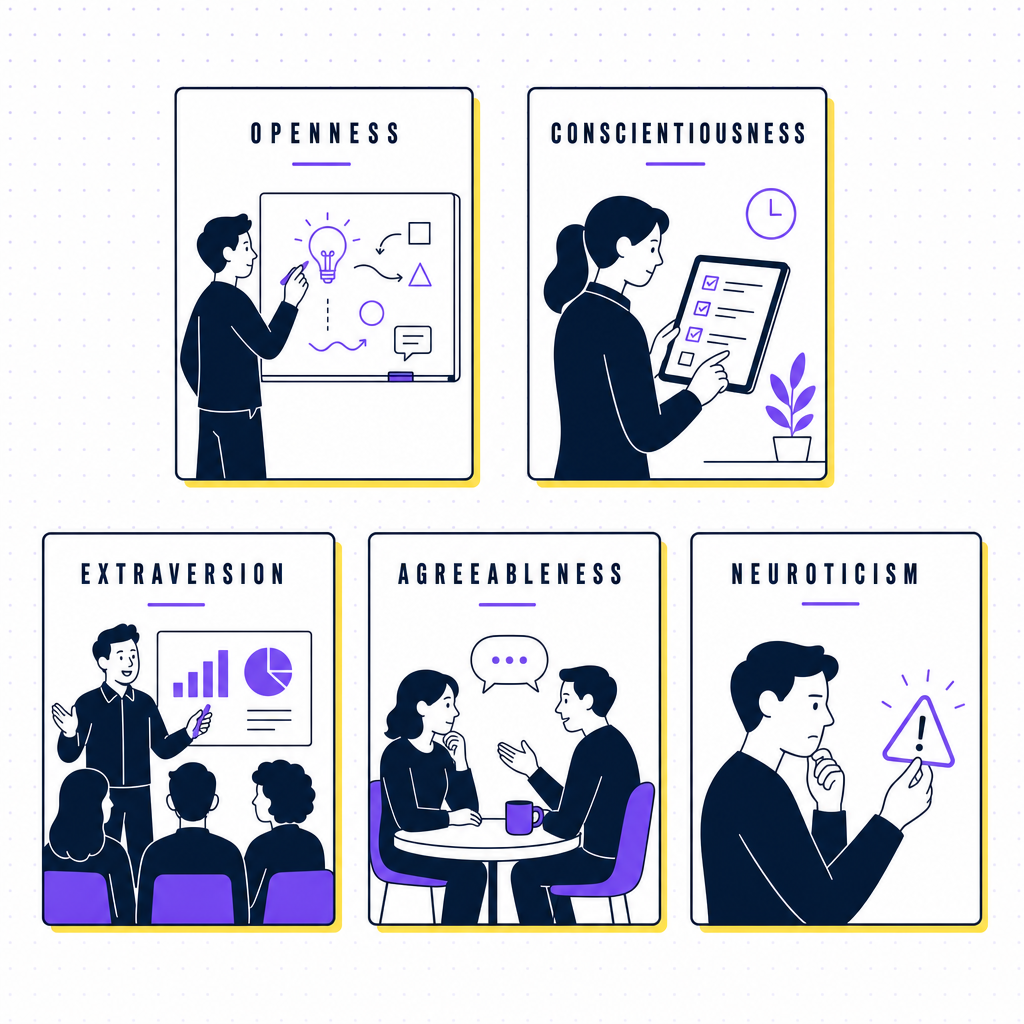
| Openness | Curiosity, imagination, preference for novelty | Comfortable with ambiguity, drawn to ideas and new methods |
| Conscientiousness | Self-discipline, organisation, follow-through | Plans the work, meets deadlines, finishes what was started |
| Extraversion | Social energy, assertiveness, positive emotionality | Speaks first, gains energy from interaction, visible in groups |
| Agreeableness | Cooperation, trust, prosocial orientation | Looks for common ground, mediates, prioritises the relationship |
| Neuroticism | Tendency toward negative emotion and stress reactivity | Reacts more strongly to setbacks, more vigilant to risk |
The rest of this guide unpacks each row, then looks at the evidence and the practical use.
Where the Big Five came from
The Big Five is an empirical discovery, not a theory someone invented in an armchair. It emerged from a long, unglamorous statistical project.
In 1936, Gordon Allport and Henry Odbert worked through an unabridged English dictionary and extracted around 4,500 adjectives describing observable personality traits. Their starting assumption was the lexical hypothesis: the personality differences that matter most for human cooperation and survival end up encoded in everyday language. If the trait matters, the language invents a word for it.
In the 1940s, Raymond Cattell used early factor-analytic methods to reduce that list, eventually producing the 16PF questionnaire. Subsequent researchers found the 16-factor solution difficult to replicate. In 1961, Ernest Tupes and Raymond Christal re-analysed Cattell’s data on US Air Force personnel and consistently found five broad underlying factors. That paper sat largely unread until Lewis Goldberg revived the work in the 1980s and confirmed the five-factor structure across multiple datasets, coining the term “Big Five”.
Working in parallel, Paul Costa and Robert McCrae built the NEO Personality Inventory through a questionnaire methodology rather than a strictly lexical one. They added Agreeableness and Conscientiousness to the original three factors in 1985, then released the revised NEO-PI-R in 1992. That instrument became the definitive operationalisation of the Big Five and introduced the now-standard hierarchy of five broad traits, each decomposed into six narrower facets, for a total of 30. Practitioners who run validated commercial Big Five inventories are almost always running some descendant of the NEO-PI-R.
The lexical and the questionnaire traditions converged on the same five dimensions from different methodological angles. That convergence is one of the reasons the model is taken seriously.
The five traits, in detail
Each trait is a continuum, not a category. Most adults score near the middle on most traits. Extreme scores are rarer than the popular framing suggests.
Openness to experience
Openness covers intellectual curiosity, imagination, aesthetic sensitivity, and a preference for novelty over strict routine. The NEO-PI-R breaks it into six facets: Fantasy, Aesthetics, Feelings, Action, Ideas, and Values.
People high in Openness are drawn to abstract problems, new tools, and unfamiliar work. They tend to do well in research, design, strategy, and any role where the path forward is unclear. They are usually early adopters of new technologies and learn novel material quickly.
People low in Openness are pragmatic and routine-oriented. They prefer methods that have been tested and work that is well defined. Roles in compliance, quality assurance, regulated industries, and detailed operational execution often suit them better than open-ended innovation roles. Neither pole is “better”; they suit different work.
Conscientiousness
Conscientiousness is the dispositional self-discipline that drives task-focused, goal-directed behaviour. Its facets are Competence, Order, Dutifulness, Achievement Striving, Self-Discipline, and Deliberation.
People high in Conscientiousness plan, organise, and finish. They meet deadlines, follow through on commitments, and pay attention to detail. They are reliable colleagues and, on average, the strongest baseline performers across almost every job category that has been studied.
People low in Conscientiousness are more spontaneous, more flexible in their attention, and more comfortable improvising. They can be effective in highly fluid environments where rigid planning would be a liability, but they often struggle with bureaucracy, repetitive administrative work, and roles with strict process discipline.
If you only have time to measure one Big Five trait for a hiring decision, Conscientiousness is the one with the most evidence behind it.
Extraversion
Extraversion captures social energy, assertiveness, and positive emotionality. Its facets are Warmth, Gregariousness, Assertiveness, Activity, Excitement-Seeking, and Positive Emotions.
People high in Extraversion are visible. They speak first in meetings, gain energy from social interaction, and tend to be quickly seen as leaders in unstructured groups. They typically perform well in sales, client-facing roles, and public-facing leadership positions.
People low in Extraversion (introverts) are reserved, energy-conserving, and often more comfortable working independently or in small groups. They are not less capable as leaders; in fact, research on proactive teams has shown introverted leaders sometimes outperform extraverted ones, because they create more space for others to contribute.
Most people are neither strongly extraverted nor strongly introverted. The midrange (sometimes called ambiverts) is the largest group.
Agreeableness
Agreeableness contrasts a cooperative, communal orientation against an antagonistic, competitive one. Facets include Trust, Straightforwardness, Altruism, Compliance, Modesty, and Tender-Mindedness.
People high in Agreeableness are cooperative, empathic, and oriented toward the relationship. They mediate conflict, build psychological safety, and are usually rated as enjoyable colleagues. They do well in HR, customer service, healthcare, and team-coordination roles.
People low in Agreeableness are more sceptical, more comfortable with confrontation, and more willing to deliver hard news. Moderately low Agreeableness is genuinely useful in roles that require tough calls under social pressure: high-stakes negotiation, financial audit, litigation, turnaround leadership. Extremely low Agreeableness, combined with low Conscientiousness, sits near the highest-risk corner of the workforce for interpersonal toxicity.
Neuroticism (Emotional Stability)
Neuroticism is the tendency to experience negative emotions, such as anxiety, frustration, and self-criticism, alongside cognitive and behavioural patterns linked to stress reactivity. Most workplace assessments flip the scale and label it Emotional Stability. Its facets are Anxiety, Angry Hostility, Depression, Self-Consciousness, Impulsiveness, and Vulnerability.
People high in Neuroticism feel setbacks more sharply, are more vigilant to risk, and are more prone to burnout under sustained pressure. The same vigilance is genuinely useful in some roles: quality assurance, risk management, safety-critical operations, where someone has to keep noticing the things that could go wrong.
People low in Neuroticism (emotionally stable) recover quickly from setbacks, hold a steady mood under stress, and are less easily destabilised by difficult feedback. They do well in crisis-driven, high-pressure environments where the cost of panic is high.
For senior leadership roles, Emotional Stability is the second of two traits (alongside Conscientiousness) that most consistently predicts effectiveness once the person is in the chair.
How the Big Five differs from MBTI and DISC
Type-based tools like the Myers-Briggs Type Indicator and DISC remain widely used in corporate training. They are not, in any rigorous sense, comparable to the Big Five.
The first difference is dimensional versus categorical. The Big Five places every individual on five continuous scales. MBTI and DISC sort people into discrete buckets (“ENFP”, “Dominant-Influence”, etc.). Real personality data does not cluster into bimodal distributions around those bucket midpoints; it sits on a bell curve. People close to the midpoint of a dimension get arbitrarily flipped from one type to the other based on which side of the line they happen to fall on the day they took the test.
The second difference is test-retest reliability. David Pittenger’s 1993 and 2005 critiques of the MBTI documented that around half of respondents receive a different four-letter type when they retake the instrument within five weeks. The Big Five, in contrast, shows rank-order stability correlations typically above .70 across years, sometimes across decades.
The third difference is predictive validity. The Big Five has been linked to job performance, leadership emergence, team performance, counterproductive behaviour, mental and physical health, and educational outcomes through multiple meta-analyses on hundreds of thousands of participants. The MBTI publisher itself states the tool should not be used for selection. DISC describes communication style usefully enough for short workshops, but does not carry the same validity evidence on work outcomes.
Type-based tools are not useless. They are accessible, memorable, and can spark good team conversations. They are simply not the right tool when you need a defensible measurement that predicts behaviour over time.
If you want a longer version of this comparison, see our companion piece, Big Five vs MBTI vs DISC.
What the evidence says
The Big Five is the framework researchers use to study personality at work because it produces replicable results. A condensed tour of the most cited meta-analyses follows. The exact numbers (effect sizes) shift between studies; the direction and rough magnitude are remarkably consistent.
Conscientiousness predicts job performance, broadly
Murray Barrick and Michael Mount’s 1991 meta-analysis in Personnel Psychology established Conscientiousness as the single Big Five trait that predicts performance across every major occupational category and every type of performance criterion (supervisor ratings, training proficiency, objective output). They reported an operational validity of around ρ = .22. Subsequent meta-analyses replicated the finding and added nuance: other traits predict performance in specific niches (Extraversion in sales and management, Openness in training proficiency, Emotional Stability across most stressful roles), but Conscientiousness is the closest thing personality research has to a universal predictor.
Frank Schmidt and John Hunter’s 1998 Psychological Bulletin synthesis, the canonical reference on selection-method validity, treats Conscientiousness combined with General Mental Ability as the strongest broadly applicable selection combination. General Mental Ability predicts the ability to learn the job; Conscientiousness predicts the motivation to do it.
Robert Hogan and Brent Holland’s 2003 Journal of Applied Psychology meta-analysis tightened the picture further. When Big Five traits are matched to theoretically aligned performance criteria, true validities climb sharply: ρ around .43 for Adjustment (Emotional Stability) and ρ around .36 for Prudence (Conscientiousness).
Leadership emergence and effectiveness diverge
Timothy Judge, Joyce Bono, Remus Ilies, and Megan Gerhardt’s 2002 meta-analysis in the Journal of Applied Psychology is the single most cited piece of work on the Big Five and leadership. Across 73 samples, Extraversion was the strongest predictor of leadership emergence (who gets identified as a leader by peers), at ρ ≈ .33. Conscientiousness followed at ρ ≈ .28, Openness at ρ ≈ .24. The multiple correlation across all five traits predicting emergence reached R = .53, which is large by personality-research standards.
Leadership effectiveness (whether the leader’s team actually performs once they are in the role) tells a slightly different story. Emotional Stability and Conscientiousness do most of the predictive work on the effectiveness side. Extraversion still helps but less reliably, and in some contexts (proactive, self-starting teams) introverted leaders outperform extraverted ones. We covered this split in detail in our companion piece, Big Five Personality Traits for Leadership.
Team composition matters, in specific ways
Suzanne Bell’s 2007 Journal of Applied Psychology meta-analysis on team composition is the canonical reference for thinking about traits at the team level. Three findings stand out.
Team mean Conscientiousness predicts performance positively: teams of people who plan, organise, and follow through do better as a group. Team minimum Agreeableness also matters, in the sense that the least agreeable member can drag the whole team down; one antagonistic individual is enough to erode psychological safety for the rest. Team mean Openness matters most when the team is operating in novel or low-structure environments where adaptability is the work.
Bell’s results are part of why team-building work that focuses only on individual traits misses something. The team’s distribution and minimum scores are often more diagnostic than its average.
Counterproductive behaviour is reduced by Conscientiousness and Agreeableness
Jesus Salgado’s 2002 meta-analysis in the International Journal of Selection and Assessment established that Conscientiousness (ρ ≈ -.26) and Agreeableness (ρ ≈ -.20) negatively predict counterproductive workplace behaviours: absenteeism, theft, sabotage, interpersonal aggression. People low on both are the highest statistical risk for interpersonal toxicity and rule-breaking.
Heritability and lifespan stability
The Big Five is substantially heritable. Twin studies, most notably the Minnesota Study of Twins Reared Apart led by Thomas Bouchard (reported through the 1990s), and Jang, Livesley and Vernon’s 1996 work using the NEO-PI-R, place broad heritability estimates at roughly 41 to 61 percent across traits. Shared family environment accounts for very little (under 10 percent in most studies). The remaining variance comes from non-shared environmental factors: individual experiences, peer groups, life events.
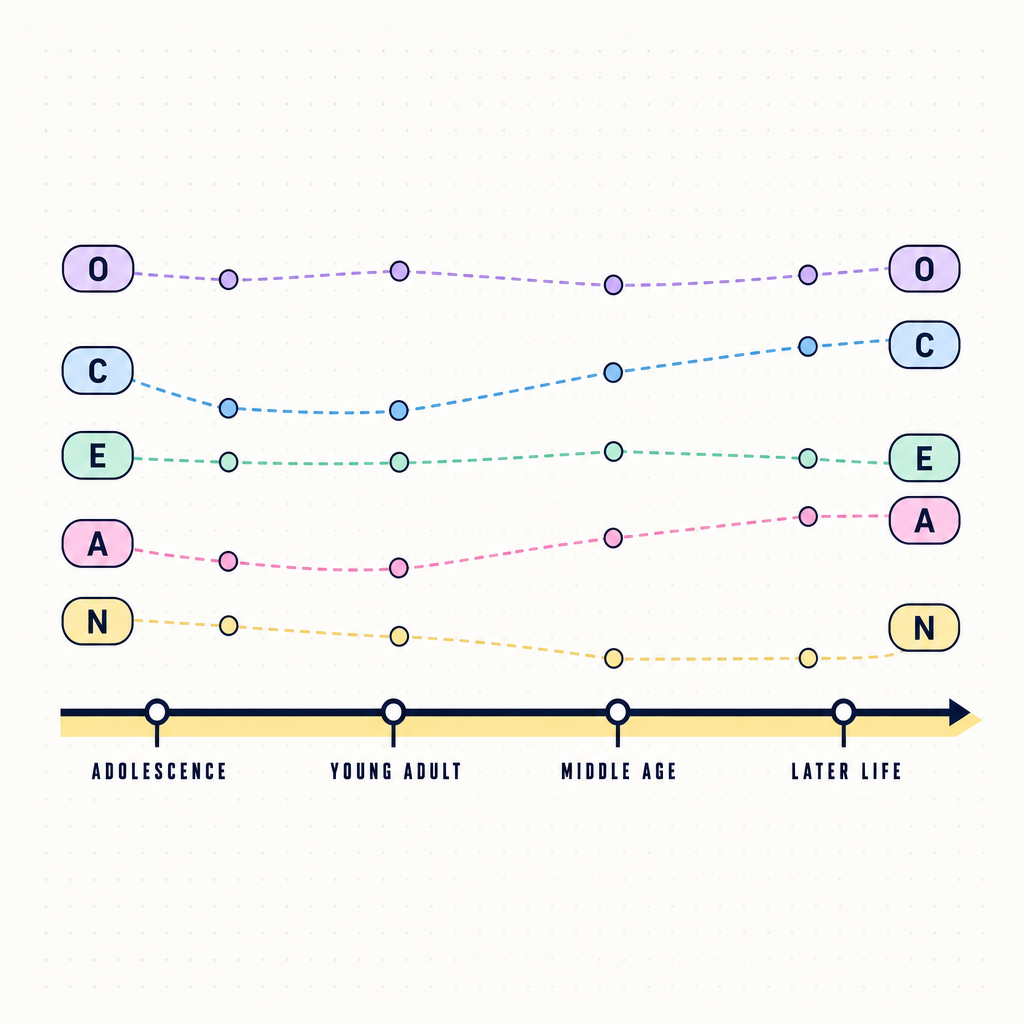
Personality is also stable across adulthood, but not frozen. Roberts and DelVecchio’s 2000 Psychological Bulletin meta-analysis on rank-order stability showed that traits become progressively more stable as people age, reaching their highest stability after age 50. Christopher Soto, Oliver John, Samuel Gosling, and Jeff Potter’s 2011 cross-sectional work mapped the mean-level changes: Agreeableness, Conscientiousness, and Emotional Stability rise gently from young adulthood through middle age, a pattern personality researchers call the maturity principle. Adolescence shows a temporary dip in Agreeableness and Conscientiousness and a rise in Neuroticism, the disruption hypothesis.
The combined picture is that the Big Five describes stable, biologically grounded dispositions that shift modestly across the lifespan and respond, at the margins, to sustained behavioural work.
What this means for the practical work
The research is dense, but the practical implications for L&D, HR, and coaches are reasonably compact.
In hiring and selection, Conscientiousness is the defensible Big Five trait to weight, with Emotional Stability close behind for high-pressure roles. Use validated commercial instruments, not free online quizzes, if the result will inform a hiring decision. US-based employers must layer in EEOC Uniform Guidelines on Employee Selection Procedures, including the 4/5ths rule on adverse impact, and Americans with Disabilities Act constraints; commercial tests built on the Big Five are typically defensible because they measure normal personality variation rather than clinical psychopathology. We cover the compliance angle in Big Five for Hiring Compliance (forthcoming).
In team composition, think in terms of mean and minimum, not just average. A team’s least Agreeable member often shapes the social climate more than its most Agreeable member does. A team with a low average Conscientiousness will struggle with execution even if individual members are talented. Teams operating in genuinely novel environments need at least some high-Openness contributors; teams running stable operations rarely do.
In leadership development and coaching, the most useful move is to layer trait data underneath behavioural feedback. A 360-degree review that says “frequently changes direction” reads very differently for a leader high on Openness and low on Conscientiousness than for one with the reverse profile. The trait data turns the feedback into a coaching plan rather than a verdict.
In debriefs and team workshops, the Big Five gives a shared vocabulary that survives the workshop. A high-Conscientiousness operations manager frustrated by a high-Openness creative director can reframe the conflict as a structural tension between execution and ideation, instead of a clash of personal failings.
The model is not a personality horoscope. It is closer to a measurement instrument. Used as one, it changes the quality of conversations a team can have.
What is moving in the field, 2024 to 2026
A few developments are worth tracking if you are designing or refreshing a programme right now.
The HEXACO model, developed by Kibeom Lee and Michael Ashton, is the most credible alternative to the standard five-factor structure. It retains Extraversion, Conscientiousness, and Openness, rotates Agreeableness and Emotionality slightly, and adds a sixth factor: Honesty-Humility (sincerity, fairness, greed avoidance, modesty). Honesty-Humility predicts unethical behaviour and “dark triad” tendencies (Machiavellianism, narcissism, psychopathy) more cleanly than any single Big Five trait. For roles where integrity risk is the headline concern, HEXACO is worth a look.
Narrow facets versus broad domains is a long-running debate that recent machine-learning work has nudged forward. Oh and colleagues’ 2024-25 work using interpretable machine learning on corporate samples found that narrow facets often outperform broad domains for predicting performance in specific roles. The work also surfaced curvilinear effects, where very high Conscientiousness can tip into rigidity and slightly reduce performance, a finding that earlier linear meta-analyses had averaged out.
AI-driven assessment is an obvious next frontier. As organisations move toward skills-first hiring, personality data is being repurposed to predict learning agility and adaptability under technological disruption. Openness and Emotional Stability are the most natural candidates here. The risk is the same one that surfaced with earlier automated assessments: opaque models that produce defensible-looking scores but cannot be audited for adverse impact. The legal and ethical bar is still being set.
None of these developments undermines the underlying Big Five framework. They refine it.
Where the Big Five has limits
Three caveats are worth keeping near the front of the brain whenever you use this model.
First, the Big Five is descriptive, not deterministic. Jack Block’s 1995 and 2010 critiques (published in Psychological Inquiry) argued that a model built bottom-up from factor analysis lacks deep theoretical grounding, and that it risks reducing people to predictive data points. Goldberg and others have responded that the empirical replication is itself a kind of theoretical signal. The practical takeaway is that a trait score is a baseline probability of behaviour, not a verdict. A highly introverted executive can deliver a brilliant keynote; it simply takes more deliberate effort than it would for an extravert.
Second, cultural validity is solid in WEIRD samples but mixed elsewhere. Michael Gurven and colleagues’ 2013 study in the Journal of Personality and Social Psychology assessed the Big Five among 1,062 members of the Tsimane, an isolated forager-horticulturalist population in the Bolivian Amazon. The five-factor structure did not replicate. Instead, the data resolved into a “Big Two”: Prosociality and Industriousness. The likely explanation is socioecological: in small-scale subsistence societies, individuals cannot afford specialised behavioural niches, so the dimensions blur. Multinational programmes built on Western-validated norms should treat cross-cultural application with care.
Third, scores shift, modestly, over time. The maturity principle and sustained behavioural coaching can move facet-level scores. People who say “I used to be much more anxious in my twenties” are often describing a real, measurable change, not a memory artefact.
FAQ
What are the Big Five personality traits? The Big Five (sometimes called the Five-Factor Model or OCEAN model) describes personality on five continuous dimensions: Openness to experience, Conscientiousness, Extraversion, Agreeableness, and Neuroticism (often reverse-scored as Emotional Stability). Every adult sits somewhere on each dimension. The model was developed through statistical analysis of personality-descriptive adjectives and questionnaire data, and is the dominant framework in academic personality research.
Is the Big Five scientifically valid? Yes, by personality-research standards. The five-factor structure has replicated across more than 50 countries; trait scores show rank-order stability correlations above .70 across years and sometimes decades; and meta-analyses have linked the traits to job performance, leadership, team performance, counterproductive behaviour, mental health, and educational outcomes. The Big Five is the framework academic and industrial-organisational psychologists default to.
How is the Big Five different from MBTI? The Big Five places people on continuous scales; MBTI sorts them into 16 discrete types. The Big Five has strong test-retest reliability; MBTI changes the four-letter result for about half of respondents within five weeks. The Big Five has decades of peer-reviewed validity evidence on work outcomes; MBTI’s own publisher states the tool should not be used for hiring. The two tools are not competing on the same axis.
Can Big Five scores change over time? Yes, modestly. Rank-order stability is high but not perfect, and mean-level changes follow predictable patterns across the lifespan. Agreeableness, Conscientiousness, and Emotional Stability rise gently from young adulthood through middle age (the maturity principle). Adolescence shows a temporary dip in those traits and a rise in Neuroticism. Sustained behavioural coaching can move facet-level scores over months and years; it cannot rewrite the underlying disposition in a weekend workshop.
Which Big Five trait matters most at work? Conscientiousness has the broadest evidence base across job categories and performance criteria. Emotional Stability matters most in high-pressure and leadership roles. Extraversion predicts who gets identified as a leader but is a weaker predictor of leadership effectiveness. Openness matters most in roles where the work is novel or the environment is ambiguous. Agreeableness matters most for team cohesion and is the trait whose minimum score on a team often drives the climate.
Can I use the Big Five for hiring? You can, with care. In the United States, EEOC Uniform Guidelines on Employee Selection Procedures and the 4/5ths rule on adverse impact apply to any personality test used in selection. Americans with Disabilities Act rules forbid using clinical instruments as pre-offer screens. Validated commercial Big Five instruments are typically defensible because they measure normal personality variation, but you still need to demonstrate job-relatedness and monitor adverse impact. We cover the compliance work in Big Five for Hiring Compliance (forthcoming).
How Team Building Bot fits in
A pillar guide is the easy part. The harder part is using the model in real sessions, where individual trait data has to land on a team that is actually working together.
That is the role we are building Team Building Bot for. The bot joins online team sessions, listens for the behavioural signals the Big Five describes, and produces a trait-based report the facilitator and the team can debrief against. The artefact survives the meeting and gives the team a shared vocabulary for the rest of the year.
If you facilitate workshops, coach leaders, or run an L&D programme that ever needs a Big Five-grounded debrief, the beta is free and we would like you in it.
Sources
- Allport, G. W., and Odbert, H. S. (1936). Trait-names: a psycho-lexical study. Psychological Monographs, 47(1).
- Barrick, M. R., and Mount, M. K. (1991). The Big Five personality dimensions and job performance: a meta-analysis. Personnel Psychology, 44(1), 1–26.
- Bell, S. T. (2007). Deep-level composition variables as predictors of team performance: a meta-analysis. Journal of Applied Psychology, 92(3), 595–615.
- Block, J. (1995). A contrarian view of the five-factor approach to personality description. Psychological Bulletin, 117(2), 187–215.
- Block, J. (2010). The five-factor framing of personality and beyond: some ruminations. Psychological Inquiry, 21(1), 2–25.
- Costa, P. T., and McCrae, R. R. (1992). Revised NEO Personality Inventory (NEO-PI-R) and NEO Five-Factor Inventory (NEO-FFI) professional manual. Psychological Assessment Resources.
- Goldberg, L. R. (1990). An alternative “description of personality”: the Big-Five factor structure. Journal of Personality and Social Psychology, 59(6), 1216–1229.
- Gurven, M., von Rueden, C., Massenkoff, M., Kaplan, H., and Lero Vie, M. (2013). How universal is the Big Five? Testing the five-factor model of personality variation among forager-farmers in the Bolivian Amazon. Journal of Personality and Social Psychology, 104(2), 354–370.
- Hogan, J., and Holland, B. (2003). Using theory to evaluate personality and job-performance relations: a socioanalytic perspective. Journal of Applied Psychology, 88(1), 100–112.
- Jang, K. L., Livesley, W. J., and Vernon, P. A. (1996). Heritability of the Big Five personality dimensions and their facets: a twin study. Journal of Personality, 64(3), 577–591.
- Judge, T. A., Bono, J. E., Ilies, R., and Gerhardt, M. W. (2002). Personality and leadership: a qualitative and quantitative review. Journal of Applied Psychology, 87(4), 765–780.
- Lee, K., and Ashton, M. C. (2004). Psychometric properties of the HEXACO Personality Inventory. Multivariate Behavioral Research, 39(2), 329–358.
- Oh, I.-S., et al. (2024). Revisiting the nature and strength of the personality-job performance relations: new insights from interpretable machine learning. Journal of Applied Psychology.
- Pittenger, D. J. (1993). The utility of the Myers-Briggs Type Indicator. Review of Educational Research, 63(4), 467–488.
- Pittenger, D. J. (2005). Cautionary comments regarding the Myers-Briggs Type Indicator. Consulting Psychology Journal, 57(3), 210–221.
- Roberts, B. W., and DelVecchio, W. F. (2000). The rank-order consistency of personality traits from childhood to old age: a quantitative review of longitudinal studies. Psychological Bulletin, 126(1), 3–25.
- Salgado, J. F. (2002). The Big Five personality dimensions and counterproductive behaviours. International Journal of Selection and Assessment, 10(1–2), 117–125.
- Schmidt, F. L., and Hunter, J. E. (1998). The validity and utility of selection methods in personnel psychology: practical and theoretical implications of 85 years of research findings. Psychological Bulletin, 124(2), 262–274.
- Soto, C. J., John, O. P., Gosling, S. D., and Potter, J. (2011). Age differences in personality traits from 10 to 65: Big Five domains and facets in a large cross-sectional sample. Journal of Personality and Social Psychology, 100(2), 330–348.
- Tupes, E. C., and Christal, R. E. (1961). Recurrent personality factors based on trait ratings (Technical Report ASD-TR-61-97). US Air Force.
Posts in this series
- arrow_forward Emotional Stability: The Big Five Trait Behind Team Resilience
- arrow_forward Openness to Experience: The Big Five Trait Behind Innovation
- arrow_forward Agreeableness at Work: The Big Five Trait Behind Team Collaboration
- arrow_forward Conscientiousness at Work: The Trait That Best Predicts Performance
- arrow_forward Extraversion at Work: What the Evidence Actually Shows
- arrow_forward Big Five Personality Tests for Hiring: The Compliance Guide
- arrow_forward Big Five Personality Traits for Leadership: What the Evidence Shows
- arrow_forward Big Five vs MBTI vs DISC: Which Should Your Team Actually Use
Run the Big Five as part of your next team session
Team Building Bot joins your online workshop, listens for the behavioural signals the Big Five describes, and produces a trait-based report you can debrief against. Free during beta.
No spam, no credit card. Unsubscribe any time.