Conscientiousness at Work: The Trait That Best Predicts Performance
Why conscientiousness is the strongest Big Five predictor of work outcomes, with effect sizes, the dark side, and how to coach high and low scorers.
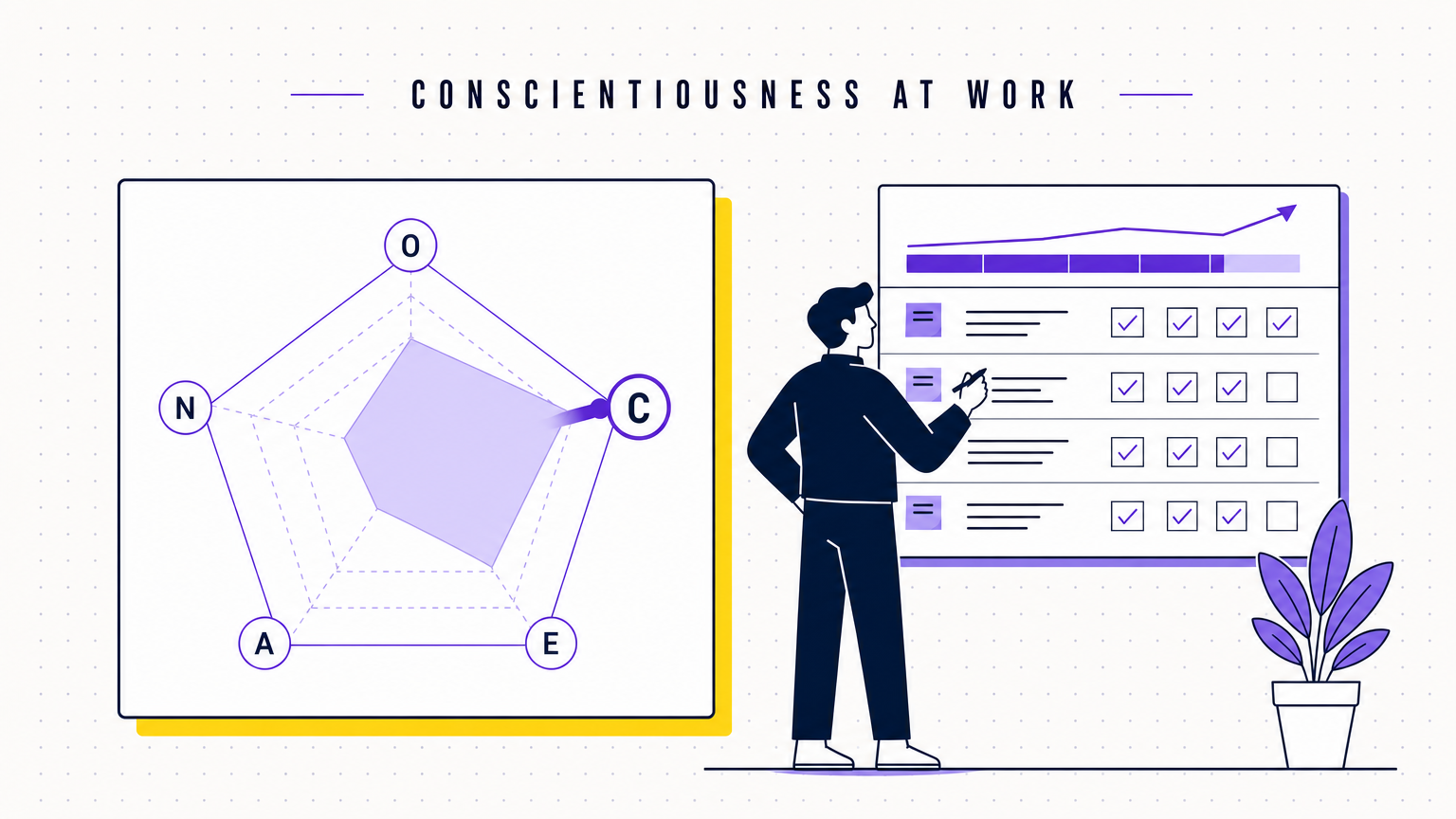
Conscientiousness is the least glamorous of the Big Five and the one with the strongest claim on workplace outcomes. It predicts who shows up prepared, who finishes what they start, and, on the meta-analytic record, who performs across almost any role you care to name. It also has a less-discussed downside that matters for anyone managing senior people: at the high end, the same trait that drives reliability starts to drive burnout, perfectionism and rigidity.
This post walks through what conscientiousness actually predicts at work, why it predicts it, where the effect stops being linear, and what to do with that information if you are hiring, coaching, or designing teams. It is part of our trait-by-trait series on the Big Five; for the wider model, start with the Big Five pillar guide.
The short answer
Across more than a century of organisational research, conscientiousness is the Big Five trait with the most consistent positive relationship to job performance, training outcomes, and career success. The effect generalises across job types, industries and countries, with operational validities in the 0.2 to 0.3 range depending on the meta-analysis you read and how it was corrected. It outperforms the other Big Five traits as a broad-band predictor, though cognitive ability still has the edge for complex roles.
For an L&D or HR buyer, the practical implications are narrower than the headline suggests. Conscientiousness is a legitimate input for development conversations and team design. It is a legally risky input for hiring decisions unless validated against the specific role. And at the top of the distribution it stops being free upside.
| What conscientiousness predicts at work | Direction of effect |
|---|---|
| Overall job performance (across roles) | Moderate positive (ρ ≈ 0.20 to 0.27) |
| Training proficiency | Moderate positive |
| Organisational citizenship behaviour | Strong positive |
| Counterproductive work behaviour | Strong negative |
| Career attainment and income | Positive over the long run |
| Creative output in novel tasks | Weak to negative at high levels |
| Burnout risk under chronic overload | Positive at high levels |
The values above are drawn from the Barrick and Mount (1991) foundational meta-analysis, Schmidt and Hunter’s (1998) selection summary, Wilmot and Ones’s (2019) century-of-research review, and Sackett et al.’s (2022) validity recalibration. Full sources are at the foot of this post.
What we actually mean by conscientiousness
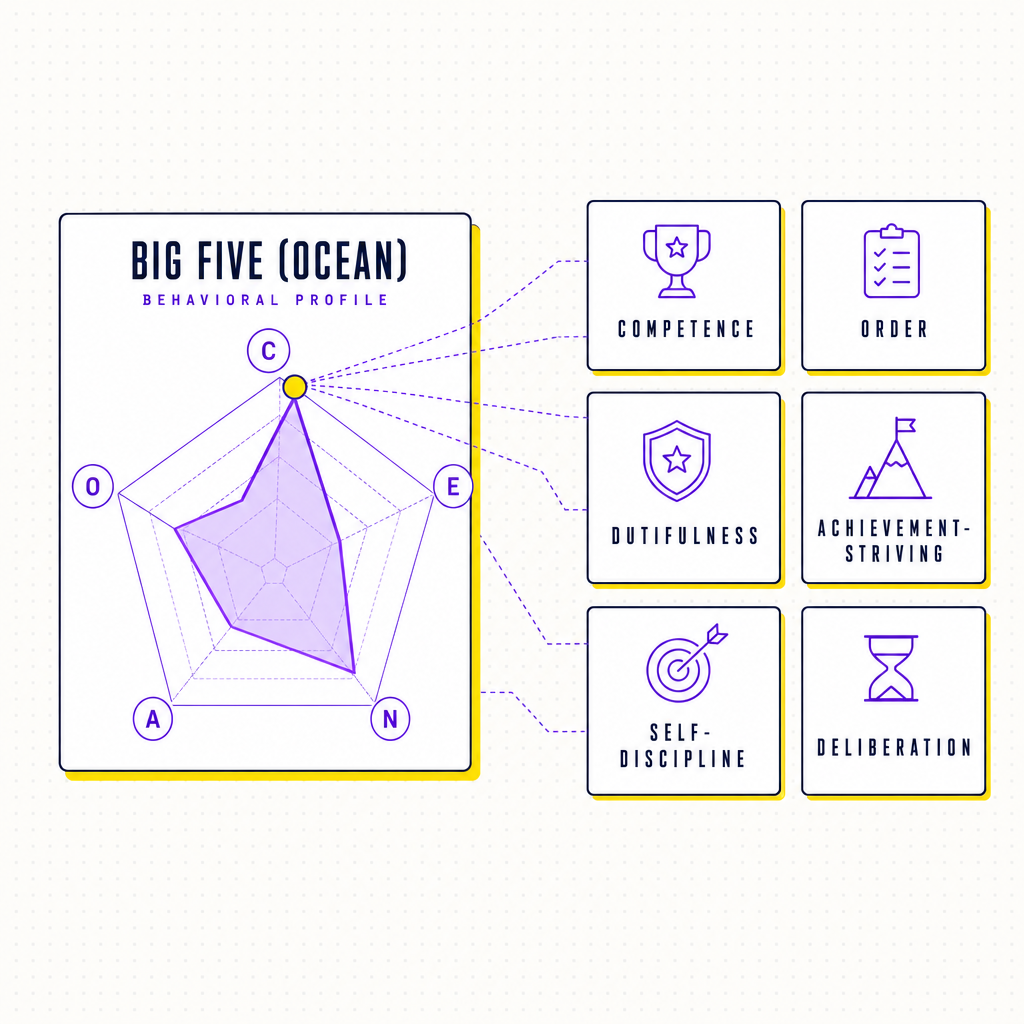
In the Big Five, conscientiousness is the trait cluster that captures the tendency to be organised, dependable, hard-working, self-disciplined and goal-directed. In the NEO-PI-R facet structure, it breaks into six components: competence, order, dutifulness, achievement-striving, self-discipline and deliberation. Recent factor work (DeYoung and colleagues) groups these into two higher-order aspects, industriousness and orderliness, that behave differently in the workplace.
That facet detail matters because the work outcomes do not move in lockstep. Industriousness (achievement-striving, self-discipline) carries most of the job performance prediction. Orderliness (order, deliberation) is the part that links to perfectionism and lower creativity at the high end. Treating conscientiousness as one monolithic switch misses the bit you actually want to develop.
It is also worth separating conscientiousness from two close cousins. Grit, in Duckworth’s framing, overlaps heavily with the achievement-striving facet and contributes little additional predictive power once conscientiousness is controlled (Credé, Tynan and Harms, 2017). Self-control overlaps with self-discipline. Neither is a separate construct in any meaningful psychometric sense; they are mostly conscientiousness wearing different jackets.
Performance: the most generalisable Big Five effect
The Barrick and Mount (1991) meta-analysis in Personnel Psychology is the paper everyone cites first. Pooling 117 studies across professionals, police, managers, sales and skilled labour, the authors found conscientiousness was the only Big Five trait that showed a consistent positive relationship with performance across all occupational groups and all performance criteria. The corrected validity hovered around 0.22 across the board. Subsequent reviews from Salgado (1997) in Europe and Schmidt and Hunter (1998) cemented this as the broadband finding of the personnel selection literature.
The most recent synthesis is Wilmot and Ones’s (2019) review in the Proceedings of the National Academy of Sciences, “A century of research on conscientiousness at work”. Drawing on roughly 100 meta-analyses covering 1.1 million participants, the authors found conscientiousness was positively associated with 98% of the workplace variables they examined, including job performance, training, career success, leadership emergence, organisational citizenship, motivation, job satisfaction and engagement. It was negatively associated with workplace deviance, absenteeism and turnover. Few constructs in organisational psychology generalise that cleanly.
Sackett, Zhang, Berry and Lievens (2022) and the follow-up Sackett et al. (2023) work in the Journal of Applied Psychology and Industrial and Organizational Psychology tightened the numbers. By correcting earlier meta-analyses for indirect range restriction and other artefacts, the authors revised the operational validity of cognitive ability downward (closer to 0.31 from a prior 0.51) and the validity of structured interviews upward, while conscientiousness held steady in the low- to mid-0.2s. The headline change is that the gap between cognitive ability and conscientiousness has narrowed; the broad ordering has not.
Mechanisms: why it works
Conscientious people do better at work because the trait packages a set of behaviours that any job benefits from: goal-setting and follow-through, lower distractibility, better self-regulation under stress, higher organisational citizenship, lower counterproductive behaviour, and a steady investment of effort over time rather than in bursts. None of these are dramatic on a given day; they compound.
The mechanism evidence is strongest for the goal-setting and self-regulation pathway. Conscientious employees set higher and more specific goals, monitor progress more reliably, and persist longer when initial attempts fail (Wilmot and Ones, 2019). The organisational citizenship pathway matters too: high-conscientiousness colleagues are more likely to help peers, follow through on minor commitments, and absorb the small acts of effort that hold a team together but rarely appear in a job description.
Moderators: where the effect is strongest, and where it is not
Conscientiousness pays off most in roles with high autonomy, ambiguous criteria, and long feedback cycles, where there is no manager telling you what to do hour by hour. Sales, knowledge work, research, project leadership, anything where the day’s work is set by the person doing it. In tightly scripted, externally paced roles (a call centre with a script and adherence metrics, a production line), the prediction shrinks because the work environment already enforces conscientious behaviour.
The trait also interacts with complexity. For very simple roles, cognitive ability adds little above and beyond conscientiousness; for very complex roles, conscientiousness still predicts but cognitive ability dominates (Sackett et al., 2023). The practical read is that conscientiousness is the closest thing the field has to a universal positive, but it is not the only thing to measure.
Creativity and novel tasks
The clearest place where conscientiousness stops helping is open-ended creative work. The orderliness component, in particular, tends to be negatively related to divergent thinking, ideational fluency and originality on novel tasks. The industriousness side still helps (you still need to do the work), but the rule-following, low-tolerance-for-ambiguity bias of high orderliness pushes toward refining existing approaches rather than generating new ones. For roles that genuinely require novelty, balancing conscientious execution with high openness in the team composition tends to outperform stacking conscientious individuals.
The dark side of conscientiousness
The trait research used to talk about conscientiousness as if more was always better. The last decade has chipped at that.
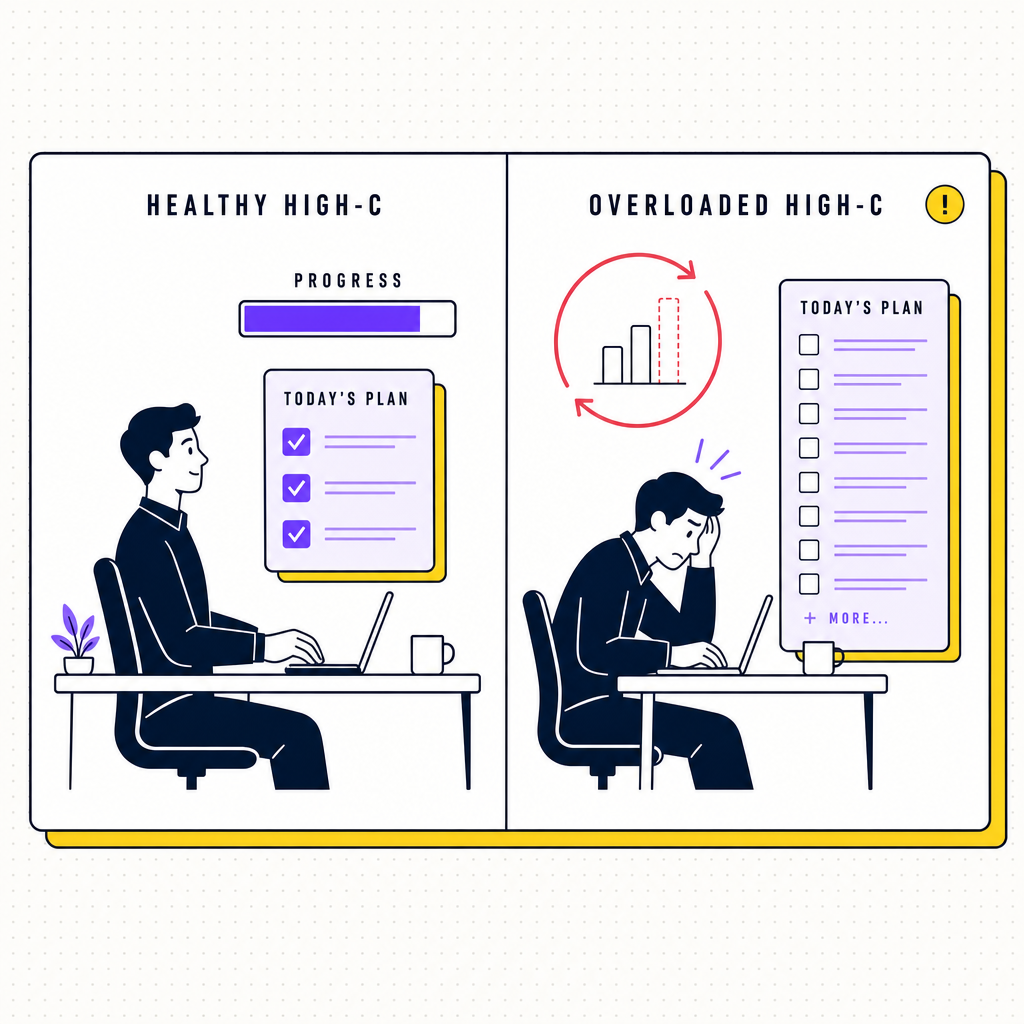
At the upper tail of the distribution, achievement-striving turns into maladaptive perfectionism: an inability to satisfice, a refusal to ship anything that is not optimal, and the chronic stress that comes with treating every task as defining. High-conscientiousness employees show elevated rates of self-induced burnout, particularly in environments with unbounded workloads or unclear stopping rules. They struggle with delegation because they equate personal effort with quality, and the cost of that compounds as they move into senior roles where leverage matters more than personal output.
In volatile or rapidly changing environments, rigid adherence to established procedure becomes an organisational liability. The same disposition that makes someone a reliable operator in stable conditions makes them slow to pivot when the conditions change. This is well documented in the algorithmic management and remote-work literature: high-conscientiousness employees adapt less well to ambiguous, fast-shifting digital workflows than their slightly less conscientious peers (psychology research on remote work adjustment, 2021, and follow-up work in Administrative Sciences, 2024).
The recent algorithmic-management research adds a wrinkle. A 2025 NBER and University of Chicago working paper found that when work is heavily monitored and paced by an algorithm, the conscientiousness-performance link weakens, because the system imposes the structure conscientious people would have generated themselves. The trait still helps; the relative advantage shrinks. Wharton AI-collaboration work from 2025 finds a related “match effect”: conscientious humans produce higher-quality output when paired with AI agents whose prompted style mirrors their own, and lower-quality output when paired with looser, more spontaneous models. The pairing matters more than people expect.
Can conscientiousness be developed?
The honest answer is yes, slowly, and with deliberate effort. The older assumption that adult personality is fixed has not survived the trait-change literature of the last fifteen years.
Roberts and colleagues’ work on the “maturity principle” shows that across the lifespan, most people become moderately more conscientious as they move into adult roles, partner up, and take on long-term responsibilities. The effect is gradual and largely passive: the environment selects for the behaviour, and the trait shifts to fit.
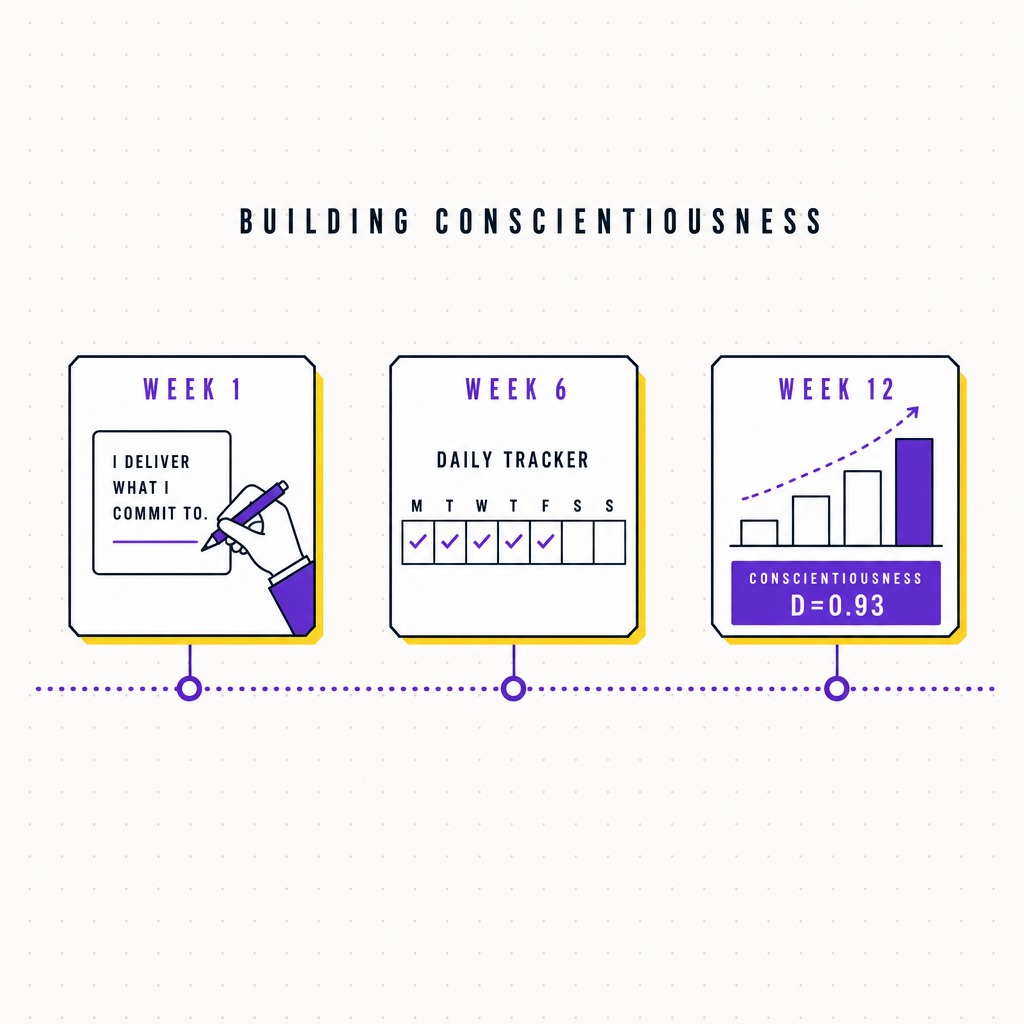
Active intervention is harder but possible. The Sociogenomic Trait Intervention Model proposed by Roberts and colleagues frames trait change as a bottom-up behavioural process: by repeatedly enacting state-level behaviours associated with the trait (planning, scheduling, finishing tasks before starting new ones), the underlying disposition shifts over time. The model has empirical support. A 2025 clinical trial of a smartphone-based “Conscientiousness Coach” intervention, combining value identification, SMART goal-setting, daily behavioural tracking and telehealth coaching, reported a large effect on overall conscientiousness over twelve weeks (d ≈ 0.93), with moderate gains specifically in orderliness and dependability facets.
The practical implication for L&D is that conscientiousness can be a development target, not just a screening variable. It just takes the long route: structure, repetition, and tying the new behaviour to a value the person already holds.
What to do with this: hiring, coaching, team design
The biggest risk in most organisations is not low conscientiousness in the team. It is the unexamined use of personality data in three places: pre-employment selection, performance reviews, and one-size-fits-all coaching.
Hiring
Conscientiousness is the Big Five trait with the strongest scientific basis for use in personnel selection. That does not make it legally safe to use casually. In the United States, the Uniform Guidelines on Employee Selection Procedures and EEOC oversight require that any selection tool, including a personality assessment, be validated for the specific role and monitored for adverse impact against protected groups. In the United Kingdom and Europe, the CIPD’s longstanding guidance is that personality data should contribute no more than around 25% of an overall hiring decision, alongside structured interviews, work samples and (where appropriate) cognitive assessment.
The well-established fix is the same one that helps with extraversion bias: structured interviews on a standardised rubric, validated cognitive ability testing, and a validated Big Five inventory used as supplementary data rather than a pass-fail gate. Where you do use conscientiousness in selection, separate the facets. Industriousness is what you usually want; orderliness can be net-negative for highly creative or fast-shifting roles. For the full compliance picture, our guide to Big Five personality tests for hiring covers the EEOC and GDPR detail.
Performance reviews
Conscientiousness shows up in performance reviews in two opposite distortions. High-conscientiousness employees are routinely over-rated because their visibility on small commitments (timeliness, follow-through, neat documentation) carries a halo effect onto unrelated dimensions. Low-conscientiousness employees with strong actual outputs are under-rated because their cadence looks chaotic, even when the substance is sound. Both errors are mitigated by the same controls: continuous feedback documented throughout the year, behavioural anchors for each rated dimension, calibration sessions across managers, and 360-degree input from peers and direct reports.
Coaching high-conscientiousness employees
For high-conscientiousness employees, particularly in senior roles, the developmental edge is rarely “do more”. It is restraint, flexibility and psychological recovery. Three interventions that show up reliably in the coaching literature:
- Explicit work-life boundaries with a defined stop-time and a tracked recovery routine, treated as a non-negotiable input rather than a wellness option.
- Delegation training that targets the underlying belief (effort equals quality) rather than the surface behaviour. The classical version is to require the leader to delegate a single recurring task in full and accept the first imperfect version without intervening.
- A “good enough” rubric for projects with diminishing returns, set in advance with the manager, so the stopping criterion is external rather than self-judged.
Frameworks like STEPPA (Subject, Target, Emotion, Perception, Plan, Pace, Action) are useful here because they make space for processing the anxiety that surfaces when a highly conscientious person is asked to lower their standard or pivot quickly.
Coaching low-conscientiousness employees
For low-conscientiousness employees, the edge is structure that is supplied externally rather than generated internally. Two interventions with reasonable evidence:
- High-visibility accountability structures. Low-conscientiousness people show some of the largest improvements in training transfer when placed in environments with clear, externally tracked commitments (research in the Journal of Managerial Psychology, 2010). The structure does not have to be heavy; it does have to be visible.
- Implementation-intention frameworks like WOOP (Wish, Outcome, Obstacle, Plan) or OSKAR (Outcome, Scaling, Know-how, Affirm, Review) that force explicit “if-then” planning. These artificially supply the forward-planning step that low-conscientiousness employees tend to skip, and they generalise to new tasks better than generic time-management training.
The mistake to avoid is imposing draconian organisation systems on a low-conscientiousness employee in one go. Trait change is slow; behavioural scaffolding works when it is incremental.
Team design
At the team level, mean conscientiousness has a smaller effect on team performance than people assume; what matters more is having at least one or two highly conscientious members who own the operational backbone, paired with members high in openness for the generative work. Stacking the team with high conscientiousness produces reliable execution and low innovation. Stacking it the other way produces ideas that never ship.
Wrapping up: where conscientiousness fits in the Big Five
Across the OCEAN series, conscientiousness is the trait with the cleanest, broadest workplace evidence base and the least cultural cachet. It is the unflashy backbone of long-running work: reliable across roles, predictive over the long term, malleable with deliberate effort, and quietly dangerous at the top of its own distribution.
If you are designing a team for sustained delivery, this is the trait to pay attention to. If you are designing a team for creative breakthroughs, you still want it, but balanced with openness rather than maximised. And whichever direction you are going, the trait is best treated as one input among several, not the line that decides whether someone gets a job.
For the wider model, the Big Five pillar guide is the place to start. If you are working with senior people, Big Five personality traits for leadership is the deeper cut on how the trait stack shows up at the top of an organisation.
FAQ
Is conscientiousness the same as being a hard worker? Close, but not identical. Hard work is one behavioural expression of high conscientiousness, mostly the achievement-striving and self-discipline facets. The trait also includes orderliness, dutifulness and deliberation, which look less like effort and more like planning, rule-following and careful judgement.
Is conscientiousness more important than IQ for job performance? Not on average. After Sackett et al.’s (2022, 2023) recalibration, cognitive ability still has the highest single-predictor operational validity for complex jobs, around 0.31. Conscientiousness is the next-strongest broad trait, in the low- to mid-0.2s, and its predictive power generalises across more roles. In practice, the two combine well, and structured interviews add further validity.
Can adults really change their conscientiousness? Yes, gradually. The maturity principle accounts for slow increases across the lifespan as people take on adult roles. Targeted interventions, particularly behaviourally structured ones tied to a personal value, show meaningful gains over 8 to 12 weeks in clinical and field studies. The change is real but not dramatic, and it requires repetition.
Is grit a separate trait from conscientiousness? No, not in any psychometrically clean sense. The Credé, Tynan and Harms (2017) meta-analysis found grit correlates strongly with conscientiousness and adds little incremental predictive validity once conscientiousness is controlled. For practical purposes, grit is a marketing rebrand of the achievement-striving and perseverance facets of conscientiousness.
How do I avoid over-weighting conscientiousness in hiring? Use validated assessments, not casual judgements. Separate the facets: industriousness is what most roles need; orderliness can hurt creative or fast-shifting roles. Cap personality data at roughly 25% of the hiring decision per CIPD guidance, pair with structured interviews and work samples, and monitor outcomes for adverse impact.
Sources
- Barrick, M. R., & Mount, M. K. (1991). The Big Five personality dimensions and job performance: A meta-analysis. Personnel Psychology, 44(1), 1–26. Cited and summarised in Personality and Job Performance: The Big Five Revisited (Appalachian State PDF).
- Wilmot, M. P., & Ones, D. S. (2019). A century of research on conscientiousness at work. Proceedings of the National Academy of Sciences, 116(46), 23004–23010. PNAS entry · ResearchGate.
- Sackett, P. R., Zhang, C., Berry, C. M., & Lievens, F. (2022/2023). Revisiting the design of selection systems in light of new findings regarding the validity of widely used predictors. Industrial and Organizational Psychology and Journal of Applied Psychology. Cambridge journal entry · Sackett et al. 2023 PDF (Gwern mirror) · Master HR summary · SIOP commentary.
- Cognitive ability and job performance recalibration: PCI Assessments summary · Controversy over the predictive validity of IQ on job performance (Human Varieties, 2024).
- Roberts, B. W., et al. (2017). A systematic review of personality trait change through intervention. Psychological Bulletin. PubMed. Trait change and the Sociogenomic Trait Intervention Model: How to Change Conscientiousness: The Sociogenomic Trait Intervention Model (ResearchGate) · Illinois Experts entry · Strengthening Conscientiousness by Means of Interventions: A Systematic Review (2025).
- Conscientiousness Coach 12-week trial (2025): PMC12356716.
- Conscientiousness facets and the narrow-vs-broad debate: Conscientiousness, its Facets and the Prediction of Job Performance (ResearchGate) · Broad versus narrow traits: Conscientiousness (Semantic Scholar).
- Dark side, perfectionism and burnout: The Big Five trait of conscientiousness: handling workplace stress (Illumyx) · PMC8709883 · Frontiers in Psychology synthesis, 2023.
- Remote, hybrid and algorithmic work: Personality predicts adjustment to remote work (Psychology Today summary of 2021 research) · Administrative Sciences, 2024 · BFI working paper on algorithmic management (2025) · Wharton AI on algorithmic management and employee helpfulness (2025) · Emerald LODJ on leading through algorithmic management.
- Human-AI collaboration and personality pairing (2025): Personality Pairing Improves Human-AI Collaboration (ResearchGate) · arXiv 2511.13979 · PMC10844202 on conscientiousness and AI attitudes.
- Counterproductive work behaviour and OCB: PMC3646072 · PMC10570736.
- Training transfer and accountability for low-conscientiousness employees: Improving individual learning for trainees (Emerald, Journal of Managerial Psychology, 2010).
- Coaching frameworks (OSKAR, WOOP, STEPPA, CLEAR): Coaching models overview (Simply.Coach) · AIHR on coaching models · Forbes Councils on executive coaching models · Coach-focused note on conscientiousness patterns (The Good Coach).
- Legal and ethical use of personality assessments in selection: Are personality tests legal in hiring (Jobcannon) · Ethical personality assessments and HR compliance (SpeedExam) · Fair and ethical use of personality tests in hiring (AssessCandidates).
- Job-type moderators and personality-by-role interactions: Personality traits predict performance differently across different jobs (University of Arkansas, 2023) · PubMed 34687041 · PubMed 31666330 · Synthesis of 50+ meta-analyses on Big Five and performance (PsyPost summary).
More on Big Five
- arrow_forward Emotional Stability: The Big Five Trait Behind Team Resilience
- arrow_forward Openness to Experience: The Big Five Trait Behind Innovation
- arrow_forward Agreeableness at Work: The Big Five Trait Behind Team Collaboration
- arrow_forward Extraversion at Work: What the Evidence Actually Shows
- arrow_forward Big Five Personality Tests for Hiring: The Compliance Guide
- arrow_forward Big Five Personality Traits for Leadership: What the Evidence Shows
- menu_book The Big Five Personality Traits Explained: A Guide to the OCEAN Model Pillar
- arrow_forward Big Five vs MBTI vs DISC: Which Should Your Team Actually Use
See conscientiousness show up in a real team report
Team Building Bot joins your next online workshop or coaching session, listens for behavioural signals across the Big Five, and produces a team report you can use in the debrief. Free during beta.
No spam, no credit card. Unsubscribe any time.