Emotional Stability: The Big Five Trait Behind Team Resilience
What emotional stability and neuroticism predict at work, the evidence linking them to team resilience, and how to coach the trait instead of screening it out.
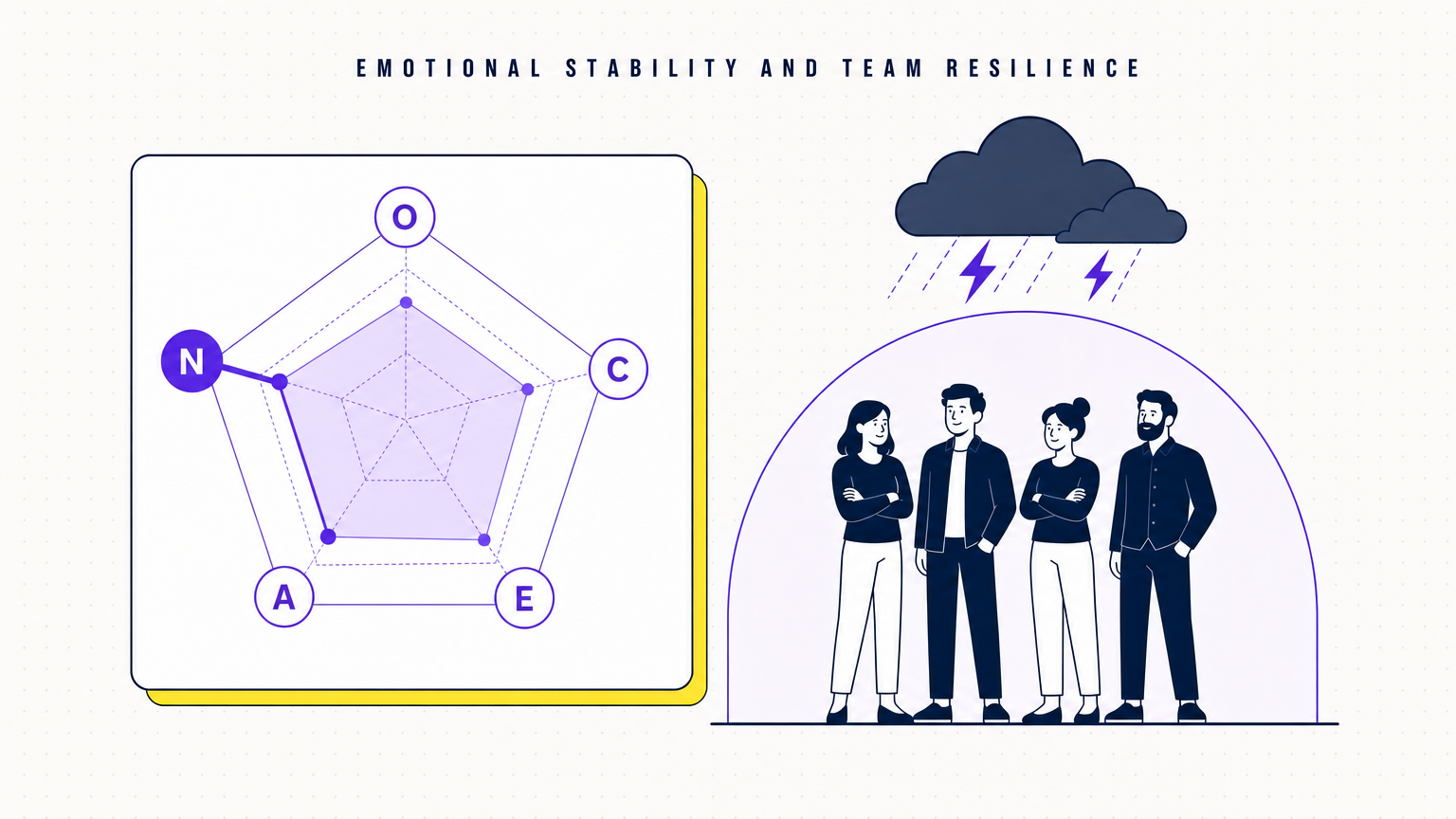
Neuroticism is the Big Five trait nobody wants to score high on, which is exactly why the more useful name is its positive pole: emotional stability. It is the dimension that governs how a person reads ambiguity, how fast their stress response fires, and how long it takes them to recover once it does. At the team level it is the trait that decides whether a group absorbs a shock and keeps coordinating, or catches each other’s anxiety and spirals. The evidence is clear that higher emotional stability predicts better performance and far lower burnout, and it is just as clear that a team engineered to contain only unshakeably calm people develops its own blind spots.
This post walks through what emotional stability actually measures, what it predicts at work, how it shapes a team under pressure, and what to do with that if you are hiring, coaching, or trying to build a team that holds together when things go wrong. It is part of our trait-by-trait series on the Big Five, alongside conscientiousness and job performance, agreeableness at work, extraversion at work, and openness and innovation. If you want the wider model first, the Big Five pillar guide covers all five dimensions and how they fit together.
The short answer
Emotional stability is the inverse of neuroticism. People high in it stay calm and even under stress; people low in it (high in neuroticism) experience negative emotions more often, more intensely, and for longer. Across decades of meta-analytic research it is a meaningful predictor of job performance, a strong negative predictor of burnout and counterproductive behaviour, and one of the traits that most reliably shapes leadership and team outcomes. At the team level, the mean emotional stability of the group predicts how well it performs in the field, and how similar members are to each other on the trait predicts how little friction they generate working together.
For an L&D or HR buyer, the practical implication is not to screen out neuroticism. It is to read emotional stability as a regulation-and-recovery signal, to coach lower-stability people on the specific skills (structure, cognitive reappraisal, mindfulness) that buffer the trait, and to remember that a team of only the unflappable tends toward complacency and misses the early warning signs that anxious people are wired to catch.
| What emotional stability predicts at work | Direction of effect |
|---|---|
| Overall job performance | Positive, secondary to conscientiousness |
| Performance in high-stress, high-interaction roles | Larger positive |
| Counterproductive work behaviour (deviance) | Negative (ρ ≈ -0.18 to -0.24) |
| Burnout and emotional exhaustion | Strong negative |
| Leadership emergence and effectiveness | Positive |
| Team performance (mean stability, field settings) | Positive (ρ ≈ 0.21) |
| Team friction (high variance in stability) | Negative for interdependent teams |
| Threat detection and risk vigilance | Negative (high stability can mean lower vigilance) |
The values above are drawn from Barrick and Mount’s (1991) meta-analysis on personality and job performance, Salgado’s (2002) and Berry, Ones and Sackett’s (2007) meta-analyses on counterproductive behaviour, Judge, Bono, Ilies and Gerhardt’s (2002) meta-analysis on personality and leadership, and the team-composition meta-analyses by Bell (2007) and Peeters, Van Tuijl, Rutte and Reymen (2006). Full sources are at the foot of this post.
What we actually mean by emotional stability
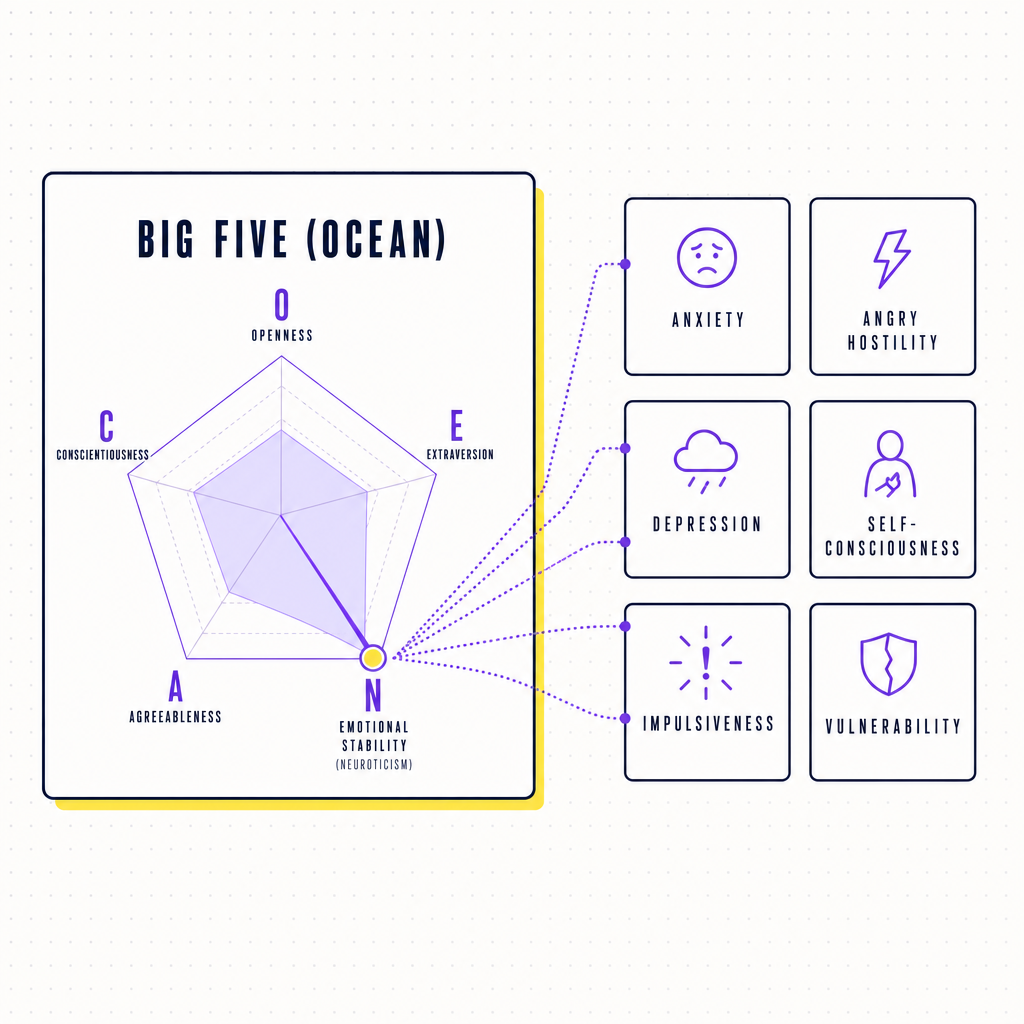
In the Big Five, neuroticism is the disposition toward experiencing negative emotion, and emotional stability is simply its low end. The facet structure used in the NEO-PI-R, IPIP-NEO and BFI-2 inventories breaks neuroticism into six components: anxiety, angry hostility, depression, self-consciousness, impulsiveness, and vulnerability to stress. A person can sit high on one facet and low on another, which is why two people with the same overall score can look completely different at work. One is a worrier who never loses their temper; another is even-keeled until provoked and then quick to anger.
That facet detail matters because the workplace effects do not move in lockstep. The anxiety and vulnerability facets carry most of the burnout and stress-recovery signal. The angry-hostility facet shows up in interpersonal conflict and counterproductive behaviour. The self-consciousness facet drives how someone responds to feedback and visibility. Treating neuroticism as one monolithic dial misses the bit you actually want to read for a given role or a given coaching conversation.
It is also worth being precise about what the trait is not. Trait neuroticism is a normal, continuous personality dimension; it is not clinical anxiety or depression, even though high neuroticism is a risk factor for both. Someone can score high on the trait and be perfectly well. The trait describes a person’s baseline sensitivity to threat and their recovery speed, not a diagnosis. The cleanest mental model across the series is: extraversion is the volume knob, conscientiousness is the discipline knob, openness is the breadth knob, and emotional stability is the thermostat, how hot a person runs under stress and how quickly they cool back down.
Three instruments do most of the measuring in applied settings. The 240-item NEO-PI-R is the most detailed and usually reserved for executive coaching or research. The open-source IPIP-NEO mirrors the same 30-facet structure with 300, 120 or 60-item forms, and its 120-item version reports a mean alpha reliability around 0.80, which makes it the workhorse for organisational use. The BFI-2 offers 60, 30 and 15-item forms that suit pulse surveys and fast team work where survey fatigue is the binding constraint.
Performance, deviance and burnout: what the trait predicts for individuals
The foundational result is Barrick and Mount’s (1991) meta-analysis in Personnel Psychology. Across job families, conscientiousness is the most universal predictor of performance, and emotional stability is a meaningful secondary one, with its predictive power rising sharply in roles that involve high interpersonal contact, crisis management, and stress tolerance. The practical reading is that emotional stability often works as a floor rather than a peak: profound instability can derail an otherwise capable, conscientious person, even when nothing else about them predicts poor performance.
The deviance evidence is more pointed. Salgado’s (2002) meta-analysis found emotional stability to be a valid negative predictor of general counterproductive work behaviour, alongside conscientiousness (ρ ≈ -0.26) and agreeableness (ρ ≈ -0.20). Berry, Ones and Sackett’s (2007) meta-analysis then split counterproductive behaviour into the kind aimed at the organisation and the kind aimed at colleagues, and reported emotional stability correlating negatively with both interpersonal deviance (ρ ≈ -0.24) and organisational deviance (ρ ≈ -0.18). The pattern is that low emotional stability drives interpersonal friction more strongly than it drives rule-breaking against the company. People low on the trait, lacking reliable regulation, are more likely to read the workplace as hostile or unfair, and that reading triggers retaliation, defensiveness, or withdrawal.
The neuroticism-burnout link
The best-established finding in this whole area is the neuroticism-burnout link, one of the steadiest results in occupational health psychology. People high in neuroticism carry a cognitive bias that tags ambiguous or ordinary events as threatening, which keeps a low-grade stress response running and steadily drains cognitive and emotional resources. The mechanism that does the damage is rumination: the repetitive, intrusive replaying of negative interactions or past mistakes. Rumination blocks psychological detachment, so the stress response stays switched on long after the workday ends, and over time that is the road to emotional exhaustion and clinical burnout. Where emotion-regulation skill is weak, the effect of neuroticism on negative affect runs much stronger through this ruminative pathway, which is precisely why the coaching levers later in this post target regulation rather than the trait itself.
Team composition: mean and variance both matter
The clearest applied synthesis on personality composition and team performance is the team-composition meta-analytic literature, especially Bell’s (2007) paper in the Journal of Applied Psychology and Peeters, Van Tuijl, Rutte and Reymen’s (2006) meta-analysis in the European Journal of Personality. Both make the same underlying point: how you aggregate a trait across a team (the mean, the lowest score, the variance) changes what you find, and emotional stability behaves differently depending on which you read.
Bell (2007) found the setting moderates everything. In controlled laboratory studies, personality effects on team performance were negligible. In real field teams doing complex, ongoing work, the team mean for emotional stability emerged as a strong positive predictor of performance, around ρ = 0.21. Raising the average baseline of calm and resilience across a team appears to help it coordinate, communicate, and sustain output, especially over the long haul rather than the one-off task.
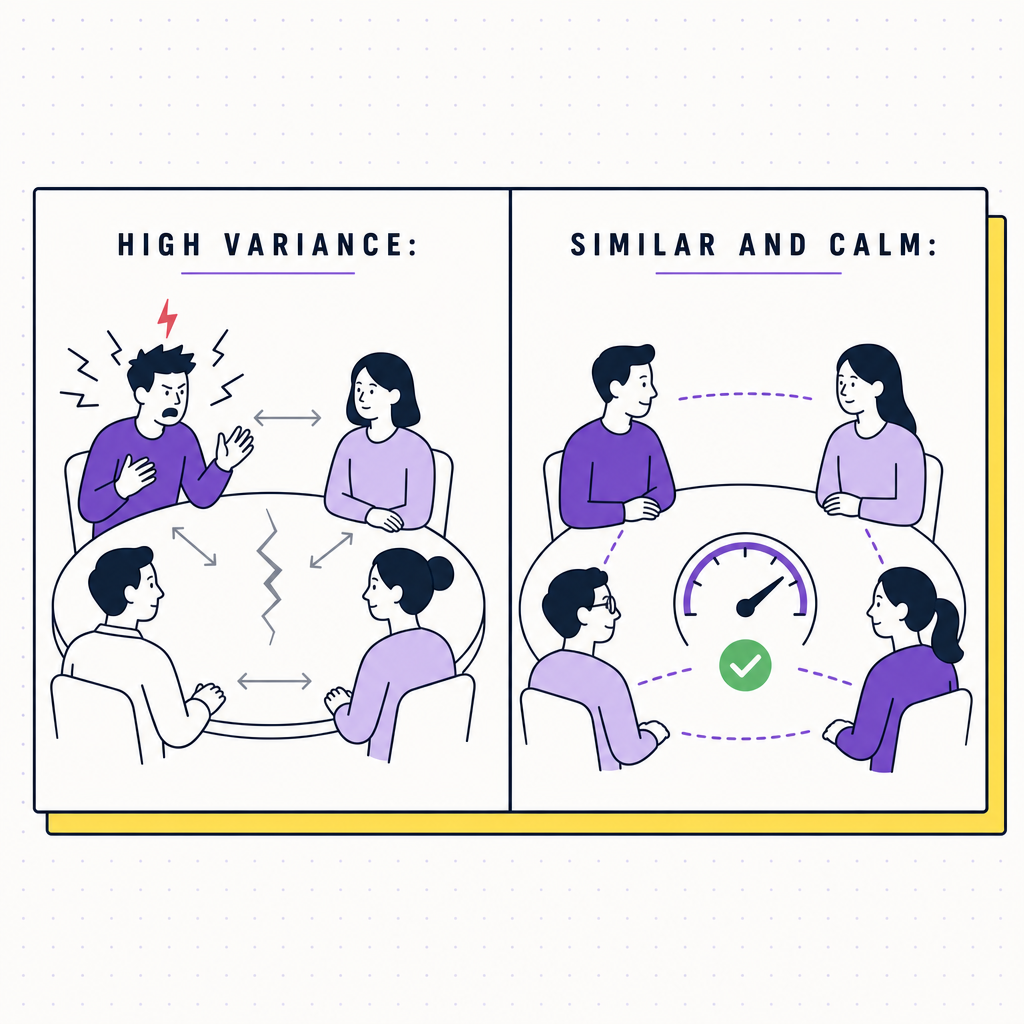
Peeters et al. (2006) added the variance dimension and the context that goes with it. While high mean agreeableness and conscientiousness predicted better performance fairly universally, emotional stability was more conditional. For professional teams that work interdependently over extended periods, low variability (members being similar to each other) in emotional stability was the beneficial pattern. When members sit at wildly different points on the trait, a highly reactive person working alongside very calm ones, it generates friction in both directions: the stable members read the reactive one as dramatic or high-maintenance, and the reactive member feels unsupported and dismissed by colleagues who seem indifferent.
| Meta-analytic focus | Bell (2007) | Peeters et al. (2006) |
|---|---|---|
| Primary metric | Team mean, minimum, maximum | Trait elevation (mean) and variability (variance) |
| Contextual moderator | Laboratory vs field settings | Professional vs student teams |
| Emotional stability effect | Field-setting team mean predicts performance (ρ ≈ 0.21) | In professional teams, low variability predicts better performance |
| Application | Raise the average level across the team | Avoid extreme mismatches within interdependent teams |
The combined operating rule is to lift the team’s average emotional stability where you can, and to watch for large gaps between members on a team that has to work closely together for a long time.
Under pressure: contagion, psychological safety, and the recovery curve
Team-level emotional stability does its most visible work in a crisis, because stress in a group is contagious. Emotions spread through teams, a phenomenon documented as emotional contagion, and the spread runs especially fast from leaders downward. When a leader signals anxiety or anger, the markers of low emotional stability, members tend to respond with uncoordinated, self-protective effort: looking busy, covering themselves, and quietly withdrawing from genuine collaboration. The effect compounds in pairs where both the leader and the report are low in stability; drawing on Conservation of Resources theory, studies of field workforces find the highest burnout in exactly those dyads, where a low-stability leader drains an already-depleted low-stability follower in a mutual loop of anxiety and exhaustion.
This is where emotional stability and psychological safety intersect. Psychological safety, the shared belief that the team is safe for interpersonal risk, admitting mistakes, and floating half-formed ideas, sits on top of the team’s baseline stability. Under acute pressure, stress fires the amygdala-driven threat response, and in teams low in aggregate stability that shows up either as groupthink (rushing to a premature, risk-averse consensus just to end the discomfort of ambiguity) or as open conflict (irritability, blame-shifting, and breakdown of structure).
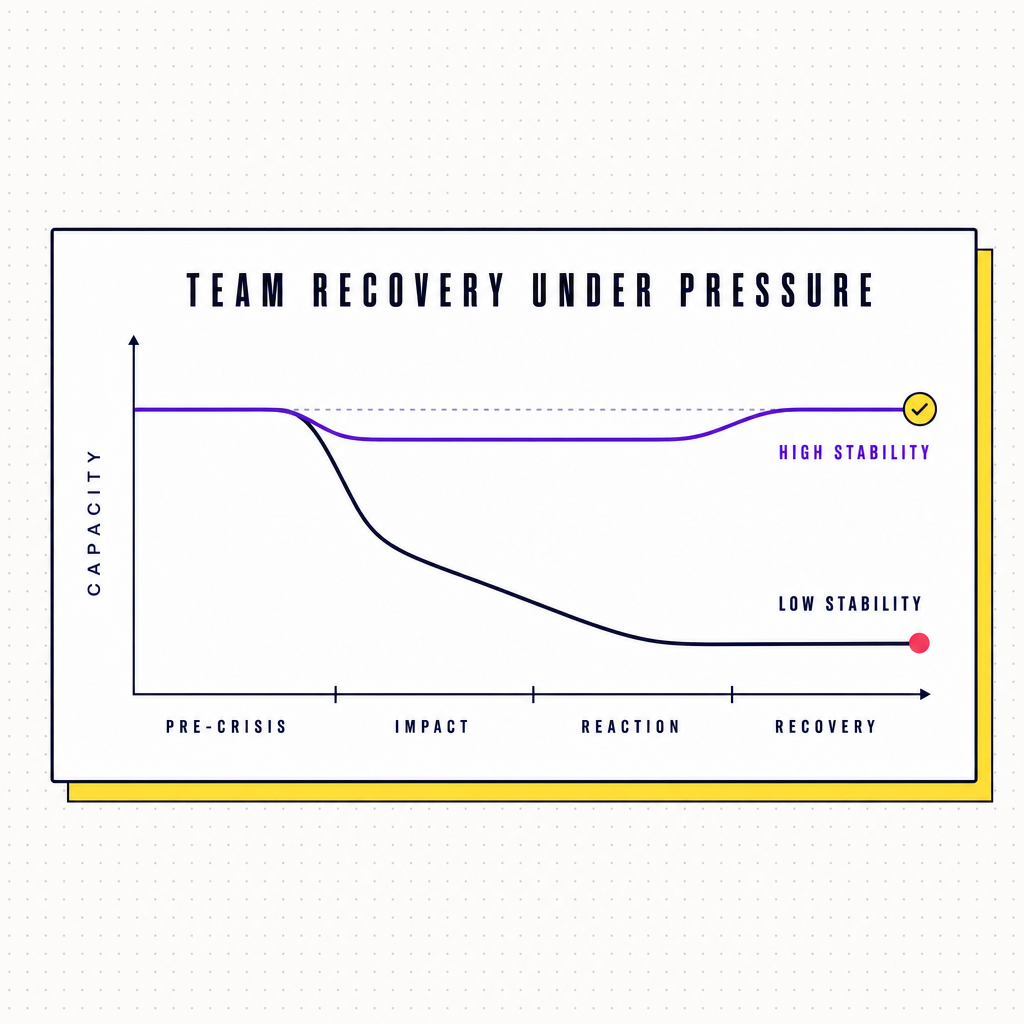
The most useful way to picture the difference is as a recovery curve across four phases: pre-crisis, impact, reaction, and recovery. Before a shock, stable and reactive teams can look equally functional. The shock itself dips everyone’s capacity. The divergence happens in the reaction phase. High-stability teams use what researchers call dyadic regulation, reciprocal calming exchanges between members, to arrest the slide and hold capacity steady, then recover back to their pre-crisis level. Low-stability teams let the contagion run; capacity drops sharply as anxiety cascades, and recovery stalls at a permanently lower level marked by communication breakdown and lingering resentment. Resilient teams reframe the adversity as a solvable operational problem rather than an existential threat, which is what keeps the tunnel vision of acute stress from setting in.
Recent developments: hybrid work, AI, and the connection deficit
Two threads from the last 24 months are worth flagging, with the caveat that the headline figures come from single industry studies rather than replicated peer-reviewed work.
The first is the renewed premium on regulation skills. The World Economic Forum’s 2025 Future of Jobs Report named resilience, flexibility and emotional regulation among the highest-demand skills for the rest of the decade, and the American Psychological Association’s 2026 work commentary argues that these human skills have atrophied under prolonged digital isolation. As routine, transactional work gets automated, the residual work handed to people is more ambiguous and more relational, which raises the floor on emotional stability that a role actually requires.
The second is the AI paradox. Industry research from 2025 and 2026 points in two directions at once. A 2026 Workday global study reported that a majority of employees felt their task-related stress fell after adopting generative AI tools, and ADP’s 2026 People at Work research found daily AI users far less likely to report feeling overloaded than non-users. At the same time, the Workday work flagged a growing connection deficit, with a notable share of Gen Z employees reporting time off for isolation and loneliness, and a minority reporting that frictionless AI interaction had eroded their patience for ordinary human nuance. Job-insecurity stress from rapid, sometimes mandated AI rollouts also lands hardest on people high in neuroticism, who feel the threat of being asked to use a tool before they feel competent at it. Treat these figures as directional signals, not settled science; the underlying pattern (lower task stress, higher relational and existential stress) is the part worth planning around.
What to do with this: hiring, team composition, coaching
The biggest practical risk in most organisations is not low emotional stability. It is treating the trait as a pure screen, hiring only for unshakeable calm and accidentally building a team that is complacent, low on vigilance, and short on empathy.
Hiring
Use emotional stability as a positive signal where the work genuinely demands stress tolerance and sustained interpersonal contact: crisis-facing roles, customer-facing roles under load, safety-critical work, and any role where recovery speed after setbacks is the job. Validate with a Big Five inventory, a structured interview that probes concrete examples of how the person has handled real pressure and feedback, and role-relevant work samples. If you are formalising selection, our guide to the Big Five in compliant hiring covers the EEOC and GDPR side, because personality screening in hiring carries real legal exposure.
What not to do is screen out neuroticism wholesale. Moderate neuroticism carries a genuine function: it is the trait that anticipates threats, forecasts what could go wrong, and catches the risk everyone else has talked themselves out of. A team with none of it tends toward optimism bias and misses early warning signs, which in safety-critical or fast-moving competitive settings is its own failure mode.
Team composition
When you read a team report, look at both the mean and the spread on emotional stability. A higher team mean tends to predict better field performance and smoother coordination under load. But on a team that has to work closely and interdependently for a long time, a very wide spread is the thing to manage, because the gap between the most reactive and the most stable member is where the day-to-day friction lives. If you are deliberately keeping a high-neuroticism member for their vigilance, which is often the right call, pair the trait with structure and an explicit role rather than leaving the mismatch to sort itself out.
Coaching the lower-stability individual
People high in neuroticism are not destined to underperform; their sensitivity is what lets them spot subtle risk and read clients with real empathy. They respond best to coaching that buffers the trait rather than trying to change it. Three interventions show up consistently in the literature:
- Structure as the antidote to ambiguity. Neurotic anxiety spirals in open-ended, ambiguous conditions, so the strongest move is to build clear routines, explicit expectations, and clean task boundaries. Structure converts free-floating worry into a finite, manageable list.
- Cognitive reappraisal. This is the top-down skill of consciously reinterpreting a situation to change its emotional charge, for example coaching someone to read critical feedback as developmental data rather than a personal verdict. It outperforms “surface acting”, the mere suppression of visible emotion, which simply accelerates burnout.
- Mindfulness-based interventions. The clinical and organisational evidence supports mindfulness for highly neurotic people specifically, because it breaks the rumination loop by building non-judgemental awareness of present-moment states. A 2024 review found mindfulness buffers the trait by restoring cognitive flexibility and decoupling self-worth from daily operational ups and downs.
Coaching the very stable
The mirror image, and the part most teams forget. Very high emotional stability has its own derailers, documented most directly in the Hogan Development Survey, which measures the behaviours that emerge under stress and fatigue. Under pressure, very stable people can spike on the Reserved scale, going detached, uncommunicative, and indifferent to how colleagues are feeling, or on the Cautious scale, sliding into analysis paralysis and avoiding necessary risk to protect an unbothered status quo. There is also evidence that extreme stability can correlate with lower affective empathy, leaving someone unable to read the emotional temperature of a room. The coaching edge for the very stable is rarely “be calmer”. It is usually to name emotional labour as part of the job, to build deliberate vigilance into roles that need it, and to check that calm has not quietly become disengagement.
Both groups benefit from the same structural shift: a team culture that treats regulation as a shared skill rather than a fixed trait, with explicit norms for how the group will surface stress, name it, and recover from it together rather than leaving each member to absorb pressure alone.
Wrapping up: where emotional stability fits in the Big Five
Across the OCEAN series, emotional stability is the trait with the worst branding and some of the steadiest evidence. Higher stability predicts better performance, far lower burnout, less counterproductive behaviour, and more effective leadership. At the team level the mean predicts field performance and the variance predicts friction. Under pressure it is the trait that decides whether a team holds its recovery curve or lets stress cascade.
The single most useful operating rule is to stop reading the trait as good-versus-bad. Read it as regulation and recovery. Lift the team’s average where the work is genuinely high-stress, manage the spread on tight-knit teams, keep enough vigilance in the room to catch real threats, and coach both the reactive and the unflappable on the specific skills their profile is missing. That is the configuration that turns a collection of individual stress responses into a team that bends under pressure without breaking.
For the full model, the Big Five pillar guide is the place to start. If you are coaching leaders, Big Five personality traits for leadership is the deeper cut.
FAQ
Is neuroticism the same as emotional stability? They are two ends of the same Big Five dimension. Neuroticism is the high end, the tendency to experience negative emotion often and intensely; emotional stability is the low end, staying calm and even under stress. Most modern workplace writing uses “emotional stability” because the positive framing is more useful for development conversations.
What does emotional stability mean in psychology? It is the disposition to remain calm, resilient and even-tempered under stress, and to recover quickly from setbacks. In the Big Five it is measured as low neuroticism across six facets: anxiety, angry hostility, depression, self-consciousness, impulsiveness, and vulnerability to stress.
Is high neuroticism the same as anxiety or depression? No. Trait neuroticism is a normal, continuous personality dimension, not a clinical diagnosis. High neuroticism is a risk factor for anxiety and depressive disorders, but a person can score high on the trait and be entirely well. The trait describes baseline sensitivity to threat and recovery speed, not a condition.
Does emotional stability predict job performance? Yes, as a meaningful secondary predictor after conscientiousness. Barrick and Mount’s (1991) meta-analysis found its predictive power is strongest in high-stress, high-interaction, and crisis-facing roles, where the ability to stay functional under pressure is part of the job itself.
Should I hire only emotionally stable people for my team? No. Screening out neuroticism entirely tends to build teams that are complacent and low on vigilance, because moderate neuroticism is the trait that anticipates threats and catches risk others miss. The better approach is to raise the team’s average stability where the work is genuinely high-stress, manage large gaps between members on close-knit teams, and coach lower-stability people on regulation skills rather than excluding them.
How do you coach someone high in neuroticism? Buffer the trait rather than trying to change it. The three interventions with the most support are building structure and clear expectations to contain ambiguity, training cognitive reappraisal to reframe stressors, and mindfulness practice to break the rumination loop. The aim is better emotion regulation, not a different personality.
Sources
- Barrick, M. R., & Mount, M. K. (1991). The Big Five personality dimensions and job performance: A meta-analysis. Personnel Psychology. Background and facet structure: Revised NEO Personality Inventory (Wikipedia) · NEO-PI-R overview (ldysinger.com) · Revised NEO Personality Inventory (Arab Psychology) · NEO Personality Inventory (psychologicalassessments.com).
- Measurement instruments (NEO-PI-R, IPIP-NEO, BFI-2): IPIP-NEO free personality test (Hello Driven) · IPIP-300/120 comparison table, Maples et al. (Scribd) · NEO-PI-R / IPIP-NEO comparison (Prezi) · The BFI-2 (Colby College Personality Lab) · Open-access BFI-2 validation (eScholarship) · BFI-2 short-form study (Dialnet PDF) · Open-access facet study (PMC10956640) · UCSD Emerge BFI resource.
- Counterproductive work behaviour, Salgado (2002), Dalal (2005), Berry, Ones & Sackett (2007): Personality and CWB meta-analysis (Journal of Work and Organizational Psychology PDF) · Relationship between personality traits and CWB (ResearchGate).
- Neuroticism, burnout, rumination and emotional exhaustion: Neuroticism (PositivePsychology.com) · Linkage of frontline employees’ neuroticism to burnout, Selzer et al. (Emerald, IJQSS 2021) · Neuroticism and burnout supporting study (Econjournals PDF) · Neuroticism in the workplace (Institute of Purpose) · What is neuroticism in the workplace (Thrive).
- Team composition, Bell (2007): Deep-level composition variables as predictors of team performance (Semantic Scholar) · Bell 2007 (PubMed) · Bell 2007 meta-analysis (ResearchGate) · Bell 2007 full text (Scribd).
- Team composition, Peeters, Van Tuijl, Rutte & Reymen (2006): Personality and team performance: a meta-analysis (Semantic Scholar) · Peeters et al. 2006 (University of Twente) · Peeters et al. 2006 (scispace) · Peeters et al. 2006 full text (Twente PDF) · Peeters et al. 2006 full text (TU Eindhoven PDF).
- Emotional contagion, dyadic stress and supervisor-subordinate exhaustion: Negative emotions hurt teams (Fast Company) · Emotions running high: supervisor and subordinate emotional stability and emotional exhaustion (ResearchGate).
- Psychological safety, resilience and team performance under pressure: How to build a resilient team (PositivePsychology.com) · Team dynamics under pressure (Inclusion Geeks) · How some teams thrive under pressure (Psychology Today) · Emotional sensitivity (Psychology Fanatic) · Impact of emotion regulation and emotional intelligence (Emerald, EMJB 2024).
- Recent developments (2024–2026), hybrid work, AI and the connection deficit: Trends at work amid uncertainty (APA Monitor 2026) · Workday Human Connection Workplace Index (Workday 2026) · AI users report lower stress, ADP research (The Global Recruiter) · AI-driven change and mental health (HR Dive) · Institutional pressure and generative-AI continuance intention (ResearchGate 2025).
- Coaching the trait, structure, cognitive reappraisal and mindfulness: Navigating the workplace as a highly neurotic person (Medium) · Mindfulness and cognitive reappraisal (ResearchGate 2024) · Cognitive reappraisal thesis (University of Queensland PDF) · Mindfulness-based interventions and neuroticism (PMC7647439) · Mindfulness and emotion regulation review (Frontiers in Psychology 2024).
- The downside of extreme stability, complacency and the Hogan derailers: Complacency in workplace safety (Orana Skills Centre) · Hogan assessment guide (PositivePsychology.com) · 11 employee behaviours to watch for (Hogan Assessments) · Hogan dimensions explained (TalentSelect) · Hogan HDS interpretation sample (PDF) · Hogan Insight HDS/HPI/MVPI sample (PDF) · Empathy and emotional intelligence in teams (PMC10543214) · Lack of emotional intelligence and team performance (Evolved Metrics).
More on Big Five
- arrow_forward Openness to Experience: The Big Five Trait Behind Innovation
- arrow_forward Agreeableness at Work: The Big Five Trait Behind Team Collaboration
- arrow_forward Conscientiousness at Work: The Trait That Best Predicts Performance
- arrow_forward Extraversion at Work: What the Evidence Actually Shows
- arrow_forward Big Five Personality Tests for Hiring: The Compliance Guide
- arrow_forward Big Five Personality Traits for Leadership: What the Evidence Shows
- menu_book The Big Five Personality Traits Explained: A Guide to the OCEAN Model Pillar
- arrow_forward Big Five vs MBTI vs DISC: Which Should Your Team Actually Use
See emotional stability show up in a real team report
Team Building Bot joins your next online workshop or coaching session, listens for behavioural signals across the Big Five, and produces a team report you can use in the debrief. Free during beta.
No spam, no credit card. Unsubscribe any time.