Agreeableness at Work: The Big Five Trait Behind Team Collaboration
What agreeableness actually predicts at work, with effect sizes, the dark side of being too nice, and how to balance it across a real team.
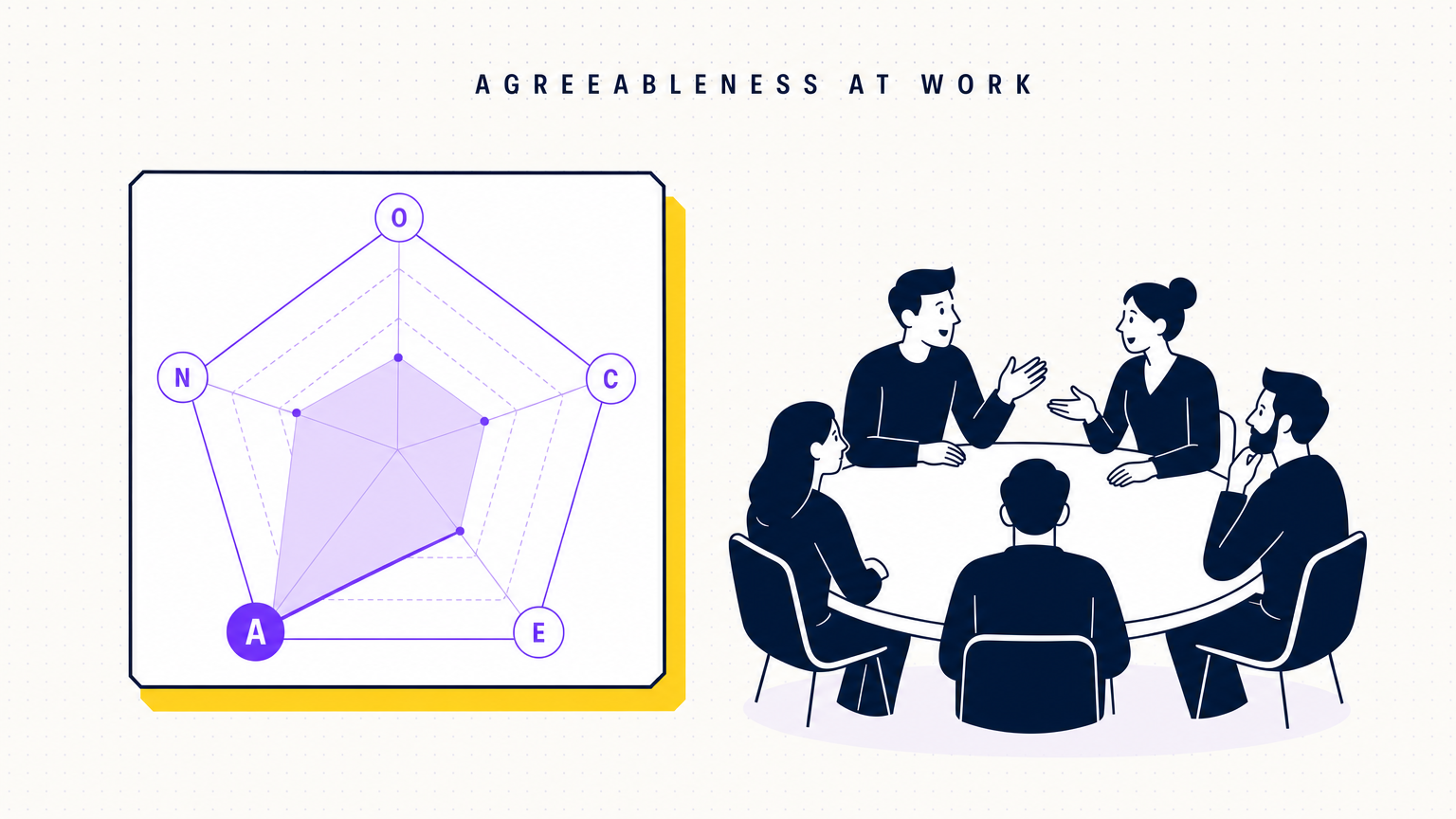
Agreeableness is the Big Five trait everyone assumes they want more of on a team. Cooperative, warm, low-drama people are easy to work with, so the surface logic says: hire for it, promote for it, stack the team with it. The peer-reviewed evidence is more interesting. Agreeableness is the single best personality predictor of low counterproductive behaviour and the cleanest predictor of “minimum-threshold” effects in team performance, and at high levels it starts costing people their pay, their negotiating leverage, and their willingness to give the feedback that keeps a team honest.
This post walks through what agreeableness actually predicts at work, where the effect flips, and what to do with that if you are hiring, coaching, or composing a team. It is part of our trait-by-trait series on the Big Five, alongside extraversion at work and conscientiousness and job performance. If you want the wider model first, the Big Five pillar guide covers all five dimensions and how they fit together.
The short answer
Agreeableness is a moderate predictor of team-relevant outcomes, a strong negative predictor of counterproductive work behaviour, a modest positive predictor of organisational citizenship, and a weak predictor of overall job performance. Its biggest impact at the team level is asymmetric: a single very-low-agreeableness member can drag a whole team down, while a team of uniformly very-high-agreeableness members tends to underperform on tasks that need debate, dissent, or hard calls.
For an L&D or HR buyer, the practical implication is to use agreeableness as a screen against toxic behaviour rather than as a positive selection criterion, to deliberately mix levels across a team, and to coach highly agreeable leaders specifically on negotiation, conflict, and developmental feedback.
| What agreeableness predicts at work | Direction of effect |
|---|---|
| Counterproductive work behaviour | Strong negative (ρ ≈ -0.46) |
| Interpersonal conflict | Negative |
| Organisational citizenship behaviour | Modest positive |
| Overall job performance | Weak positive (ρ ≈ 0.05–0.13) |
| Team performance (mean of members) | Weak positive |
| Team performance (lowest member) | Strong positive (the minimum matters) |
| Earnings and salary negotiation | Negative, larger penalty for men |
| Leadership emergence | Near zero |
| Leadership effectiveness | Small positive |
The values above are drawn from the Berry, Ones and Sackett (2007) meta-analysis on counterproductive work behaviour, Barrick, Mount and Judge’s reviews of Big Five performance prediction, Bell’s (2007) meta-analysis of team composition, the Judge, Bono, Ilies and Gerhardt (2002) leadership meta-analysis, and Judge, Livingston and Hurst’s (2012) work on agreeableness and earnings. Full sources are at the foot of this post.
What we actually mean by agreeableness
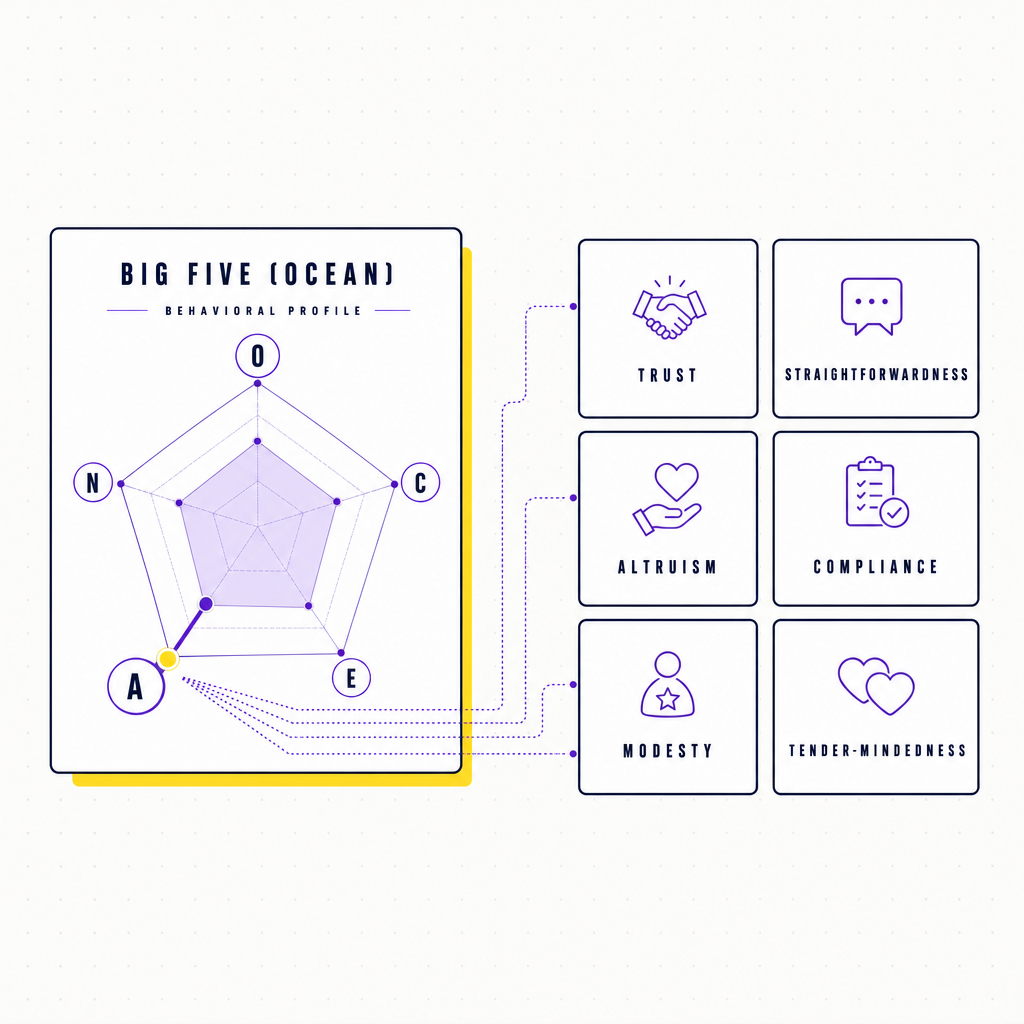
In the Big Five, agreeableness is the disposition toward cooperation and prosocial behaviour, the dial that controls how a person resolves the daily tension between self-interest and the interests of the people around them. The modern facet structure, used in the NEO-PI-R, IPIP-NEO and BFI-2 inventories, breaks it into six components: trust, straightforwardness (or honesty), altruism, compliance, modesty, and tender-mindedness.
That facet detail matters because the workplace effects do not move in lockstep. Trust and altruism carry most of the citizenship and team-cooperation signal. Compliance is the facet that gets people into trouble in negotiations and in difficult feedback conversations, because it operationalises a tendency to yield rather than push back. Modesty interacts with self-promotion at promotion time. Treating agreeableness as one monolithic switch misses the bit you actually want to measure.
Agreeableness is also distinct from the two traits people often confuse it with. Extraversion is about energy and social activity, not warmth toward others, an extravert can be socially dominant and disagreeable. Emotional stability is about how easily someone is rattled, not how cooperative they are when calm. The clearest mental model is: extraversion is the volume knob, emotional stability is the smoothing filter, agreeableness is the orientation toward the other person in the room.
Performance: where agreeableness helps, and where it does not
The big synthesis to know is the Barrick and Mount (1991) meta-analysis in Personnel Psychology, replicated and refined by Salgado (1997) and by Hurtz and Donovan (2000) in the Journal of Applied Psychology. The headline result has held up across three decades: agreeableness is a relatively weak predictor of overall job performance, with meta-analytic correlations clustering in the ρ = 0.05 to 0.13 range depending on the criterion and the job family. Conscientiousness is the trait that does the heavy lifting for general performance prediction across roles.
Agreeableness does meaningfully better when the criterion is narrowed to interpersonal or team-oriented performance, where it predicts how well someone gets on with colleagues and customers more than how much they produce. In customer-facing roles, healthcare, teaching, and team-based knowledge work, the effect is larger than the average-across-all-jobs number suggests.
The counterproductive work behaviour finding
The cleanest, largest empirical hit for agreeableness is on the negative side of the ledger. Berry, Ones and Sackett’s (2007) meta-analysis in the Journal of Applied Psychology put the meta-analytic correlation between agreeableness and counterproductive work behaviour around ρ = -0.46, the strongest Big Five predictor of CWB. Low agreeableness is the single best dispositional marker for the kinds of behaviour that show up in HR complaints: interpersonal aggression, sabotage, theft, harassment, and corrosive workplace gossip.
This is the finding that justifies using agreeableness as a hiring screen, not a selection criterion. You are not hiring high agreeableness to make the team perform better. You are screening out very low agreeableness to reduce the probability of importing a problem.
Organisational citizenship behaviour
On the positive prosocial side, Organ and Ryan (1995) and Ilies, Fulmer, Spitzmuller and Johnson (2009) showed that agreeableness is a modest but consistent predictor of organisational citizenship behaviour, the discretionary helpful acts that fall outside formal job descriptions but make organisations function: covering for a colleague, mentoring a new joiner, picking up the work nobody owns. The effect is smaller than the CWB finding but goes in the expected direction, and it compounds in long-tenured teams.
Interpersonal conflict
Bono, Boles, Judge and Lauver’s (2002) work in the Journal of Personality documented the predictable corollary: agreeable employees experience and generate less interpersonal conflict at work, both because they are less likely to provoke it and because they de-escalate when it appears. The trade-off is that they also sometimes paper over conflict that should have been surfaced.
Team composition: the minimum matters more than the mean
Bell’s (2007) meta-analysis in the Journal of Applied Psychology is the most useful single piece of evidence on agreeableness and team performance. Bell synthesised the literature on team composition and personality and found something many earlier studies had missed by averaging: for agreeableness, the team’s minimum score is a stronger predictor of team performance than the team’s mean.
In plain language: a single very-low-agreeableness member can drag a team’s effectiveness down more than a uniformly moderate team will. The Mount, Barrick and Stewart (1998) work earlier in the Human Performance literature pointed in the same direction, that agreeableness matters more in team settings than in individual-contributor settings, and Peeters, Van Tuijl, Rutte and Reymen’s (2006) meta-analysis confirmed that team-level agreeableness predicts team performance more reliably than it predicts individual performance.
The practical implication is the “minimum-threshold rule” we recommend in team coaching workshops: when composing or rebalancing a team, do not aim for high mean agreeableness. Aim to prevent anyone from sitting in the bottom decile, then deliberately preserve variance above that floor so the team has natural challengers.
The all-agreeable team problem
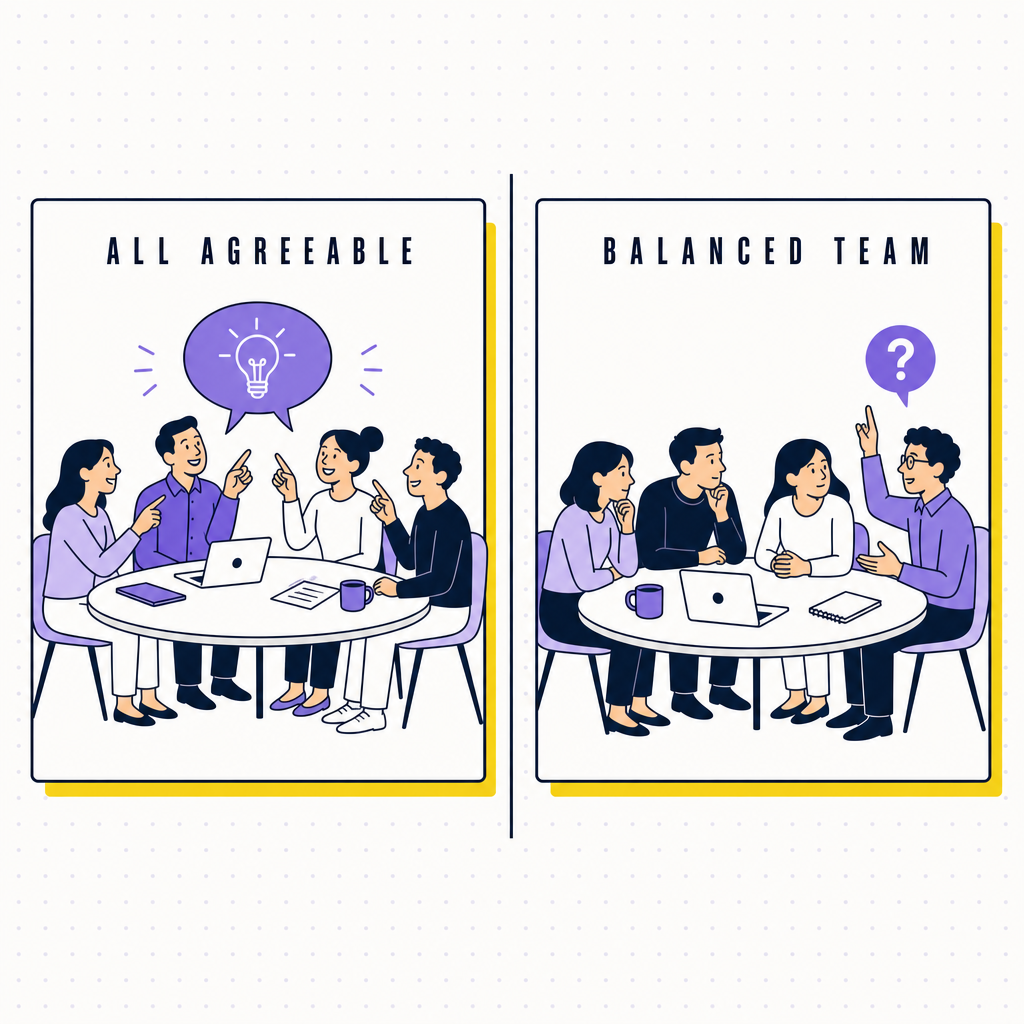
The corollary, well-documented in the team-composition literature, is that uniformly high-agreeableness teams underperform on tasks that need debate. They generate less task conflict, which is the productive kind, alongside the less relationship conflict, which is the destructive kind. They drift toward consensus before fully exploring options. They suffer the classic groupthink failure modes that Janis described in the 1970s and which subsequent organisational research has reproduced in controlled team studies.
The high-performing team picture is therefore not “everyone agreeable” but “no one disagreeable, with calibrated variance”. A team needs at least one natural challenger to keep it honest, ideally one whose disagreeableness is paired with high conscientiousness and emotional stability so the challenge stays task-focused.
The dark side of being too agreeable
The single most-cited finding on the downside of agreeableness comes from Judge, Livingston and Hurst’s (2012) study in the Journal of Personality and Social Psychology. Across four large samples they showed that agreeableness is negatively related to earnings, and the penalty is substantially larger for men than for women. Disagreeable men out-earned agreeable men by a meaningful margin, controlling for tenure, role, and education.
The proposed mechanism is straightforward and replicates across the negotiation literature: agreeable employees are less likely to initiate salary negotiations, less likely to anchor high when they do, and more likely to concede on contested terms to preserve the relationship. None of these are catastrophic in isolation. Across a career, they compound into a six-figure gap.
The same mechanism shows up in three other places worth flagging:
- Difficult feedback. Highly agreeable managers systematically delay, soften, and avoid critical feedback. The intended kindness reads to the recipient as ambiguity, which extends underperformance and damages the eventual conversation when it finally happens.
- Necessary firings, restructures, and contract renegotiations. Highly agreeable leaders defer decisions that are interpersonally costly even when the strategic cost of waiting is higher.
- Yielding in cross-functional disputes. A highly agreeable team lead in a meeting with a more disagreeable counterpart will concede scope, budget, or timeline that the team will then have to absorb.
The coaching reframe that holds up best in the executive-coaching literature is to treat critical feedback as an expression of agreeableness, not a violation of it. If you genuinely care about a person’s long-term welfare, withholding the feedback that would help them improve is not kindness, it is self-protective avoidance. That framing converts the dissonance from “being mean” to “being honest because I care”, which is the operative mode highly agreeable leaders can actually sustain.
Leadership: emergence vs effectiveness
The Judge, Bono, Ilies and Gerhardt (2002) meta-analysis is the source most leadership-and-personality discussions trace back to. For agreeableness specifically, the picture is unlike extraversion. Agreeableness is essentially uncorrelated with leadership emergence, the social process by which a group identifies someone as the leader. The correlation with leadership effectiveness, how the team performs once that person is in the role, is small but positive.
In other words, agreeable people do not stand out as the obvious leader, but when they end up in the role they do slightly better than the average personality profile, in part because they generate less interpersonal conflict with the team they are leading. The catch is that “slightly better on average” hides large variance: highly agreeable leaders with low conscientiousness or low emotional stability struggle badly with the conflict-and-feedback dimensions of the role.
What changed in 2024–2026
Two recent threads in the literature are worth flagging.
The first is the hybrid and AI-collaboration work. Recent studies of distributed and hybrid teams (including work emerging in 2025 and 2026 on AI-augmented collaboration) suggest that agreeableness becomes more, not less, important when teams cannot rely on hallway repair of bruised relationships. Text-mediated communication strips out the warmth cues that agreeable people use to keep conflict productive, so the trait does heavier work in maintaining team trust. Conversely, the AI-collaboration literature is starting to show that highly agreeable users are more likely to defer to confidently wrong AI outputs, which is a new risk to coach against.
The second is the generational replication work. Despite popular framings, recent multi-generation samples have not found large, replicable trait differences across cohorts that would justify generational stereotypes. The within-cohort variance dwarfs the between-cohort difference. The practical move is to treat agreeableness as an individual trait, not a generational one, and to read the data accordingly.
What to do with this: hiring, team composition, coaching
The biggest practical risk in most organisations is not low agreeableness. It is using agreeableness as a positive selection signal in hiring and a lazy lever in team composition.
Hiring
Use agreeableness as a screen against the bottom decile, paired with a validated cognitive ability test, a Big Five inventory, and a structured interview. The legally defensible use case is reducing counterproductive work behaviour risk, which the Berry et al. (2007) effect supports. Selecting on high agreeableness positively, especially for roles that require negotiation, accountability, or hard calls, is harder to defend and creates the dark-side problems above. If you are formalising any of this, our guide to the Big Five in compliant hiring covers the EEOC and GDPR side.
Team composition
Apply Bell’s (2007) minimum-threshold rule. When you read a team report, look at the lowest agreeableness score on the team first, not the average. If anyone is sitting in the bottom decile, that is the person who needs coaching or a structural buffer (clear escalation paths, peer feedback, a chair-rotation rule in meetings) before the team can rely on its own self-regulation.
Then look at the variance. A team where every member is above the 75th percentile on agreeableness is at elevated groupthink risk. The intervention is not to hire a hostile person, it is to nominate a rotating challenger role, run pre-mortems, and use structured dissent rituals (a designated devil’s advocate, or a written “red team” pass on big decisions) so the challenge happens by design.
Coaching the highly agreeable
Agreeable employees and leaders respond best to coaching that reframes the costly behaviour as an expression of the trait, not a violation of it. Three interventions that show up consistently in the executive-coaching literature:
- The “withholding is not kindness” reframe for developmental feedback, described above. It reliably moves highly agreeable managers from avoidance to engagement once they accept the premise.
- Pre-scripted negotiation openings. Highly agreeable employees benefit disproportionately from having a written, rehearsed first move in salary, scope, and deadline negotiations, because the structural prompt overrides the in-the-moment instinct to concede.
- A “two-minute pause” rule before agreeing to take on additional scope. The trait makes the immediate yes feel like the kind response. The pause moves the decision into a more deliberate mode where the person can register the cost they are about to absorb.
Coaching the highly disagreeable
The mirror image. Low-agreeableness team members are often technically excellent and chronically under-credited because their delivery generates friction. The development edge is usually relational repair without forcing personality change. Two interventions that work:
- The “criticise the work, not the person” rewrite. A short coaching habit of restating one’s own feedback before sending it, isolating the substantive point from the framing that activated the conflict.
- Visible relationship investment. Asking one question about a colleague’s actual situation at the start of a meeting, before the work topic. It is structural, not emotive, which is the mode low-agreeableness people can actually sustain.
Both groups benefit from the same structural shift in team rituals: documented decision rationales, structured dissent (a named challenger role), and depersonalised conflict frames that route disagreement through the work product rather than through the people.
Wrapping up: where agreeableness fits in the Big Five
Across the OCEAN series, agreeableness is the trait with the strongest popular reputation as the “team player” trait and one of the more counterintuitive empirical pictures. It is a relatively weak predictor of overall job performance and a strong negative predictor of counterproductive behaviour. It matters more in teams than in solo roles. It costs people meaningfully in pay and negotiation, especially men. It helps slightly with leadership effectiveness once someone is in the role.
The single most useful operating rule is the minimum-threshold one. Do not aim for a uniformly agreeable team. Aim for no-one-in-the-bottom-decile and calibrated variance above that floor, then coach the highly agreeable on negotiation and feedback and the highly disagreeable on relational repair. That is the configuration that does the work.
For the full model, the Big Five pillar guide is the place to start. If you are coaching leaders, Big Five personality traits for leadership is the deeper cut.
FAQ
Is agreeableness the same as being nice? No. “Nice” is a behavioural impression that depends on context. Agreeableness is a stable disposition to prioritise cooperation and others’ interests in the daily trade-off with self-interest. A disagreeable person can be perfectly polite and still push hard for their own position. An agreeable person can be socially awkward and still default to yielding under pressure.
Are agreeable employees better performers? On average, slightly, and mostly in roles where interpersonal cooperation is the work. The Barrick and Mount (1991), Salgado (1997) and Hurtz and Donovan (2000) meta-analyses put the correlation with overall job performance in the ρ = 0.05 to 0.13 range, much weaker than conscientiousness. The bigger empirical hit is on the negative side: low agreeableness predicts counterproductive work behaviour strongly (Berry, Ones and Sackett, 2007).
Are agreeable people worse leaders? No. The Judge, Bono, Ilies and Gerhardt (2002) meta-analysis found a small positive relationship with leadership effectiveness, mostly because agreeable leaders generate less interpersonal conflict with the team. The risk is concentrated in the conflict-and-feedback dimensions of the role. Highly agreeable leaders need explicit coaching on negotiation and developmental feedback.
Do all-agreeable teams perform better? No. Bell’s (2007) meta-analysis shows the team’s minimum agreeableness predicts performance more strongly than the mean. A uniformly high-agreeableness team is at elevated risk of groupthink and consensus-without-debate. The high-performing pattern is no-one-in-the-bottom-decile, with calibrated variance above that floor and a named challenger role.
Does agreeableness really cost people money? Yes, on average. Judge, Livingston and Hurst (2012) found a negative relationship between agreeableness and earnings, larger for men than for women. The mechanism is reduced negotiation initiation and faster concessions, not lower competence. Coaching for negotiation framing reliably narrows the gap.
How do I avoid agreeableness bias in performance reviews? The risks are different from extraversion. Agreeable employees are over-credited on “team player” criteria and under-credited on outcomes, while disagreeable employees are penalised on relational ratings even when their outcomes are strong. Concrete mitigations: separate “how” and “what” ratings, peer and 360 input alongside the manager view, and explicit calibration meetings to surface where agreeableness is doing the rating work rather than the actual performance.
Sources
- Berry, C. M., Ones, D. S., & Sackett, P. R. (2007). Interpersonal deviance, organizational deviance, and their common correlates: A review and meta-analysis. Journal of Applied Psychology, 92(2), 410–424. PubMed: pubmed.ncbi.nlm.nih.gov/17371088. Integrity-test bridging review: Bridging the gap between overt and personality-based integrity tests (ResearchGate).
- Barrick, M. R., & Mount, M. K. (1991). The Big Five personality dimensions and job performance: A meta-analysis. Personnel Psychology. Revisited in Hurtz, G. M., & Donovan, J. J. (2000). Personality and job performance: The Big Five revisited. Journal of Applied Psychology: Hurtz & Donovan 2000 (PDF).
- Bell, S. T. (2007). Deep-level composition variables as predictors of team performance: A meta-analysis. Journal of Applied Psychology, 92(3), 595–615. ResearchGate entry.
- Peeters, M. A. G., Van Tuijl, H. F. J. M., Rutte, C. G., & Reymen, I. M. M. J. (2006). Personality and team performance: A meta-analysis. Twente / TU/e: Personality and team performance (TU/e PDF) and Twente repository PDF.
- Judge, T. A., Bono, J. E., Ilies, R., & Gerhardt, M. W. (2002). Personality and leadership: A qualitative and quantitative review. Journal of Applied Psychology: Judge, Bono, Ilies & Gerhardt 2002 (PDF).
- Ilies, R., Fulmer, I. S., Spitzmuller, M., & Johnson, M. D. (2009). Personality and citizenship behavior: The mediating role of job satisfaction. Journal of Applied Psychology: Ilies, Fulmer, Spitzmuller & Johnson 2009 (PDF) · PubMed: pubmed.ncbi.nlm.nih.gov/19594236.
- Judge, T. A., Livingston, B. A., & Hurst, C. (2012). Do nice guys, and gals, really finish last? The joint effects of sex and agreeableness on income. Journal of Personality and Social Psychology: PubMed (Judge, Livingston & Hurst 2012) · APA prepublication PDF.
- Gender pay gap and personality, supporting context: World Bank gender-based pay disparity study (PDF) · Wage gap and bargaining (JEL, PDF via r.jordan.im) · Econstor discussion paper on bargaining and earnings (PDF) · SOLE-JOLE personality and earnings paper (PDF) · IAB discussion paper 34/2020 (PDF).
- Big Five facet structure (NEO-PI-R / IPIP-NEO / BFI-2): see the facet table in the Oxford Handbook of Personnel Psychology entry and the Personality and Values at Work review (ResearchGate).
- Agreeableness, team composition and conflict in practice: The personality profile of early generative-AI users (Emerald, CEMJ 2025) · Big Five traits and self-determination (Emerald JCOM 2025) · Personality and the workplace: agreeableness (Institute of Purpose).
- Hybrid and AI-collaboration work (2024–2026): Intergenerational dynamics in hybrid AI work (ResearchGate, 2025) · arXiv 2511.13979v2 on personality and AI collaboration · Preprints.org 2026 working paper · Tandfonline 2025 study on Big Five and digital collaboration · Journal of Work and Organizational Psychology 2025 article · Journal of Work and Organizational Psychology 2026 article · Journal of Work and Organizational Psychology 41(3) (PDF).
- Practitioner and ethical guidance: APA industrial-organizational psychology guidelines (PDF) · SIOP graduate-training guidelines · SIOP personality-assessment overview (PPTX) · Predictive Index on personality tests for team building · DeeperSignals guide to online workplace personality tests.
- Coaching and team-facilitation references: Coaching Manual for Teachers (Sutherland, PDF) · Understanding personality as a leader (Medium) · Courageous conversations and performance (Opire) · Liane Davey on generational stereotypes · Conservancy UMN thesis on Big Five and workplace outcomes (PDF) · Debating Bad Leadership (Palgrave, PDF) · Principles of Leadership & Management (eCampusOntario, PDF) · Organizational Behavior and Management (textbook PDF) · European Journal of Psychology article on personality and prosocial behaviour · Redalyc 2023 Big Five in the workplace · Emil Kirkegaard meta-analytic compendium on Big Five and job performance (PDF) · German national library thesis on personality at work (PDF).
More on Big Five
- arrow_forward Emotional Stability: The Big Five Trait Behind Team Resilience
- arrow_forward Openness to Experience: The Big Five Trait Behind Innovation
- arrow_forward Conscientiousness at Work: The Trait That Best Predicts Performance
- arrow_forward Extraversion at Work: What the Evidence Actually Shows
- arrow_forward Big Five Personality Tests for Hiring: The Compliance Guide
- arrow_forward Big Five Personality Traits for Leadership: What the Evidence Shows
- menu_book The Big Five Personality Traits Explained: A Guide to the OCEAN Model Pillar
- arrow_forward Big Five vs MBTI vs DISC: Which Should Your Team Actually Use
See agreeableness show up in a real team report
Team Building Bot joins your next online workshop or coaching session, listens for behavioural signals across the Big Five, and produces a team report you can use in the debrief. Free during beta.
No spam, no credit card. Unsubscribe any time.