Openness to Experience: The Big Five Trait Behind Innovation
What openness to experience predicts at work, the evidence linking it to creativity and innovation, and how to spot openness imbalances on a team.
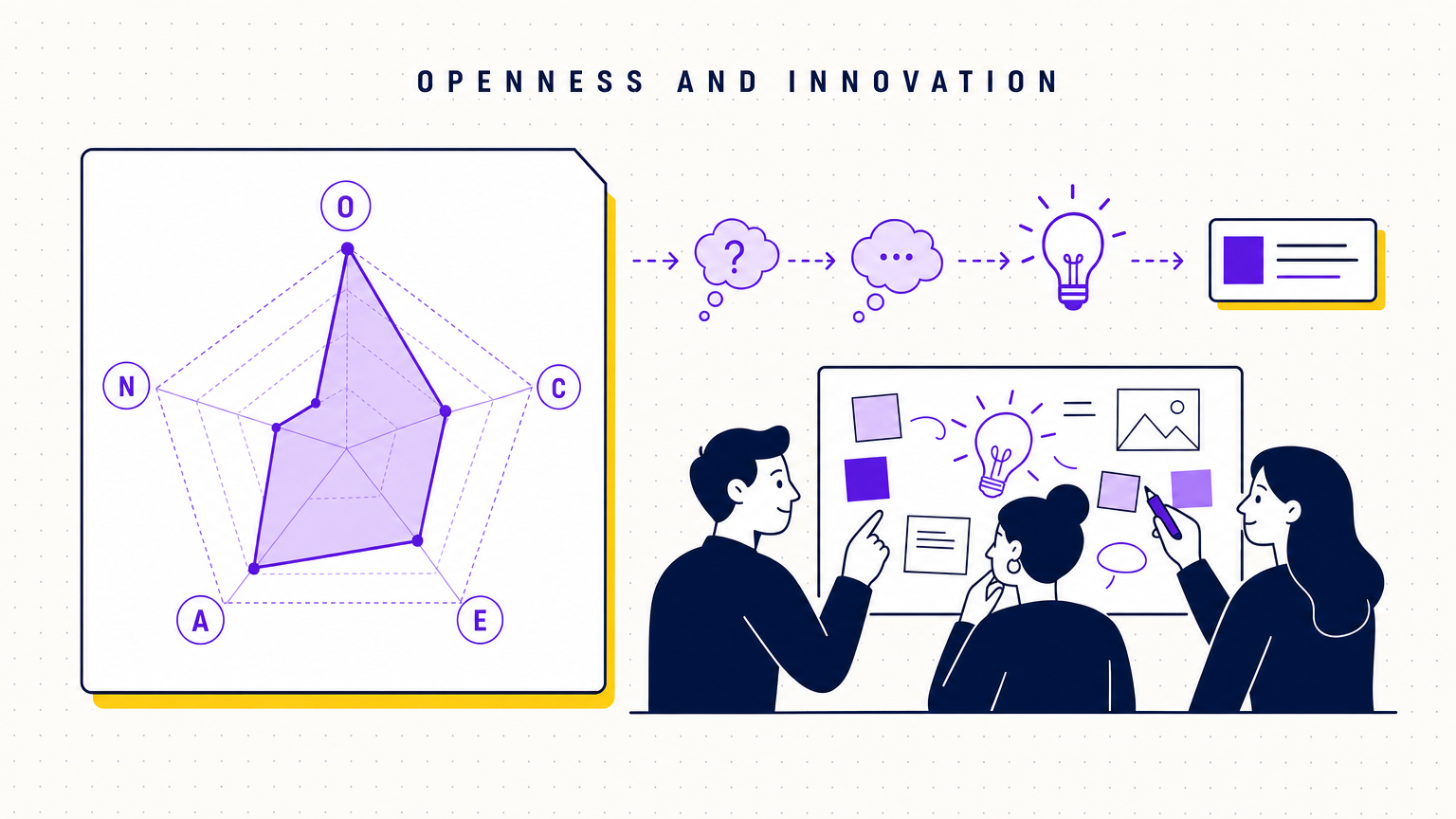
Openness to experience is the Big Five trait everyone reaches for when the conversation turns to innovation. Creative, curious, idea-hungry people are easy to point at on a whiteboard, so the surface logic says: hire for it, promote for it, stack the team with it. The peer-reviewed evidence is more nuanced. Openness is the single best dispositional predictor of creative achievement and one of the more reliable predictors of innovation behaviour, and at high levels, paired with low conscientiousness, it starts costing teams their finished work, their focus, and their ability to ship the ideas they generate.
This post walks through what openness actually measures, what it predicts at work, where the effect flips, and what to do with that if you are hiring, coaching, or composing a team for innovation. It is part of our trait-by-trait series on the Big Five, alongside conscientiousness and job performance, agreeableness at work, and extraversion at work. If you want the wider model first, the Big Five pillar guide covers all five dimensions and how they fit together.
The short answer
Openness is a moderate-to-strong predictor of creativity and innovation behaviour, a weak positive predictor of overall job performance, and a stronger predictor in jobs that require learning, change, and idea generation than in routine roles. Its biggest impact at the team level is asymmetric: a team with no high-openness members tends to under-explore, while a team uniformly skewed toward maximum openness tends to over-explore, drift between projects, and ship less than the average team.
For an L&D or HR buyer, the practical implication is to use openness as a positive signal in roles where novelty and learning are the work, to deliberately mix openness with conscientious execution on teams that need to actually finish things, and to coach highly open leaders specifically on follow-through, prioritisation, and the cost their ideation imposes on the people downstream.
| What openness predicts at work | Direction of effect |
|---|---|
| Creative achievement (artistic and scientific) | Strong positive |
| Individual innovation behaviour | Moderate positive (ρ ≈ 0.25) |
| Adaptive performance and learning new tasks | Moderate positive |
| AI tool adoption and effective use | Positive |
| Overall job performance | Weak positive (ρ ≈ 0.05–0.15) |
| Performance in complex / knowledge-work jobs | Larger positive |
| Performance in routine / proceduralised jobs | Near zero |
| Team innovation (mean openness) | Positive, moderated by conscientiousness |
| Project completion under high openness, low conscientiousness | Negative |
| Leadership emergence | Small positive |
The values above are drawn from Feist’s (1998) meta-analysis on personality in scientific and artistic creativity, Hammond, Neff, Farr, Schwall and Zhao’s (2011) meta-analysis on individual innovation antecedents, Barrick, Mount and Judge’s reviews of Big Five performance prediction, recent 2024 to 2026 work on openness and AI adoption, and the team-composition literature reviewed in Personos’s 2025 synthesis. Full sources are at the foot of this post.
What we actually mean by openness
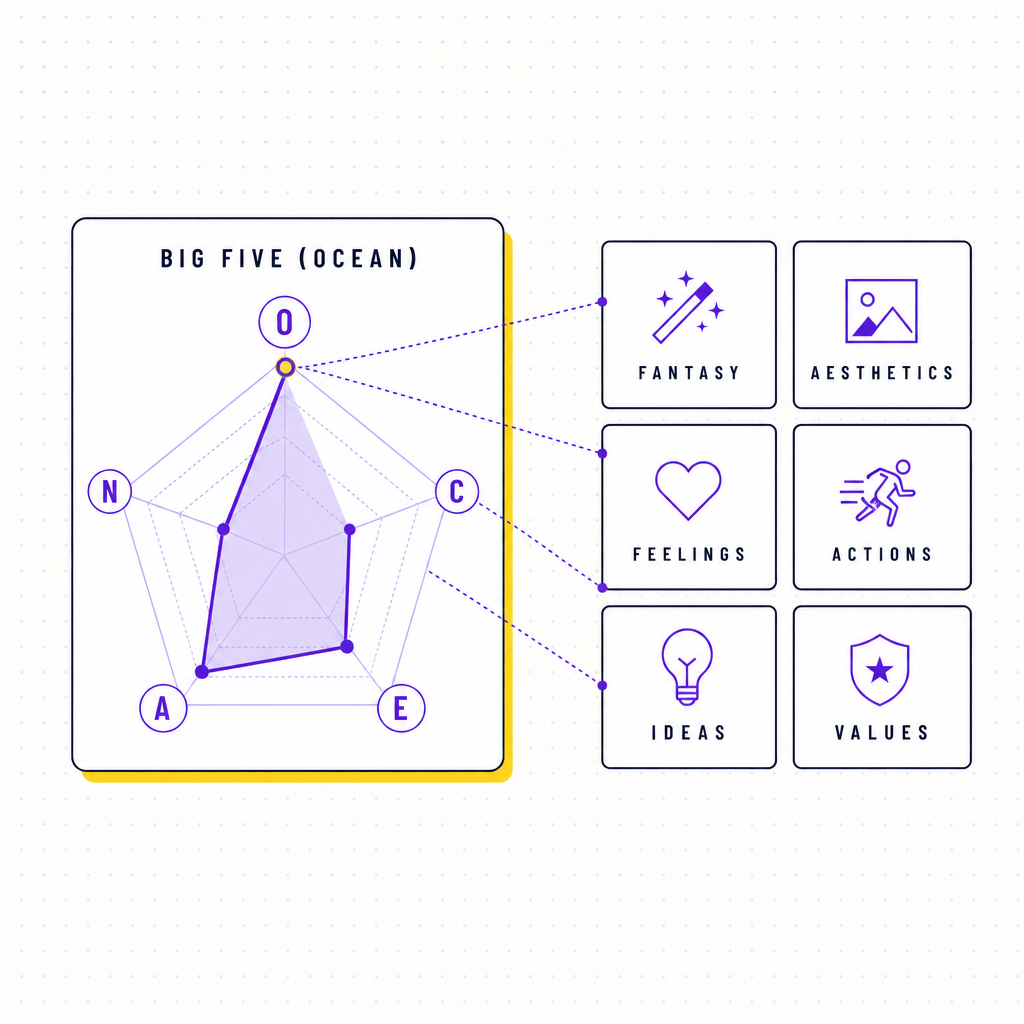
In the Big Five, openness to experience is the disposition toward novelty, curiosity, and a willingness to update one’s view of the world. The modern facet structure, used in the NEO-PI-R, IPIP-NEO and BFI-2 inventories, breaks it into six components: fantasy (rich inner imagination), aesthetics (appreciation of art and beauty), feelings (depth and breadth of emotional experience), actions (preference for variety in activities), ideas (intellectual curiosity), and values (willingness to re-examine social and political beliefs).
That facet detail matters because the workplace effects do not move in lockstep. The ideas and actions facets carry most of the innovation and learning signal at work. The fantasy and aesthetics facets predict more of the artistic and design-side creativity. The values facet is the one that shows up in change-readiness during restructures and culture work. Treating openness as one monolithic switch misses the bit you actually want to measure for a given role.
Openness is also distinct from the two traits people often confuse it with. Intelligence correlates with openness but they are not the same thing, openness is the orientation toward novelty, not the cognitive capacity to process it. Extraversion is about social energy, not curiosity, an introvert can be highly open and a confident extravert can be conventional and incurious. The clearest mental model is: extraversion is the volume knob, conscientiousness is the discipline knob, openness is the breadth knob, how wide a span of ideas, options, and experiences a person voluntarily reaches for.
Creativity: where openness does the heavy lifting
The single most-cited synthesis on openness and creativity is Feist’s (1998) meta-analysis, published in Personality and Social Psychology Review. Across more than eighty studies and tens of thousands of participants, Feist found that creative people, both scientists and artists, were reliably higher in openness than non-creative comparison groups, and that openness was the single largest Big Five differentiator of the creative profile. That finding has been replicated and extended by Batey and Furnham across the 2000s and by Kaufman and colleagues into the 2010s.
The second result to know is Hammond, Neff, Farr, Schwall and Zhao’s (2011) meta-analysis on individual innovation behaviour at work, the closest applied criterion to creativity for the workplace buyer. They synthesised personality predictors of workplace innovation across studies and reported openness as a moderate predictor, with a meta-analytic correlation around ρ = 0.25, second among the Big Five only to specific motivational and contextual variables. The size of the effect is meaningful for a single personality trait against a behavioural workplace criterion.
A more recent second-order meta-analysis on creativity research, published in 2025, confirmed the picture. Across the accumulated meta-analyses now in the literature, openness remained the most consistent dispositional predictor of creative output, even as moderators such as task complexity, intrinsic motivation, and team climate have been added to the modelling.
Why openness predicts creativity
The mechanism the cognitive literature converges on has three pieces. First, high-openness people have a wider associative scan, they activate a broader spread of concepts in response to a stimulus, which is what divergent-thinking tasks measure. Second, they have higher tolerance for ambiguity, so they spend longer in the messy stage of a problem before collapsing to an answer. Third, they have stronger intrinsic curiosity, so they invest cognitive effort in problems that have no immediate reward, which is where most genuine innovation actually lives.
None of those mechanisms guarantee finished, useful output. They predict the supply of candidate ideas. Whether the candidate ideas become a shipped product, a published paper, or a successful workshop intervention depends on a different trait entirely.
Performance: where openness helps, and where it does not
The big synthesis to know on the general-performance side is the Barrick and Mount (1991) meta-analysis in Personnel Psychology, refined by Hurtz and Donovan (2000) in the Journal of Applied Psychology and by Zell and colleagues in more recent work. The headline result has held up across three decades: across all job families combined, openness is a relatively weak predictor of overall job performance, with meta-analytic correlations clustering in the ρ = 0.05 to 0.15 range. Conscientiousness is the trait that does the heavy lifting for general performance prediction across roles.
Openness does meaningfully better when the criterion is narrowed. In complex knowledge-work roles, R&D, scientific research, design, strategy, consulting, where the job is to generate, evaluate, and integrate novel information, the effect is larger. In routine, proceduralised roles where the job is to execute a known process accurately, the effect is near zero or even slightly negative, because the high-openness pattern of seeking variety becomes friction against the work the role actually requires.
This is also why openness is the strongest Big Five predictor of adaptive performance, the ability to learn new tasks and adjust to changing demands. When work changes, high-openness people are reliably faster to update.
The AI-adoption finding
Two threads of work published between 2024 and 2026 have started to land the same conclusion: openness is the strongest Big Five predictor of effective AI tool adoption at work. A 2025 Central European Management Journal paper on the personality profile of early generative-AI users found openness to be the dominant trait among heavy adopters. A 2025 ResearchGate working paper on the impact of AI usage on innovation behaviour at work specifically modelled openness as a moderator and found that the innovation lift from AI tools was much larger for high-openness users than for low-openness users, even when controlling for job complexity.
The buyer-side translation is straightforward: when you roll out an AI tool to a team, the high-openness members will get most of the productivity gain in the first quarter. The low-openness members will need scaffolded onboarding, paired adoption, and a meaningful business reason before they will move. Budget for both.
Team composition: mean and variance both matter
The clearest applied synthesis on personality composition and team performance is the team-composition meta-analytic literature, including Bell’s (2007) Journal of Applied Psychology paper and Peeters, Van Tuijl, Rutte and Reymen’s (2006) meta-analysis. Openness has a smaller, more conditional effect on team performance than agreeableness or conscientiousness do, but the conditional pattern is interesting and practical.
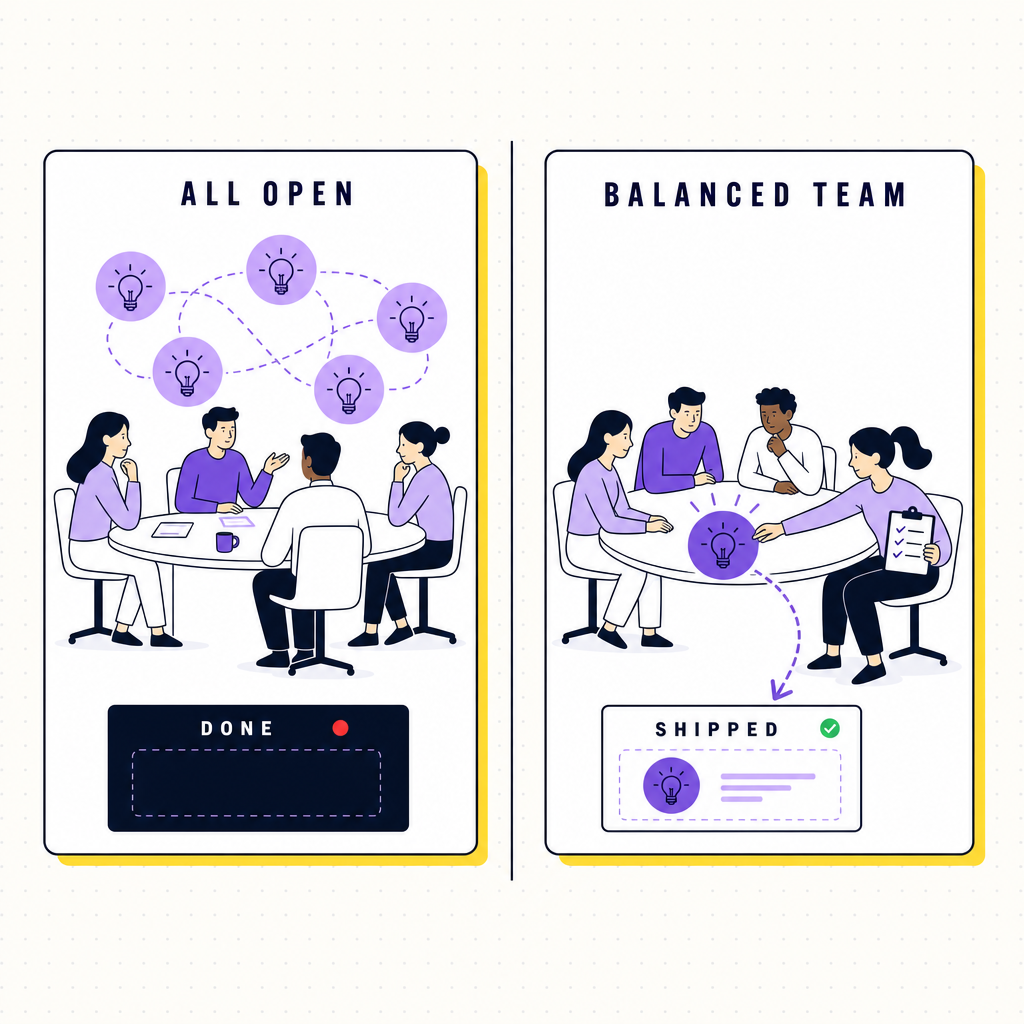
For tasks that require idea generation, prototyping, exploration, or strategic re-framing, mean team openness is positively related to team performance. For tasks that require coordinated execution, mean team openness is not, and the variance becomes the relevant signal: a team with high variance in openness, some scanners and some executors, generally outperforms both a uniformly low-openness team (under-explores) and a uniformly high-openness team (never converges).
The recent Personos synthesis on openness vs other traits in team innovation makes the same point in operational language: an ambidextrous team needs both exploratory variety (mean openness above the population median) and reliable execution (at least one or two members high in conscientiousness who can close ideas down to delivery).
The all-open team problem
The corollary, well-documented in the team-composition literature and in the Hogan derailer work on the “Imaginative” scale, is that uniformly high-openness teams under-deliver. They generate more candidate ideas. They start more projects. They drift between options before any one of them is fully tested. The pattern shows up in early-stage startup teams that pivot quarterly, in research groups that publish thinly across many topics rather than going deep on one, and in innovation labs that produce slide decks but no shipped product.
The high-performing innovation team picture is therefore not “everyone maximally open” but “mean openness above the median, with at least one disciplined executor to close the loop”. A team needs the breadth to find the right problem and the depth to actually solve it.
The dark side of being too open
The single most operational framing of the openness downside comes from the Hogan Development Survey, an industry assessment that measures personality traits that emerge as career derailers under stress. The Hogan scale most closely aligned with extreme openness is called Imaginative, and the literature on it is unusually direct about the failure modes.
At their baseline, leaders scoring high on the Imaginative scale are visionary, original, and quick to see around corners. Under sustained pressure, the same pattern manifests as eccentric and erratic behaviour: constant strategic direction changes, abstract communication that leaves teams unsure what to do on Monday morning, stubborn confidence in instinct over evidence, and impatience with the implementation detail that turns an idea into a shipped product. Over time, this style exhausts the team that has to absorb it, erodes psychological safety, and damages the leader’s organisational credibility.
The non-leadership version of the same pattern shows up in three places worth flagging:
- Novelty bias. Highly open individuals systematically abandon viable, ongoing projects in favour of newer, more intellectually exciting ones. The intended exploration reads to the team as a lack of follow-through, which extends every project’s actual cycle time and erodes trust that anything started will be finished.
- Distractibility under low conscientiousness. High openness paired with low conscientiousness is the most distractible Big Five combination, because the scanning system is active and the discipline system is not. Deep-work researchers consistently land on high conscientiousness, low neuroticism, and only moderate openness as the focus-friendly profile.
- Over-engineering and scope creep. Highly open individuals add features, possibilities, and side-explorations to projects past the point where the marginal value of any of them is positive. The downstream team absorbs the cost.
The coaching reframe that holds up best is to treat closing a project as an expression of openness, not a violation of it. The interesting ideas are not the ones that stay open in someone’s notebook, they are the ones that survive contact with a finished implementation and produce real-world signal to update on. That framing converts the dissonance from “settling” to “shipping is where the next round of curiosity starts”, which is the mode highly open people can actually sustain.
Leadership: emergence and effectiveness
The Judge, Bono, Ilies and Gerhardt (2002) meta-analysis is the source most leadership-and-personality discussions trace back to. For openness specifically, the picture is meaningful but more conditional than the extraversion or conscientiousness findings. Openness has a small positive correlation with both leadership emergence and leadership effectiveness across pooled studies, and the size of the effect grows in samples drawn from change-heavy contexts: startups, restructures, R&D-led organisations, and roles where the leader’s job is genuinely to set strategic direction in uncertain terrain.
The catch is the same one the Hogan Imaginative scale documents. The small average positive effect hides large variance: highly open leaders with low conscientiousness or low emotional stability struggle badly with the execution-and-consistency dimensions of the role. The development edge for highly open leaders is rarely “be more visionary”, it is almost always “be more reliable about closing the loop on the visions you are already proposing”.
What changed in 2024 to 2026
Two recent threads in the literature are worth flagging.
The first is the AI-collaboration work mentioned above. The 2025 and 2026 papers on AI use and innovation behaviour at work are starting to show that openness is doing more workplace work than it used to, because the marginal value of being willing to try a new tool, prompt, and workflow has gone up sharply. The same studies are also starting to document a new failure mode: highly open users who under-evaluate AI output and accept confidently wrong answers as starting points, then build downstream on the error.
The second is the renewed interest in team-level openness as variance rather than mean. The Personos 2025 synthesis and several 2025 to 2026 papers on personality composition in hybrid and AI-augmented teams are converging on the same operational rule: for innovation outcomes, mean openness predicts the ideation phase, and variance in openness predicts whether the team converts ideation into shipped output. The implication for team composition is to stop optimising openness as a single number and start reading the distribution.
What to do with this: hiring, team composition, coaching
The biggest practical risk in most organisations is not low openness. It is using openness as a uniform positive selection signal in roles where execution is the work, or stacking innovation teams to the point where no one is left who can finish anything.
Hiring
Use openness as a positive signal in roles where the job genuinely requires learning new things, generating ideas, integrating diverse information, or adapting to change. R&D, design, strategy, consulting, product, research, applied AI, and most knowledge-worker roles where the work itself is non-routine. Validate with a Big Five inventory, a structured interview that probes specific examples of self-directed learning and idea generation, and a cognitive ability test. If you are formalising any of this, our guide to the Big Five in compliant hiring covers the EEOC and GDPR side.
In routine, proceduralised roles, do not select on high openness positively. The job will not reward it and the trait will read to the person as friction, which raises turnover. Select for conscientiousness instead.
Team composition
When you read a team report, look at both the mean openness and the variance. If you are composing a team that needs to innovate, aim for mean openness above the population median, with at least one or two members high in conscientiousness who can close ideas down to delivery. If everyone on the team is in the top decile of openness, you have an ideation team, not a delivery team, and you should plan accordingly.
If you are rebalancing an existing team that is shipping slowly despite generating a lot of ideas, the diagnosis is rarely “not creative enough”. It is usually “no one is closing the loop”. The intervention is to assign explicit ownership of finishing, set sharper definition-of-done rituals, and protect the team from the leader’s next new idea long enough to land the current one.
Coaching the highly open
Highly open employees and leaders respond best to coaching that reframes the costly behaviour as a stage of the trait, not a violation of it. Three interventions that show up consistently in the executive-coaching literature:
- Idea parking lots. A structural place to capture new ideas without acting on them mid-project. The trait makes every shiny new option feel urgent. The parking lot moves the decision to commit into a deliberate weekly review rather than an in-the-moment yes.
- Closing rituals. A short coaching habit of explicitly closing a project before opening the next one, with a written debrief of what was learned. This converts the trait’s hunger for novelty into a renewable resource rather than a leak.
- Pre-mortems for direction changes. When a highly open leader is about to redirect a team, a fifteen-minute pre-mortem asking what the team will lose by the change reliably surfaces the implementation cost the leader is otherwise unable to feel.
Coaching the lower-openness
The mirror image. Low-openness team members are often technically excellent and chronically under-credited in cultures that fetishise novelty. The development edge is usually adaptive learning rather than forcing personality change. Two interventions that work:
- Scaffolded exposure to new tools and methods. Low-openness people adopt new tools when they have a clear business reason, a worked example, and a paired peer to consult. Drop-and-go rollouts fail with this profile.
- Explicit framing of variety as part of the job, not a distraction from it. Low-openness people will absorb significant change willingly when it is named as the work rather than as an interruption to the work.
Both groups benefit from the same structural shift in team rituals: a visible separation of the “diverge” phase (where high openness leads) and the “converge” phase (where high conscientiousness leads), so the trait that should be steering at each moment is unambiguous.
Wrapping up: where openness fits in the Big Five
Across the OCEAN series, openness is the trait with the strongest popular reputation as the innovation trait, and the empirical picture mostly bears that out. It is a strong predictor of creative achievement and a moderate predictor of workplace innovation behaviour. It is a stronger predictor of performance in complex, change-heavy roles than in routine ones. It is the dominant trait among effective AI-tool adopters. It is the trait you most need to balance with conscientiousness on a team that needs to finish what it starts.
The single most useful operating rule is the variance one. For innovation outcomes, do not optimise mean openness in isolation. Aim for mean openness above the median, deliberately preserve variance with one or two disciplined executors, and coach the highly open on closing the loop rather than on being more visionary. That is the configuration that converts curiosity into shipped work.
For the full model, the Big Five pillar guide is the place to start. If you are coaching leaders, Big Five personality traits for leadership is the deeper cut.
FAQ
Is openness the same as being intelligent? No. Openness and general cognitive ability are correlated but distinct. Openness is a dispositional orientation toward novelty, curiosity, and aesthetic experience. Cognitive ability is the capacity to process information. A high-openness person of average intelligence will explore widely; a high-intelligence person low in openness will go deep on conventional territory.
Does openness predict creativity? Yes, more reliably than any other Big Five trait. Feist’s (1998) meta-analysis identified openness as the single largest personality differentiator between creative and non-creative groups in both science and art, and the result has replicated in subsequent meta-analyses including a 2025 second-order synthesis.
Does openness predict job performance? Weakly across all jobs, more strongly in complex knowledge-work roles, and near zero in routine procedural roles. The Hammond et al. (2011) meta-analysis put the correlation between openness and individual innovation behaviour around ρ = 0.25, which is meaningful for a single personality trait against a workplace criterion.
Is openness the trait behind AI adoption? Recent 2024 to 2026 work, including a 2025 Central European Management Journal paper on the personality profile of early generative-AI users, identifies openness as the dominant Big Five trait among effective AI adopters. The lift in innovation behaviour from AI tools is much larger for high-openness users than for low-openness users.
Is there a downside to very high openness? Yes. Highly open individuals with low conscientiousness systematically struggle with project completion, focus, and follow-through. The Hogan “Imaginative” derailer scale captures the leadership version of the pattern, where unchecked openness under stress shows up as strategic drift and abstract communication that the team cannot operationalise.
How do I avoid openness bias in performance reviews? The risks are different from extraversion and agreeableness. Highly open employees are often over-credited for the ideas they generate and under-credited for the projects they leave unfinished, while lower-openness employees are penalised on “innovation” criteria even when their delivery is strong. Concrete mitigations: separate ideation and execution ratings, count shipped output explicitly, and run calibration meetings that surface where openness is doing the rating work rather than the actual performance.
Sources
- Feist, G. J. (1998). A meta-analysis of personality in scientific and artistic creativity. Personality and Social Psychology Review: Feist 1998 (PDF, gwern) · Semantic Scholar entry.
- Hammond, M. M., Neff, N. L., Farr, J. L., Schwall, A. R., & Zhao, X. (2011). Predictors of individual-level innovation at work: A meta-analysis. ResearchGate entry.
- Conceptions and correlates of openness to experience, NEO-PI-R / IPIP facet structure: Conceptions and Correlates of Openness to Experience (ResearchGate) · Costa & McCrae open-access review (PMC2937090) · Simply Psychology Big Five overview.
- Barrick, M. R., & Mount, M. K. (1991) and follow-ups: Personality & Job Performance: The Big Five Revisited (Hurtz & Donovan 2000 PDF) · Zell et al. open-access meta-analysis (PDF, gwern).
- Second-order meta-analysis of creativity research (2025): Second-Order Meta-Analysis of the Creativity Research (ResearchGate).
- Openness, creativity and divergent thinking, supporting literature: The creative person in science (Ovid PDF) · Creativity and personality (Batey & Furnham, PubMed) · Cercol team summary of Big Five and creativity research · Frontiers in Psychology on openness and creative cognition · Tandfonline creativity research article 2026 · PMC open-access study on openness facets (PMC4459939) · PMC open-access study on openness and creativity (PMC8964389) · PMC open-access work on openness and behaviour (PMC6736231) · San Jose State scholarworks thesis on openness · LessWrong summary of the Feist creativity literature.
- Openness, AI adoption and innovation behaviour (2024 to 2026): Personality profile of early generative-AI users (CEMJ 2025) · The Impact of AI Usage on Innovation Behavior at Work, moderating role of openness (ResearchGate 2025) · Digital Overload, self-efficacy and innovation performance in the age of AI (ResearchGate 2025) · Tandfonline 2025 study on personality and digital collaboration · MDPI Behavioral Sciences 2025 on Big Five and innovation · MDPI Behavioral Sciences 2025 on personality and adaptive work · SCIRP 2025 paper on openness and workplace innovation · CCSEnet International Business Research 2025 paper.
- Team composition and openness: Personos 2025 synthesis on openness vs other traits in team innovation · Effects of Team Personality Composition on Member Performance (ResearchGate) · The Role of Team Personality in Team Effectiveness and Performance (ResearchGate) · Personality and the Prediction of Team Performance (ResearchGate) · Alva Labs guide to team personality and performance · PMC open-access team composition study (PMC8814604) · Are the effects of conscientiousness on contextual and innovative performance context specific? (ResearchGate) · PMC open-access study on ambidexterity and team traits (PMC6671867).
- The “Imaginative” derailer and the dark side of high openness: The Dark Side of Creativity: How Imagination Derails Performance (Hogan Assessments) · Introducing the Imaginative Derailer (Why Everyone Matters) · Hogan HPI Insight (PDF) · Hogan Potential report (PDF) · Hogan Leadership Forecast Series with coaching (PDF) · Hogan Competency Model whitepaper (PDF) · Hogan HPI without occupational sub-scales (PDF) · Hogan HiPo Technical Manual (PDF) · Hogan Team Report Facilitator Guide (PDF) · Positive Psychology guide to the Hogan assessment · Simply Coach guide to Hogan · Hunt Scanlon on the dark side of leadership · Richard Marshall Coaching on the Hogan derailers · Peter Berry Consultancy on low HDS scores (PDF).
- Attention, focus and conscientiousness pairing: Attention and focus by personality type (JobCannon) · Personality, attitudes and work (2012 textbook) · Personality and the workplace, OpenOregon Pressbooks · MIDUS findings on openness and behaviour (PDF) · PMC12938308 open-access study on openness and outcomes · WUR repository on personality at work (PDF).
- Coaching and L&D references: 5 Ways L&D Pros Can Use Coaching to Drive Career Growth (ATD) · Navigating team dynamics, strategies for coaches (ICF) · Putting teamwork front and centre, a guide for HR and L&D leaders (Training Journal 2025) · Coaching vs Managing in L&D (Litmos) · USC digital library leadership and personality reference · Radboud thesis on personality, change and coaching (PDF).
More on Big Five
- arrow_forward Emotional Stability: The Big Five Trait Behind Team Resilience
- arrow_forward Agreeableness at Work: The Big Five Trait Behind Team Collaboration
- arrow_forward Conscientiousness at Work: The Trait That Best Predicts Performance
- arrow_forward Extraversion at Work: What the Evidence Actually Shows
- arrow_forward Big Five Personality Tests for Hiring: The Compliance Guide
- arrow_forward Big Five Personality Traits for Leadership: What the Evidence Shows
- menu_book The Big Five Personality Traits Explained: A Guide to the OCEAN Model Pillar
- arrow_forward Big Five vs MBTI vs DISC: Which Should Your Team Actually Use
See openness show up in a real team report
Team Building Bot joins your next online workshop or coaching session, listens for behavioural signals across the Big Five, and produces a team report you can use in the debrief. Free during beta.
No spam, no credit card. Unsubscribe any time.