Big Five Personality Traits for Leadership: What the Evidence Shows
A trait-by-trait look at the Big Five and leadership, with meta-analytic evidence, the emergence-vs-effectiveness split, and what to do with it.
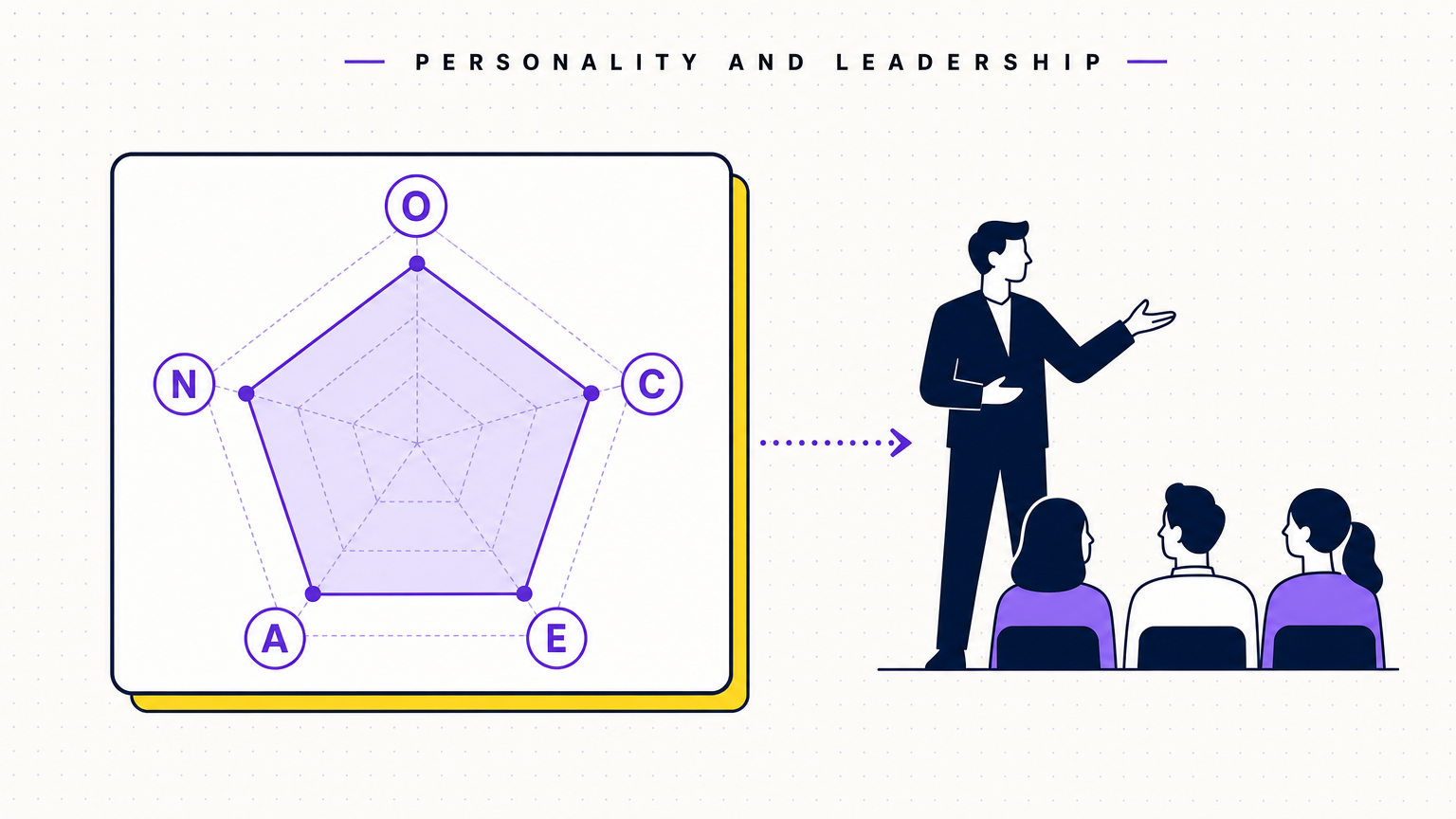
If you are picking a personality framework to anchor a leadership-development programme, the Big Five is the model with the cleanest evidence base. It is also the one that exposes a useful, slightly uncomfortable truth: the traits that get people noticed as leaders are not the same traits that make them effective once they are in the role.
This post walks through what the meta-analyses actually say, trait by trait, and what to do with that when you are coaching, hiring, or designing a programme. The short version is in the next paragraph; if you want the numbers, they sit further down.
The short answer
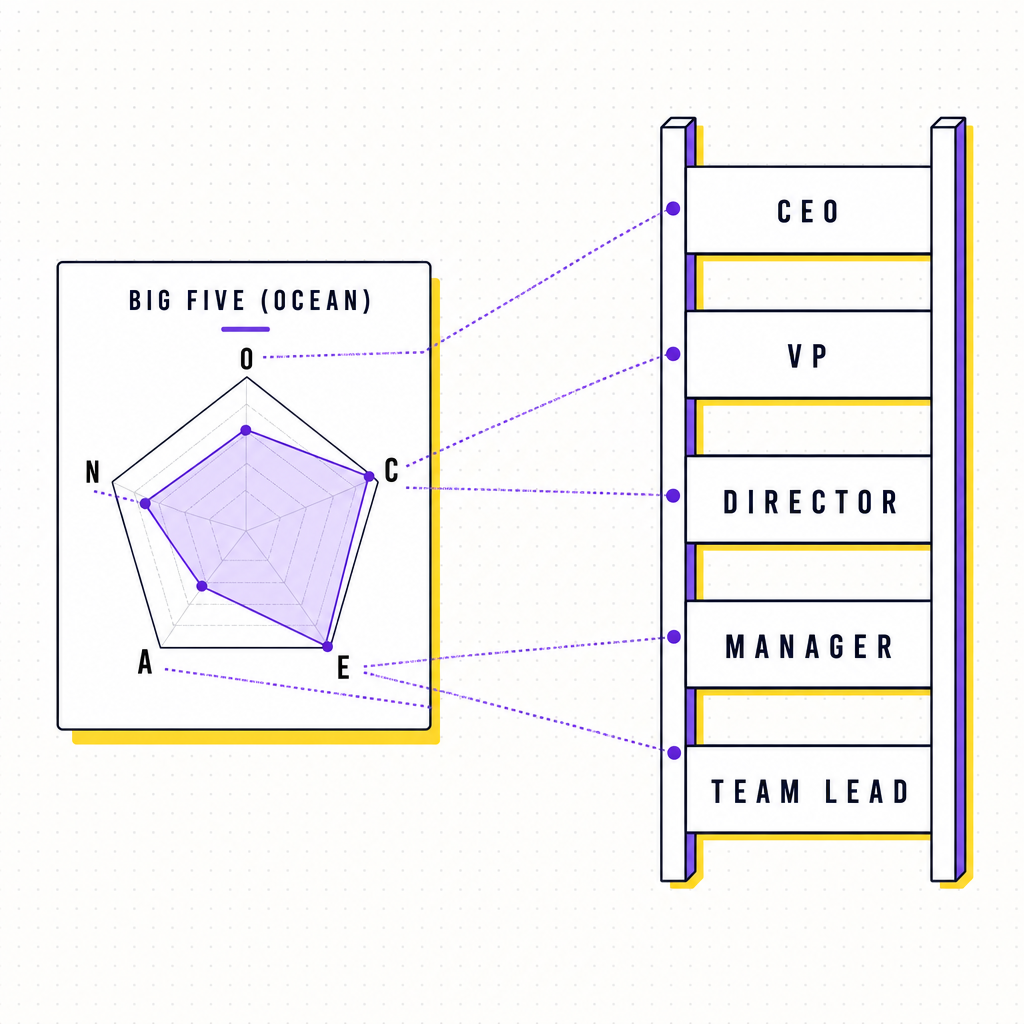
Across decades of meta-analytic work, four of the Big Five traits show consistent, non-trivial relationships with leadership outcomes. Extraversion is the strongest predictor of leadership emergence, who ends up running the meeting, but a weaker predictor of leadership effectiveness. Conscientiousness and emotional stability (low Neuroticism) are the workhorses on the effectiveness side: they predict whether the leader actually performs once promoted. Openness to experience predicts transformational and change-oriented leadership. Agreeableness sits closest to zero overall and is best read in context.
For an L&D or HR buyer, the practical implication is simple. Select for the traits that are hard to train (conscientiousness, emotional stability). Develop the behaviours layered on top (feedback, delegation, communication). And design assessment so it does not just keep promoting the loudest voice in the room.
| Big Five trait | Leadership emergence | Leadership effectiveness |
|---|---|---|
| Extraversion | Strong positive | Modest positive |
| Conscientiousness | Modest positive | Modest-to-strong positive |
| Openness to experience | Modest positive | Modest positive, stronger for transformational leadership |
| Agreeableness | Near zero | Mixed, near zero in most meta-analyses |
| Neuroticism | Negative | Negative |
The values above summarise the direction of the meta-analytic correlations reported by Judge, Bono, Ilies and Gerhardt (2002) in the Journal of Applied Psychology, with later refinements from DeRue, Nahrgang, Wellman and Humphrey (2011) in Personnel Psychology and Do and Minbashian (2014) in The Leadership Quarterly. The patterns have replicated; the precise effect sizes shift by study and outcome measure.
Emergence vs effectiveness: why the distinction matters
Leadership research splits into two outcomes that look similar from the outside but reward different things.
Leadership emergence asks who, in a group of peers, ends up being seen as the leader. It is measured by peer ratings, observation in unled groups, and who gets the promotion. Emergence is heavily perceptual: it rewards visibility, social confidence, and the willingness to speak first.
Leadership effectiveness asks whether, once that person is in the role, the team and organisation actually perform. It is measured by supervisor ratings, subordinate ratings, financial outcomes, and 360-degree feedback. Effectiveness is closer to a behavioural and results-based criterion.
The two are correlated, but not identical, and the same trait can score very differently on each. The clearest example is extraversion, which the Judge et al. (2002) meta-analysis identified as the single strongest Big Five correlate of emergence, with effectiveness lagging well behind. Any leadership assessment that conflates the two ends up systematically over-promoting one type of person.
Trait by trait, what the evidence says
Extraversion
Extraversion is about social energy, assertiveness, and positive emotionality. In Judge et al.’s (2002) meta-analysis of 73 samples, extraversion was the strongest single Big Five correlate of leadership across criteria, with the relationship driven primarily by emergence rather than effectiveness. DeRue et al. (2011) reported a similar pattern in their integrative review: extraversion predicts who is perceived as a leader more reliably than it predicts how well the leader performs.
The follow-on work matters more than the headline number. Grant, Gino and Hofmann (2011), publishing in the Academy of Management Journal, found that extraverted leaders outperformed introverted leaders with passive teams, but introverted leaders outperformed extraverted leaders with proactive teams, the kind of self-starting team most modern workplaces want. Pure extraversion is not the universal advantage that promotion panels tend to treat it as.
The coaching implication is to help extraverted leaders develop active listening and the ability to invite dissent, and to help introverted leaders build situational visibility without forcing a personality change.
Conscientiousness
Conscientiousness, the tendency toward organisation, follow-through, and goal-directed self-discipline, is the Big Five trait with the broadest evidence base in work psychology. Barrick and Mount (1991), in Personnel Psychology, established conscientiousness as the most consistent Big Five predictor of job performance across occupations, and that finding has been replicated in subsequent meta-analyses.
On leadership specifically, Judge et al. (2002) reported conscientiousness as the second-strongest Big Five correlate of leadership, with a modest positive relationship to both emergence and effectiveness. For an L&D buyer, this is the trait you most want as a baseline before any leadership behaviour gets layered on. It is also a trait that is genuinely hard to develop in adulthood, so it belongs more naturally on the selection side than the development side of the programme.
A caveat worth flagging: some authors have argued for curvilinear effects, where extremely high conscientiousness tips into rigidity, micromanagement, or perfectionism. The original meta-analytic relationship is linear and positive, so treat the curvilinear story as a coaching nuance rather than a reason to discount the trait.
Openness to experience
Openness covers curiosity, intellectual breadth, and willingness to consider new ideas. It is the trait that lights up most strongly in transformational leadership research. Bono and Judge (2004), in another Journal of Applied Psychology meta-analysis, found that extraversion and to a lesser extent openness were the strongest Big Five correlates of transformational leadership behaviours, which include articulating a vision, intellectual stimulation, and individualised consideration.
For leadership roles where the mandate is change, turnaround, or moving into a new market, openness is the trait worth weighting. For roles that are about reliable, steady execution, it matters less. Matching the trait profile to the strategic mandate is more useful than picking a single “leader profile” and applying it everywhere.
Agreeableness
Agreeableness is the trickiest of the five to read in a leadership context. Judge et al. (2002) reported a near-zero overall correlation with leadership criteria. DeRue et al. (2011) found small positive effects on effectiveness and near-zero on emergence. The signal is genuinely weak at the aggregate level.
The interesting effects are conditional. Agreeable leaders tend to be better at building psychological safety and reducing relationship conflict, but they can struggle with delivering hard feedback and with the kind of task conflict that healthy teams need. The implication for coaching is not “develop more or less agreeableness” but rather to give agreeable leaders structured feedback frameworks they can lean on when their default would be to soften the message.
Neuroticism (emotional stability)
Neuroticism, the tendency toward negative emotionality and stress reactivity, is the only trait in the Big Five with a consistently negative relationship to leadership outcomes. Judge et al. (2002) reported a negative correlation with both emergence and effectiveness. DeRue et al. (2011) confirmed the pattern.
The mechanism is intuitive. Senior roles deliver steady, low-grade stress punctuated by occasional crises. Leaders with low emotional stability are more vulnerable to derailment behaviours under that load: avoidance, defensiveness, lashing out, or freezing. The Hogan Development Survey, used widely in executive coaching, leans on this evidence to map “dark side” patterns that show up disproportionately when stable trait Neuroticism interacts with extended stress.
For an L&D programme, emotional stability is the second trait worth treating as a selection baseline rather than a development target. You can teach stress-management techniques and emotional regulation, but you cannot easily change the underlying reactivity profile.

The extraversion paradox in selection
If you take only one practical idea from the Big Five leadership literature, take this. Promotion panels, assessment centres, and unstructured behavioural interviews reward visible confidence, social dominance, and quick verbal response. Those behaviours map onto extraversion. They are exactly the behaviours that show up in leadership emergence studies.
The same behaviours predict effectiveness more weakly, and in certain contexts (proactive teams, distributed decision-making, technical-deep environments) they predict the opposite. The result is a systematic bias in who ends up in senior roles, and a long tail of effective-but-not-loud candidates who never get the seat.
The fix is not to penalise extraverts. It is to design selection that scores effectiveness signals as well as emergence signals: structured interviews tied to leadership behaviours, multi-rater data from people the candidate has already led, and situational judgement exercises that surface listening and self-regulation alongside presence.
What is moving in the 2024 to 2026 research
Three threads are worth tracking if you are building or revisiting a programme right now.
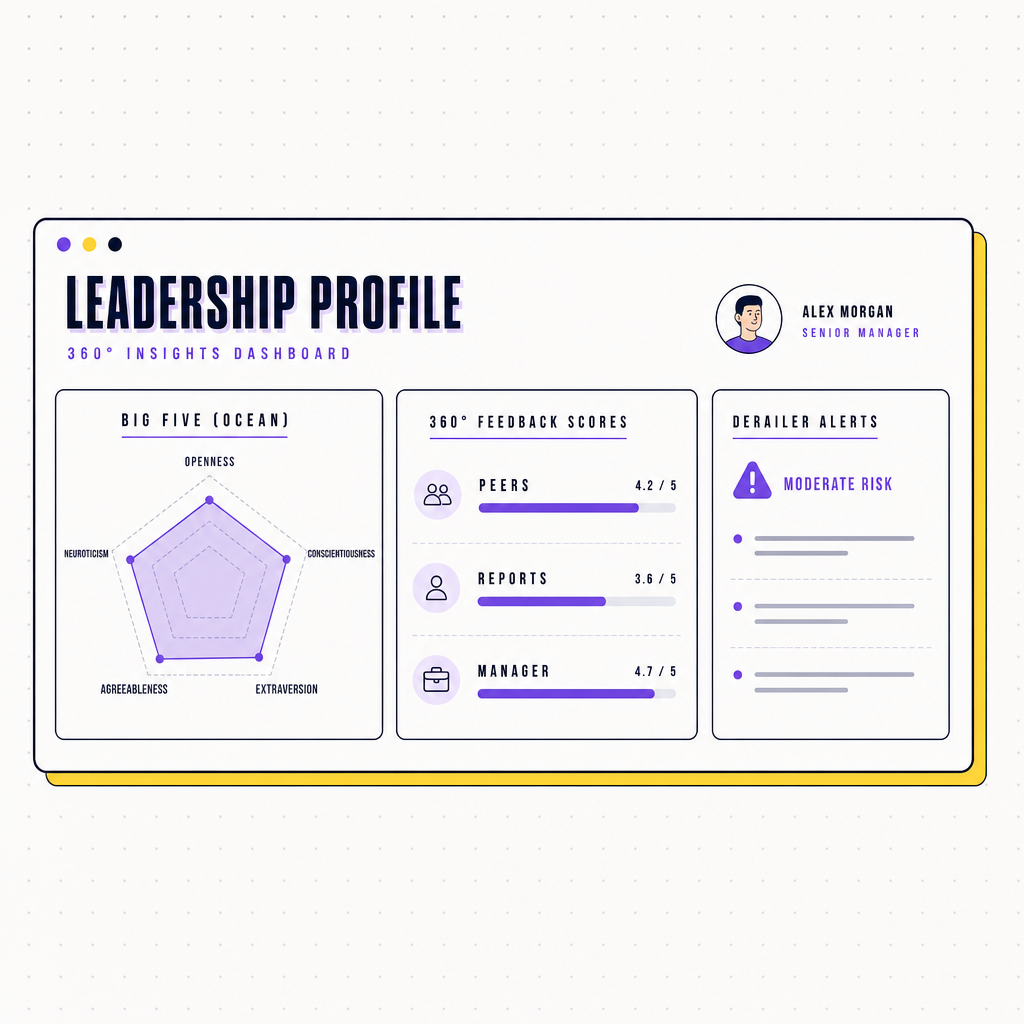
The first is integration with 360-degree feedback. The current best practice in executive coaching is to layer Big Five (or NEO-PI) data underneath 360 ratings so behavioural feedback is interpreted against trait profile. A leader who scores high openness and low conscientiousness will read a 360 finding of “frequently changes direction” very differently than one who scores low openness and high conscientiousness. The trait data turns the feedback into a coaching plan rather than a criticism.
The second is the dark side. Hogan’s derailer research and broader work on the dark triad (Machiavellianism, narcissism, psychopathy) have made it into mainstream leadership programmes. Big Five Neuroticism overlaps with the “moving away” and “moving against” derailer clusters, and low Agreeableness combined with high Extraversion is the trait combination most associated with abusive supervision in recent reviews. None of this replaces the Big Five; it tells you which leaders need active monitoring under stress.
The third is neurodiversity and assessment design. There is a growing line of psychometric work showing that neurodivergent profiles often score higher on Openness and Neuroticism and lower on Extraversion, Agreeableness, and Conscientiousness than neurotypical norms. Assessment systems calibrated narrowly to a “high E, high C, low N” leader profile will screen out a significant share of the talent pool. Programmes are moving toward more flexible profiles and toward developing the surrounding behaviours rather than insisting on one trait signature.
These are directional. The underlying Big Five and leadership meta-analyses from the 2000s and 2010s have not been overturned; they have been refined.
What to do with this if you run an L&D or coaching practice
A handful of moves are reasonable for almost any programme.
- Select for conscientiousness and emotional stability, develop the rest. These two traits are stable, predictive of effectiveness, and hard to coach. The rest of the profile is shape, not gate.
- Score emergence and effectiveness separately in promotion and high-potential identification. Use multi-rater data, not just panel impressions.
- Match openness to mandate. Change-heavy roles want higher openness; steady-state operational roles can tolerate lower.
- Read agreeableness in context. High agreeable leaders need feedback scaffolding; low agreeable leaders need a check on how their hard edges land.
- Treat Neuroticism as the primary coaching target under stress. Most derailment patterns sit here.
- Pair Big Five with 360 feedback rather than running either in isolation. The trait data interprets the behaviour data.
- Audit your selection pipeline for the extraversion bias, especially in unstructured interviews and assessment centres.
None of this is exotic. It is what the evidence has been pointing at for two decades, applied with a little discipline.
Why this matters for a team debrief
A leadership-development programme that ends after the assessment is a missed opportunity. The interesting work happens in the debrief, where individual trait data meets the team it is actually working with.
A debrief grounded in the Big Five looks different from one anchored to MBTI types or DISC quadrants. It avoids fixed labels, because trait scores are continuous. It connects to job-relevant outcomes, because the underlying research is built on work-performance criteria. And it gives the leader and the team a shared vocabulary for the rest of the year, not just the morning of the workshop.
That is the role we are building Team Building Bot for. The bot joins online leadership sessions, listens for the behavioural signals the Big Five describes, and produces a Big Five-based report the leader and the facilitator can debrief against. The report is the artefact that survives the meeting.
FAQ
Is the Big Five better than MBTI or DISC for leadership development? For development, yes. The Big Five has decades of peer-reviewed evidence linking traits to leadership emergence and effectiveness. MBTI was not designed for performance prediction, and its publisher confirms it should not be used for selection. DISC describes behavioural style and is fine for communication training, but does not have the same validity evidence on leadership outcomes.
Which Big Five trait matters most for leaders? It depends on the outcome you care about. Extraversion most strongly predicts who emerges as a leader. Conscientiousness and emotional stability (low Neuroticism) most strongly predict who is effective once in the role. Openness predicts transformational and change-oriented leadership. Agreeableness has a small and context-dependent effect.
Can leadership-relevant Big Five traits be developed, or are they fixed? The traits themselves are relatively stable in adulthood, with small changes over years rather than weeks. Behaviours layered on top of the traits, listening, feedback, delegation, stress regulation, are very much developable. The practical move is to select for the foundational traits and coach the behaviours.
Why does extraversion predict emergence more than effectiveness? Emergence is about being seen and chosen as a leader, which rewards visible confidence and social energy, both extraversion behaviours. Effectiveness is measured by team and organisational outcomes, which depend on a broader behavioural set including listening, follow-through, and emotional regulation. Extraversion contributes to emergence directly and to effectiveness more conditionally.
Should we use the Big Five for hiring leaders? You can, with care. Conscientiousness has strong meta-analytic validity for job performance and is defensible in selection. Compliance considerations (EEOC adverse-impact analysis in the US, EU equivalent regulations) apply to any personality test used in hiring, and that is a separate piece of work covered in our hiring-compliance post.
Sources
- Judge, T. A., Bono, J. E., Ilies, R., and Gerhardt, M. W. (2002). Personality and leadership: a qualitative and quantitative review. Journal of Applied Psychology, 87(4), 765–780.
- DeRue, D. S., Nahrgang, J. D., Wellman, N., and Humphrey, S. E. (2011). Trait and behavioral theories of leadership: an integration and meta-analytic test of their relative validity. Personnel Psychology, 64(1), 7–52.
- Bono, J. E., and Judge, T. A. (2004). Personality and transformational and transactional leadership: a meta-analysis. Journal of Applied Psychology, 89(5), 901–910.
- Barrick, M. R., and Mount, M. K. (1991). The big five personality dimensions and job performance: a meta-analysis. Personnel Psychology, 44(1), 1–26.
- Grant, A. M., Gino, F., and Hofmann, D. A. (2011). Reversing the extraverted leadership advantage: the role of employee proactivity. Academy of Management Journal, 54(3), 528–550.
- Do, M. H., and Minbashian, A. (2014). A meta-analytic examination of the effects of the agentic and affiliative aspects of extraversion on leadership outcomes. The Leadership Quarterly, 25(5), 1040–1053.
More on Big Five
- arrow_forward Emotional Stability: The Big Five Trait Behind Team Resilience
- arrow_forward Openness to Experience: The Big Five Trait Behind Innovation
- arrow_forward Agreeableness at Work: The Big Five Trait Behind Team Collaboration
- arrow_forward Conscientiousness at Work: The Trait That Best Predicts Performance
- arrow_forward Extraversion at Work: What the Evidence Actually Shows
- arrow_forward Big Five Personality Tests for Hiring: The Compliance Guide
- menu_book The Big Five Personality Traits Explained: A Guide to the OCEAN Model Pillar
- arrow_forward Big Five vs MBTI vs DISC: Which Should Your Team Actually Use
See the Big Five run in a real leadership debrief
Team Building Bot joins your next leadership offsite or coaching session, listens for behavioural signals, and produces a Big Five-based team report you can use in the debrief. Free during beta.
No spam, no credit card. Unsubscribe any time.