Extraversion at Work: What the Evidence Actually Shows
Extraversion's real effect on sales, leadership and team performance, with effect sizes, the ambivert finding, and what to do about hiring bias.
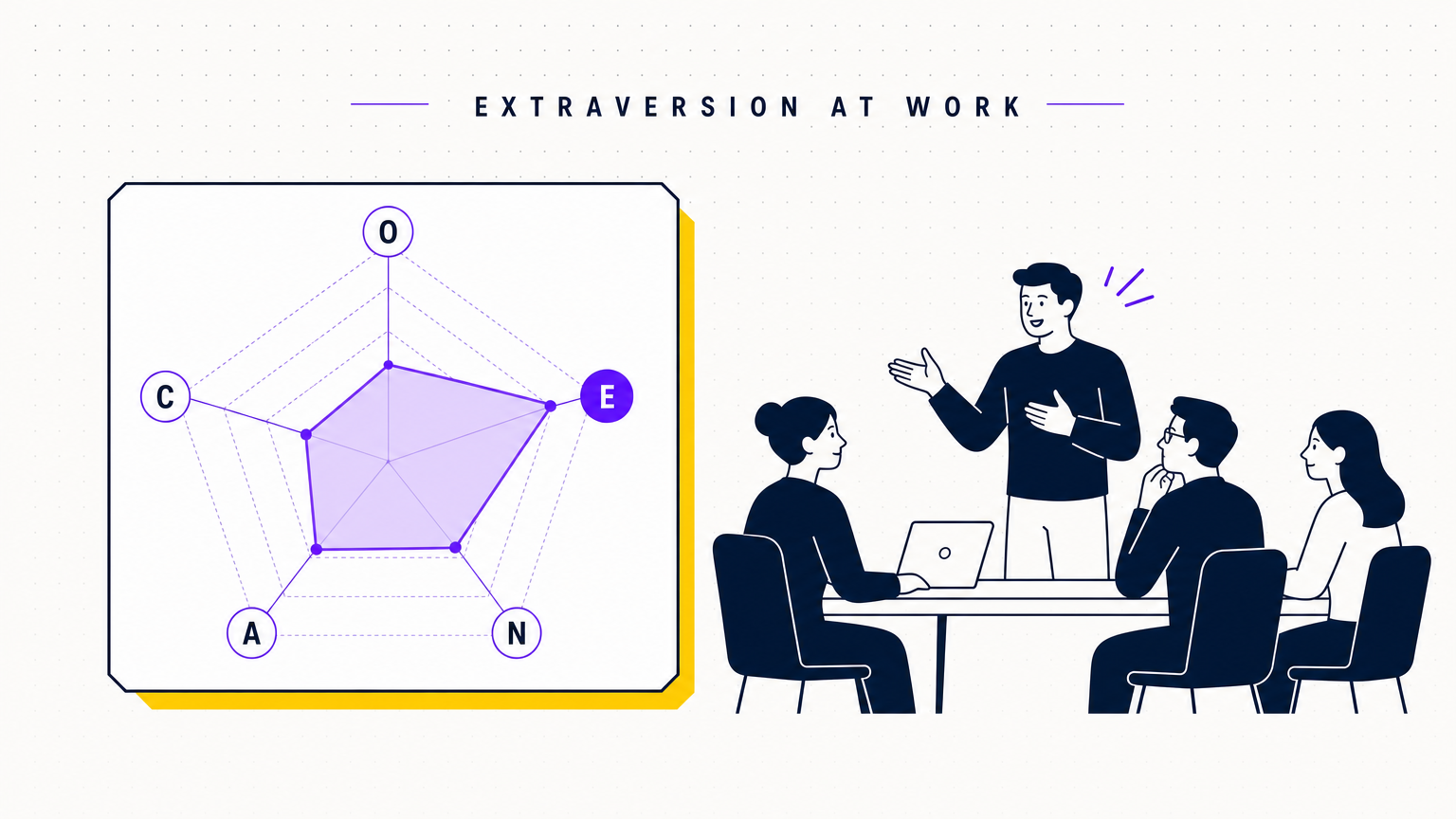
Extraversion is the Big Five trait that gets the most airtime in offices and the least nuance. The popular shorthand is simple: extraverts make better salespeople, better leaders, better teammates. The peer-reviewed evidence is more interesting, and in places it points the other way. This post walks through what extraversion actually predicts at work, where the effect flips, and what to do with that if you are hiring, coaching, or designing team rituals.
It is the last in our trait-by-trait series on the Big Five. If you want the wider model first, the Big Five pillar guide covers all five dimensions and how they fit together.
The short answer
Extraversion is a moderate, positive predictor of performance in roles that involve influence, energy and visible social activity, and a strong predictor of leadership emergence, who ends up running the meeting. It is a much weaker predictor of leadership effectiveness, and at high levels it stops helping and starts hurting. The much-cited “ambivert advantage” in sales is real, the introvert-leader research is real, and the remote-work data from 2020 onward shows the old extravert edge attenuating in distributed teams.
For an L&D or HR buyer, the practical implication is to stop using extraversion as a proxy for competence in hiring, structure meetings and ideation so the loudest voice does not own the room, and coach extraverts and introverts on different things.
| What extraversion predicts at work | Direction of effect |
|---|---|
| Leadership emergence (who is seen as a leader) | Strong positive (ρ ≈ 0.33) |
| Leadership effectiveness (team performance) | Modest positive (ρ ≈ 0.24) |
| Sales performance | Curvilinear, ambiverts peak |
| Customer service / influence roles | Modest positive |
| Workplace safety / risk roles | Negative (excitement-seeking facet, ρ ≈ -0.27) |
| Engagement under sustained remote work | Negative shift over time |
The values above are drawn from the Wilmot et al. (2019) quantitative review of extraversion at work, the Judge, Bono, Ilies and Gerhardt (2002) leadership meta-analysis, and Grant (2013) on the ambivert advantage. Full sources are at the foot of this post.
What we actually mean by extraversion
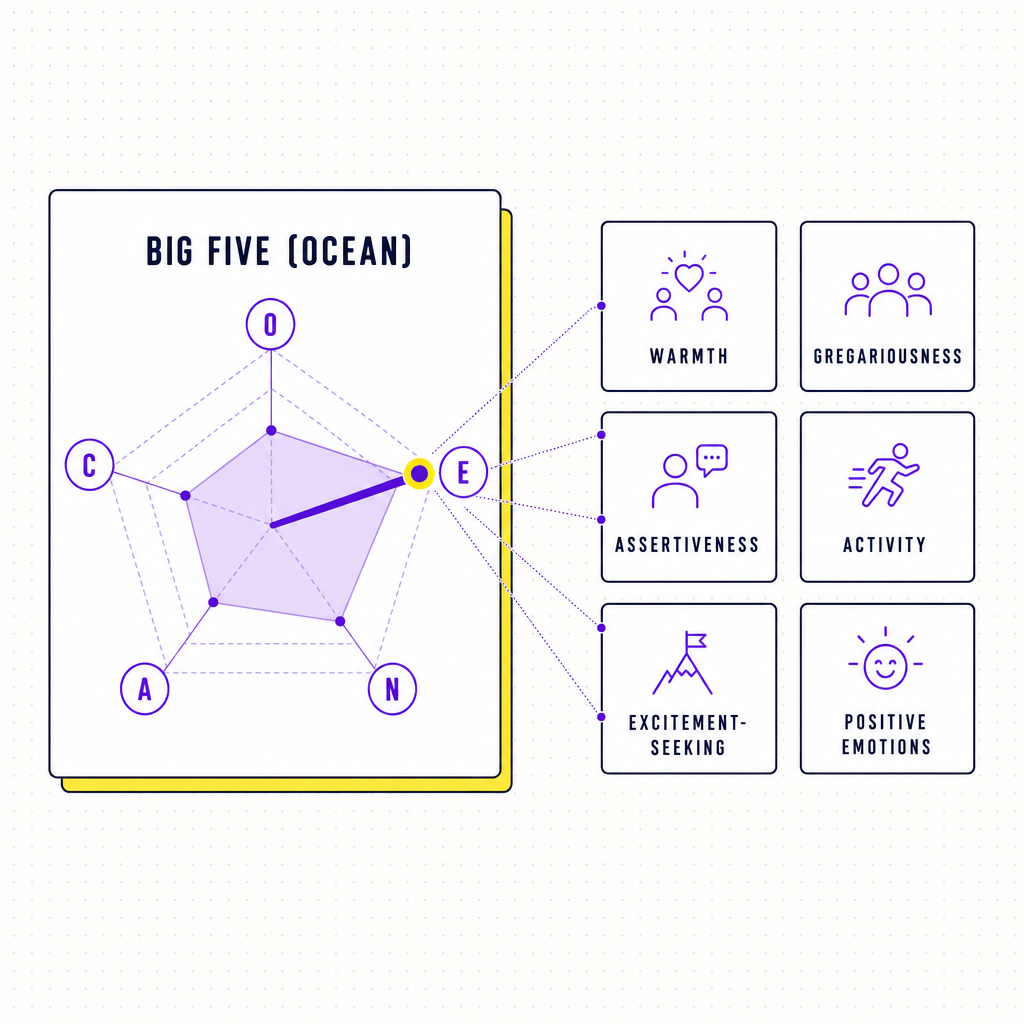
In the Big Five, extraversion is not just “outgoing”. The modern facet structure, used in the NEO-PI-R, IPIP-NEO and BFI-2 inventories, breaks it into six components: warmth, gregariousness, assertiveness, activity, excitement-seeking, and positive emotions. Two people can both score “high extraversion” overall and behave very differently at work because their facet profiles diverge.
That facet detail matters because the workplace effects do not move in lockstep. The assertiveness and activity facets carry most of the leadership and sales prediction. The excitement-seeking facet is the one that runs into trouble in safety- and compliance-heavy environments. Treating extraversion as one monolithic switch misses the bit you actually want to measure.
Performance: where extraversion helps, and where it does not
The Wilmot, Wanberg, Kammeyer-Mueller and Ones (2019) review in the Journal of Applied Psychology is the biggest recent synthesis of extraversion at work. It confirmed the long-held picture that extraversion is associated with positive job attitudes, advancement, and performance in roles with strong social and influence components, with the effect concentrated in the assertiveness and activity facets.
The same review surfaced the part most popular write-ups leave out: the excitement-seeking facet has a substantially negative relationship with workplace safety performance, around ρ = -0.27. For roles where the cost of a bad call is high (operations, healthcare, transport, finance), an extraversion-driven hiring filter that does not separate the facets is selecting on the wrong thing.
Sales: the ambivert advantage
The cleanest finding in the trait-and-sales literature is Adam Grant’s 2013 study in Psychological Science, “Rethinking the Extraverted Sales Ideal”. Tracking software sales professionals over three months, Grant found the relationship between extraversion and sales revenue was not linear. Extreme introverts underperformed because they were reluctant to assert and close. Extreme extraverts underperformed because they dominated conversations and missed customer cues. The peak sat in the middle: ambiverts outsold both ends, by a meaningful margin.
The mechanism is straightforward: ambiverts can deploy enthusiasm when the moment calls for it and switch to listening when it does not. Pure extraversion robs people of that second mode.
Leadership: emergence vs effectiveness
The Judge et al. (2002) meta-analysis is the source most leadership-and-personality discussions trace back to. Across 73 samples, extraversion was the strongest single Big Five correlate of leadership emergence, the social process by which a group identifies someone as the leader. The correlation with leadership effectiveness, how the team actually performs once that person is in the role, was meaningfully weaker.
This emergence-versus-effectiveness gap is the single most useful thing to know about extraversion in a hiring or promotion context. The trait that helps someone get the role is not the same set of traits that makes them good at it. If your promotion process rewards visibility and social confidence, you will systematically over-promote one type of person.
Proactive teams and the introvert-leader finding
Grant, Gino and Hofmann’s 2011 study in the Academy of Management Journal, run in a pizza-delivery chain and a follow-up lab experiment, looked at the interaction between leader extraversion and team proactivity. The headline result has held up well in subsequent work: extraverted leaders outperformed introverted leaders with passive teams that needed direction. Introverted leaders outperformed extraverted leaders with proactive teams, the kind of self-starting team most modern workplaces say they want.
The proposed mechanism is dominance complementarity. Highly extraverted leaders tend to read proactive contributions as a threat to their social position and end up shutting them down. Introverted leaders are more likely to listen, absorb the ideas, and run with them.
Team composition and the “too much of a good thing” effect
When you move from the individual to the team level, the relationship between mean team extraversion and team performance is surprisingly weak in the meta-analytic record. Conscientiousness and agreeableness composition are the cleaner predictors. Extraversion variance, the spread of extraversion scores within the team, seems to matter more than the average.
This shows up in a body of work, sometimes called the “too much of a good thing” effect, on highly extraverted teams and individuals. Teams stacked with high extraverts suffer from off-task socialising, interpersonal conflict, and a tendency for individuals to inflate their own contributions. Status that is initially granted on the basis of vocal confidence gets recalibrated downward over time as the group sees who is actually producing.
The practical read is that a balanced team needs both modes: the energy and external advocacy that high extraversion provides, and the deep, analytical focus that lower extraversion supports.
Brainstorming is the obvious place this breaks
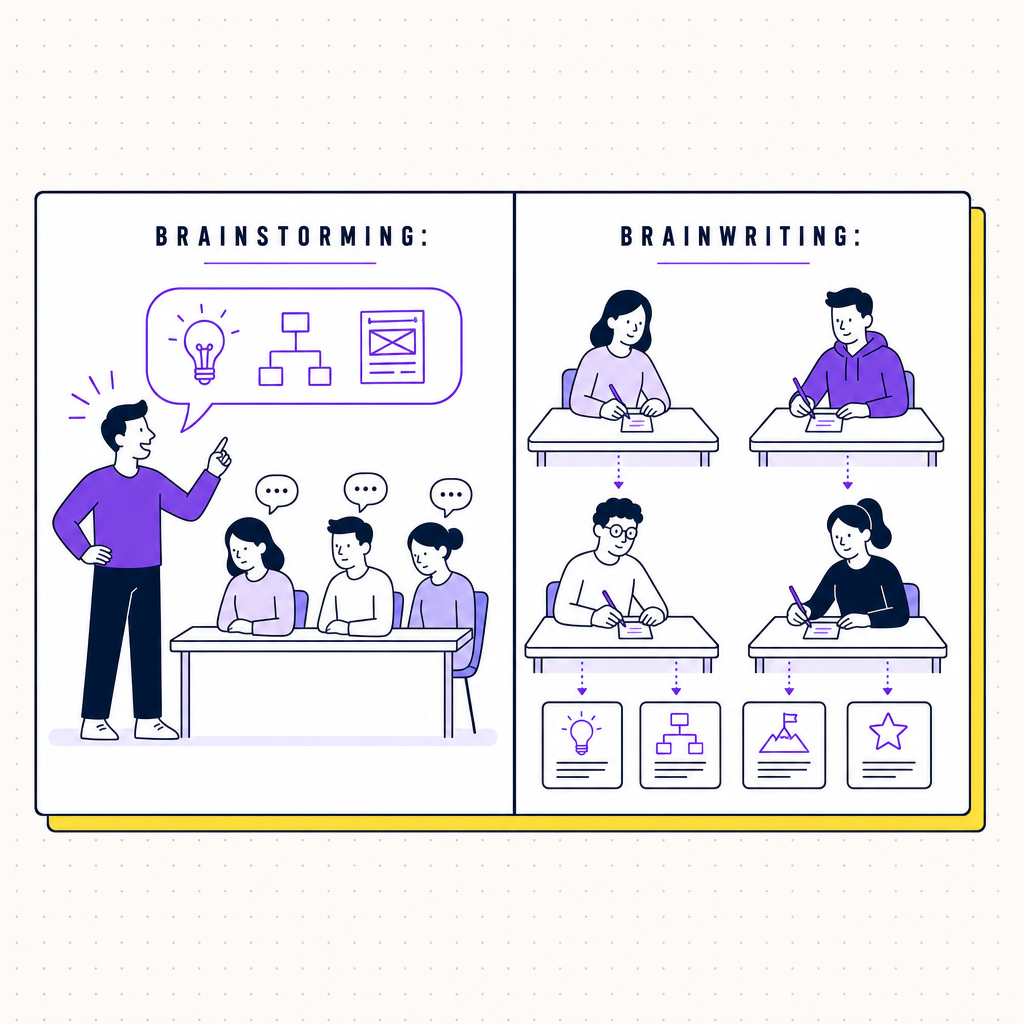
Traditional verbal brainstorming is one of the most extraversion-biased rituals still in widespread corporate use. The research is unambiguous: group brainstorming produces fewer and lower-quality ideas than the same people working silently in parallel, because of production blocking, anchoring on the first loud idea, and social loafing. In practice, the loudest voices win and quieter team members are filtered out.
Brainwriting, where everyone writes ideas independently before any verbal discussion, neutralises most of that. Ideas get evaluated on merit instead of who said them, introverts get the incubation time their cognitive style requires, and the verbal phase still gets to happen, just later, on a level playing field.
The remote-work twist
The post-2020 shift to sustained remote and hybrid work has acted as a natural experiment on the extravert advantage. Longitudinal work tracking employees through the transition has consistently shown that high-frequency remote work attenuates, and in some cases reverses, the positive relationship between extraversion and engagement.
Extraverts depend on external social stimulation and visible interaction to fuel their motivation. Strip that out, replace it with calendar-blocked video calls, and a high-extraversion baseline starts working against the employee. Introverts, by contrast, often benefit from the quieter, less stimulating environment, particularly in roles with a strong deep-focus component.
Subsequent 2024 to 2026 work on virtual collaboration tools, including dyadic problem-solving studies in collaborative platforms, shows the traditional extraversion advantage shrinking in digital settings. The dominant cues in a video call (turn-taking discipline, written follow-up, asynchronous summaries) reward structured communicators over spontaneous ones. None of this means extraverts cannot succeed remotely. It does mean the baseline assumption that extraversion is a universal workplace advantage needs an asterisk in a hybrid era.
What to do with this: hiring, performance reviews, coaching
The biggest practical risk in most organisations is not low extraversion. It is unexamined extraversion bias in three places: unstructured interviews, performance reviews, and meeting design.
Hiring
The unstructured job interview is the single most leveraged point at which extraversion bias enters the system. Interviewers consistently mistake conversational ease and immediate warmth for actual job competency, particularly in roles where neither is centrally required. The well-established fix is structured interviews: the same job-relevant questions in the same order, scored on a standardised rubric immediately after each answer. Pair that with a validated cognitive ability test and a validated Big Five measure earlier in the funnel, and the predictive validity for actual performance is roughly double that of unstructured interviews on their own. If you are formalising any of this, our guide to the Big Five in compliant hiring covers the EEOC and GDPR side.
Performance reviews
Annual performance reviews are particularly vulnerable to extraversion bias through three channels: recency bias (extraverts maintain higher day-to-day visibility), the halo effect (a single strong social trait lifts the rest of the rating), and idiosyncratic rater bias (an extraverted manager systematically under-rates a competent introvert because they would have done the job more vocally themselves).
Concrete mitigations: continuous feedback documented through the year rather than memory-based annual reviews, standardised behavioural criteria evaluated independently per dimension, manager calibration meetings, and 360-degree input from peers and direct reports rather than a single manager view.
Coaching extraverts
Extraverts process externally and respond well to real-time, action-oriented coaching. The development edge for most high extraverts at work is restraint and active listening. Two practical interventions that show up in the coaching literature:
- The “WAIT” check (Why Am I Talking?) as a self-prompt before contributing in a meeting they are already dominating.
- The “three-person rule” for extraverted leaders in team meetings: wait until three other people have spoken before weighing in again.
Coaching introverts
Introverts process internally and are routinely under-credited because their best work is invisible. The development edge is usually visibility without forcing a personality change. Two interventions that work:
- A short, regular written stakeholder update, bi-weekly, bulleted, sent to a defined audience. It provides visibility through a comfortable asynchronous medium.
- “Narrate the pause”: when an introvert needs time to think in a fast meeting, saying “this is complex, I’ll come back with a recommendation tomorrow” reframes their silence as strategic diligence instead of indecision.
Both groups benefit from the same structural shift in team rituals, brainwriting over brainstorming, agendas circulated in advance, written input channels alongside verbal ones, so the load of being heard does not rest entirely on individual personality.
Wrapping up: where extraversion fits in the Big Five
Across the OCEAN series, extraversion is the trait with the loudest cultural reputation and one of the more conditional empirical pictures. It matters most for who emerges as a leader, less for whether they are effective, and not in a straight line for sales. The facet structure matters: assertiveness and activity carry most of the work-relevant signal, excitement-seeking is the one to watch in safety-critical roles.
If you have read the rest of this series, you will notice that the trait with the cleanest, broadest workplace evidence base is still conscientiousness, not extraversion. Extraversion is the more interesting story, but conscientiousness is the one to bet on when you are building a long-running team.
For the full model, the Big Five pillar guide is the place to start. If you are coaching leaders, Big Five personality traits for leadership is the deeper cut.
FAQ
Is extraversion the same as confidence? No. Confidence is a self-evaluation that can sit at any extraversion level. A confident introvert is common; an anxious extravert is too. The facets that often look like confidence (assertiveness, positive emotions) are subcomponents of extraversion, not synonyms for it.
Are extraverts better at sales? On average, slightly. The strongest finding is Grant’s (2013) ambivert advantage: people in the middle of the extraversion distribution outperform both ends in sales revenue, because they can switch between asserting and listening. Pure extraversion is not the optimum.
Are introverts worse leaders? No. Introverts emerge as leaders less often, but once in role, the evidence is mixed and context-dependent. Grant, Gino and Hofmann (2011) found introverted leaders outperformed extraverted ones with proactive teams. Effective leadership rests more on conscientiousness, emotional stability and behavioural skills than on extraversion.
Does the Big Five measure introversion separately from extraversion? No. They are two ends of one dimension. A low extraversion score is the operational definition of introversion in the Big Five. There is no separate “introversion scale”.
How do I avoid extraversion bias in hiring? Replace unstructured interviews with structured ones (the same job-relevant questions, in the same order, scored on a standardised rubric). Pair with a validated cognitive ability test and a validated Big Five measure. Use blind work samples wherever the role allows. Train interviewers to score answers, not likeability.
Sources
- Wilmot, M. P., Wanberg, C. R., Kammeyer-Mueller, J. D., & Ones, D. S. (2019). Extraversion advantages at work: A quantitative review and synthesis of the meta-analytic evidence. Journal of Applied Psychology, 104(12), 1447–1470. Carlson School working version (PDF) · PubMed abstract · Semantic Scholar entry
- Judge, T. A., Bono, J. E., Ilies, R., & Gerhardt, M. W. (2002). Personality and leadership: A qualitative and quantitative review. Journal of Applied Psychology. Modern review citing the meta-analysis: PMC9733865.
- Grant, A. M., Gino, F., & Hofmann, D. A. (2011). Reversing the extraverted leadership advantage: The role of employee proactivity. Academy of Management Journal, 54(3), 528–550. AOM entry.
- Grant, A. M. (2013). Rethinking the extraverted sales ideal: The ambivert advantage. Psychological Science. Cited in: Global Diversity Practice summary and Psychology Today on balancing styles.
- “Too much of a good thing” / curvilinear extraversion at work: Frontiers in Psychology, 2021 and PMC6767192.
- Big Five facet structure (NEO-PI-R / IPIP-NEO / BFI-2): IPIP NEO facets table · BFI-2 measurement, Oregon PSD Lab · Ten-facet BFI scales (ResearchGate).
- Team composition and extraversion variance: Personality and team performance review (Twente, PDF) · Alva Labs team personality summary.
- Remote work and extraversion engagement: MDPI Administrative Sciences 2024 · Tilburg University: Extroversion and conscientiousness predict deteriorating job outcomes under remote work.
- Virtual collaboration and personality (2024–2026): Palgrave Communications, 2024 · PMC12223796 · PMC12938108.
- Brainwriting vs brainstorming evidence: Adventure Associates summary · Capterra review · Ideatovalue on introvert creativity.
- Hiring bias and structured interviews: SHRM, practical ways to reduce hiring bias · Test Partnership on interviewer bias · Humanly on structured interview questions · Paycor structured-interview guide.
- Performance review bias: Tech Class on review bias · Figures.hr on review-bias mitigation · Lattice on review bias · Deloitte on mitigating bias in performance management.
- Coaching extraverts and introverts: Agile Leadership Journey on balancing introvert/extravert teams · Bridges Coaching: coaching introverts and extroverts · Pinnacle Wellbeing on quiet influence for introverted leaders · Coaching for Leaders podcast on leading both styles.
- Workforce stress and leadership trends 2025–2026: Fruitful Toolbox 2025 stress insights · Help Net Security workplace stress report 2026 · RHR International 2026 leadership trends.
More on Big Five
- arrow_forward Emotional Stability: The Big Five Trait Behind Team Resilience
- arrow_forward Openness to Experience: The Big Five Trait Behind Innovation
- arrow_forward Agreeableness at Work: The Big Five Trait Behind Team Collaboration
- arrow_forward Conscientiousness at Work: The Trait That Best Predicts Performance
- arrow_forward Big Five Personality Tests for Hiring: The Compliance Guide
- arrow_forward Big Five Personality Traits for Leadership: What the Evidence Shows
- menu_book The Big Five Personality Traits Explained: A Guide to the OCEAN Model Pillar
- arrow_forward Big Five vs MBTI vs DISC: Which Should Your Team Actually Use
See extraversion show up in a real team report
Team Building Bot joins your next online workshop or coaching session, listens for behavioural signals across the Big Five, and produces a team report you can use in the debrief. Free during beta.
No spam, no credit card. Unsubscribe any time.