Big Five vs MBTI vs DISC: Which Should Your Team Actually Use
An evidence-based comparison of the three most common personality frameworks for team development, and what to look for in your next session report.
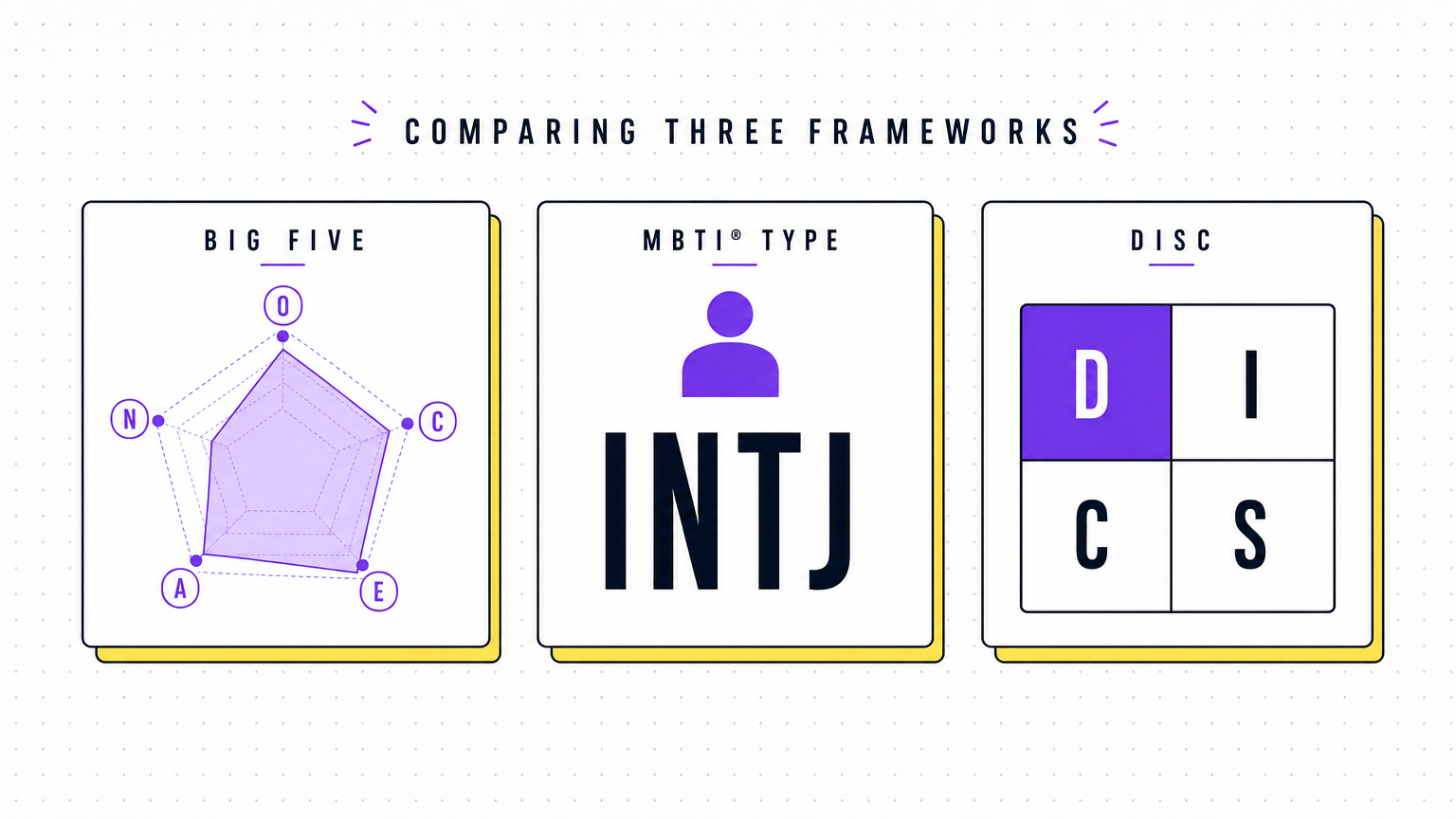
If you are choosing a personality assessment for an upcoming team workshop, you are probably comparing the same three options every facilitator looks at. The Big Five (sometimes called OCEAN or the Five Factor Model), the Myers-Briggs Type Indicator (MBTI), and DISC.
They are not the same kind of thing. One is a peer-reviewed academic model. One is a popular self-report instrument with a famously rocky relationship to the data. One started in 1928 as a behavioural theory by the man who later created Wonder Woman. They all get sold to the same buyer: an L&D lead, an HR partner, a coach, or a team manager planning a debrief.
This post compares the three on the criteria that actually matter for a team session: what each framework measures, what the evidence says, how reliable the results are six weeks later, and which one gives you material you can use in the debrief room. If you only have two minutes, skip to the table below.
The short answer
If you want a defensible behavioural model your team can use for development, coaching, hiring, and follow-up, Big Five is the evidence-based choice. MBTI is fine for an icebreaker and produces conversation, but it should not anchor a development plan. DISC is a behavioural language with weak validity evidence; it works for communication training and not much else.
Here is the comparison at a glance.
| Big Five (OCEAN) | MBTI | DISC | |
|---|---|---|---|
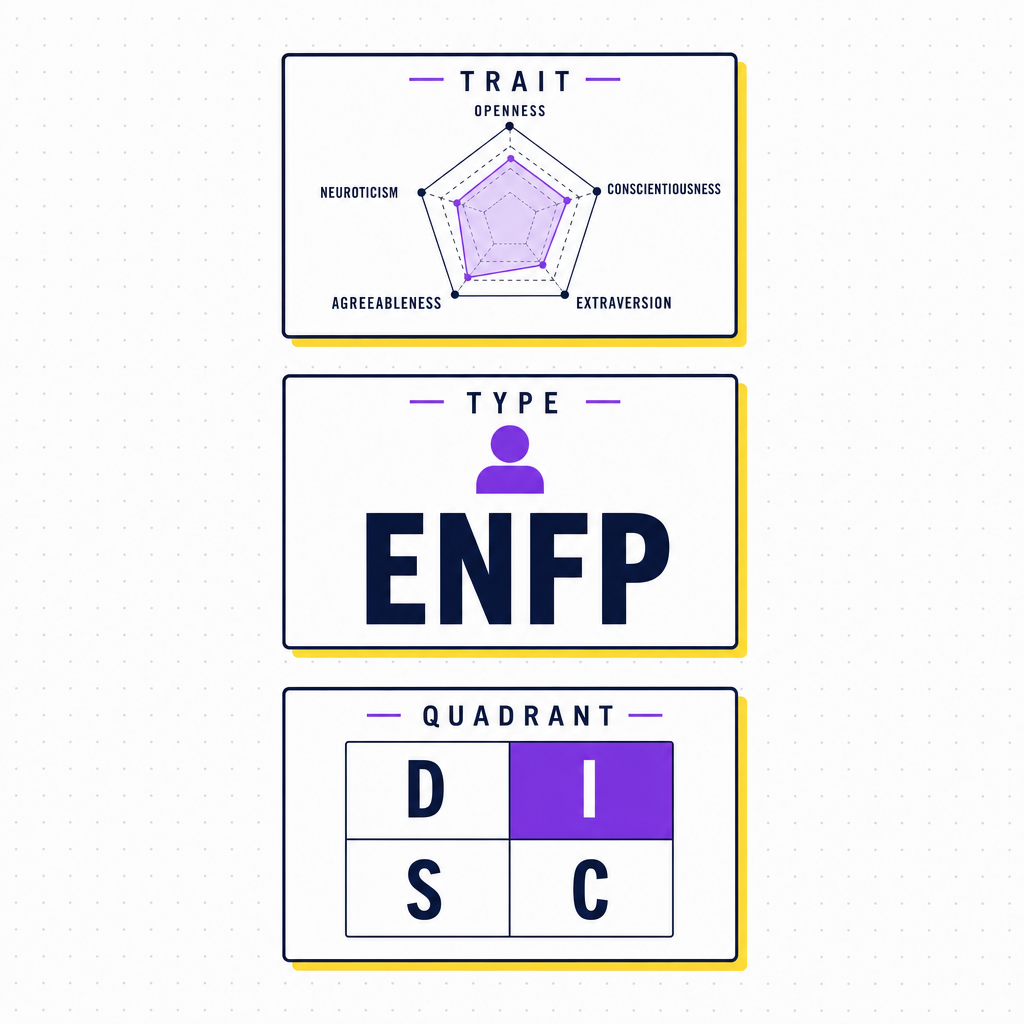
| What it measures | Five continuous traits: Openness, Conscientiousness, Extraversion, Agreeableness, Neuroticism | Four binary preferences combined into 16 types (e.g. INTJ) | Four behavioural quadrants: Dominance, Influence, Steadiness, Conscientiousness |
| Year first published | 1980s-90s, building on lexical research from the 1930s onwards | 1962 (Form A); current Step I from 2018 | 1928 (theory only, no formal assessment from the author) |
| Peer-reviewed validity | Yes, thousands of studies, replicates across cultures | Contested, weak for “type” stability, better at the preference level | Not demonstrated in independent peer-reviewed work |
| Test-retest reliability | Strong on the trait level | About 50% of people get a different four-letter type after five weeks | Varies by vendor, no standard instrument |
| Predicts job performance | Yes, conscientiousness is a consistent predictor across roles | No, the publisher confirms it is not designed for this | No strong evidence |
| Best use | Development, coaching, hiring, team composition | Icebreaker, self-reflection, type-based language | Communication style training |
| Risk in a debrief | Low, traits are continuous and non-judgemental | Type labels stick, people defend them | Quadrant labels feel definitive, the data underneath is thin |
If the table answered your question, the section that matters next is “What this means for your debrief” further down. The middle sections explain why the table reads the way it does.
What each framework actually measures
Big Five (OCEAN)
The Big Five describes personality as five continuous dimensions: Openness to experience, Conscientiousness, Extraversion, Agreeableness, and Neuroticism (often reported as its positive pole, emotional stability). Your score on each trait is a position on a continuum, not a category.
The model was not invented by one researcher. It emerged from decades of factor-analytic work on the words people use to describe each other (the “lexical hypothesis”), with the modern five-factor structure consolidated by Goldberg, Costa and McCrae, and others through the 1980s and 1990s. Independent research groups arrived at the same five factors using different methods and different languages, which is part of why the model is taken seriously in academic psychology.
MBTI
The MBTI sorts you into one of 16 four-letter types by asking which of two preferences you favour on each of four dichotomies:
- Extraversion / Introversion
- Sensing / iNtuition
- Thinking / Feeling
- Judging / Perceiving
It is based on Carl Jung’s theory of psychological types, formalised into a self-report instrument by Katharine Cook Briggs and Isabel Briggs Myers in the mid-twentieth century. The current version, MBTI Global Step I, was released in 2018.
The defining feature of MBTI is that it produces a type, not a profile. You are an INTJ or you are not. That binary framing is the source of both its appeal (concrete labels feel useful) and its biggest problem (people are not actually binary on any of the four dimensions).
DISC
DISC sorts behaviour into four quadrants: Dominance, Influence, Steadiness, and Conscientiousness (some vendors use Compliance). It is built on William Moulton Marston’s 1928 book Emotions of Normal People, written before any formal assessment tool existed.
Marston, who also invented the systolic blood-pressure test that became part of the polygraph and created the comic-book character Wonder Woman, did not publish a DISC instrument himself. Industrial psychologist Walter V. Clarke and several commercial successors built assessments on Marston’s theory from the 1940s onwards, which is why “DISC” today refers to a family of products rather than a single instrument with a unified psychometric record.
What the evidence says
This is where the three frameworks part company.
Big Five: well-evidenced and predictive
The Big Five is the dominant model in academic personality psychology because the structure replicates. The same five factors keep showing up across cultures, languages, and methods (factor analysis of trait adjectives, item-level analysis of questionnaires, observer ratings, behavioural studies).
For team and workplace decisions, the most cited evidence is Barrick and Mount’s 1991 meta-analysis in Personnel Psychology, which pooled studies across professionals, police, managers, sales, and skilled workers. They found one trait, conscientiousness, predicted job performance across every occupation and criterion they looked at. That finding has been replicated repeatedly since.
At the team level, Bell’s 2007 meta-analysis in the Journal of Applied Psychology found that team-mean conscientiousness, agreeableness, openness, and preference for teamwork were significant predictors of team performance in field settings. Peeters et al. (2006) reported similar effects, with team agreeableness (r = 0.24) and conscientiousness (r = 0.20) the strongest team-level predictors.
The validity coefficients are not enormous. Conscientiousness predicts job performance with a corrected correlation around .20 to .23, which is meaningful but means personality is one signal among several, not the whole picture. That is honest science. It is also why Big Five is normally combined with cognitive ability and structured interviews in serious selection processes.
MBTI: the test-retest problem
The MBTI’s biggest credibility issue is the gap between what type theory claims about personality (stable, lifelong) and what the data shows (it moves).
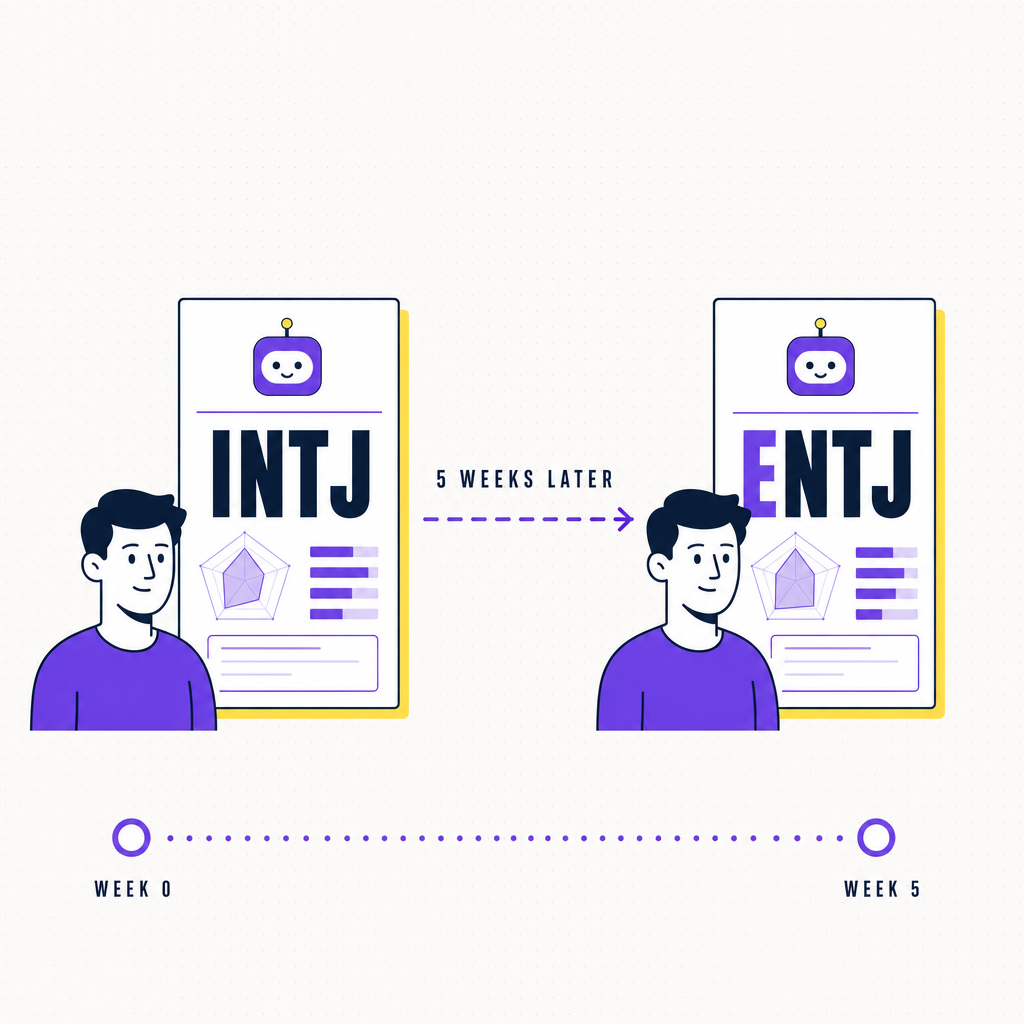
The most quoted study is McCarley and Carskadon (1983), replicated in Howes and Carskadon (1979). Across a five-week test-retest interval, around 50% of participants received a different four-letter type. The MBTI publisher’s own response is that about half of people get the exact same four letters on retest, and that this exceeds chance. Both can be true. Either way, “half of people get a different type within five weeks” is not the kind of stability the framework promises.
David Pittenger’s 1993 critique in the Journal of Career Planning & Placement argued that the categorical nature of the test creates this fragility: if your score on a dimension sits near the midpoint (which is where most people are, because traits are continuous), a small change in mood or context flips you from I to E, or from T to F. The label changes; you have not.
The MBTI publisher is also clear, on their own website, that the instrument is not designed to predict occupational success. That is a fair caveat from the vendor, and it is worth knowing if you were planning to use MBTI for hiring or for assigning roles.
DISC: a behavioural model with thin evidence
DISC’s situation is different again. The framework itself is a behavioural model, not a personality theory in the academic sense, and there is no canonical DISC instrument. Each vendor builds their own assessment on Marston’s quadrants, with varying levels of validation.
Independent peer-reviewed studies of DISC validity are scarce. The Wikipedia entry on DISC describes the assessment family as “pseudoscientific” and notes that “the scientific validity of the DISC assessment has not been demonstrated, and psychologists question its predictive validity”. That is a strong claim, but it broadly reflects the academic literature: DISC is not absent from organisational research, but it does not have the cumulative evidence base that Big Five does.
DISC works well as a shared language for communication style, the “you are more D, I am more S, let’s adjust” kind of conversation that is common in sales training and customer-facing teams. The risk is treating that shared language as a diagnostic tool for hiring, role fit, or development plans, which is asking the instrument to do work it has not earned.
What this means for your debrief
The reason all of this matters is that the framework you choose changes what you can do in the debrief room.
Type-based frameworks feel sticky in workshops. Telling someone they are an ENFP gives them a concrete label, and people defend labels. That is part of why MBTI workshops feel energising. You have just put a name on yourself and you want to argue for or against it. The problem is that you have also told them they are not the other 15 types, which is not really what the data supports.
Trait-based frameworks give you better material for the follow-up. A score of 78 on conscientiousness is harder to defend or attack than “I am a J”. It opens a conversation about behaviour in specific contexts, under deadline pressure, in a new role, with this team, rather than about identity. That is the conversation a coach actually wants to have.
If your debrief is genuinely a one-off icebreaker, MBTI will not hurt anyone. If it is the start of a development plan, a coaching engagement, or a team-composition decision, Big Five gives you more honest material to work with and a defensible audit trail if anyone challenges the recommendation later.
When each one is the right pick
To be fair to all three:
- Use MBTI when you want a single-session icebreaker, a vocabulary for self-reflection, or a warm-up for a deeper conversation. Treat the type as a starting point, not a verdict.
- Use DISC when you want a shared communication-style language for a sales team or customer-facing group, and you are using a vendor that publishes its validity evidence.
- Use Big Five when the output of your session has to support development, coaching, hiring, team composition, or a longer-running leadership programme. It is also the right pick when the buyer (HR, L&D, the executive sponsor) needs an evidence-backed model on paper.
Five questions to ask any personality-test vendor
If you are about to commit budget to one of these, ask the vendor:
- Which model is your assessment based on, and where is the peer-reviewed evidence for it? A serious vendor will name papers, not just say “thousands of studies”.
- What is your test-retest reliability over six to twelve weeks? If the answer is “we do not publish that”, that is itself an answer.
- What is the assessment not designed to do? A vendor who can name limits is more credible than one who claims everything.
- How is the result reported back to the person? Continuous scores invite a conversation; categorical labels invite defence.
- Does the output give my coach or facilitator something concrete to work with in the debrief, or just a label? This is the practical test.
How Team Building Bot uses Big Five in session reports
For full transparency, this is what we build. Team Building Bot joins your online workshop or coaching session, listens to how people communicate, and produces individual and team-level reports based on the Big Five model. We picked Big Five for the reasons in this article. It is the model with the strongest evidence base for team and workplace decisions, the scores are continuous (which makes them honest), and the report gives a facilitator concrete material to work with in the debrief.
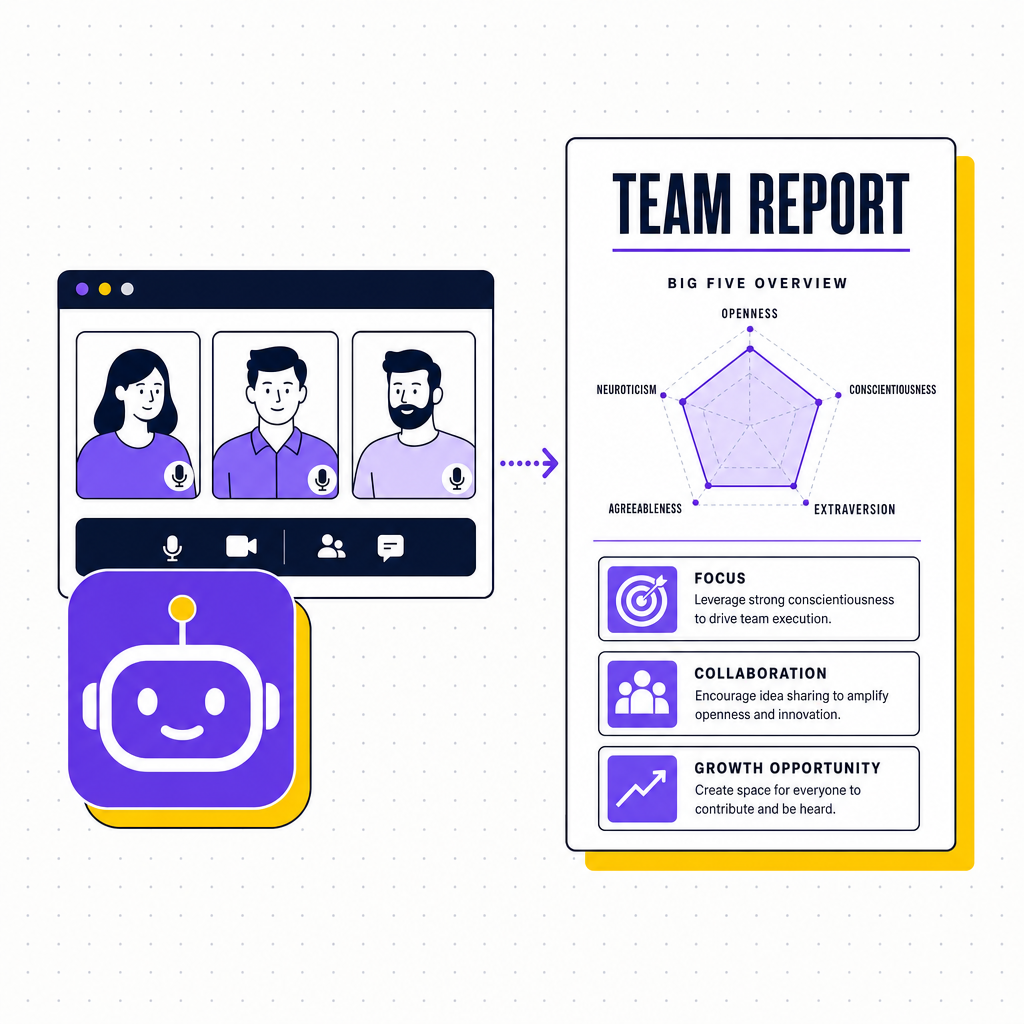
What you get out of a session is a per-participant communication profile mapped against the Big Five traits, a team dynamics map that shows how the group balances task and relationship focus, and a key-moments analysis with timestamped transcript snippets. None of that requires anyone to fill in a questionnaire before or after. The signal is taken from the conversation itself.
If you want to see what that looks like on a real session, the beta is free and the bot can be added to your next Zoom, Teams, or Meet call in about 30 seconds.
FAQ
Is MBTI scientifically valid?
The MBTI has acceptable internal consistency, and its preference scales show moderate test-retest reliability on the trait level. The instrument’s biggest credibility problem is the four-letter type itself: across a five-week interval, around 50% of people are reclassified on at least one of the four scales (McCarley and Carskadon, 1983). The publisher is also explicit that the assessment is not designed to predict occupational success. For self-reflection, fine. For decisions about people, the evidence is thinner than the popularity of the test suggests.
Why do companies still use MBTI?
Three reasons. It produces vocabulary that workshops can build on, the type labels are concrete and easy to remember, and it has 60+ years of brand recognition in HR. None of these are evidence of validity, but they are real reasons it survives.
Can DISC predict team performance?
There is no strong peer-reviewed evidence that DISC predicts team performance in the way Big Five conscientiousness or agreeableness does. DISC is a useful shared language for communication style. Treating it as a predictor of who will succeed on a team is asking the instrument to do work it has not earned.
What is the best personality test for team building?
For a team-building or development context where the output has to be defensible and useful for follow-up coaching, Big Five is the strongest evidence-based choice. The team-level meta-analyses (Bell 2007, Peeters et al. 2006) consistently find team-mean conscientiousness and agreeableness predict team performance. MBTI works for an icebreaker. DISC works for communication-style training. For everything else, Big Five.
Can Big Five be measured from how people talk in a meeting?
Yes, behavioural signals during a conversation (turn-taking, language patterns, response to pressure, balance of task and relationship focus) carry information about Big Five traits. That is what Team Building Bot is built on. It does not replace a self-report questionnaire when you need one, but it gives you a continuous behavioural read on a real session, which a questionnaire cannot do.
Sources
- Barrick, M. R., & Mount, M. K. (1991). The Big Five personality dimensions and job performance: A meta-analysis. Personnel Psychology, 44, 1-26.
- Bell, S. T. (2007). Deep-level composition variables as predictors of team performance: A meta-analysis. Journal of Applied Psychology, 92, 595-615.
- McCarley, N. G., & Carskadon, T. G. (1983). Test-retest reliabilities of scales and subscales of the Myers-Briggs Type Indicator and of criteria for clinical interpretive hypotheses involving them. Research in Psychological Type, 6, 24-36.
- Peeters, M. A. G., Van Tuijl, H. F. J. M., Rutte, C. G., & Reymen, I. M. M. J. (2006). Personality and team performance: A meta-analysis. European Journal of Personality, 20, 377-396.
- Pittenger, D. J. (1993). Measuring the MBTI and coming up short. Journal of Career Planning & Placement.
- Marston, W. M. (1928). Emotions of Normal People. Kegan Paul, Trench, Trubner & Co.
- The Myers-Briggs Company. MBTI Facts and Common Criticisms (themyersbriggs.com).
More on Big Five
- arrow_forward Emotional Stability: The Big Five Trait Behind Team Resilience
- arrow_forward Openness to Experience: The Big Five Trait Behind Innovation
- arrow_forward Agreeableness at Work: The Big Five Trait Behind Team Collaboration
- arrow_forward Conscientiousness at Work: The Trait That Best Predicts Performance
- arrow_forward Extraversion at Work: What the Evidence Actually Shows
- arrow_forward Big Five Personality Tests for Hiring: The Compliance Guide
- arrow_forward Big Five Personality Traits for Leadership: What the Evidence Shows
- menu_book The Big Five Personality Traits Explained: A Guide to the OCEAN Model Pillar
See Big Five run in a real session debrief
Team Building Bot joins your next online workshop, listens for behavioural signals, and produces a Big Five-based team report you can use in the debrief. Free during beta.
No spam, no credit card. Unsubscribe any time.