Psychological Safety in Online Meetings: 7 Signals to Watch
Seven behaviours that reveal psychological safety in a remote meeting, from who breaks the first silence to where the chat goes quiet, with the research.
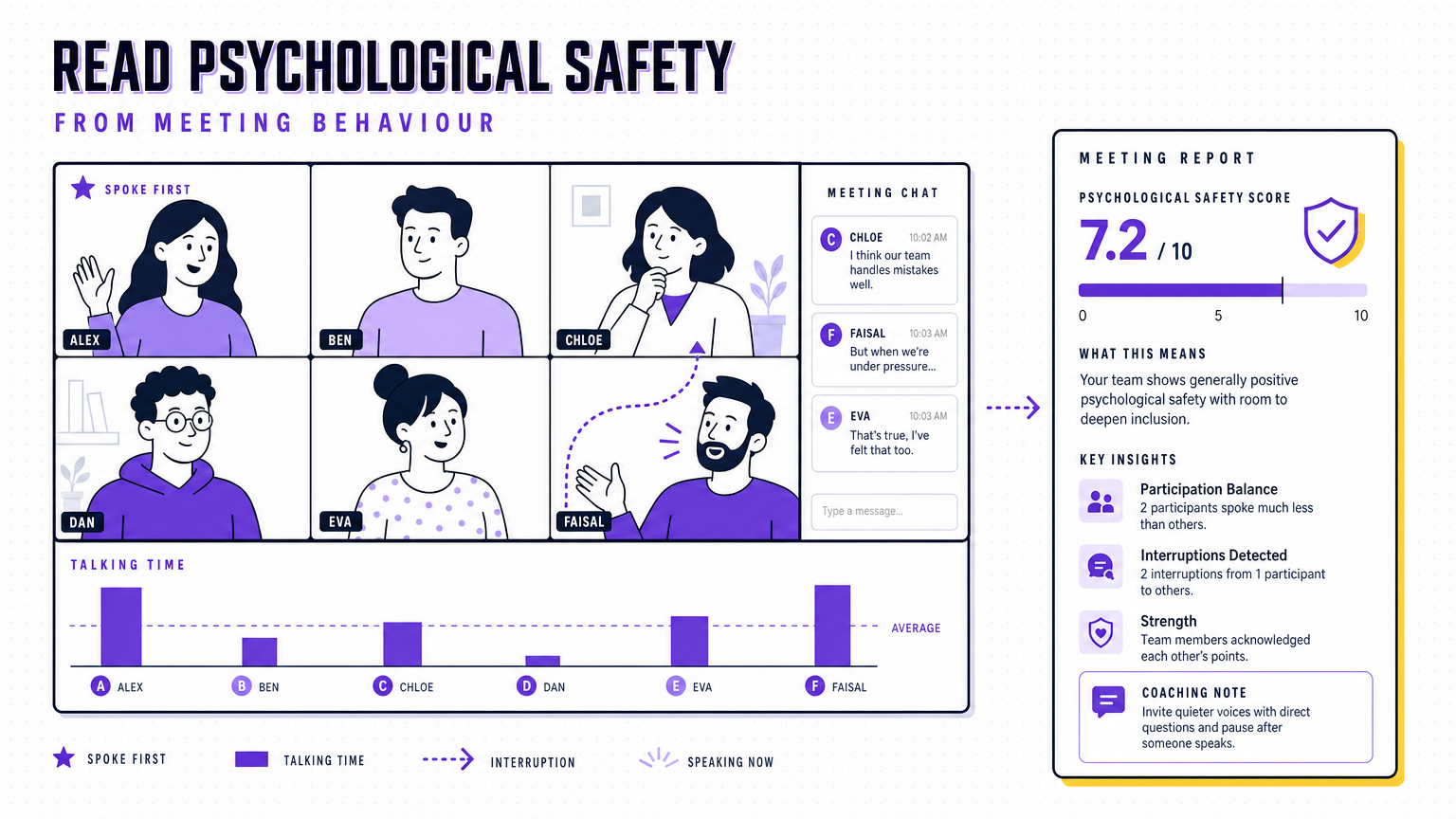
You can read a remote team’s psychological safety in the first ten minutes, before anyone has said anything that matters. Not from what people say, but from the shape of the conversation: who speaks first, how evenly the talk-time lands, who gets cut off, whether anyone asks a question instead of stating a position, and whether the chat is alive or dead. These are observable, and they move before the content of the meeting does.
This guide lists seven of those signals, what each one looks like on a video call, and the evidence that ties it to safety rather than to personality or mood. It sits under our pillar guide to psychological safety at work, which covers the wider definition and research; here the focus is narrow and practical, the read you can take while a session is actually running.
Key Takeaways
- Psychological safety is observable from meeting behaviour, not just surveys. The strongest proxies are conversational turn-taking equality, interruption patterns, who breaks silence, and whether the chat channel is used.
- Woolley and colleagues’ 2010 study in Science found that a group’s collective intelligence depended more on equality in conversational turn-taking and social sensitivity than on the average IQ of its members.
- Frazier and colleagues’ 2017 meta-analysis (136 samples, over 22,000 people) confirmed psychological safety correlates with engagement at roughly r = .36 and information sharing as high as r = .68.
- Camera-on mandates can backfire. A four-week field experiment by Shockley and colleagues (2021) found required camera use increased fatigue and reduced voice, with women and newer employees most affected.
- The first ten minutes carry disproportionate weight. Who speaks early, and whether silence falls only to the leader, predicts how the rest of the session goes.
Why meeting behaviour reads safety better than a survey
Psychological safety is a shared belief that a team is safe for interpersonal risk-taking, a definition Amy Edmondson set out in her 1999 study in Administrative Science Quarterly. The catch is that the belief lives in people’s heads, and the usual way to measure it, an annual engagement survey, arrives months late and averages everyone into a single number.
Behaviour does not have that lag. When safety is low, people protect themselves in visible ways. They wait for someone senior to speak first, they stop asking questions, they let one or two voices fill the hour, and they go quiet in the channels where their silence is hardest to notice. Remote meetings make these tells sharper, because the medium strips out the corridor chat and the read-the-room glances that used to carry some of the signal. What is left is the call itself, which is more legible than people assume.
The research backs the idea that conversational structure carries real information about a group. In a 2010 study in Science, Anita Woolley, Thomas Malone and colleagues identified a collective intelligence factor that predicted how well groups performed across very different tasks. Two things drove it: the average social sensitivity of members, and the equality of conversational turn-taking. Groups where a few people dominated the discussion were less collectively intelligent than groups where contribution was spread out, regardless of the individual IQs in the room. Turn-taking is not a courtesy. It is a performance variable, and you can watch it happen.
1. Who breaks the first silence
The first real silence in a meeting is a small test, and who breaks it tells you a lot. In a safe team, the gap after a question gets filled by whoever has something to say, sometimes a junior person, sometimes the quietest one. In an unsafe team, the silence stretches until the most senior person fills it, every time, and the group learns that waiting for the boss is the safe move.
Watch the opening question of a session, the check-in or the first agenda item, and note who answers without being named. If it is only ever the leader or the same one deputy, the floor is not really open. Facilitators feel this as the moment they have to call on someone by name to get any other voice, which is itself the diagnosis.
The first-voice pattern compounds. People who speak early in a meeting, even on something trivial, are far more likely to speak again later when the stakes are higher. Someone who has stayed silent through the first ten minutes rarely volunteers a dissenting view at minute forty. So the opening is not warm-up to be rushed through; it is where the session’s participation pattern gets set.
2. How evenly the talk-time is shared
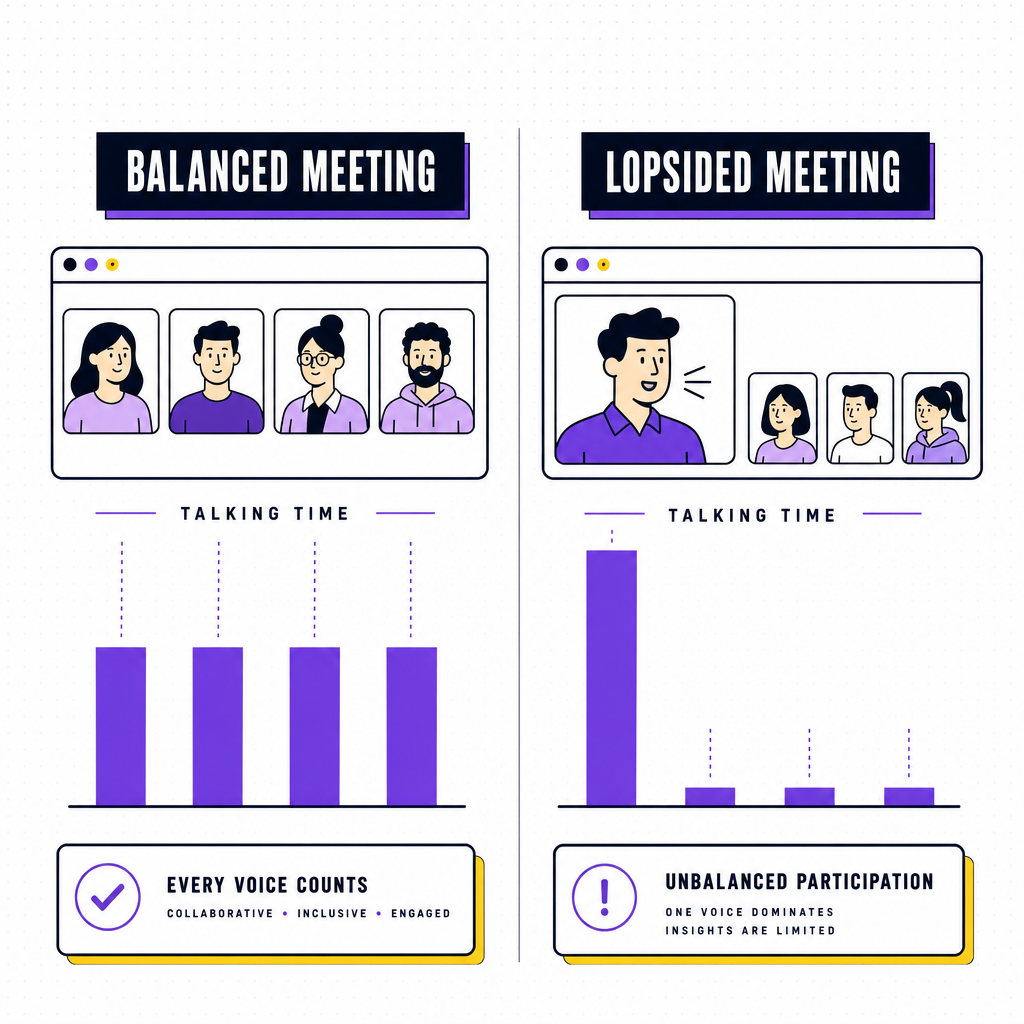
Talk-time distribution is the single most useful number you can take off a meeting. A session where one person holds 60 per cent of the floor and four others split the rest is not collaborating, whatever the agenda says it is doing. The Woolley finding gives this teeth: equality of turn-taking was one of the two strongest predictors of a group’s collective performance, and the groups dominated by one voice did worse.
On a video call this is easier to track than in a room, because only one person can comfortably talk at a time and the active-speaker frame makes turns visible. You are looking for whether the distribution roughly matches the number of people who are supposed to be contributing, or whether it collapses onto one or two. A steep imbalance early tends to hold for the whole meeting unless someone interrupts the pattern deliberately. We go deeper on this in our piece on talking-time imbalance in team meetings.
One caution. Imbalance is a signal, not a verdict. Sometimes one person genuinely holds the context everyone needs, and a briefing is meant to be lopsided. The diagnostic question is whether the quiet people stay quiet when the floor does open, because that is the part that points at safety rather than at agenda.
3. The direction of the interruptions
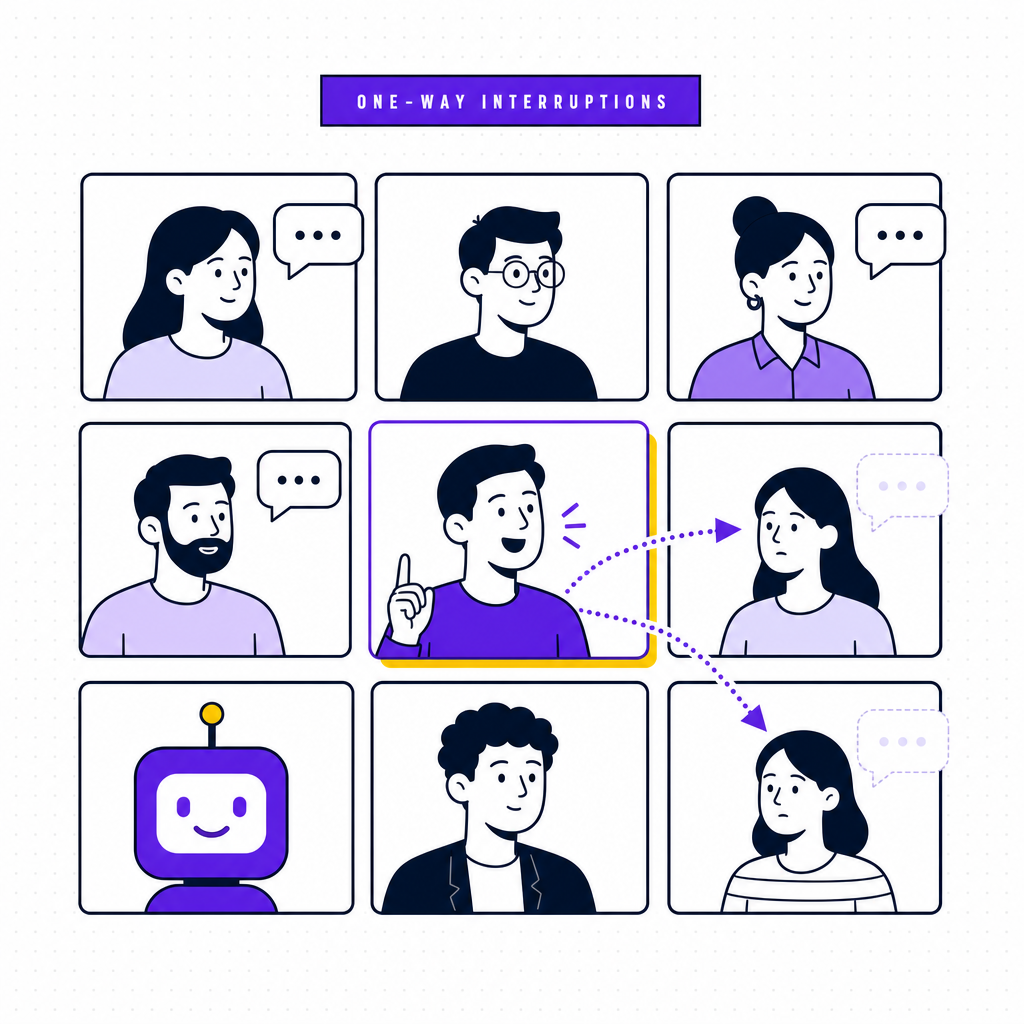
Interruptions are normal. Overlapping talk, finishing each other’s sentences and quick “yes, and” cut-ins are signs of an engaged group, and trying to ban them produces a stilted call. What matters is the direction and the effect. The unsafe pattern is one-way: the same person repeatedly talks over the same colleagues, and those colleagues stop reclaiming the floor after they lose it.
There is a consistent and uncomfortable finding in conversation research that interruptions are not evenly distributed. Intrusive interruptions tend to flow down the status gradient and disproportionately land on women and more junior staff, who then often yield the turn rather than contest it. When you see the same person on a call drop their point the moment they are cut off, and never circle back to it, you are watching the cost of low safety in real time.
On a remote call the audio makes this brutal, because two people talking at once is unintelligible, so whoever yields loses the thought entirely. Note who yields and who never does. If the same names always give way, the meeting has a dominance pattern that no amount of “we value all voices” framing will fix on its own.
4. Whether people ask or only assert
Listen for the ratio of questions to assertions. A team that feels safe asks a lot: clarifying questions, “what am I missing here”, “can you say more about that”. Asking a question is a small admission that you do not already know, which is exactly the kind of interpersonal risk that disappears when safety is low. A meeting made entirely of confident declarations, with nobody ever asking anything, is usually not a meeting of people who all understand everything. It is a meeting where not knowing has become unsafe to show.
This is one of the clearest early reads because it does not depend on rank. When safety is present, you hear questions from across the group, including upward, junior people asking senior ones to explain. When it is absent, questions dry up first, well before open disagreement does, because asking feels exposed before disagreeing does.
The facilitator’s version of this signal is how the leader frames the opening. A leader who invites rough, first-draft thinking and says plainly that half-formed ideas are welcome lowers the bar to entry. A leader who opens by presenting conclusions and asking only “any questions?” has signalled that the thinking is already done. The first reliably produces more voices than the second.
5. Where the cameras go off, and why
Cameras are the most misread signal on this list, so handle them carefully. The intuitive reading, cameras off means disengagement means low safety, is often wrong, and acting on it can make things worse. A four-week within-person field experiment by Kristen Shockley and colleagues, published in the Journal of Applied Psychology in 2021, found that requiring cameras to be on increased fatigue, and that this fatigue was associated with lower voice and engagement during the meeting, the opposite of what the mandate intends.
The cost is not evenly shared. Stanford research by Fauville, Bailenson and colleagues found women report markedly higher video-meeting fatigue than men, with roughly 13.8 per cent of women versus about 5.5 per cent of men reporting they felt very or extremely fatigued by video calls. A driver is the self-view, the constant mirror of your own face, which pulls attention into managing how you look rather than into the conversation. So a blanket cameras-on rule can quietly tax the exact people who already carry more self-presentation load.
What is diagnostic is not whether cameras are off but whether the norm is freely chosen. In a safe team, people turn cameras on and off as suits the moment and nobody reads anything into it. In an unsafe one, camera state becomes a compliance display, watched and judged, and that surveillance itself is the safety problem. If you want engagement, the more reliable lever is letting people hide their self-view, not forcing the camera on.
6. Whether the chat channel is alive or silent
The meeting chat is a parallel safety signal, and a useful one because it has a lower bar than speaking. In a safe remote team the chat carries real content: questions, links, a quick “+1”, someone surfacing a point they did not want to interrupt for. A chat that stays completely empty through a working session is not neutral. It usually means people have decided that even the low-risk channel is not worth using.
Read the chat for what kind of traffic it carries. Substantive questions and additions are a good sign. Nothing at all is a flat read worth noticing. And a third pattern is the most diagnostic of the lot: people going silent on the main call while side-channelling on a separate platform, a private Slack or a direct message thread, where the leader cannot see. When the real conversation has moved somewhere the facilitator is not, the visible meeting has lost the room, and the silence on screen is hiding an active backchannel.
This matters most in hybrid meetings, where people in the physical room hold the floor and remote participants struggle to find a gap to speak into. Meeting equity, giving remote attendees a genuinely equal path to contribute, is partly a chat-and-hand-raise discipline. If the remote half of a hybrid call only ever appears in the chat and never in the talk-time, the meeting has an in-group and an out-group, and the out-group has stopped trying to break in by voice.
7. What happens to the first rough idea or admitted mistake
The last signal is the highest-value one, because it is the actual behaviour psychological safety is supposed to protect. Wait for the first moment someone takes a risk: a half-formed idea, a naive question, an admission that they got something wrong or are behind. Then watch the next five seconds. Does the group build on it, or does it get met with a correction, a faint silence, or a quick move on?
One response teaches the room that risk is rewarded, the other that it is punished, and people calibrate fast. A single visible put-down early in a session can shut down contribution for the rest of it, especially from anyone who has not yet spoken. Conversely, a leader who responds to a rough idea with genuine curiosity, or who meets an admitted mistake with “thank you for flagging that” rather than a reprimand, buys a lot of subsequent candour.
This is also where you separate safety from comfort. The goal is not a meeting where nobody is ever challenged. Edmondson is explicit that safe teams have more candid conflict, not less. The healthy pattern is hard questions aimed at the idea, with the person left intact. The unhealthy one is the idea waved through while the person quietly pays a status cost for having floated it. The first builds safety, the second only looks polite.
How to read these signals without spying on people
Two practical notes before you start watching meetings differently. First, these are signals, not scores. Any one of them has an innocent explanation on a given day: someone is tired, the topic genuinely belongs to one expert, the new starter is finding their feet. The read comes from the pattern across several signals and several meetings, not from a single tell. A team that is quiet, lopsided, interruption-heavy and chat-dead all at once is telling you something a single quiet call is not.
Second, the point of reading safety is to act on it, and the interventions are mostly structural. If silence only ever falls to the leader, use a round-robin or a structured format so the floor does not default to seniority. If talk-time is lopsided, name it and hand the next turn out deliberately. If interruptions run one way, protect the interrupted person’s turn out loud. If the chat is dead, ask a question that can only be answered there. These moves cost little and shift the pattern more than any survey will. For the wider set of failure modes, our guide to team communication breakdown warning signs maps where these signals tend to lead if left alone.
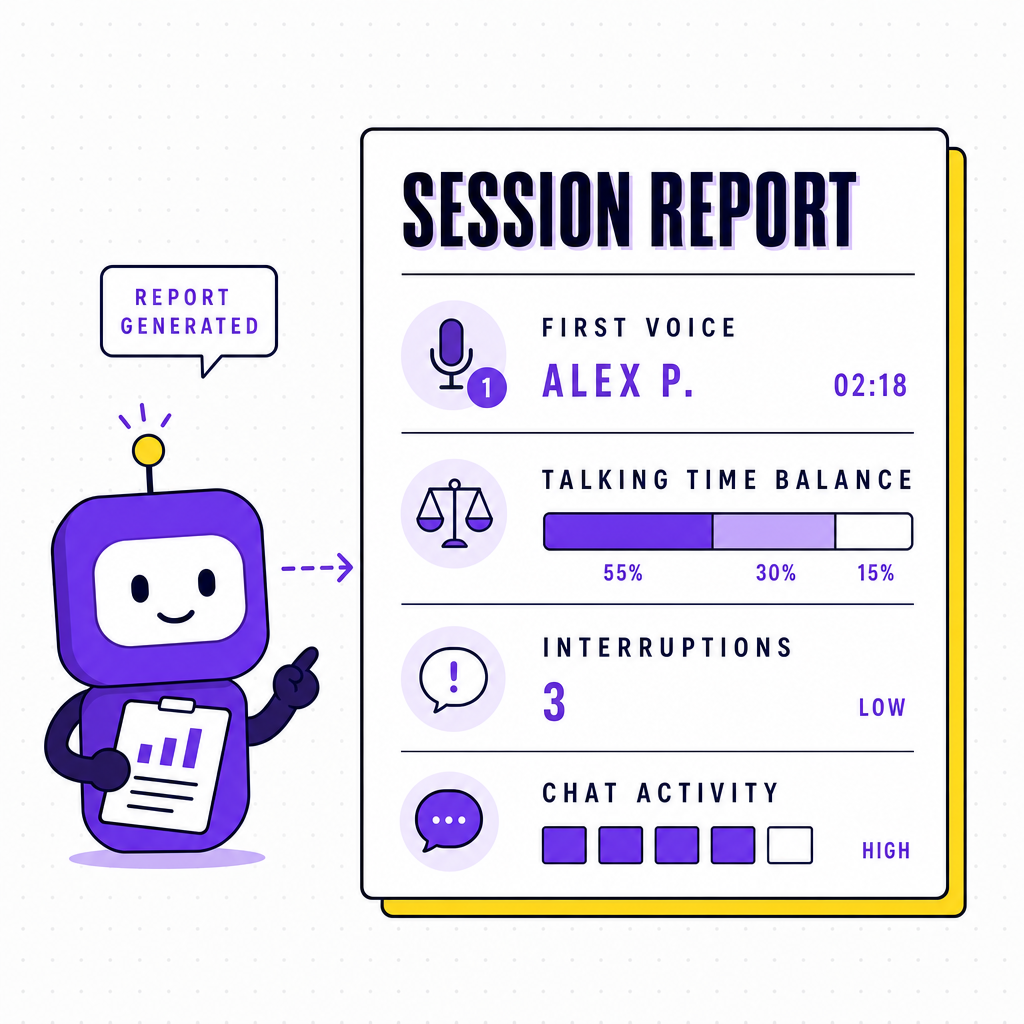
This is also the gap a tool can close. A facilitator running the session cannot reliably track who spoke first, how talk-time split and who got cut off while also running the agenda. That observation load is what we built Team Building Bot to carry, so the read is there after the meeting instead of lost in it.
Frequently asked questions
What are the signs of low psychological safety in a remote meeting?
The clearest signs are behavioural: silence that only the most senior person breaks, talk-time dominated by one or two voices, one-way interruptions where the same people always yield, an absence of questions, a dead chat channel, and rough ideas or admitted mistakes met with correction rather than curiosity. No single one is proof, but several together across meetings are a reliable read of low safety.
Does cameras-off mean low psychological safety?
No, and assuming it does can make things worse. Research by Shockley and colleagues found that mandating cameras on increased fatigue and reduced participation, with women and newer employees most affected. What signals a safety problem is not camera state itself but whether it has become a compliance display people feel watched on. Freely chosen camera norms are healthier than enforced ones.
How quickly can you tell if a meeting is psychologically safe?
Often within the first ten minutes. Who breaks the opening silence, whether questions appear, and how evenly the early talk-time lands tend to set the pattern for the whole session. People who stay silent through the opening rarely raise a dissenting view later, so the start carries more diagnostic weight than its length suggests.
What is the difference between psychological safety and just being nice?
Psychological safety is about being able to take interpersonal risks, ask, admit, disagree, without being punished. It is not the absence of conflict. Edmondson’s work is explicit that safe teams often have more candid disagreement, because people are willing to say the hard thing. A meeting that is smooth and conflict-free can be unsafe, with disagreement suppressed rather than absent. See our pillar guide to psychological safety at work for the full distinction.
Can you measure psychological safety from meeting data?
Partly. Conversational structure, turn-taking equality, interruption patterns, who speaks first, chat participation, is a well-evidenced proxy for inclusion and collective performance, going back to Woolley and colleagues’ 2010 work on collective intelligence. It does not replace asking people how they feel, but it surfaces patterns weeks before a survey would and points at specific behaviours you can change.
See the safety signals you miss while you facilitate
Team Building Bot sits in your online sessions and reports on the behaviours that signal psychological safety: who spoke first, how evenly talk-time landed, who interrupted whom, and where the chat went quiet. You get a read after each session instead of guessing from a survey. Free during beta.
No spam, no credit card. Unsubscribe any time.