The 4 Stages of Psychological Safety: A Diagnostic Guide
Timothy Clark's four stages of psychological safety, inclusion to challenger, explained with team examples, a per-stage self-diagnostic and facilitation moves.
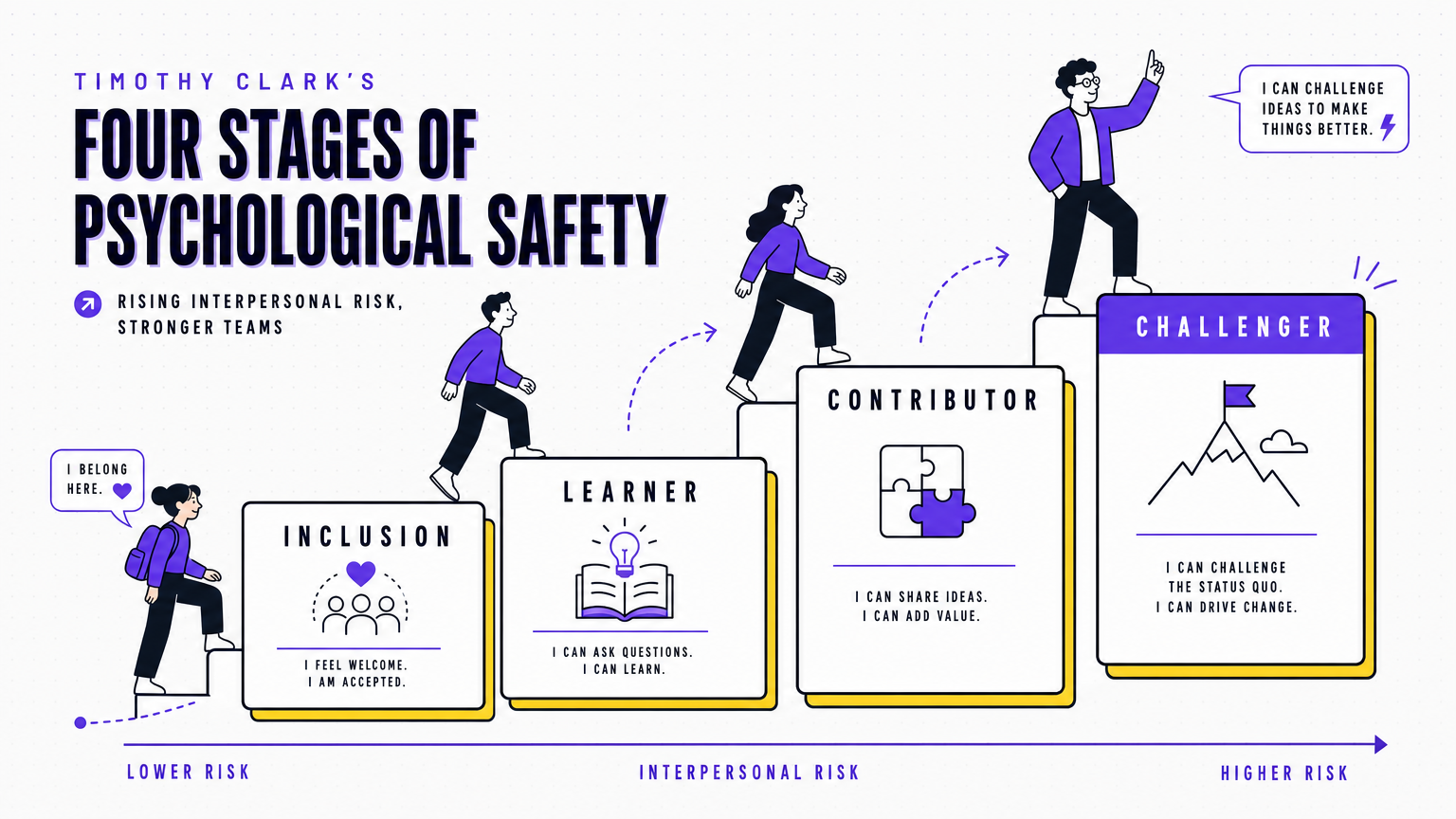
A team will not suddenly produce someone willing to challenge the boss if half the room still does not feel they belong. That is the single most useful idea in Timothy Clark’s model, and it is the one most leaders skip. They run a workshop on “speaking truth to power” for a group that has not yet established the basic safety of being accepted, and they wonder why nobody speaks.
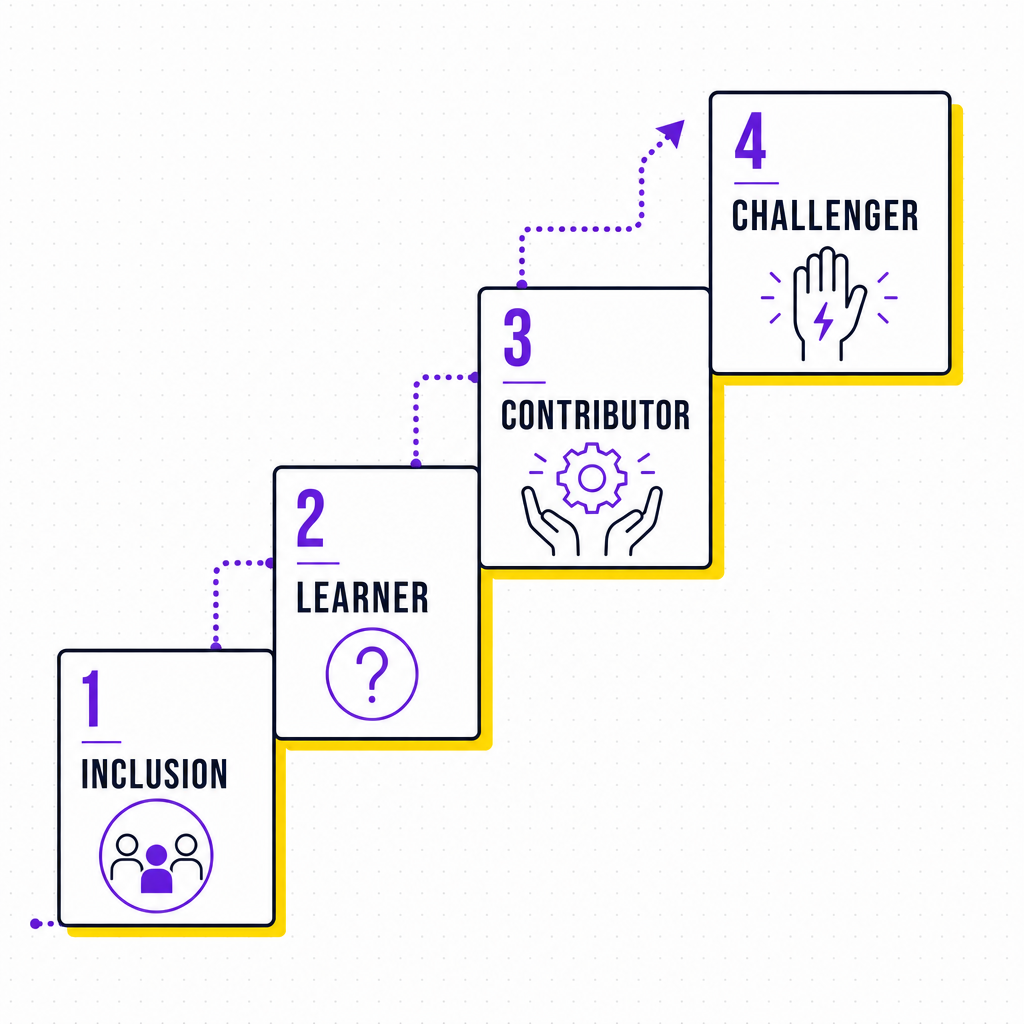
Clark’s four stages give you an order. Inclusion safety, then learner safety, then contributor safety, then challenger safety. Each one unlocks a riskier and more valuable behaviour, and each depends on the one before it. This guide explains what each stage means, what it looks like when a team is stuck there, and the specific facilitation moves that advance a team to the next one. It sits under our pillar guide to psychological safety at work, which covers the wider evidence base; here we go deep on the staged model itself.
Key Takeaways
- The four stages, from Timothy Clark’s 2020 book, run in order: inclusion, learner, contributor, challenger safety. Each unlocks riskier behaviour and depends on the one before it.
- The underlying construct is well evidenced. Frazier and colleagues’ 2017 meta-analysis (136 samples, 22,000+ people) found psychological safety correlates with engagement at roughly r = .36 individually and information sharing as high as r = .68.
- The strict four-step progression is Clark’s own model, validated mainly in-house by his firm LeaderFactor; teams oscillate between stages rather than climbing a one-way ladder.
- You can diagnose where a team is stuck from observable behaviour, and move it with concrete leader moves rather than another survey.
What are the four stages of psychological safety?
The four stages of psychological safety are inclusion safety, learner safety, contributor safety and challenger safety. The model comes from Timothy R. Clark, an organisational social scientist, in his 2020 book The 4 Stages of Psychological Safety. Clark frames safety as four needs a team satisfies in sequence, each one granting permission for a more exposed and more useful kind of behaviour.
The engine underneath the model is a simple social exchange. At every stage the team trades two things: respect and permission. As a member shows more vulnerability, by asking a naive question or disagreeing with a senior colleague, the group either rewards it or punishes it. Reward enough times and the team climbs. Clark’s own framing for a leader’s job is sharp: increase intellectual friction, the rigorous debate about the work, while decreasing social friction, the interpersonal cost of taking part.
That is also the cleanest way to keep this model honest. Safety here is not comfort. The point of the top stage is more candid conflict, not less, with the personal sting removed.
Stage 1: inclusion safety
Inclusion safety asks one question on the team’s behalf: can I be my authentic self here? It is the foundation, and it is granted for nothing more than being human and present. No performance, no expertise, no track record required. The exchange is the simplest of the four: the group offers acceptance, and asks only that the member does no harm.
This stage is easy to underrate because its absence is quiet. When inclusion is missing, people do not file complaints, they manage impressions. They spend energy hiding the parts of themselves they think the group will reject, and that energy is then not available for the work. The US Surgeon General’s 2023 advisory on loneliness noted that exclusion and marginalisation trigger biological stress responses close to physical pain, which is a useful reminder that this is not a soft concern.
You can see a team stuck at stage one. Cliques form and harden. Gossip runs underneath the official conversation. An “us versus them” line appears, often between a core group and newer, more remote or more different members, and turnover concentrates among exactly those people.
Self-diagnostic, inclusion safety. Read each statement as a team member would:
- I feel accepted as a member of this team.
- People here do not reject others for being different.
- My particular attributes are valued, not just tolerated.
- I do not feel I have to mask who I am to fit in.
If those ring false for some of your team, the facilitation moves are practical. Introduce new members deliberately rather than waiting for them to network their way in. Ask more than you tell, because a leader who mostly tells signals that contribution is not wanted. And audit your team’s norms now and then for the small exclusions, the in-jokes and shorthand, that quietly mark who belongs.
Stage 2: learner safety
Learner safety asks: can I grow here? Once people feel they belong, the next thing they need is permission for the vulnerable act of learning, asking the basic question, requesting feedback, running an experiment, and admitting the mistake when it fails. The exchange shifts to encouragement traded for engagement. The team encourages exposure, and gets a member who actually leans in rather than hiding.
This stage is a gate, and a lot of organisations jam it. If you demand high performance and fast skill acquisition without granting the safety to fumble through the learning, you push people into an anxiety zone. They produce in the short term, driven by fear of looking incompetent, then burn out and turn defensive. The output is real and the cost is hidden until it is not.
A team stuck at stage two hides its errors. Mistakes surface late, when they can no longer be concealed. New hires ask few questions during onboarding because the cost of looking unprepared feels too high. And everyone funnels problems up to the manager rather than risk solving them in the open.
Self-diagnostic, learner safety. Again, from the member’s seat:
- I am allowed to learn from my mistakes here.
- When I get something wrong, it is not held against me.
- It is easy to ask other people on this team for help.
- The team supports my efforts to learn and improve.
The moves that open this stage all involve the leader going first. Adopt a student mindset out loud, talk about what you are still learning rather than performing certainty. Share your own past mistakes plainly, with enough detail that they read as real rather than as a humble brag. Spend time framing the problem before anyone rushes to a solution. And reward the smart failure, the careful experiment that did not work but taught the team something, so failure reads as evidence of effort.
Stage 3: contributor safety
Contributor safety asks: can I create value? This is the shift from consuming the group’s attention, which is what learning does, to generating value with your own judgement and skill. The exchange rises again, to autonomy with guidance in return for performance. The team grants real independence, and expects results.
The need underneath is autonomy and competence, the human pull to do work that matters and to be trusted to do it your way. When the stage is blocked, the symptom has a name: workplace silence. Meetings turn into echo chambers where the same two or three senior voices fill the air and everyone else quietly checks out. The organisation’s problem-solving capacity shrinks to whoever is loudest, and the rest of the talent it is paying for goes unused.
A team stuck at stage three is easy to spot once you know the shape. The same senior people dominate every discussion. Micromanagement is normal and delegation is rare. Disengagement, the quiet-quitting kind, spreads among the people whose contributions never seem to land.
Self-diagnostic, contributor safety. From the member’s view:
- My team values what I contribute.
- I am encouraged to contribute as much as I can.
- I have the autonomy to do my job the way I judge best.
- No one here would deliberately undermine my efforts.
To move it, hand over real ownership. Rotate who runs the meeting, often to a more junior member, to build confidence and visibility. Delegate by setting the outcome and the strategic reason for it, then step back and let people choose their own route. Match stretch assignments to what individuals actually care about and are good at. And ban the shutdown statements, the casual “bad idea” or “I told you so” that teach a whole room to self-censor in a single sentence. This is also where uneven talking-time in meetings stops being a style quirk and becomes a safety problem you can measure.
Stage 4: challenger safety
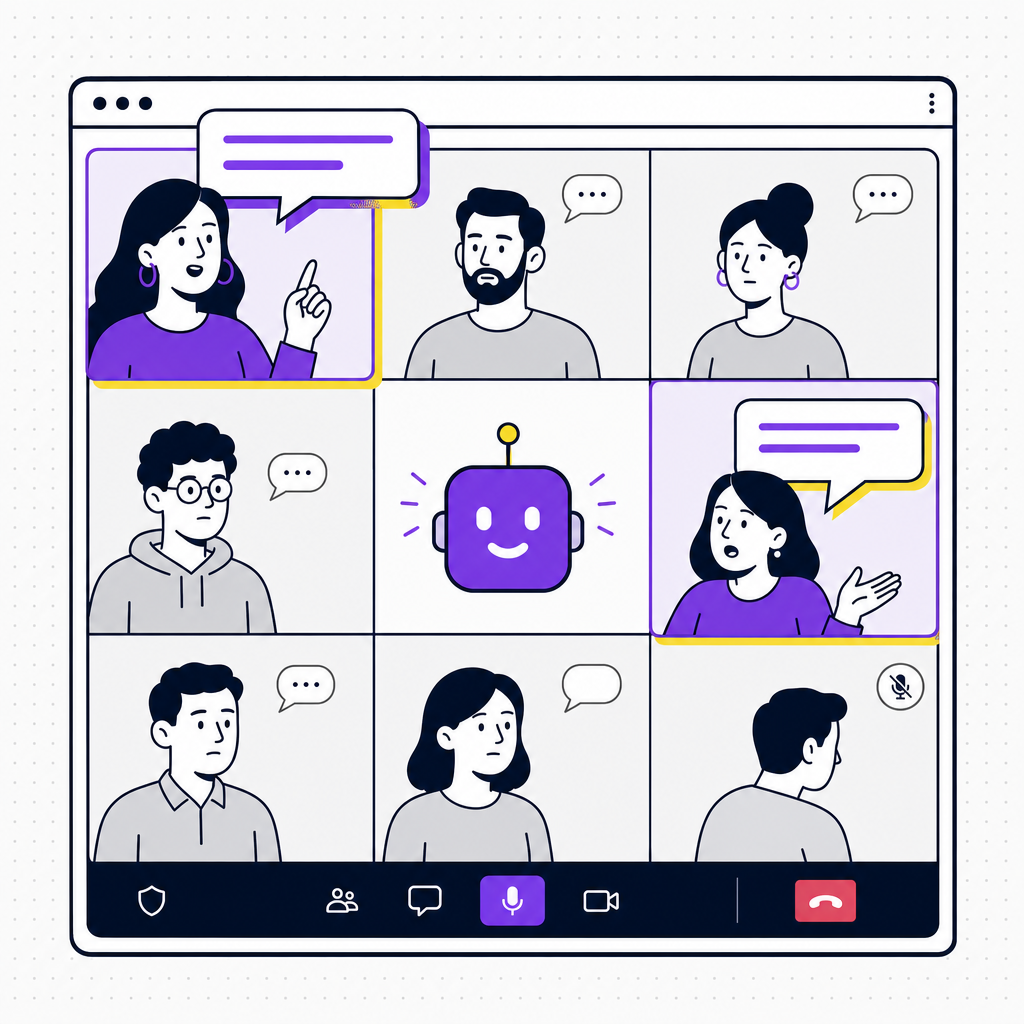
Challenger safety asks the riskiest question of all: can I be candid about change? This is the top of the model, where a person can question the status quo, disagree with authority and propose pulling apart something the organisation is attached to. The exchange is the boldest one too. The leader provides air cover, real protection from retaliation, in return for absolute candour.
This is the stage that pays for itself, because it is where innovation and error-catching actually live. It is also the one most teams never reach. When it is missing, you get performative agreement in the room followed by the real conversation in the corridor afterwards, the “meeting after the meeting.” Groupthink sets in. Redundant, obsolete and trivial processes survive for years because nobody feels safe enough to say they should be killed. Our guide to team communication breakdown warning signs catalogues this drift in more detail.
What makes challenger safety hard is that it requires the team to fully separate the intellectual friction of a hard debate from the social friction of the relationship. Ideas have to be stress-tested without anyone taking it personally.
Self-diagnostic, challenger safety. From the member’s seat, these are close to the items on Amy Edmondson’s validated safety scale:
- It is safe to take a risk on this team.
- People here can raise tough issues and problems.
- I feel comfortable questioning the way we do things.
- Candour is allowed and expected in this group.
The moves are mostly about the leader managing their own gravity. Weigh in last, because the moment a senior person states a view, they anchor everyone else’s. Run a deliberate disruption sequence on big decisions, working through why, then what if, then how, so critique is built into the process rather than left to brave individuals. Hunt for the redundant, obsolete and trivial work explicitly, as a team exercise. And model constructive disagreement yourself, debating the issue on its merits and keeping it off the person. A blameless after-action review is one of the most reliable structures for practising exactly this.
Does the four-stage progression hold up?
Here the honest answer matters more than the tidy one. The underlying construct, psychological safety, is one of the better-evidenced ideas in organisational research. The specific four-stage ladder is Clark’s own framework, and it has thinner independent validation.
Start with what is solid. The foundational construct traces to Amy Edmondson’s 1999 work and, before her, to Kahn’s 1990 study identifying safety as a condition for personal engagement. The broadest synthesis is the meta-analysis by Frazier and colleagues, published in Personnel Psychology in 2017, which pooled 136 independent samples covering more than 22,000 individuals and nearly 5,000 groups. It found psychological safety reliably associated with work engagement, with an estimated mean correlation around r = .36 at the individual level and r = .32 at the group level, and stronger still in risk-averse cultures. Information sharing showed one of the strongest links in the wider literature, with correlations reported as high as r = .68. These are not small effects.
Clark’s progression is a different kind of claim. His firm, LeaderFactor, measures the stages with a proprietary team survey on an unusual 11-point scale and reports high internal consistency for it, but that validation is largely in-house rather than independently replicated. The more useful critique from external facilitators is about the word “stages.” Teams do not climb a one-way staircase and stay at the top. Practitioners at Spill and PsychSafety both note that teams oscillate, and that a change of leadership, a new joiner or a sudden shift to remote work can drop a team from challenger safety straight back to needing inclusion safety again. The progression is best read as a conditional dependency, you cannot safely challenge if you do not feel you belong, rather than as a fixed sequence a team passes through once. Treat the four stages as a diagnostic map, not a maturity certificate.
How facilitators and L&D should use the model
For the people who buy and run team development, the value of this model is diagnostic precision. It turns the vague brief “improve our culture” into a specific question: which stage is this team stuck at, and what is the next behaviour we need to unlock? That is far more coachable than a generic safety workshop.
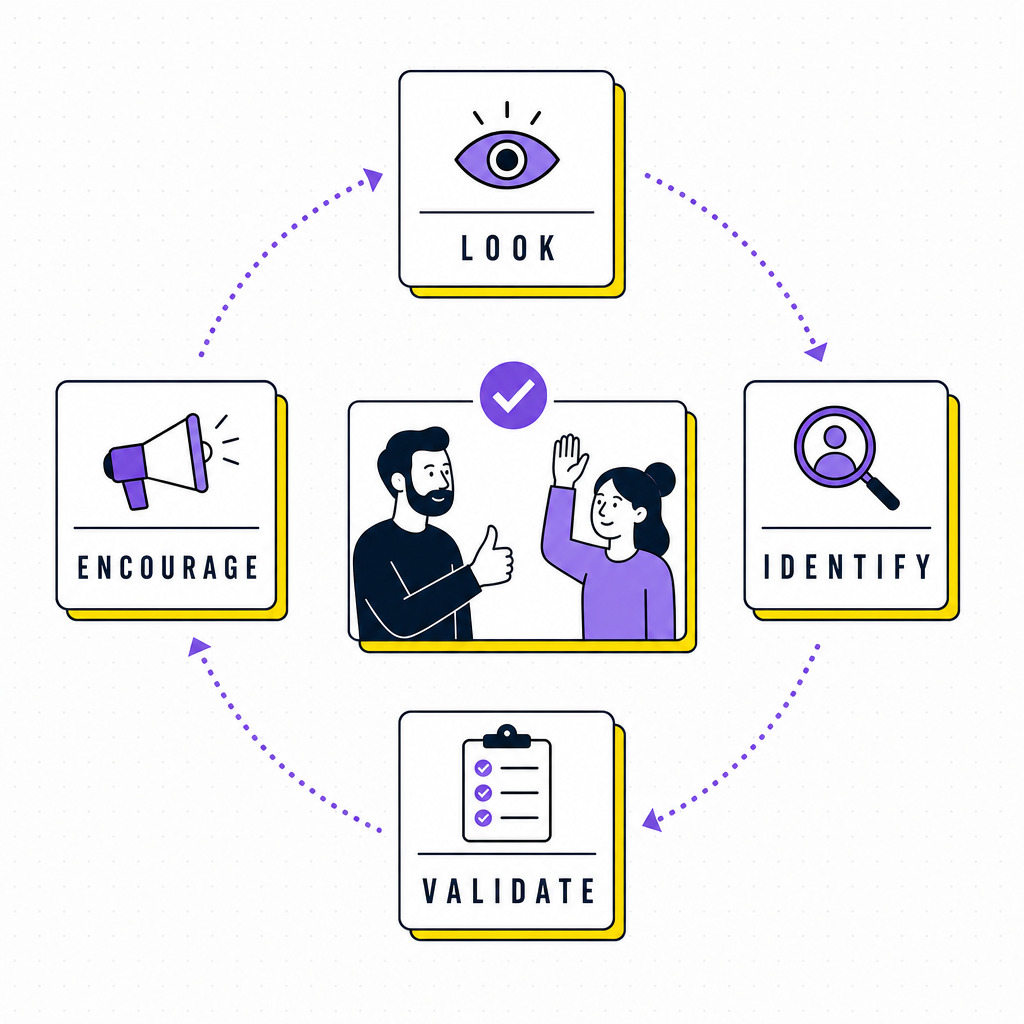
The practical shift is from measuring sentiment once a year to changing micro-behaviours weekly. LeaderFactor packages this as a continuous loop it calls L.I.V.E.: look for moments of vulnerability in a meeting, identify the specific act worth reinforcing, validate it on the spot so the person feels seen, and encourage more of it. The mechanism is simple operant conditioning applied to candour. You are rewarding the exact behaviours each stage needs, in the moment they happen, which is where climate is actually set.
The vendors who teach this report real numbers, with the usual caveat that they are vendor-reported. McKinsey, framing safety as the way out of the “adaptability paradox,” says structured programmes combining it with peer coaching and behavioural nudges produced up to 2.7 times better adaptability and 3 times better performance against control groups. CultureAmp’s case study with the retailer Hanna Andersson, which brought in Clark himself and paired the model with a structured listening framework, reports an 8 percentage point rise in engagement. Atlassian operationalises the same ideas through its open Team Playbook, with blameless post-mortems and retrospective formats like the 4 Ls, loved, loathed, learned and longed for, plus personal user manuals so people state their working styles up front rather than waiting for inclusion to happen by chance. Read these as directional evidence that the model can be operationalised, not as proof of any specific multiplier.
The recent research adds one more reason this matters now. The move to hybrid work introduced proximity bias, the unconscious pull to favour the people physically in the room, which quietly erodes inclusion and contributor safety for remote staff. A 2024 study by Nilsson and colleagues on hybrid teams found that safety did not survive the shift organically; the teams that held onto it leaned on pre-existing relationships and deliberate, structured leadership. Other recent work, including a 2025 longitudinal study in Cogent Psychology, found psychological safety acts as a measurable buffer against the burnout that techno-stress and always-on connectivity produce, partly because people who feel safe will actually push back on unrealistic demands. The way teams talk online is now part of the safety equation, which we cover in nonverbal communication in online meetings.
Frequently asked questions
What are the 4 stages of psychological safety?
The four stages, defined by Timothy Clark in his 2020 book, are inclusion safety (feeling accepted as a member of the group), learner safety (feeling safe to ask questions and make mistakes while learning), contributor safety (feeling safe to use your skills and judgement to do real work), and challenger safety (feeling safe to question the status quo and disagree with authority). They build in order, and each depends on the stage before it.
Who created the four stages of psychological safety?
The four-stage model was created by Timothy R. Clark, an organisational social scientist, in his 2020 book The 4 Stages of Psychological Safety: Defining the Path to Inclusion and Innovation. It builds on the broader psychological safety construct defined by Harvard’s Amy Edmondson in 1999, and earlier work by William Kahn in 1990. Clark’s contribution is the staged progression and the social-exchange logic of respect and permission underneath it.
How is Clark’s model different from Edmondson’s psychological safety?
Edmondson treats psychological safety as a single team climate, a shared belief that it is safe to take interpersonal risks, and her construct has decades of independent academic validation. Clark breaks the same idea into a four-stage developmental sequence and frames it as a leadership practice. The constructs overlap heavily; the difference is that Clark adds an order of progression, which is useful as a diagnostic but has lighter independent evidence than the core climate measure.
What stage is my team stuck at?
Diagnose it from behaviour, not feelings. Cliques, gossip and turnover among different or remote members point to a gap at stage one, inclusion. Hidden mistakes and few questions point to stage two, learner. The same senior voices dominating while others disengage points to stage three, contributor. Public agreement followed by private criticism, the “meeting after the meeting,” points to stage four, challenger. Most teams stall at three or four.
Is the four-stage progression scientifically validated?
The underlying construct is strongly validated, including a 2017 meta-analysis in Personnel Psychology across 136 samples and 22,000-plus people. Clark’s specific four-step ladder is validated mainly in-house by his firm LeaderFactor rather than independently replicated, and external practitioners note that teams oscillate between stages rather than climbing once and staying. Use it as a practical diagnostic map, not as a proven fixed sequence.
Where to start
Pick one stage and one behaviour. Watch your next meeting for the single tell that matters at the stage you suspect you are stuck at: who gets included in the opening minutes, whether anyone admits not knowing something, whether voice is shared or captured, whether anyone disagrees with you and survives it. Then choose one leader move from that stage and run it for a month. Safety is built in those small, repeated moments, not in the offsite.
For the wider evidence and the leader behaviours that cut across all four stages, start with the pillar guide to psychological safety at work. For the conversational mechanics underneath contributor safety, see talking-time imbalance in meetings.
Sources
- Clark, T. R. The 4 Stages of Psychological Safety (model overview). LeaderFactor. https://www.leaderfactor.com/learn/psychological-safety-timothy-clark
- “The 4 Stages of Psychological Safety” (book summary). Shortform. https://www.shortform.com/summary/the-4-stages-of-psychological-safety-summary-timothy-r-clark
- “The Four Stages of Psychological Safety: A Behavioral Guide” (Clark model, 100 behaviours). GM Good Employment Charter. https://www.gmgoodemploymentcharter.co.uk/media/2409/the_four_stages_of_psychological_safety_behavioral_guide.pdf
- “Book review: The 4 Stages of Psychological Safety.” Thor Projects. https://thorprojects.com/2020/10/05/book-review-the-4-stages-of-psychological-safety-defining-the-path-to-inclusion-and-innovation/
- “The 4 Stages of Psychological Safety” (book notes). BeFreed. https://www.befreed.ai/book/the-4-stages-of-psychological-safety-by-timothy-r-clark
- “What Is Psychological Safety at Work?” Center for Creative Leadership. https://www.ccl.org/articles/leading-effectively-articles/what-is-psychological-safety-at-work/
- “Psychological safety” (glossary, Clark + Edmondson). Stimpunks. https://stimpunks.org/glossary/psychological-safety/
- “Four stages of psychological safety in high-risk sites.” HSE Network. https://www.hse-network.com/four-stages-of-psychological-safety-in-high-risk-sites/
- Frazier, M. L., Fainshmidt, S., Klinger, R. L., Pezeshkan, A., and Vracheva, V. “Psychological Safety: A Meta-Analytic Review and Extension.” Personnel Psychology, 2017 (record). ResearchGate. https://www.researchgate.net/publication/305488140_Psychological_Safety_A_Meta-Analytic_Review_And_Extension
- “Frazier et al. 2017” (full text). Scribd. https://www.scribd.com/document/619418692/Frazier-et-al-2017
- “Psychological safety and engagement: the importance of work design” (Frazier-aligned analysis). Journal of Management Development, Emerald. https://www.emerald.com/jmd/article/45/2/151/1311023/Psychological-safety-and-engagement-the-importance
- Psychological safety and voice / engagement evidence review. Old Dominion University Digital Commons. https://digitalcommons.odu.edu/cgi/viewcontent.cgi?article=1018&context=management_fac_pubs
- Psychological safety construct and outcomes (Kahn 1990, Liang et al. 2012 review). IJAPT. https://www.ijapt.org/index.php/journal/article/download/351/290
- “Team psychological safety assessment” (Edmondson 7-item scale). University of South Carolina HR. https://www.sc.edu/about/offices_and_divisions/human_resources/docs/team_psychological_safety_assessment.pdf
- LeaderFactor 4 Stages Team Survey instrument (11-point scale, validation). Reginfo.gov. https://www.reginfo.gov/public/do/DownloadDocument?objectID=125627101
- “The Four Stages of Psychological Safety” (linearity critique, oscillation). PsychSafety. https://psychsafety.com/the-four-stages-of-psychological-safety/
- “Four stages of psychological safety” (stages oscillate, Tuckman comparison). Spill. https://www.spill.chat/company-culture/four-stages-of-psychological-safety
- “4 stages of psychological safety” (conditional dependency framing). Mutomorro. https://mutomorro.com/tools/4-stages-of-psychological-safety
- “The 4 stages of psychological safety” (anxiety quadrant). Noomii. https://orgs.noomii.com/the-4-stages-of-psychological-safety/
- “Psychological safety” (stage-gate diagnostics). Leda. https://getleda.com/psychological-safety
- “Leader’s guide to psychological safety” (facilitation moves). Success Unlimited Mantra. https://www.successunlimited-mantra.com/index.php/blog/leaders-guide-to-psychological-safety-transform-silence-into-innovation-and-fear-into-trust
- “How psychological safety at work spurs innovation” (Fearless Organization, workplace silence). Volaris Group. https://www.volarisgroup.com/acquired-knowledge/how-psychological-safety-at-work-spurs-innovation-and-growth/
- “Future-proof: solving the adaptability paradox” (2.7x / 3.0x figures). McKinsey & Company. https://www.mckinsey.com/capabilities/people-and-organizational-performance/our-insights/future-proof-solving-the-adaptability-paradox-for-the-long-term
- “The new possible: how HR can help build the organization of the future” (learning journeys). McKinsey & Company. https://www.mckinsey.com/capabilities/people-and-organizational-performance/our-insights/the-new-possible-how-hr-can-help-build-the-organization-of-the-future
- “Hanna Andersson” (Clark four stages + LARA, 8pp engagement). CultureAmp case study. https://www.cultureamp.com/case-studies/hanna-andersson
- “How to measure workplace inclusion” (CultureAmp four-level analytics). Edstellar. https://www.edstellar.com/blog/how-to-measure-workplace-inclusion
- “Retrospective play” (blameless post-mortems, 4 Ls). Atlassian Team Playbook. https://www.atlassian.com/team-playbook/plays/retrospective
- “Atlassian and remote work” (Work Life Impact Play). Mural. https://www.mural.co/blog/atlassian-remote-work
- “Building resilient engineering teams” (Atlassian practices in tech). Medium. https://ssocialjustice.medium.com/building-resilient-engineering-teams-lessons-from-22-years-in-tech-22e2063e5808
- “Neurodiversity-affirming approaches at work” (personal user manuals). Diversity Partners. https://diversitypartners.com.au/news-insights/diversity/neurodiversity-affirming-approaches-at-work/
- “Simple rules for psychological safety” (Nilsson et al. 2024 hybrid study, proximity bias). PM Essentials. https://pmessentials.us/simple-rules-psychological-safety/
- “Hybrid work and burnout” (longitudinal study). Cogent Psychology, 2025, Taylor & Francis. https://www.tandfonline.com/doi/full/10.1080/23311908.2025.2454084
- “Psychological safety as a buffer against techno-stress and burnout” (β = -0.41). RCIS. https://www.rcis.ro/images/documente/rcis92_02.pdf
- “Healthy, healthier hybrid work: the burnout-reducing role of job crafting.” International Journal of Workplace Health Management, Emerald. https://www.emerald.com/ijwhm/article/17/4/319/1213444/Healthy-healthier-hybrid-work-the-burnout-reducing
- “How CTOs can prevent burnout in tech teams” (challenger safety and connectivity). Adaptavist. https://www.adaptavist.com/blog/how-ctos-can-prevent-burnout-in-tech-teams
- “Psychological safety and software quality” (Khan et al. systematic review, 2024/2025). arXiv. https://arxiv.org/html/2508.03369v1
See which stage your team is actually stuck at
Team Building Bot sits in your online sessions and reports on the behaviours that map to each stage: who got included, who asked questions, who contributed, and whether anyone challenged the plan. You get a read on where voice stalls instead of guessing from an annual survey. Free during beta.
No spam, no credit card. Unsubscribe any time.