Talking-Time Imbalance in Meetings: What Quiet Tells You
Why unequal talk-time in team meetings predicts worse decisions, what the research on conversational turn-taking says, and how facilitators rebalance the room.
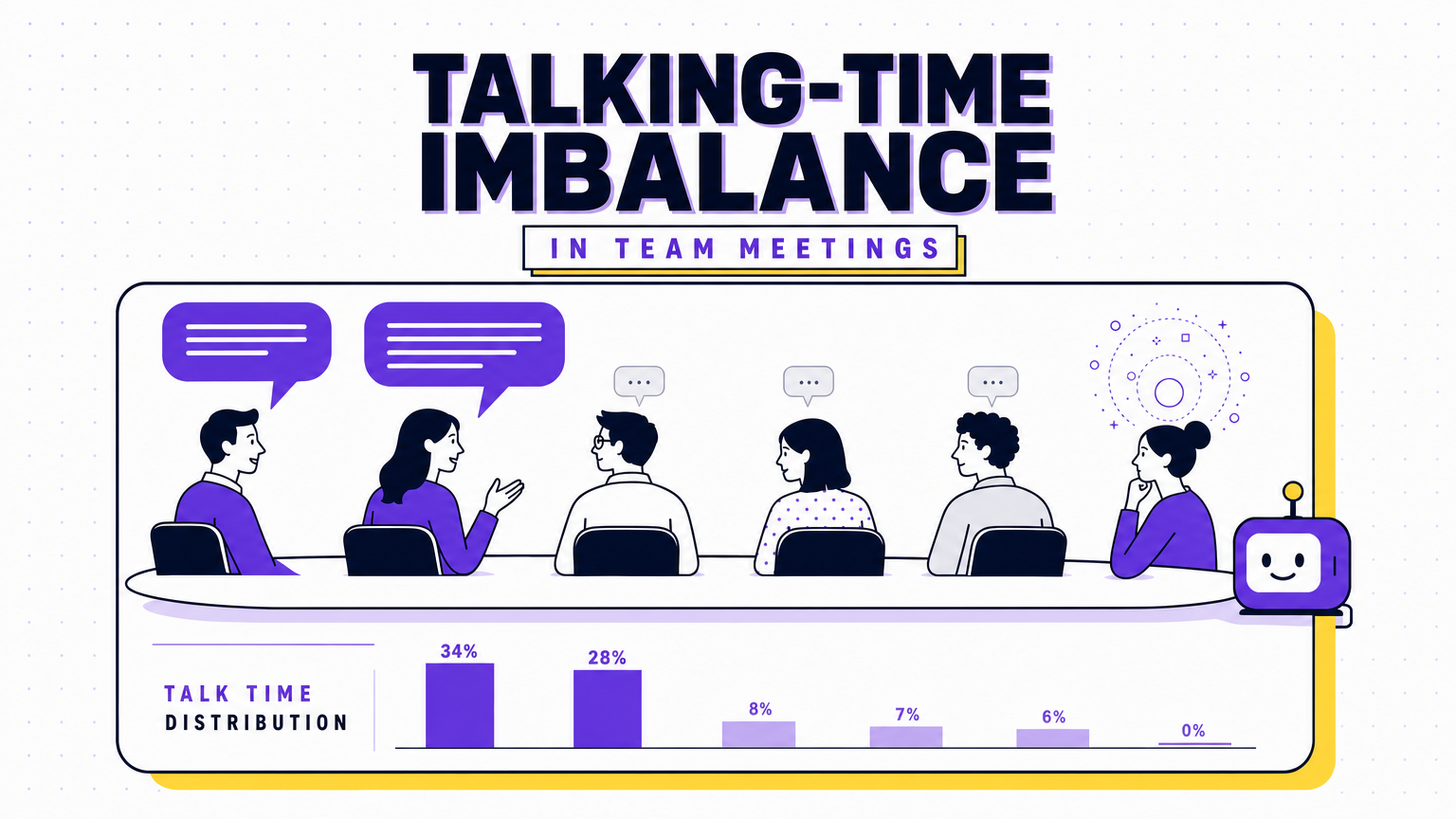
Watch almost any team meeting closely and you will see the same shape. Two or three people carry most of the conversation. A few others speak when asked. And at least one person says almost nothing for an hour, then sends the sharpest message of the day in a private channel afterwards. The imbalance feels normal because it is so common. It is also one of the most reliable predictors of how well that group will actually perform.
This is a guide to talking-time imbalance: what an uneven split of airtime does to a team, what the evidence says about conversational turn-taking, and how a facilitator can rebalance a room in the moment. It sits inside our wider communication styles at work guide, which covers why individual styles collide in the first place. Here the focus is one specific pattern, and what the quietest person in the room is usually telling you.
The short answer
Talking-time imbalance is when a small number of people consume most of the speaking time in a meeting while the rest stay quiet. It matters because the equality of conversational turn-taking, how evenly people get to speak, is one of the strongest known predictors of a group’s collective intelligence. When a few voices dominate, the group makes worse decisions than the talent in the room should produce.
The landmark finding comes from Anita Woolley, Thomas Malone and colleagues, writing in Science in 2010. Across 192 groups, they found a single statistical factor, which they called collective intelligence, that predicted how well a team performed across many different tasks. It correlated only weakly with the average or maximum individual intelligence of members. What it correlated strongly with was social sensitivity and the equality in distribution of conversational turn-taking. Groups where one or two people dominated the discussion were measurably less intelligent as a group than groups where the conversation moved around.
So the quiet person is not a side issue. In a balanced room, their contribution is part of what makes the group smart. In an imbalanced one, the fact that they have gone silent is a signal worth reading.
What “imbalance” actually looks like
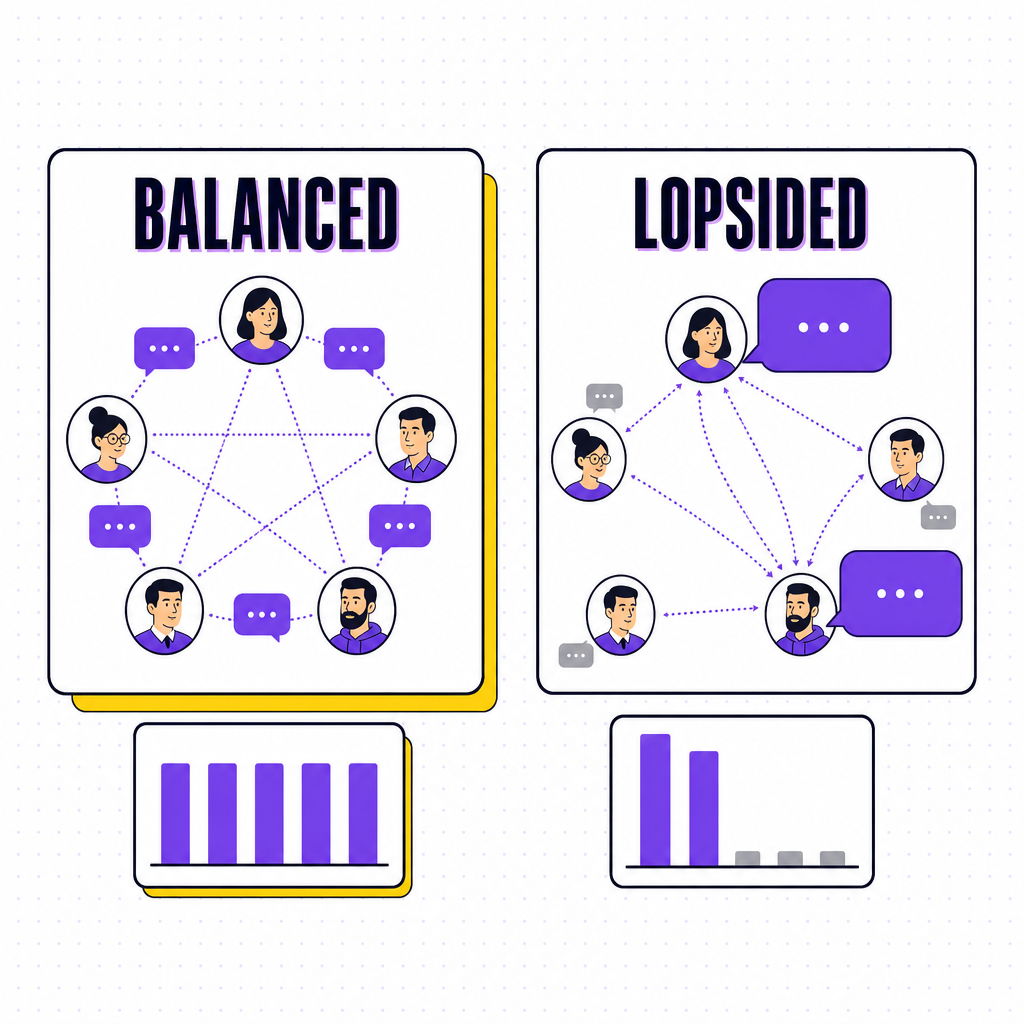
People reach for the 80/20 shorthand here: 20% of the people doing 80% of the talking. Treat that as a rough mental picture rather than a measured law. The real number varies by team, meeting type and culture, and most meetings have never been measured at all. What is consistent is the direction. Left unmanaged, group conversation concentrates. The fastest processors and the most senior people take the floor, and the gap between the top talkers and the silent tail widens over the course of a meeting rather than closing.
Two forces drive the concentration. The first is structural: an unmanaged meeting is a free-for-all, and a free-for-all rewards whoever is quickest to speak and least worried about interrupting. The second is cultural. In many fast-paced organisations, speaking quickly and filling silence reads as confidence and competence, while pausing to think reads as hesitation. The reward goes to the loudest, not the most considered, and the pattern reinforces itself meeting after meeting.
The cost is not just unfairness. When a dominant speaker consumes the airtime, the group hears fewer alternative perspectives, which pushes it toward premature consensus. Cognitive diversity is the thing that catches hidden risks and surfaces better options, and it is exactly what gets squeezed out when one voice fills the room. The harm lands unevenly too: people who are more likely to be interrupted or talked over in the first place, including more junior and underrepresented colleagues, lose the most airtime, so the imbalance compounds existing bias rather than correcting it.
Decoding the quietest person in the room
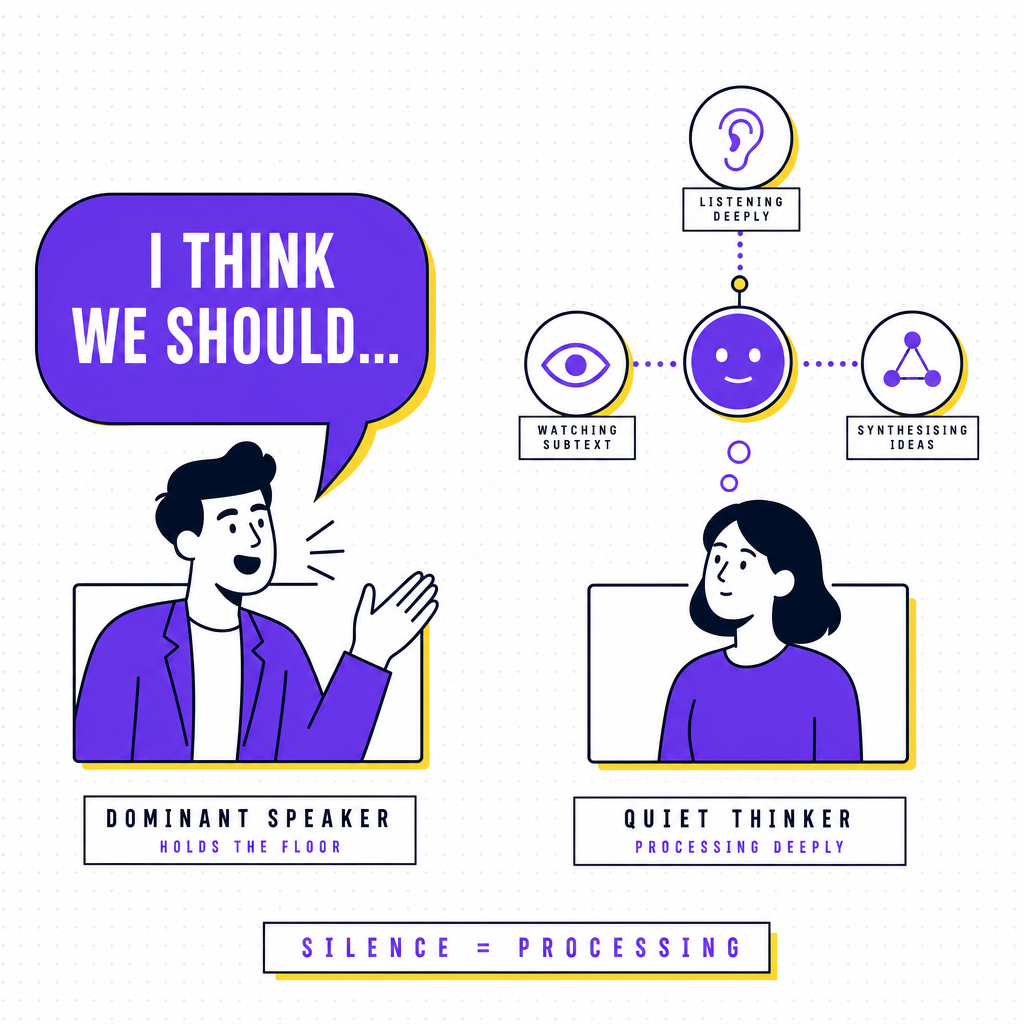
The easiest mistake a dominant talker makes is to read silence as absence. The quiet person gets labelled disengaged, shy, short on expertise, or not a team player. Usually none of that is true.
Silence in a functioning group is often an active state, not an empty one. People who process before they speak are doing work that fast talkers skip while they hold the floor. They are encoding what was said at a deeper level, relating it to the wider context rather than scanning for a gap to jump into. They have the spare attention to monitor the subtext of the room, the shift in posture, the tone that went flat, the question nobody answered. And they are synthesising, tracking who is actually listening versus waiting for their turn, and connecting the start of the conversation to where it has drifted.
There is a temperament dimension to this. Research on introversion and extraversion has long suggested that more introverted people tend to process information more internally and deliberately before speaking, which in a fast meeting reads as slowness when it is often depth. The practical implication is the same regardless of the underlying mechanism: a meeting structured to reward the first and fastest voice will systematically lose the input of the people doing the most careful thinking.
That is why the quiet person so often holds the most useful information. In a retrospective, a planning session, or a post-mortem, the participant who spent the hour evaluating the whole board rather than defending their own piece is frequently the one who can name the real blocker. Some research on workplace candour suggests a large share of employees self-censor at work because speaking up feels socially risky, which means the insight exists but never reaches the room. When a facilitator draws it out, it tends to be disproportionately valuable precisely because it was nearly lost.
How software started measuring talk-time
For most of the history of meetings, talk-time was invisible. You felt that someone had dominated, but you could not point to a number. That has changed fast over the last two years, as a wave of AI meeting tools began turning conversation into measurable data.
The most mature work sits in sales. Conversation-intelligence platforms such as Gong built their reputation on the talk-to-listen ratio, measuring how long a sales rep speaks versus listens and whether they pause after a customer raises an objection rather than talking straight over it. That kind of analytics carries an enterprise price tag, often well over a thousand dollars per seat per year, which tells you how much value revenue teams place on getting the balance right. Mid-market tools like Fireflies.ai and MeetGeek brought talk-time tracking and sentiment analysis to internal team meetings at a far lower cost, while general transcription tools such as Otter.ai put speaker identification on the map without the deeper behavioural layer.
Platform vendors have joined in. In late 2024 Microsoft rolled out Speaker Coach and Speaker Progress features in Teams that give presenters private feedback on pace, with a recommended speaking rate in the region of 100 to 165 words per minute, along with nudges on monotone delivery and filler words. Visual collaboration tools like Miro added facilitation features, such as anonymous voting and timers, that mechanically spread participation rather than just reporting on it after the fact.
Two cautions sit underneath all of this. The first is that measurement is not the same as fixing. A talk-time dashboard tells you the room was lopsided; it does not rebalance the room. The second is trust. If people feel that participation analytics are a surveillance tool used to police them, they will perform for the metric or reject it outright. The deployments that work treat the data as a private coaching signal for the individual and the facilitator, not a scoreboard for management. We go deeper on how that intersects with candour in our piece on team communication breakdown warning signs.
Five ways to rebalance a meeting in the moment
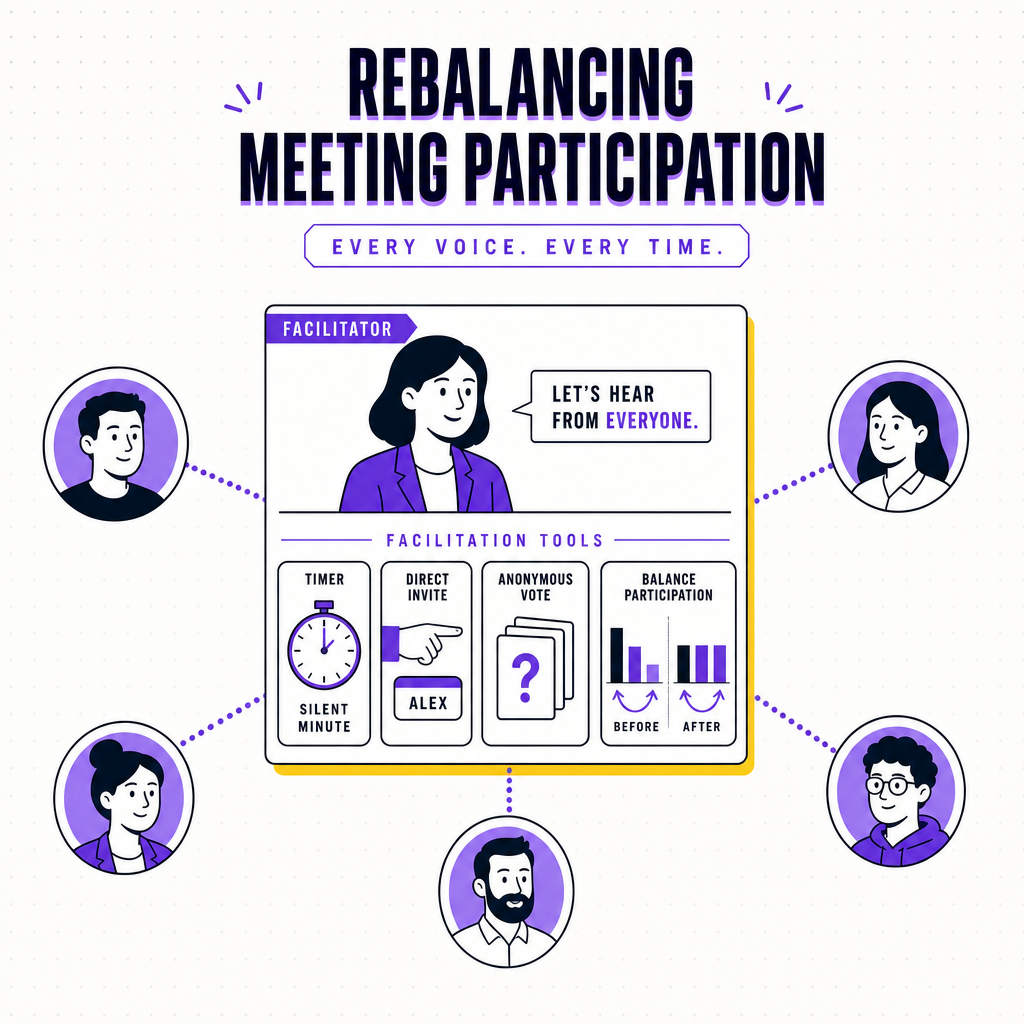
Diagnosis is the easy half. The harder and more valuable half is intervention, the things a leader or facilitator does mid-meeting to widen participation. These five are well supported and quick to apply.
1. Open with silence, not a question
Starting a discussion with “any thoughts?” hands the floor to the fastest reactor. Replace it with a short, structured pause: “Let’s take sixty seconds to read this and write down one reaction before anyone speaks.” The silent minute equalises the starting line. Deliberate processors get time to form a view, and the first voice is no longer simply the quickest one.
2. Invite specific people by their expertise
A general invitation gets a general non-response. A specific one works: “Sarah, you have the clearest view of the technical dependencies here, how does this land for you?” Naming the person and the reason gives them a legitimate reason to speak and signals that their silence was noticed and their input wanted. Use it deliberately on the people the room tends to talk over.
3. Decouple ideas from identity
When hierarchy is the thing keeping people quiet, anonymity is the lever. Anonymous input, whether through a quick poll, a written round, or the voting features in a virtual whiteboard, lets people contribute without the social cost of contradicting a senior colleague out loud. Once the ideas are on the board without names attached, the group can argue about what is right rather than who said it.
4. Read the spread, do not average it
In estimation or decision rounds, a wide spread of views is a gift, not a problem to smooth over. If half the room rates a risk low and half rate it high, the disagreement is information. A weak facilitator rushes to a compromise number. A strong one stops and asks the outliers to explain, because the gap usually hides an unvoiced assumption or a dependency nobody has named.
5. Watch your own share of the airtime
If you are leading and you are speaking more than roughly a fifth of the time, you are probably part of the imbalance. Leaders set the ceiling for everyone else: the more space you take, the less anyone junior will claim. Cutting your own talk-time is often the single most powerful change you can make, and it costs nothing but restraint.
Why this matters for L&D, HR and coaches
For the people who buy and run team development, talk-time balance is more than a facilitation nicety. It is one of the few behavioural signals that connects directly to outcomes you already care about.
Leadership and inclusion training has always struggled to prove that it changed anything. Satisfaction surveys measure whether people enjoyed the session, not whether a manager actually learned to yield the floor. A manager’s talk-to-listen ratio, measured before and after a programme, is a concrete behavioural marker of whether the training transferred into the room. It moves the conversation from “people liked it” to “people behave differently.”
There is an organisational-capacity angle too. Time spent in meetings has climbed sharply over the past two decades, and a meeting where most attendees are silent is often a meeting that did not need most of those attendees. Talk-time data helps separate the sessions where broad participation is the point from the recurring status calls where it is just calendar drag, which is a direct route to giving people back time for focused work.
The honest caveat is that none of this works as a stick. The moment participation metrics feel punitive, you get performative meetings and quiet resentment. Used as a mirror, held by the team and its facilitator rather than wielded from above, the same data builds the kind of psychologically safe room where the quiet person finally speaks. For more on the habits underneath that, see our guide to interpersonal communication at work, and for the mechanics of running the room, meeting facilitation skills and patterns.
Frequently asked questions
What is talking-time imbalance in a meeting?
Talking-time imbalance is when a small number of participants use most of the available speaking time while the rest contribute little or nothing. It tends to develop on its own in unmanaged meetings, because the format rewards whoever speaks fastest and most readily, and the gap between the dominant voices and the quiet majority usually widens as the meeting goes on.
Does unequal participation actually hurt team performance?
Yes, according to the research on collective intelligence. Anita Woolley, Thomas Malone and colleagues, in Science (2010), found that a group’s collective intelligence depended heavily on the equality of conversational turn-taking and on social sensitivity, far more than on the average IQ of the members. Groups dominated by one or two speakers performed worse across varied tasks than groups where airtime was spread more evenly.
Why is the quietest person in a meeting often worth listening to?
Because silence in a functioning group is frequently an active state, not disengagement. Quiet participants tend to process information more deeply, monitor the unspoken dynamics of the room, and synthesise the whole conversation rather than defending a single position. In retrospectives and problem-solving sessions, they often hold the clearest view of the real blocker, simply because they spent the meeting observing rather than competing for the floor.
How can a facilitator get quieter people to speak up?
Use structure rather than pressure. Open with a short silent writing period so deliberate thinkers can form a view, invite specific people by naming their relevant expertise, and offer anonymous channels such as polls or written rounds so people can contribute without the social risk of contradicting a senior colleague. Leaders should also watch and cut their own share of the talk-time, since that sets the ceiling for everyone else.
Can software measure meeting talk-time?
Yes. A wave of AI meeting tools now measures talk-time, from sales-focused conversation-intelligence platforms that track talk-to-listen ratios to team tools that report per-participant speaking time, and platform features like Microsoft Teams Speaker Coach. The important limit is that measurement only diagnoses the imbalance. It works best as a private coaching signal for the individual and facilitator rather than a management scoreboard, which tends to produce performative meetings.
Where to start
Pick your next meeting and just count. Notice who carries the conversation and who never gets in. If two voices are doing most of the talking, you have found a lever that pulls on decision quality, inclusion and trust at once, and the fixes above cost nothing but a change in how you run the room.
For the bigger picture of how communication styles create these patterns, see our communication styles at work guide. For the early signals that a team’s communication is failing more broadly, our piece on team communication breakdown warning signs goes wider.
Sources
- Woolley, A. W., Chabris, C. F., Pentland, A., Hashmi, N., and Malone, T. W. “Evidence for a Collective Intelligence Factor in the Performance of Human Groups.” Science, 2010. https://ofew.berkeley.edu/sites/default/files/evidence_for_a_collective_intelligence_factor_in_the_performance_of_human_groups_woolley_et_al.pdf
- Woolley, A. W. et al. “Evidence of a Collective Intelligence Factor in the Performance of Human Groups” (record). PubMed. https://pubmed.ncbi.nlm.nih.gov/20929725/
- Woolley, A. W., Aggarwal, I., and Malone, T. W. “Collective Intelligence in Teams and Organizations.” MIT. https://web.mit.edu/curhan/www/docs/Articles/15341_Readings/Collective_Intelligence/Woolley_Aggarwal_Malone_Collective%20Intelligence%20in%20Teams%20and%20Organizations.pdf
- “Evidence of a Collective Intelligence Factor in the Performance of Human Groups” (record). ResearchGate. https://www.researchgate.net/publication/47369848_Evidence_of_a_Collective_Intelligence_Factor_in_the_Performance_of_Human_Groups
- Engel, D. et al. “Reading the Mind in the Eyes or Reading between the Lines? Collective Intelligence in Online and Face-to-Face Groups.” PLOS ONE. https://journals.plos.org/plosone/article?id=10.1371/journal.pone.0247655
- “Collective intelligence” (overview and references). Wikipedia. https://en.wikipedia.org/wiki/Collective_intelligence
- “Meeting effectiveness and inclusiveness: large-scale measurement, identification of key features, and prediction in real-world remote meetings.” ResearchGate. https://www.researchgate.net/publication/369760133_Meeting_effectiveness_and_inclusiveness_large-scale_measurement_identification_of_key_features_and_prediction_in_real-world_remote_meetings
- “Reclaiming organizational capacity” (collaboration overload and meeting load). Deloitte Insights, 2025. https://www.deloitte.com/us/en/insights/topics/talent/human-capital-trends/2025/reclaiming-organizational-capacity.html
- “Unpacking the meeting-load paradox: impacts on employees.” Management Research Review (Emerald). https://www.emerald.com/mrr/article/48/6/940/1274806/Unpacking-the-meeting-load-paradox-impacts-on
- “Otter vs Gong vs alternatives” (talk-time ratio and conversation intelligence). nimitai. https://nimitai.com/blog/otter-vs-gong-vs-nimitai
- “Best AI meeting assistant, enterprise 2026” (conversation-intelligence landscape). zackproser. https://zackproser.com/blog/best-ai-meeting-assistant-enterprise-2026
- “Best AI meeting tools 2026” (talk-time and participation analytics). aivario. https://aivario.com/blog/best-ai-meeting-tools-2026
- “Top Gong alternatives 2026” (conversation-intelligence platforms). proshort. https://proshort.ai/resources/blog/top-gong-alternatives-in-2026-9-conversation-intelligence-platforms-worth-exploring
- “Speaker Progress in Microsoft Teams for Education now globally rolled out.” Texas State Digital Trends. https://digitaltrends.wp.txstate.edu/2024/08/13/speaker-progress-in-microsoft-teams-for-education-now-globally-rolled-out-and-generally-available/
- “Speaker Progress for Microsoft Teams available worldwide.” UC Today. https://www.uctoday.com/unified-communications/speaker-progress-for-microsoft-teams-available-worldwide/
- “Microsoft Teams for Education adds Speaker Progress.” Neowin. https://www.neowin.net/news/microsoft-teams-for-education-adds-speaker-progress-to-help-improve-public-speaking/
- “Miro Recap 2025” (participation and collaboration analytics). Miro Help. https://help.miro.com/hc/en-us/articles/31564910762770-Miro-Recap-2025
- “Team Voice” (anonymous input and self-censorship at work). performalise. https://performalise.com/platform/team-voice
- “Psychology says people who fall silent in group conversations are processing at depth.” The Economic Times. https://m.economictimes.com/us/news/psychology-says-people-who-fall-silent-in-group-conversations-arent-withdrawn-or-disengaged-theyre-processing-at-a-depth-most-rooms-dont-recognize-and-their-silence-is-often-the-deepest-form-of-attention/articleshow/131547661.cms
- “Why the quietest person in the room may be the most socially intelligent.” Medium (Public Library SG). https://medium.com/publiclibrarysg/why-the-quietest-person-in-the-room-may-just-be-the-most-socially-intelligent-0a8a04ef99e3
More on Communication Styles
- arrow_forward 8 Warning Signs of Team Communication Breakdown in 2026
- arrow_forward Nonviolent Communication at Work: Conflict Scripts for 2026
- arrow_forward Nonverbal Communication in Online Meetings: What Survives the Screen
- arrow_forward Assertive Communication: 30 Phrases That Work in 2026
- arrow_forward Interpersonal Communication at Work: 7 Habits of Trusted Colleagues
- menu_book Communication Styles at Work: The Complete 2026 Guide Pillar
See who actually spoke in your last meeting
Team Building Bot sits in your online sessions and measures talk-time for every participant: who carried the room, who went quiet, and where the balance tipped. You get a Team Dynamics report after each session instead of guessing. Free during beta.
No spam, no credit card. Unsubscribe any time.