Meeting Facilitation: Skills, Patterns, and Pitfalls
A pillar guide to meeting facilitation: the core skills, the patterns that structure good discussion, the pitfalls that derail meetings, and the evidence.
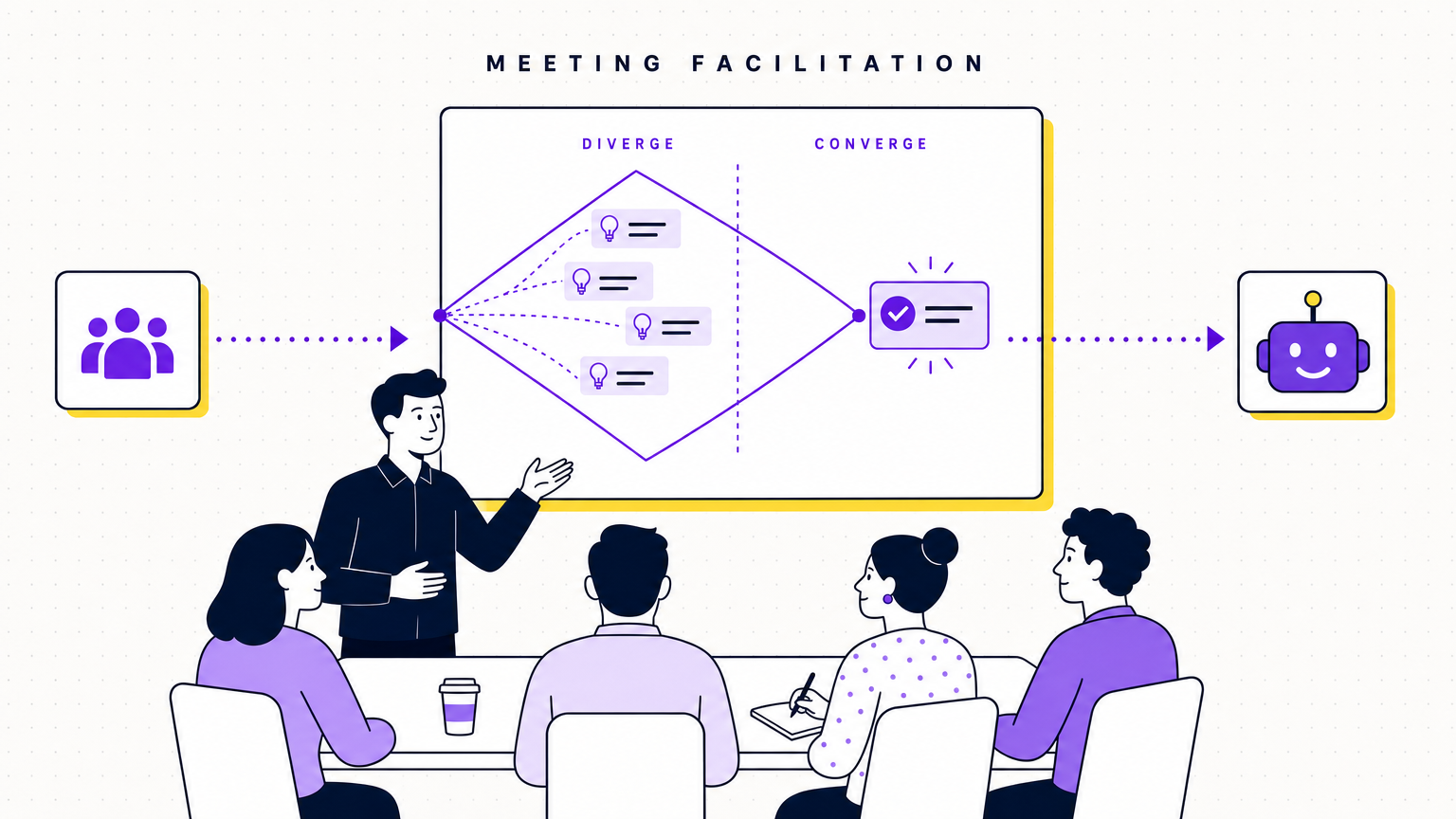
If you run meetings for a living, or you are the person an organisation turns to when a session has to produce a real decision, facilitation is the skill that separates a productive ninety minutes from a polite waste of everyone’s time. Most people have never been taught it. They were handed an agenda, a room, and the assumption that running a good meeting is just a matter of being organised and reasonably likeable.
It is not. Meeting facilitation is a distinct craft with its own skills, its own repeatable patterns, and its own well-documented ways of going wrong. This guide is the pillar reference for the whole topic: what facilitation actually is, the evidence on why it matters, the core skills, the process patterns that structure good discussion, the pitfalls that quietly kill meetings, and how the job is changing as work goes hybrid and AI moves into the room.
It is written for L&D, HR, coaches, and facilitators who want to use this in real sessions, not just nod along to it.
The short answer
Meeting facilitation is the practice of guiding a group through a conversation so it reaches a useful outcome, while staying neutral on the content. The facilitator owns the process, how the discussion is structured, sequenced, and closed, and the group owns the decision. That single split, process versus content, is what makes facilitation different from chairing, managing, or presenting.
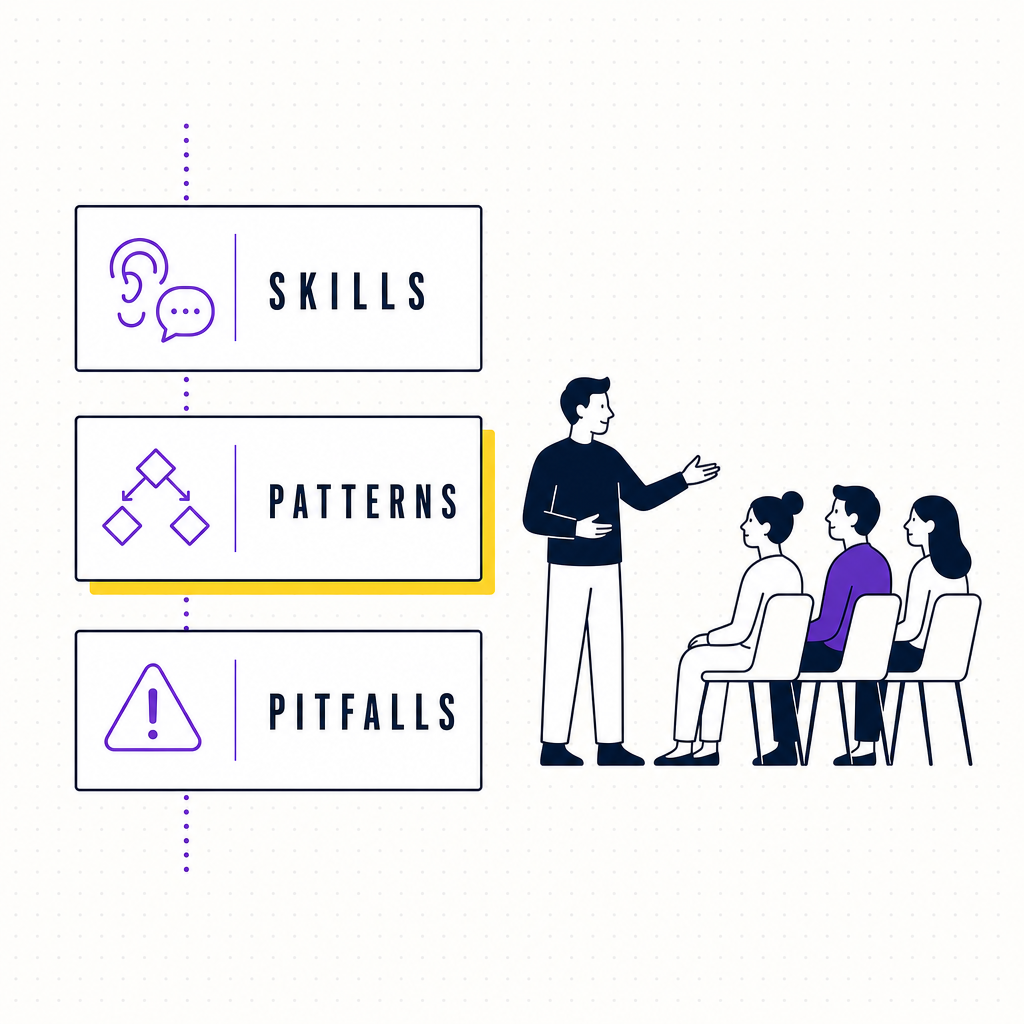
Good facilitation rests on three layers:
| Layer | What it covers | Why it matters |
|---|---|---|
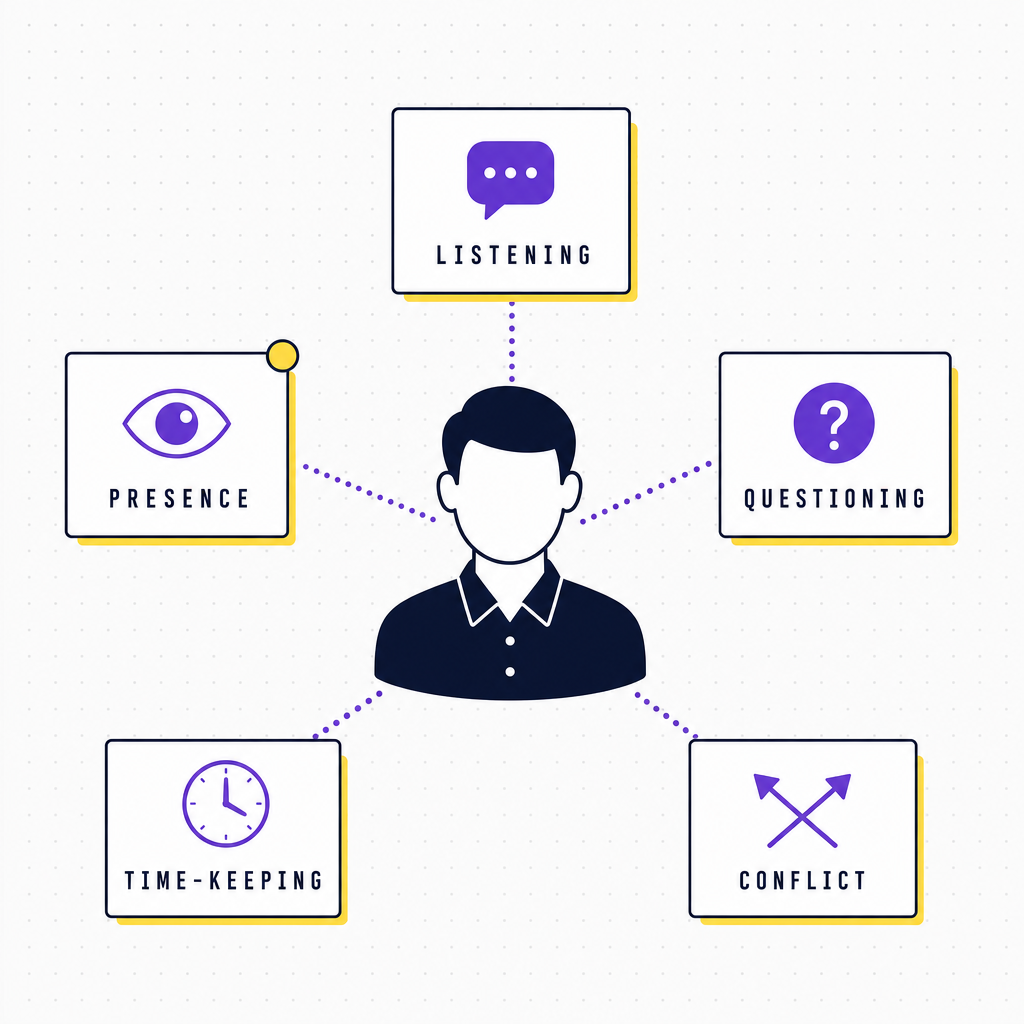
| Skills | Presence, neutrality, active listening, questioning, sequencing, time-keeping, conflict-handling, summarising | The minute-by-minute behaviours that keep a group safe, focused, and moving |
| Patterns | Open / explore / close, divergent then convergent thinking, structured methods like ORID and 1-2-4-All | Repeatable structures that route a group from a messy start to an owned decision |
| Pitfalls | Over-facilitating, hijacks, side conversations, groupthink, ignoring quiet voices, no clear owner | The predictable failure modes that turn a well-planned session into a circular one |
The rest of this guide unpacks each layer, with the evidence behind why structured facilitation outperforms the alternative of hoping a smart group will sort itself out.
What meeting facilitation actually is
The word comes from the Latin facilis, to make easy. A facilitator makes it easier for a group to think together. The International Association of Facilitators, the main professional body for the field, defines a facilitator as someone who designs and runs the process of a group’s work while remaining substantively neutral, holding no decision-making power over the content and no stake in which option the group chooses.
That neutrality is the whole point, and it is what most people get wrong. When the person running the meeting also has the strongest opinion about the answer, the group reads the room and quietly converges on the boss’s view. The facilitator’s job is to protect the conversation from that gravity, to make sure the quiet engineer’s objection gets the same airtime as the loudest voice, and to keep the group honest about whether it has actually decided anything.
It helps to define facilitation against the three roles it gets confused with.
- Facilitator versus chair. A chair runs the meeting by the rules and often has a vote or a casting say. A facilitator runs the process and abstains from the content.
- Facilitator versus manager. A manager owns the outcome and is accountable for it. When a manager facilitates their own team’s decision, they are wearing two hats, and the team knows it. Naming that openly, or bringing in a neutral third party for high-stakes sessions, is one of the most useful moves in the craft.
- Facilitator versus presenter. A presenter pushes information out to an audience. A facilitator pulls thinking out of a group. The direction of flow is reversed.
A clean way to hold the distinction: the facilitator is responsible for how the group works, never for what it concludes.
Why facilitation matters: the meeting-science evidence
Meetings are where most organisational work now happens, and a large share of that time is wasted. Steven Rogelberg, the organisational psychologist who has done more than anyone to build a science of meetings, summarises the research bluntly in The Surprising Science of Meetings: managers consistently rate around half of their meetings as poor or ineffective, employees spend a growing slice of the working week in them, and the cumulative cost to the economy runs into the hundreds of billions. Bad meetings are not a minor annoyance. They are one of the largest unaudited line items in white-collar work.
The discipline studying this is now mature. In Thirty Years of Meeting Science: Lessons Learned and the Road Ahead, Rogelberg, Joseph Allen, and colleagues lay out a body of evidence showing that meeting quality is not random. It is driven by design choices, things a facilitator controls, such as whether there is a clear purpose, whether the right people are present, whether airtime is distributed, and whether the session ends with owned actions rather than a vague sense of agreement.
The closely related research on structured debriefs gives the clearest numbers on what facilitation buys you. Tannenbaum and Cerasoli’s 2013 meta-analysis in Human Factors, summarised in Rice University’s widely quoted write-up, found that teams which ran a structured debrief outperformed those that did not by roughly 20 to 25 per cent. The technique itself is simple. The gain comes almost entirely from running the conversation with structure and discipline rather than letting it happen by default. That is facilitation, measured.
The buyer-side takeaway is direct. If you can move even a fraction of your organisation’s meeting time from ineffective to effective, the return dwarfs the cost of the facilitation skill that gets you there.
The core facilitation skills
Patterns and frameworks get the attention, but they fail without the underlying skills. These are the behaviours a good facilitator runs almost continuously, often without the group noticing.
Presence and neutrality
Presence is the capacity to stay fully attentive to the room, to track not just what is being said but who has gone quiet, where the energy dropped, and when the real disagreement is being talked around. Neutrality is the discipline of holding your own opinion out of the conversation. Both are harder than they sound, and both erode the moment you start caring more about the answer than the process.
Active listening and reflecting back
The single most useful facilitation move is to summarise what someone just said and check that you got it right. It does three things at once: it shows the speaker they were heard, it gives the group a shared, accurate version of the point, and it slows a fast conversation down enough to think. Reflecting back, paraphrasing, and naming the underlying concern are the bread and butter of the job.
Questioning and sequencing
A facilitator works mostly through questions, not statements. Open questions to widen the thinking, focusing questions to narrow it, and probing questions to push past the first plausible answer. Sequencing is the higher-order version of this: deciding what question the group tackles first, second, and last, so the conversation builds instead of looping. A well-sequenced agenda does half the facilitation before the meeting starts.
Time-keeping and the agenda
Time is the facilitator’s main lever. A visible agenda with rough timeboxes, and the willingness to actually hold them, is what stops a single item from eating the session. Good facilitators use a parking lot, a visible list where off-topic but valuable points get written down and deliberately deferred, so the contributor feels heard without the meeting being derailed.
Conflict-handling and drawing out the quiet
Disagreement is not the problem; suppressed disagreement is. A facilitator surfaces conflict early, while it is still about ideas, and keeps it from curdling into something personal. The mirror skill is drawing out the people who have not spoken. In any group, a few confident voices will fill the space and the rest will hold back, and a decision that only hears the loud half is a worse decision. Round-robins, direct invitations, and silent written input are all ways to rebalance the floor.
The core patterns and frameworks
Skills keep a meeting safe and focused. Patterns give it shape. These are the repeatable structures experienced facilitators reach for, and learning a handful of them is what lets you walk into an unfamiliar group and still run a good session.
Open, explore, close
The most portable pattern in facilitation is the three-part arc. You open by setting the purpose, the desired outcome, and the ground rules, so everyone knows what the session is for and how it will run. You explore in the long middle, where the real thinking happens. You close by converging on a decision, capturing owned actions, and confirming next steps. Most failed meetings skip the open or the close and live entirely in a shapeless middle.
Divergent and convergent thinking, and the groan zone
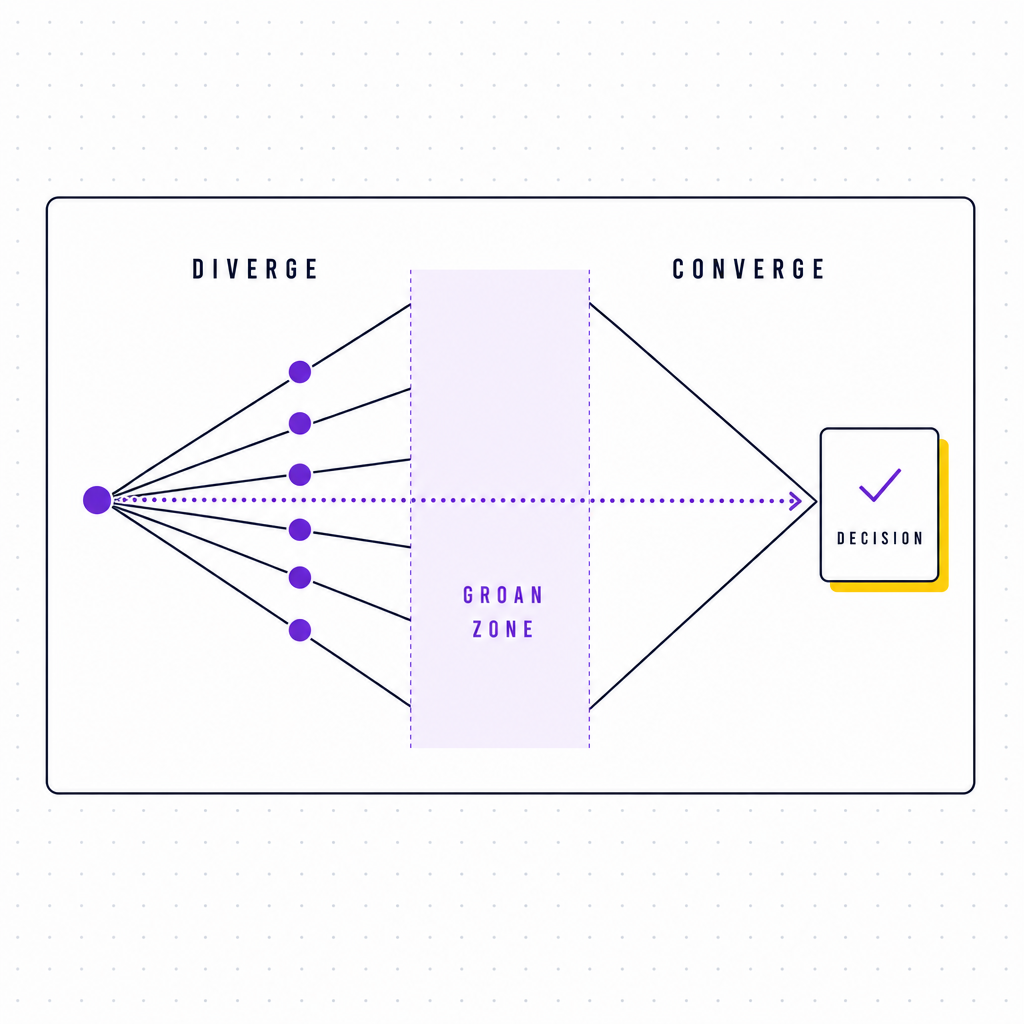
Underneath that arc is the most important idea in modern facilitation, drawn from Sam Kaner’s Facilitator’s Guide to Participatory Decision-Making. Good group thinking moves through two distinct modes. First divergent thinking, where the group generates options widely and withholds judgement. Then convergent thinking, where it evaluates, narrows, and decides. Kaner draws this as a diamond: the conversation fans out, then funnels in.
The part everyone underestimates is the middle. Kaner calls it the groan zone, the uncomfortable stretch where a pile of divergent ideas has to become a single shared decision, and the group feels stuck, frustrated, and tempted to grab the first easy answer. The instinct is to rush through it. The facilitator’s job is the opposite: to recognise the groan zone as a normal, necessary phase and to hold the group in it long enough to reach real, shared understanding rather than false consensus. A group that learns to tolerate the groan zone makes markedly better decisions.
Structured conversation: the ORID method
When you need a discussion to move from raw reaction to grounded decision, the ORID method gives you a reliable sequence of questions. Developed by the Institute of Cultural Affairs and also called the focused conversation method, ORID walks a group through four levels in order: Objective (what are the facts, what did we observe), Reflective (how do we feel about it, what is our gut reaction), Interpretive (what does it mean, what are the implications), and Decisional (what do we do about it). The discipline is in the order. Groups that jump straight to the decisional level argue about conclusions before they have agreed on the facts. ORID forces the foundation first.
Generating ideas without the loudest voice winning
Open brainstorming has a well-known flaw: the first idea anchors the group, and the most confident person dominates. Structured generation techniques fix this by separating individual thinking from group discussion.
- Brainwriting has everyone write ideas silently before any are spoken, so the quiet contributors and the introverts are not crowded out. The classic 6-3-5 variant, six people, three ideas each, passed on five times, can produce over a hundred ideas in half an hour.
- 1-2-4-All, one of the Liberating Structures, ramps participation: people reflect alone, then in pairs, then in fours, then the whole group, so every voice has already been heard in a small group before the plenary discussion starts.
- Dot voting converges the long list. Each person gets a fixed number of votes to place on the options they favour, and the pattern of dots makes the group’s priorities visible in seconds.
Deciding on purpose: choosing a decision rule
The most common reason a meeting ends without a real decision is that nobody agreed how the decision would be made. Before you converge, name the rule. Is this a consensus decision, where everyone has to actively agree? A consent decision, the lighter sociocratic version, where you proceed unless someone has a reasoned objection? A vote? Or is one person the decider, taking input and then choosing? None of these is wrong, but using the wrong one, or leaving it implicit, is how groups end up relitigating a decision three meetings later.
The pitfalls that quietly kill meetings
Most meeting failures are not exotic. They are the same handful of patterns, repeated. Knowing them by name is the first step to catching them in the moment.
Over-facilitating. The beginner’s mistake is to intervene too much, narrating every transition and over-structuring every minute until the group stops thinking and waits to be told what to do. The skill is knowing when to step back and let a productive conversation run.
Letting the meeting get hijacked. One person rides a hobby-horse, or a tangent swallows the agenda. The parking lot is the antidote: capture the point visibly, acknowledge it, and defer it, so the contributor feels respected and the session stays on track.
Side conversations and fractured attention. When the room splinters into pairs, the shared thread is lost. A short, direct re-gather, or a deliberate move to silent individual input, pulls the focus back.
Groupthink and anchoring. When a group converges too fast on the first idea, or on the senior person’s preference, it stops genuinely evaluating. The structured generation techniques above exist precisely to break this, by getting independent thinking onto the table before discussion can anchor it.
Ignoring the quiet voices. A decision that only the confident half of the room shaped is a worse decision and a less committed one. Actively drawing out the people who have not spoken is not politeness, it is decision quality.
No clear decision or owner. The most common failure of all. The meeting ends on a warm note of apparent agreement, and a week later nothing has happened because no one named what was decided, who owns it, or by when. Closing hard, with an owned action list, is the step that turns a conversation into a result.
How facilitation is changing: hybrid, async, and AI
The mechanics of facilitation are being reshaped by where and how teams now meet.
Hybrid and remote. Facilitating a session where some people are in a room and others are on a screen is genuinely harder, because the remote participants are easy to forget and quick to disengage. The discipline that works is to level the playing field deliberately: run more of the session through shared digital surfaces that everyone, in-room or remote, uses equally, and check in with the remote voices by name rather than waiting for them to break in.
Asynchronous facilitation. A growing number of organisations, with all-remote companies like GitLab and Doist as the documented pioneers, have pushed work that does not need real-time discussion out of meetings entirely and into written, asynchronous threads. The facilitator’s role shifts from running a live room to designing a good written prompt, setting a clear deadline, and synthesising the responses. The meeting is reserved for the genuinely interactive part: the decision, the debate, the relationship.
AI in the room. AI meeting assistants and notetakers are now common, and they change what a facilitator has to hold in their head. Used well, they take the friction out of capture, transcribing the discussion, drafting the summary, and tracking the action items, so the human can spend their attention on the part that needs judgement: reading the room, managing the conflict, drawing out the quiet voice. The limits are real. Current tools still struggle to attribute speech reliably, tend towards generic summaries, and are blind to the non-verbal signals a facilitator reads instinctively. The sober industry view, echoed in 2025’s reporting on enterprise AI adoption, is that most AI pilots underdeliver when they are bolted on without rethinking the workflow. Treat these tools as support for the facilitator, not a replacement for one.
Why this matters for L&D, HR, and coaches
If you are responsible for how teams work and decide, facilitation is one of the highest-return capabilities you can build, in yourself and in your managers. It is teachable, the evidence that structured sessions outperform unstructured ones is strong, and the cost of getting it wrong, measured in wasted meeting hours, is enormous and almost entirely invisible on any budget.
The hard part is not the techniques. It is seeing what is actually happening in your meetings clearly enough to improve them. Most facilitators run on memory and gut feel, and both are unreliable: memory rewrites the session within days, and the facilitator who is busy steering the conversation is the worst-placed person to also be observing it objectively. Who really dominated? Who never got drawn in? Where did the group rush the groan zone and grab a false consensus?
This is the gap Team Building Bot is built for. It joins your online sessions, listens for the behavioural signals this guide describes, who spoke, who held back, where the conversation turned, and produces a Team Dynamics Map you can facilitate against. Instead of guessing how the group is functioning, you get an evidence-based read you can act on. You can see what those reports look like on the reports overview, and if you want a structured way to turn a finished session into team learning, the companion guide on how to run an after-action review walks through the debrief side of the same discipline.
FAQ
What is meeting facilitation? Meeting facilitation is the practice of guiding a group through a conversation so it reaches a useful outcome, while the facilitator stays neutral on the content. The facilitator owns the process, how the discussion is structured and sequenced, and the group owns the decision. That split between process and content is what distinguishes facilitation from chairing, managing, or presenting.
What is the difference between a facilitator and a chairperson? A chairperson runs the meeting by its rules and usually holds a vote or a casting say on the outcome. A facilitator runs the process and stays substantively neutral, holding no stake in which option the group chooses. The chair is accountable for the decision; the facilitator is accountable only for how well the group works together to reach it.
What are the core meeting facilitation skills? The foundational skills are presence and neutrality, active listening and reflecting back, questioning and sequencing, time-keeping against a visible agenda, conflict-handling, drawing out quiet participants, and summarising clearly. These run almost continuously through a good session and underpin every structured technique a facilitator might layer on top.
What is the groan zone in facilitation? The groan zone is a term from Sam Kaner’s Facilitator’s Guide to Participatory Decision-Making for the uncomfortable middle phase of a group decision, where a wide pile of divergent ideas has to be narrowed into a single shared choice and the group feels stuck and frustrated. The facilitator’s job is to recognise it as a normal, necessary phase and hold the group in it long enough to reach genuine agreement rather than grabbing the first easy answer.
What is the ORID method? ORID, also called the focused conversation method, is a four-level questioning sequence developed by the Institute of Cultural Affairs. It moves a group through Objective questions (the facts), Reflective questions (the reactions), Interpretive questions (the meaning), and Decisional questions (the action), in that order. The structure stops groups from arguing about conclusions before they have agreed on what actually happened.
How do you handle someone who dominates a meeting? Use structure rather than confrontation. A parking lot lets you capture and defer a tangent without shutting the person down. Round-robins and silent written input, such as brainwriting, give the floor to everyone before discussion starts, so a single voice cannot anchor the group. Naming the airtime norm up front, in the ground rules, makes it easier to redistribute it fairly later.
Does facilitation actually improve meeting outcomes? The evidence is strong. Tannenbaum and Cerasoli’s 2013 meta-analysis in Human Factors found that teams running a structured debrief outperformed those that did not by roughly 20 to 25 per cent, and the broader meeting-science literature consistently links meeting effectiveness to design choices a facilitator controls. The gain comes from running the conversation with structure and discipline rather than letting it happen by default.
Sources
- Rogelberg, S. G. (2019). The Surprising Science of Meetings: How You Can Lead Your Team to Peak Performance. Oxford University Press. Overview and summary: befreed.ai · book summary PDF (NCEDA) · author profile (ResearchGate).
- Allen, J. A., Rogelberg, S. G., and colleagues. Thirty Years of Meeting Science: Lessons Learned and the Road Ahead. overview (CiteDrive) · publication record (Scilit) · ResearchGate. On the cost and frustration of poor meetings: APA Monitor · interactions before, during, and after meetings (Emerald).
- International Association of Facilitators, definition and core competencies of facilitation: IAF definition (Global Flipchart) · what is facilitation (IAF Indonesia) · about facilitation (IAF world) · Certified Professional Facilitator competencies (PDF) · the facilitation model and four flows (The Grove) · the ultimate guide to facilitation.
- Kaner, S. Facilitator’s Guide to Participatory Decision-Making, on divergent/convergent thinking, the diamond, and the groan zone. Practitioner explanations of the diverge-converge pattern: activity design frameworks every facilitator should know (SmartLab) · the impact of effective facilitation (Voltage Control) · workshop facilitation techniques (SpeakerStacks) · workshop facilitation (SkillDay).
- ORID / focused conversation method (Institute of Cultural Affairs): the four-level ORID method (ICA Associates) · the ORID reflection process (PDF) · focused conversation ORID (ASPHN PDF) · ORID method explained (Kithindin) · ORID facilitation reference (UCANR).
- Idea generation and structured participation, brainwriting, 6-3-5, and dot voting: brainstorming vs brainwriting (IdeaScale) · brainwriting guide (Zapier) · the 6-3-5 method (RCC HSLU) · 6-3-5 method (Creativity Teaching) · brainwriting module (Teaching the Future PDF).
- Workshop and session design, sequencing, and agenda planning: planning a workshop (SessionLab) · State of Facilitation 2024-25 (SessionLab PDF) · workshop planning guide (Workshop Weaver) · planning a facilitated workshop (HPT by DTS).
- Hybrid, remote, and asynchronous facilitation: asynchronous working (GitLab handbook) · equal contributions, TeamOps (GitLab) · how Doist works remote · asynchronous meetings (Mural) · effective async meetings (Rightworks) · GitLab remote work (Tidaro) · virtual facilitation challenges (Futures Without Violence PDF).
- AI in meetings and enterprise adoption (2025-2026): scaling AI, strategies from MIT Sloan Management Review · State of AI in Business 2025 report (PDF) · scaling generative AI for value (AWS CDO Agenda 2025 PDF).
- Evidence that structured debriefs improve performance: Tannenbaum, S. I., & Cerasoli, C. P. (2013). Do team and individual debriefs enhance performance? A meta-analysis. Human Factors, 55(1), 231–245. PubMed · Rice University write-up (teams that debrief outperform by ~20%) · do team and individual debriefs enhance performance? (Safety Insights) · high-performing teams scientific summary (CIPD PDF).
- Selecting and assessing a facilitator: interview questions to assess facilitation skills (Voltage Control) · how to hire a facilitator (SessionLab) · key questions when choosing a facilitator (LeadStrat) · 7 steps before hiring a facilitator (Onyx Teams) · questions to ask before you start facilitating (Endurance Learning) · L&D practitioner checklist (iMocha).
Posts in this series
- arrow_forward The Facilitator Skills Map: Good vs Great in 6 Dimensions
- arrow_forward 7 Sprint Retrospective Ideas for Non-Engineering Teams (2026)
- arrow_forward Social Facilitation at Work: When an Audience Helps or Hurts
- arrow_forward 8 Group Facilitation Skills Every Trainer Needs in 2026
- arrow_forward 10 Team Meeting Agenda Templates That Drive Decisions (2026)
- arrow_forward 55 Icebreaker Questions for Team Meetings (Tagged by Personality)
See what your meetings actually look like
Team Building Bot joins your online sessions, listens for who spoke, who held back, and where the decision turned, and produces a Team Dynamics Map you can facilitate against. Free during beta.
No spam, no credit card. Unsubscribe any time.