8 Group Facilitation Skills Every Trainer Needs in 2026
The eight group facilitation skills professional trainers actually use, each with a transcript example of what good looks like in a live session.
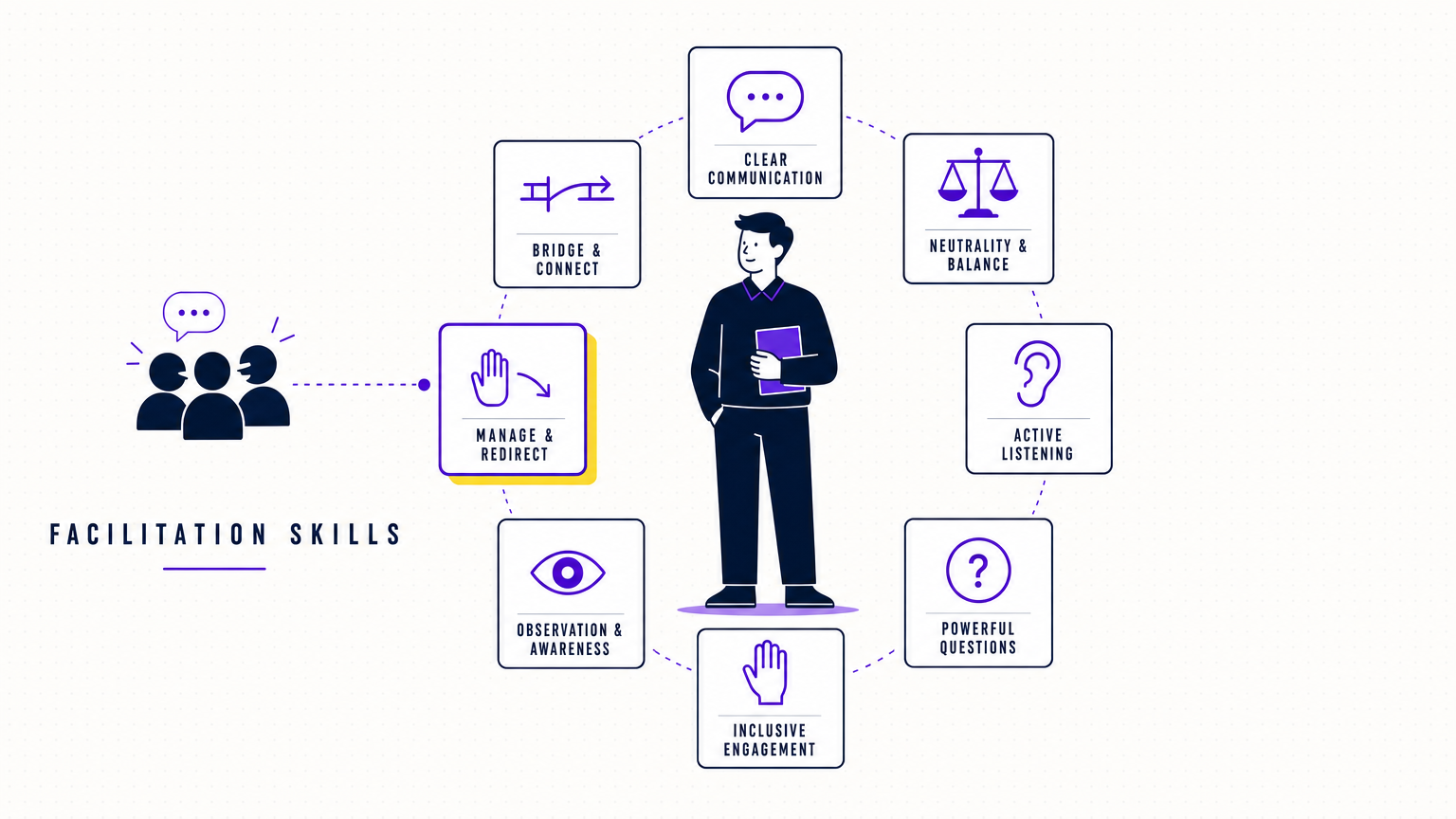
A trainer who knows their content cold can still run a flat, lopsided session where two people do all the talking and nothing gets decided. Subject expertise and group facilitation are different skills, and the second one is the one almost nobody is taught.
Group facilitation is the craft of helping a group think and decide together while you stay neutral on what they conclude. It is closer to refereeing than to teaching. You are not pushing content out to an audience, you are pulling thinking out of a room and shaping how it flows. This guide breaks the craft into eight concrete skills, and for each one it shows what good actually sounds like in the moment, because the gap between knowing a skill exists and being able to run it live is where most facilitation falls down.
It sits under our pillar guide on meeting facilitation skills and patterns; read that for the frameworks, and read this for the hands-on behaviours a trainer runs minute to minute.
The short answer
The core group facilitation skills are: holding space and psychological safety, staying neutral on content, active listening and reflecting back, asking instead of telling, redirecting dominant voices, drawing out quiet contributors, naming group dynamics in the moment, transitioning cleanly between activities, and handling conflict. The thread connecting all of them is the same: a facilitator owns the process of the conversation, never the outcome.
| Skill | What good looks like |
|---|---|
| Holding space | The group does most of the talking; you create the conditions, then get out of the way |
| Neutrality | You structure the debate without revealing which option you favour |
| Active listening | You reflect points back accurately before the group moves on |
| Asking, not telling | You work through questions; the answers come from the room |
| Redirecting dominators | You close one person down without bruising them, using structure not confrontation |
| Drawing out the quiet | You build in ways for reluctant voices to contribute before discussion anchors |
| Naming dynamics | You describe what is happening in the room out loud, neutrally, so the group can adjust |
| Clean transitions | You bridge between activities so the session feels like one arc, not a list of exercises |
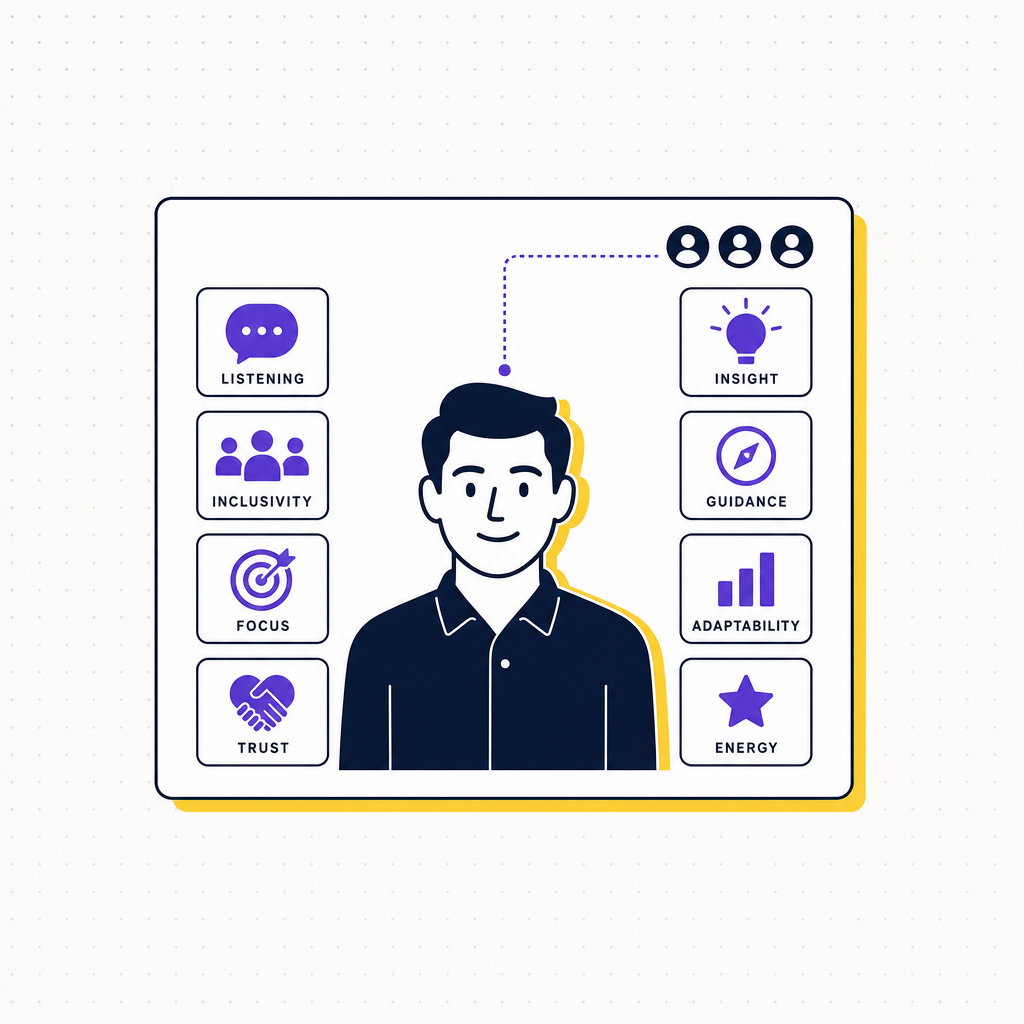
What group facilitation actually is
The International Association of Facilitators, the field’s main professional body, defines a facilitator as someone who designs and runs the process of a group’s work while staying substantively neutral, holding no stake in which option the group picks. That neutrality is the dividing line between facilitating and the two roles it gets confused with.
Training and presenting push information from one expert to many learners. Facilitating reverses the direction: the expertise is assumed to live in the group, and your job is to surface and organise it. As one widely cited L&D piece puts it, a trainer is responsible for transferring knowledge, while a facilitator is responsible for the conditions under which a group generates its own. You can be brilliant at one and clumsy at the other, which is why a strong workshop leader can still chair a terrible decision meeting.
Roger Schwarz, whose book The Skilled Facilitator is one of the field’s standard references, frames the underlying stance as a choice between two mindsets. A unilateral-control mindset treats the facilitator as the person with the answer who steers the group toward it. A mutual-learning mindset treats the group as a source of valid, partial information that has to be combined, and treats the facilitator’s own view as one more thing to be tested rather than imposed. Most of the skills below are mutual learning in practice.
The 8 group facilitation skills
1. Holding space and psychological safety
Holding space means creating conditions where people will say the thing they would otherwise keep to themselves: the half-formed idea, the quiet objection, the uncomfortable observation. Without it, a meeting only hears the safe, rehearsed contributions, and those are rarely where the value is. Psychological safety, the shared belief that you will not be punished for speaking up, is the precondition for every other skill on this list. If it is missing, your clever questions land in silence.
You build it less through what you say and more through how you respond to risk. The first time someone offers a tentative or dissenting view, the whole room is watching how you treat them. If you reward it, you get more. If you let it get flattened, you get less.
What good sounds like. A junior participant says, “This might be a silly question, but I don’t see how this hits the customer.” Instead of moving on, the facilitator says: “That’s not silly, that’s the question we’ve been talking around for ten minutes. Say more about what you’re not seeing.” The point gets airtime, and the room learns that half-formed thoughts are welcome here.
2. Staying neutral on the content
Neutrality is the discipline of keeping your own opinion on the answer out of the conversation, even when you have one and even when you are sure you are right. The moment a group senses what you want, it starts performing for you, and you have quietly turned a participatory session into a rubber stamp. This is hardest for trainers and managers, because they are usually in the room precisely because they know the subject.
The skill is not pretending to have no view. It is separating your two possible roles and being explicit about which one you are in. When you must contribute content, say so and step out of the facilitator chair for a moment, then step back in.
What good sounds like. “I’m going to take my facilitator hat off for thirty seconds and give you one data point, then I’ll put it back on and you decide what to do with it.” The group keeps ownership of the decision, and your input is clearly labelled as input, not a verdict.
3. Active listening and reflecting back
The single most useful facilitation move is to summarise what someone just said and check you got it right. Reflecting back does three jobs at once: it shows the speaker they were heard, it gives the group a shared and accurate version of the point, and it slows a fast conversation down enough to actually think. It is also how you catch the moment when two people think they agree but are talking about different things.
Done well, this is not parroting. You compress, you clarify, and you sometimes name the concern underneath the words. Then you hand it back for confirmation rather than assuming you nailed it.
What good sounds like. “So if I’ve got this right, your worry isn’t the timeline itself, it’s that we’d be committing before the legal review is back. Have I understood that?” The speaker either confirms or corrects, and either way the group now has a sharper version of the point than the speaker first gave.
4. Asking instead of telling
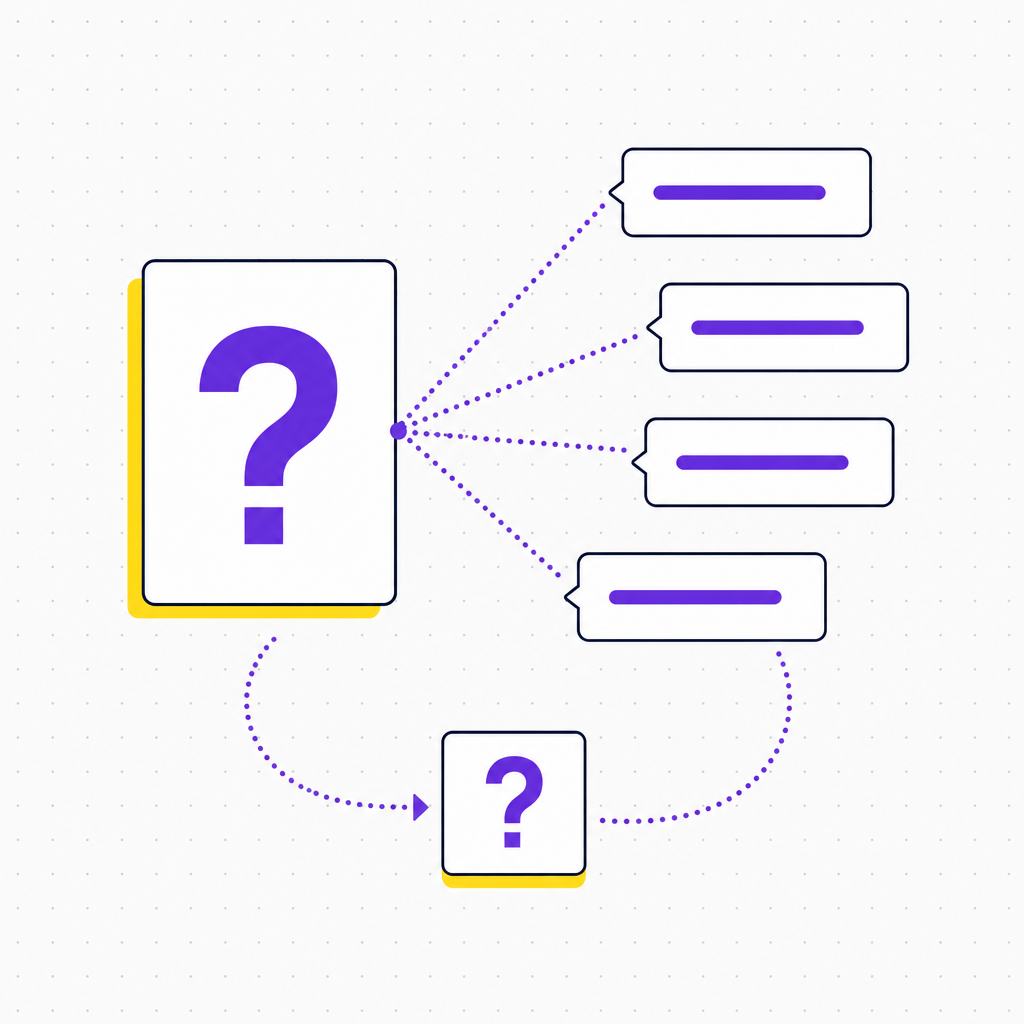
A facilitator works mostly through questions. Open questions widen the thinking, focusing questions narrow it, and probing questions push past the first plausible answer to the reasoning underneath. The reflex to fill a silence with your own answer is the one most worth unlearning, because every time you supply the conclusion, you train the group to wait for you instead of doing the work.
The harder version is the follow-up. The first answer in any discussion is usually the surface one. A good second question is what turns a shallow round of opinions into something the group can actually use.
What good sounds like. After the obvious answer lands, the facilitator does not move on. “That’s the standard reason. What would have to be true for the opposite to be the right call?” The question forces the group off autopilot and onto the tradeoff that matters.
5. Redirecting dominant voices
In almost every group, a few confident people will fill the available space and the rest will hold back. A decision shaped only by the loudest half is a worse decision, and a less committed one, because the people who never spoke never bought in. Redirecting a dominator is a skill precisely because the blunt version, telling someone to be quiet, costs you the safety you worked to build.
The move is to use structure rather than confrontation. You acknowledge the contribution, then deliberately route the floor elsewhere. A parking lot, a visible list where a valid but off-topic point gets written down and returned to later, lets you defer a tangent without shutting the person down.
What good sounds like. “That’s three strong points from you, and I want to make sure we capture them, so I’m noting them here. Before we go further I want to hear from people we haven’t heard from yet. Priya, you were nodding earlier, what’s your read?” The dominator feels heard, the floor reopens, and nobody got slapped down.
6. Drawing out the quiet contributors
The mirror skill is pulling in the people who have not spoken. Reluctance is rarely about having nothing to say; more often it is pace, hierarchy, or a discussion that anchored on the first confident opinion before quieter people had formed theirs. The fix is structural, and the most reliable version separates individual thinking from group discussion so that every voice exists on the table before debate can crowd it out.
Techniques like silent written input, brainwriting, or a quick round where everyone says one thing before open discussion all do the same job: they stop the loudest voice from setting the frame. A direct, warm invitation to a specific person works too, as long as it is an opening and not a spotlight that punishes.
What good sounds like. “Before anyone responds, take ninety seconds and write your one main concern on a card. Then we’ll hear every card before we discuss any of them.” The introverts and the cautious get their thought down before the room’s gravity pulls everyone toward the first thing said.
7. Naming the group dynamics in the moment
Experienced facilitators do something that feels almost rude the first time you try it: they describe out loud what is happening in the room. “We’ve circled this point three times.” “The energy just dropped.” “We seem to be avoiding the budget question.” Naming the dynamic neutrally, without blame, gives the group a chance to see itself and adjust, which it cannot do while the pattern is invisible.
This is the highest-wire skill on the list, because it only works if it is genuinely neutral. Said with an edge, it becomes an accusation. Said cleanly, it is a gift, and it often unlocks the real conversation the group was talking around.
What good sounds like. “I want to name something. Every time the new market comes up, we change the subject within a minute. I don’t know why, and I’m not saying it’s wrong, but I notice it. Is there something we’re not saying about it?” The avoided topic comes into the open without anyone being put on the spot.
8. Transitioning cleanly between activities
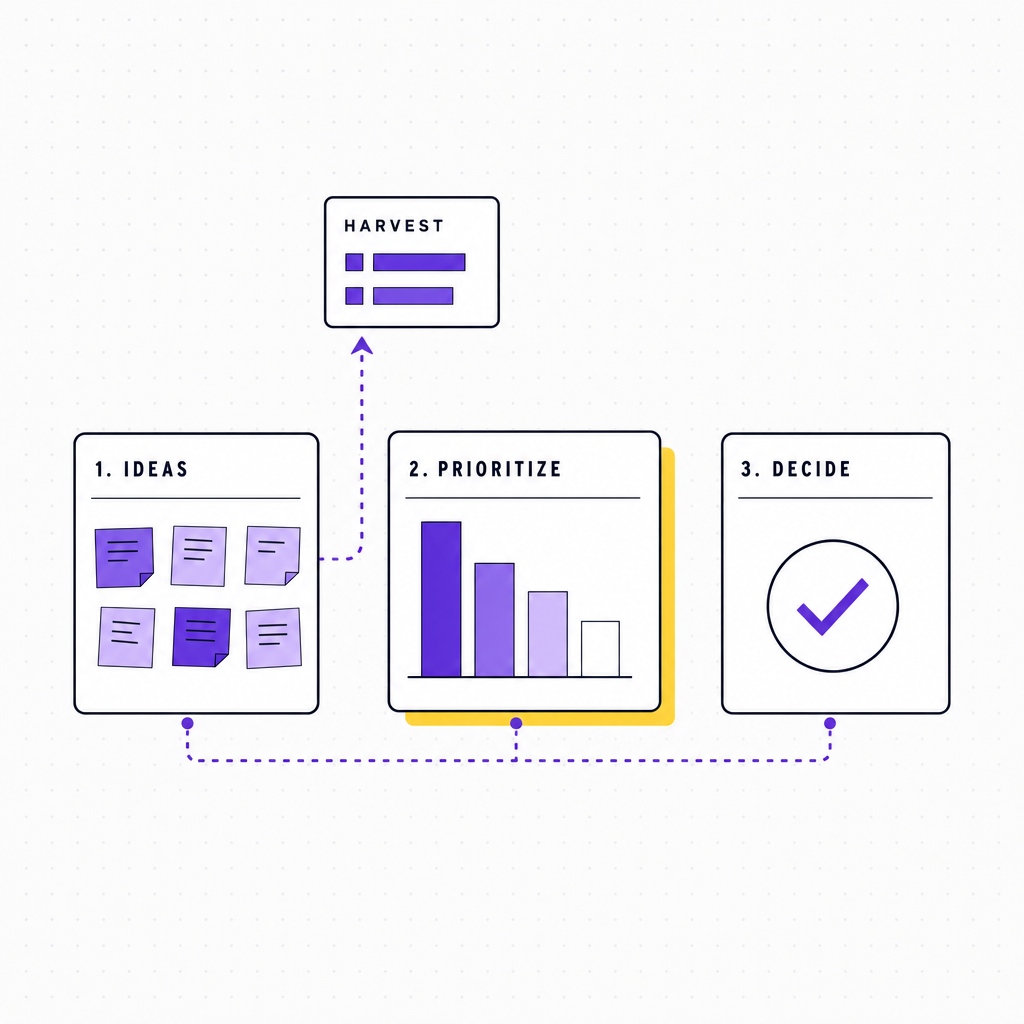
A session is not a list of exercises, it is one arc, and the joins between activities are where energy and meaning leak out. A clean transition closes one piece, explains why the next piece follows, and links the two so the group understands the journey rather than just complying with instructions. Bridging like this is what makes the difference between a workshop that feels designed and one that feels like a sequence of unrelated tasks.
The pattern is simple: harvest what just happened, name what it gave you, then set up what comes next and why. Skipping the harvest is the common mistake; the group finishes an activity, the output evaporates, and the next exercise starts cold.
What good sounds like. “So from that round we’ve got three themes up on the wall: cost, speed, and trust. Hold those. The next twenty minutes are about pressure-testing them, because a theme that survives a hard look is one we can actually plan around. Here’s how we’ll do it.” The group carries its own work forward instead of leaving it behind.
The skill underneath the skills: handling conflict
Run the eight skills well and you will surface more disagreement, not less, because safety and good questions bring buried tension into the open. That is the goal, not a side effect. Suppressed conflict does not disappear, it leaks into side conversations and quiet non-compliance. The facilitator’s job is to let disagreement happen while it is still about ideas, and to keep it from curdling into something personal.
The practical moves are the ones already covered, pointed at heat instead of calm. Reflect both positions back accurately so each side feels understood before anyone tries to resolve anything. Name the dynamic when an argument turns from the issue to the people. Use a structured format so a clash becomes a comparison of options rather than a contest of personalities. Conflict handled in the room is cheaper than conflict that walks out of it unresolved.
Why facilitation skill quality matters for L&D and HR
If you are responsible for how teams work and decide, facilitation is one of the highest-return capabilities you can build, in yourself and in your managers, because so much organisational work now happens in meetings and so much of that time is wasted by default. SessionLab’s annual State of Facilitation surveys, the largest regular read on the profession, consistently show practitioners pointing to participation, engagement, and the move to hybrid and virtual rooms as the skills under most pressure. The demand is rising while the average meeting stays poor.
The honest difficulty is not learning the techniques, it is seeing your own sessions clearly enough to improve them. The facilitator steering a conversation is the worst-placed person to also observe it objectively, and memory rewrites a meeting within days. Who actually dominated? Who never got drawn in? Where did the group avoid the real question? You were too busy running the room to track it, and by the next morning your recollection has quietly smoothed everything over.
This is the gap Team Building Bot is built for. It joins your online sessions, listens for the behavioural signals this guide describes, who spoke, who held back, where the conversation turned, and produces a Team Dynamics Map you can facilitate against. Instead of guessing how the group functioned, you get an evidence-based read you can act on. You can see what those reports look like on the reports overview, and the companion guide on how to run an after-action review walks through turning a finished session into team learning.
How facilitation is changing: hybrid and AI
Two shifts are reshaping the skill set. The first is hybrid. Facilitating a room where some people are physically present and others are on a screen is genuinely harder, because the remote participants are easy to forget and quick to disengage. The discipline that works is to level the field deliberately: run more of the session through shared digital surfaces everyone uses equally, and check in with remote voices by name rather than waiting for them to break in.
The second is AI. A growing set of AI workshop and meeting tools now handle capture, transcribing the discussion, drafting summaries, and tracking actions, which frees the facilitator to spend attention on the parts that need human judgement: reading the room, managing conflict, drawing out the quiet voice. The limits are real. Current tools still struggle to attribute speech reliably and tend toward generic summaries, and early research on AI-assisted facilitation treats these systems as support for a skilled human rather than a replacement for one. Used that way, they take friction off the facilitator. Used as a substitute, they miss exactly the dynamics that make facilitation matter.
FAQ
What are group facilitation skills? Group facilitation skills are the behaviours that let someone guide a group to think and decide together while staying neutral on the outcome. The core set includes holding space and psychological safety, neutrality, active listening and reflecting back, asking rather than telling, redirecting dominant voices, drawing out quiet contributors, naming group dynamics in the moment, transitioning cleanly between activities, and handling conflict.
What is the difference between facilitating and training? Training transfers knowledge from an expert to learners, so the content flows outward from the trainer. Facilitating assumes the useful thinking lives in the group, so the facilitator’s job is to surface and organise it while staying neutral on the conclusion. A strong trainer can still be a weak facilitator, because the two roles point in opposite directions.
How do you handle someone who dominates a meeting? Use structure rather than confrontation. Acknowledge their contribution, capture any valid but off-topic points in a visible parking lot, then deliberately route the floor to people who have not spoken, ideally by inviting a specific person in. Building silent written input or a round-robin into the design stops a single voice from anchoring the discussion in the first place.
Can group facilitation skills be learned? Yes. Facilitation is a teachable craft with established frameworks, from the IAF core competencies to Roger Schwarz’s mutual-learning model and Sam Kaner’s participatory decision-making diamond. The techniques are learnable quickly; the harder part is getting accurate feedback on your own sessions, since the person running the room is poorly placed to observe it objectively.
What is the most important facilitation skill? Neutrality is the foundation, because the whole value of facilitation comes from the group owning its decision rather than reading the facilitator’s preference and converging on it. Psychological safety is the close second, since every other skill, from good questions to drawing out quiet voices, only works once people feel safe enough to speak honestly.
Sources
- International Association of Facilitators and the role of a facilitator: what are facilitation skills (Roffey Park) · the role of a facilitator (MindTools) · how to facilitate meetings (Atlassian) · facilitation skills (SessionLab).
- Facilitating versus leading or training in L&D: facilitating versus leading (Litmos) · the impact of effective facilitation (Voltage Control).
- Roger Schwarz, The Skilled Facilitator and the mutual-learning mindset: Schwarz on whether leadership reduces learning (UNC SOG PDF) · The Skilled Facilitator (ResearchGate) · Schwarz Associates.
- Sam Kaner, Facilitator’s Guide to Participatory Decision-Making, on divergent/convergent thinking and the groan zone: Kaner guide (StoryPikes PDF) · participatory decision-making (Simpson Executive Coaching PDF).
- Managing group dynamics, dominant and quiet participants: managing group dynamics (Change Companies) · managing group dynamics (One Circle Foundation) · defining moments in group facilitation (Burt Bertram PDF).
- Facilitation techniques and questioning: facilitation techniques (The Knowledge Academy) · facilitation for beginners (SessionLab) · consequential conversations (ATD).
- Transitions and bridging between activities: workshop transitions (SessionLab) · facilitating bridging discussions (Berkeley GGIE) · facilitation at different stages (Julia Vastrik).
- Conflict in group settings: conflict resolution in group therapy (ICANotes).
- State of the profession, hybrid and demand for facilitation: State of Facilitation 2026 (SessionLab) · State of Facilitation 2025 (SessionLab) · hybrid work trends (Zoom) · why facilitation training matters in 2026 (Inclusivv).
- AI-assisted facilitation and tooling: AI-driven workshop tools for 2026 (Metodic) · AI-assisted facilitation research (arXiv).
More on Meeting Facilitation
- arrow_forward The Facilitator Skills Map: Good vs Great in 6 Dimensions
- arrow_forward 7 Sprint Retrospective Ideas for Non-Engineering Teams (2026)
- arrow_forward Social Facilitation at Work: When an Audience Helps or Hurts
- arrow_forward 10 Team Meeting Agenda Templates That Drive Decisions (2026)
- arrow_forward 55 Icebreaker Questions for Team Meetings (Tagged by Personality)
- menu_book Meeting Facilitation: Skills, Patterns, and Pitfalls Pillar
See the group dynamics you can't catch while facilitating
Team Building Bot joins your online sessions, listens for who spoke, who held back, and where the conversation turned, and produces a Team Dynamics Map you can facilitate against. Free during beta.
No spam, no credit card. Unsubscribe any time.