7 Sprint Retrospective Ideas for Non-Engineering Teams (2026)
Seven sprint retrospective ideas adapted for marketing, ops, HR and sales teams: each format, when to use it, and how to avoid a gripe session.
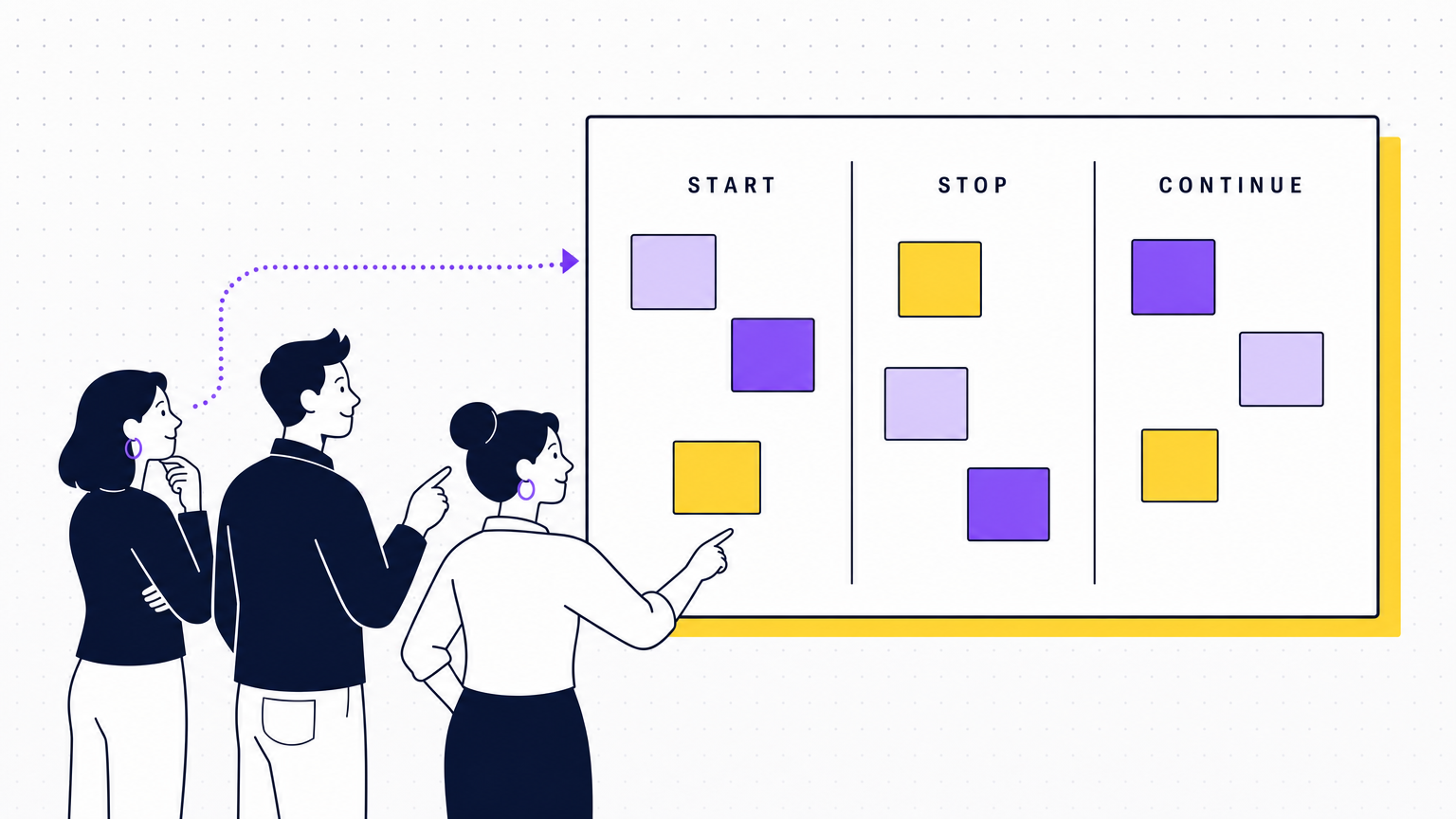
The retrospective is the one Agile ritual that has nothing to do with code. It is a structured pause where a team looks back at the last stretch of work and decides what to change. That makes it just as useful for a marketing squad, an ops team, an HR function, or a sales pod as it is for a group of engineers. The only thing you have to swap out is the example board.
This is a set of seven retrospective ideas you can run with any team, plus the part most articles skip: how to keep the meeting from sliding into a complaint session that produces nothing. If you want the wider craft these sit inside, the meeting facilitation pillar guide covers the skills and patterns in full. This post is the format kit.
The short answer
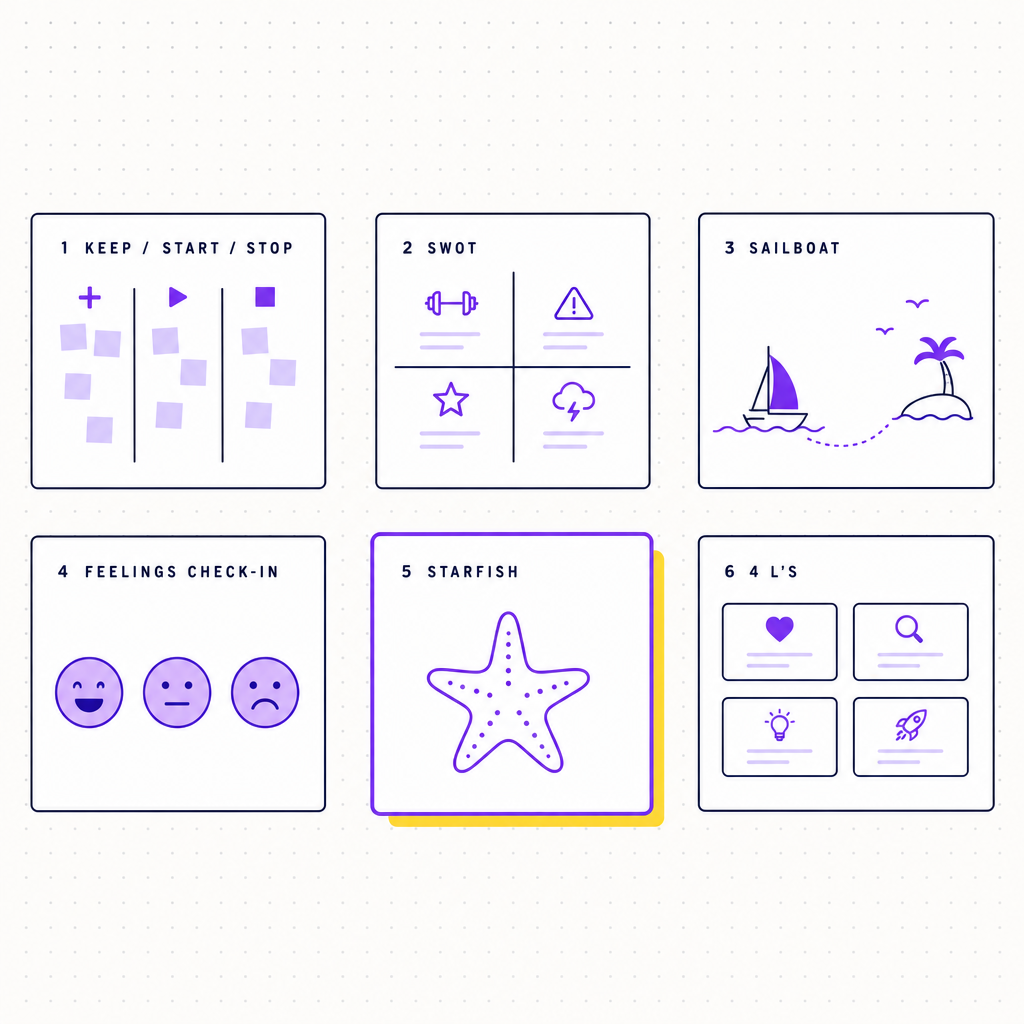
A sprint retrospective is a recurring meeting where a team reflects on how it worked, not just what it produced, and commits to one or two specific changes for the next cycle. The format is a prompt structure that organises the conversation. Start, Stop, Continue is the simplest. The 4Ls, Sailboat, Mad/Sad/Glad, Starfish and KALM each tilt the conversation toward a different angle: emotion, strategy, fine-tuning, or honest gripes.
For non-engineering teams, the shift is the vocabulary, not the mechanics. A sales team’s “sprint” might be a campaign or a month. A retrospective on a product launch, a hiring round, or a quarterly close works the same way as one on a two-week development sprint.
| The retro is working when | The retro is broken when |
|---|---|
| It ends with one or two owned actions | It ends with twenty complaints and no owners |
| Quiet people contribute | Two loud voices run the room |
| People name process problems, not each other | It turns into a blame session |
| The format changes every few cycles | The same three questions go stale |
Why retrospectives work for any team
The case for reflection is not an Agile belief. It rests on team reflexivity research: the degree to which a team openly reviews its objectives and methods predicts how well it adapts and performs. A meta-analysis of team and individual debriefs (Tannenbaum and Cerasoli, Human Factors, 2013) found that teams which deliberately review their performance improve effectiveness by roughly 20 to 25 percent over those that do not, across military, medical and workplace settings. The retrospective is simply the recurring container that makes that review a habit instead of an accident.
The catch is that the container only works if people feel safe filling it honestly. Without that safety, a retro collects polite surface comments and misses the real problems. The two ingredients are therefore inseparable: a clear format to structure the conversation, and enough psychological safety that people will actually say the awkward thing. The formats below give you the first. The facilitation section gives you the second.
One practical reason these matter outside engineering: most non-technical teams have no equivalent ritual. Sales has the pipeline review, but that interrogates numbers, not how the team worked. HR runs hiring debriefs about candidates, rarely about its own process. A retrospective fills that gap with a blameless, repeatable habit of getting better.
1. Start, Stop, Continue: best for action-focused teams
The most direct format on the list. The team fills three columns: what to start doing, what to stop doing, and what to keep doing. It produces clear, near-binary decisions, which is why sales and operations teams tend to like it.
How to adapt it: a sales pod might start booking discovery calls before sending a proposal, stop chasing leads that have gone cold for three weeks, and continue the Monday pipeline triage that has been working. An ops team might start logging every manual workaround, stop the duplicate status email no one reads, and continue the new vendor scorecard.
Best for teams that want momentum over nuance, and for groups new to retros who need an easy on-ramp. The weakness is the binary framing: real work is rarely all-or-nothing, which is where the next formats earn their place.
2. The 4Ls (Liked, Learned, Lacked, Longed For): best for HR and L&D
The 4Ls ask four questions: what did people like about the cycle, what did they learn, what did they feel they lacked, and what did they long for that was missing. It pulls in learning and unmet needs, not just process fixes, which makes it a natural fit for HR, L&D, and any team running a project with a strong development angle.
How to adapt it: after a hiring round, a recruiting team might like the new structured interview scorecard, learn that take-home assignments scared off senior candidates, lack a clear feedback loop with hiring managers, and long for a faster offer-approval chain. The “longed for” column is the quiet gold here, because it surfaces wishes people would not raise unprompted.
Best for retrospectives where growth and experience matter as much as output. It runs a little slower than Start, Stop, Continue, so give it the time it needs.
3. The Sailboat: best for operations and strategy
The Sailboat is a visual metaphor. You draw a boat heading toward an island. The island is the goal. The wind is what pushes the team forward. The anchors are what slow it down. The rocks ahead are the risks that could sink the work. Teams map their reality onto the picture.
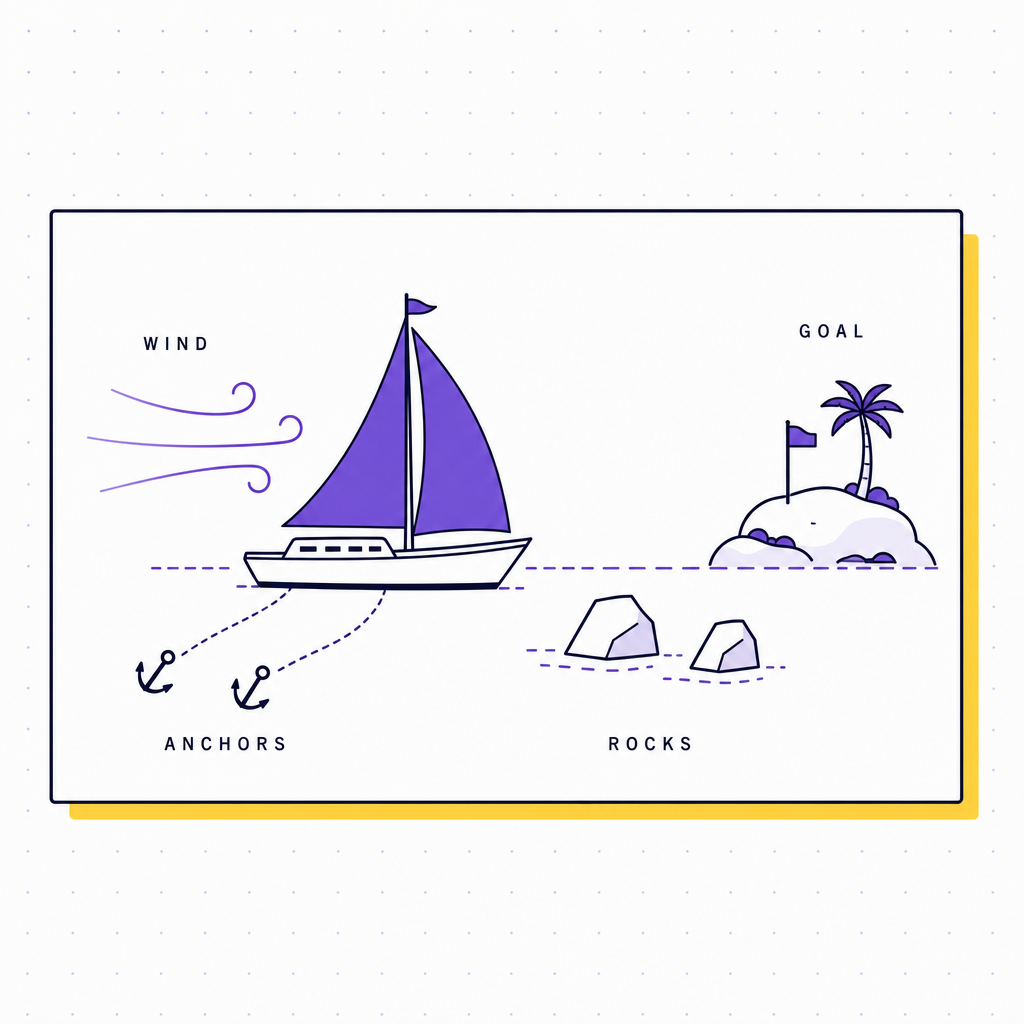
How to adapt it for operations: the island might be a 99.9 percent on-time delivery rate for the quarter. The wind could be a newly engaged frontline crew and strong vendor relationships. The anchors might be a slow manual invoice approval that still needs a physical signature, or legacy hardware that fails at random. The rocks ahead could be a looming supplier single point of failure or incoming tariff changes. Because it forces a team to look forward at risks as well as back at friction, it suits planning-heavy and logistics teams especially well. The Sailboat is also one of the more searched formats for exactly this reason: it doubles as a strategy conversation.
4. Mad, Sad, Glad: best for marketing and creative teams
This format deliberately skips process mechanics and goes straight for emotional health. People sort the cycle’s events by the feeling they triggered: what made them mad, what made them sad, and what made them glad. It works as a release valve before a team tries to fix anything.
How to adapt it: creative and marketing teams live with subjective scrutiny, tight launch deadlines, and friction with sales. Mad/Sad/Glad lets a designer vent about a last-minute brief change from a stakeholder (mad), process the disappointment of a beautiful campaign that did not land with its audience (sad), and celebrate a rebrand that shipped clean (glad). Naming the feeling first tends to defuse it, which clears the way for a calmer conversation about the production pipeline.
Best for teams under emotional load, or for the cycle right after a stressful launch. Use it sparingly, since not every retro needs to open emotional ground.
5. The Starfish: best for customer success and fine-tuning
The Starfish is an evolution of Start, Stop, Continue that adds two middle gears. Instead of three columns, you get five: keep doing, more of, less of, start doing, and stop doing. The two new categories let a team adjust the volume of an activity rather than choosing between keeping it whole or killing it.
How to adapt it for customer success: account managers rarely stop a client process outright. They calibrate it. A CS team might keep its quarterly executive business reviews with top-tier clients, do more proactive outreach about new feature adoption, do less long unstructured check-in calls with no agenda, stop manually compiling weekly usage reports, and start a buddy system for onboarding new managers. The “more of” and “less of” columns are where the honest, useful detail lives.
Best for mature teams whose work is about tuning a relationship or a system, not flipping switches.
6. KALM (Keep, Add, Less, More): best for lean teams
KALM is the Starfish stripped down to four prompts: keep, add, less, more. It keeps the volume nuance that makes the Starfish good while dropping a column, which makes it faster to run. For a small or time-pressed team, that trade is often worth it.
How to adapt it: a four-person operations team might keep its daily fifteen-minute standup, add a shared blocker log, do less ad-hoc Slack fire-fighting, and do more written handovers between shifts. The shorter prompt set means you can run a useful KALM retro in half an hour, which lowers the cost of doing one every cycle.
Best for lean teams who want the nuance of the Starfish without the full meeting length.
7. The async retrospective: best for distributed teams
Not every retrospective has to happen live. Distributed teams across time zones increasingly run retros asynchronously, and the format is less about the prompts and more about the schedule. A common staggered approach spreads the work over a few days: people log reflections on day one, group and vote on the themes on day two, then meet for a short, focused video call on day three only to lock in the actions.
The payoff is real. Async retros cut meeting time, fit around time zones, and tend to produce deeper input because they give quiet, careful thinkers room to write instead of forcing them to compete with quick talkers in a live room. Any of the six formats above can run async; you are changing the container, not the prompts.
Best for remote and hybrid teams, and for any group where the loudest voice usually wins the live conversation.
How to keep a retro from becoming a blame session
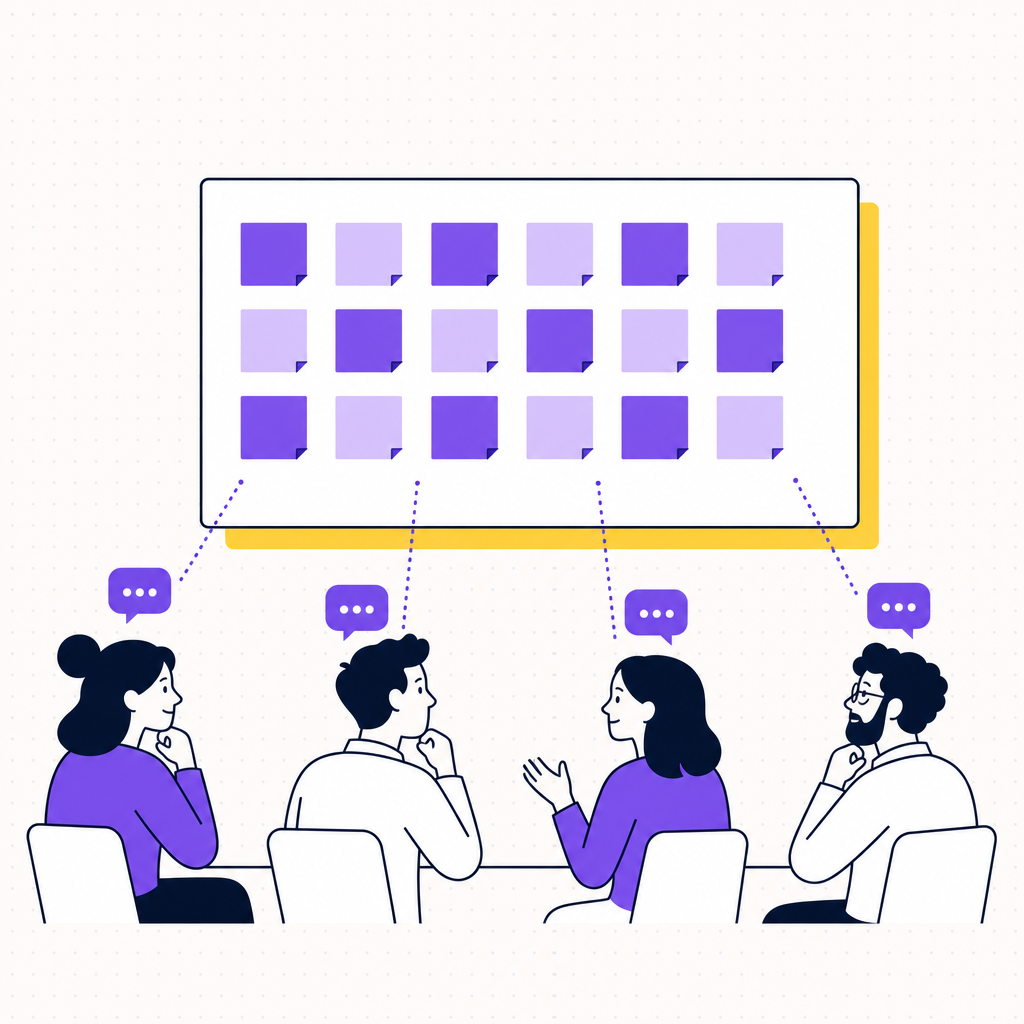
A retrospective that generates twenty complaints and zero owned actions is broken. So is one where two confident voices dominate and everyone else nods. Here is what experienced facilitators do to prevent both.
Open with the Prime Directive. Norm Kerth’s line is read aloud at the start of countless retros for a reason: “Regardless of what we discover, we understand and truly believe that everyone did the best job they could, given what they knew at the time, their skills and abilities, the resources available, and the situation at hand.” It frames the hour as a hunt for systemic problems, not for people to blame, and it sets the tone in thirty seconds.
Gather input anonymously first. Letting people submit their reflections without their name attached reduces groupthink and the chilling effect of having a manager in the room. Quieter team members will raise things anonymously that they would never say first out loud. Tools like sticky notes folded over, or a shared doc filled in before the meeting, do the job if you do not have dedicated software.
Get everyone to speak once early. People who say even one thing in the first few minutes of a meeting are far more likely to contribute substance later. A thirty-second check-in question, light enough that no one can get it wrong, primes the room and breaks the opening silence before the real work starts.
Narrow ruthlessly to one or two actions. The enthusiastic failure mode is a team that lists ten improvements and tries to do all of them at once, then completes none. Pick the top one or two, give each a named owner, and let the rest wait. A retro is judged by what changes next cycle, not by the length of the list.
Rotate the facilitator. If the same manager runs every retro, the team grows dependent and the format goes stale. Passing the role around builds shared ownership and brings fresh styles, which is one of the cheapest ways to keep retros from going flat. For the deeper version of this, our after-action review guide covers blameless review structure, and the debrief questions library gives you prompts to rotate in.
A note on AI-assisted retros
The other shift of the last two years is software that does some of the facilitation work. Retro platforms now use language models to cluster dozens of raw notes into themes in seconds, a task that used to eat fifteen minutes of live meeting time. Some go further and track sentiment across cycles, flagging a recurring frustration with a cross-team dependency before it shows up as turnover. The promise is more meeting time spent on the discussion and less on the admin. Treat it as a sidecar, not a replacement: the format and the facilitation still carry the meeting.
How to choose a retrospective format
| Format | Best for | Strength |
|---|---|---|
| Start, Stop, Continue | Sales, ops, first-timers | Fast, clear, near-binary actions |
| 4Ls | HR, L&D, project teams | Surfaces learning and unmet needs |
| Sailboat | Operations, strategy | Looks forward at risk, not just back |
| Mad, Sad, Glad | Marketing, creative | Releases emotion before fixing process |
| Starfish | Customer success | Adjusts volume, not just on/off |
| KALM | Lean, time-pressed teams | Nuance of Starfish, shorter run |
| Async | Distributed teams | Time-zone friendly, deeper input |
The simple rule: start with Start, Stop, Continue if the team is new to retros, switch to the Sailboat or 4Ls when you want more depth, reach for Mad/Sad/Glad after a hard cycle, and rotate formats every few sprints so the ritual never goes stale.
Frequently asked questions
What is the best retrospective format for a non-engineering team?
Start, Stop, Continue is the best starting point for any team new to retrospectives, because it is fast and produces clear actions. As the team matures, the Sailboat suits operations and strategy work, the 4Ls suit HR and L&D, and Mad/Sad/Glad suits creative teams under pressure. The best format is the one you change every few cycles so it stays fresh.
How often should a non-engineering team run a retrospective?
Run one at the end of each natural work cycle: a campaign, a month, a project phase, or a quarterly close. The key is regularity, not frequency. A short retro every cycle beats a long one twice a year, because the habit of reviewing is what drives the gains, not the depth of any single session.
How do you stop a retrospective turning into a complaint session?
Open with a blameless framing like the Prime Directive, gather input anonymously, and force the team to narrow down to one or two owned actions before the meeting ends. A retro that produces a long list of gripes and no owners has failed. Judge it by what actually changes in the next cycle.
Do retrospectives really improve performance?
The evidence is strong. A meta-analysis of structured debriefs (Tannenbaum and Cerasoli, 2013) found that teams which deliberately review their work improve effectiveness by roughly 20 to 25 percent over teams that do not. The mechanism is team reflexivity: the habit of openly examining how you work, then changing it.
Can you run a retrospective asynchronously?
Yes. Distributed teams often spread a retro over a few days: log reflections on day one, group and vote on day two, and hold a short focused call on day three to finalise actions. Async retros fit across time zones and tend to produce deeper input, because they give careful thinkers room to write rather than compete in a live room.
More on Meeting Facilitation
- arrow_forward The Facilitator Skills Map: Good vs Great in 6 Dimensions
- arrow_forward Social Facilitation at Work: When an Audience Helps or Hurts
- arrow_forward 8 Group Facilitation Skills Every Trainer Needs in 2026
- arrow_forward 10 Team Meeting Agenda Templates That Drive Decisions (2026)
- arrow_forward 55 Icebreaker Questions for Team Meetings (Tagged by Personality)
- menu_book Meeting Facilitation: Skills, Patterns, and Pitfalls Pillar
See how your team actually talks in a retro
Team Building Bot joins your online retrospective, notices who spoke, who stayed quiet, and where the energy shifted, and turns it into a Team Dynamics Map you can act on. Free during beta.
No spam, no credit card. Unsubscribe any time.