The Facilitator Skills Map: Good vs Great in 6 Dimensions
A map of facilitator skills across six dimensions, with the observable behaviours that separate a good facilitator from a great one, grounded in research.
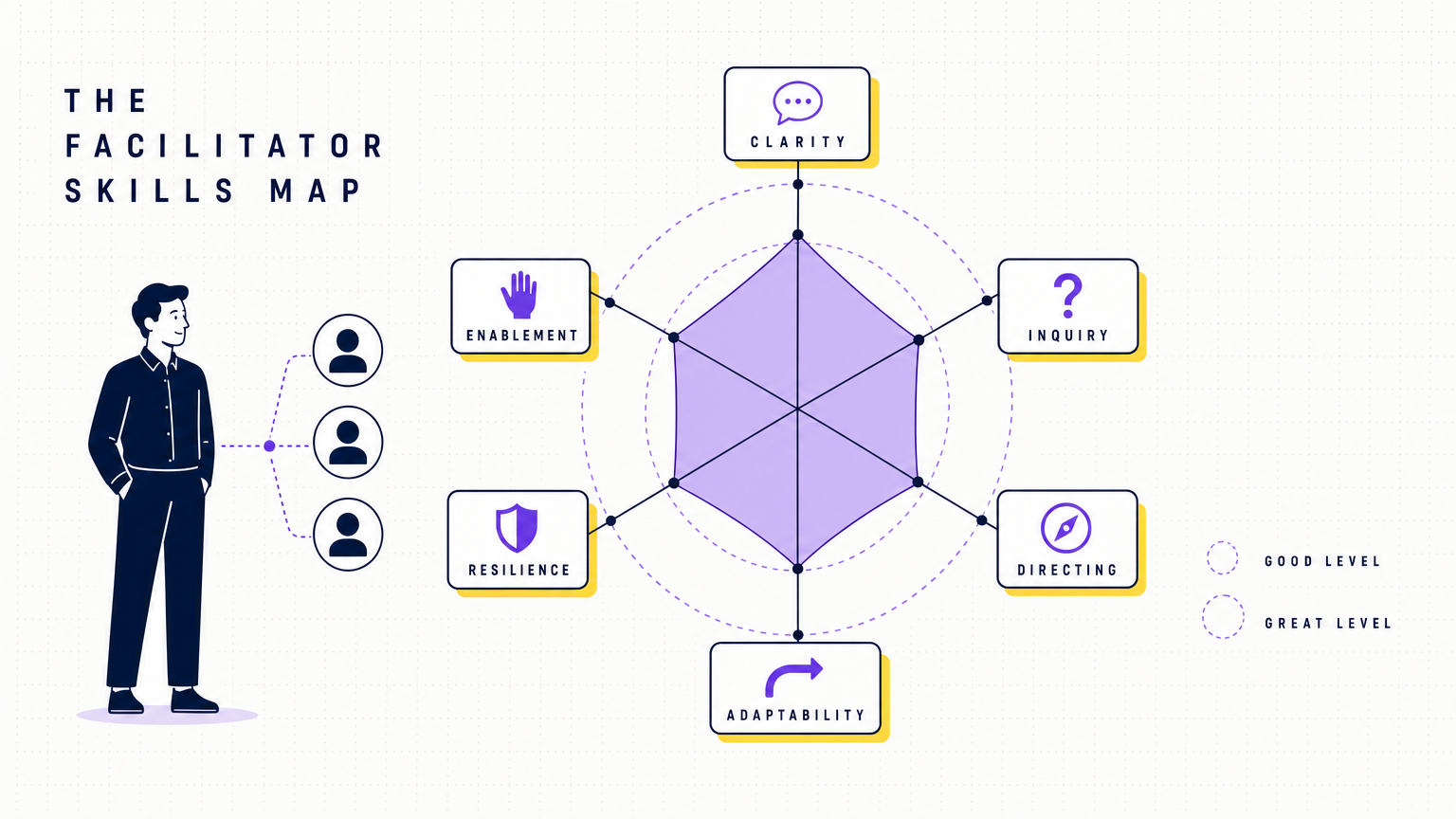
Two facilitators can run the same meeting, follow the same agenda, and keep to the same clock, and one session produces a decision the room owns while the other produces a polite list nobody acts on. The difference is rarely charisma or a bigger bag of icebreakers. It is a set of concrete, observable behaviours, and you can map them.
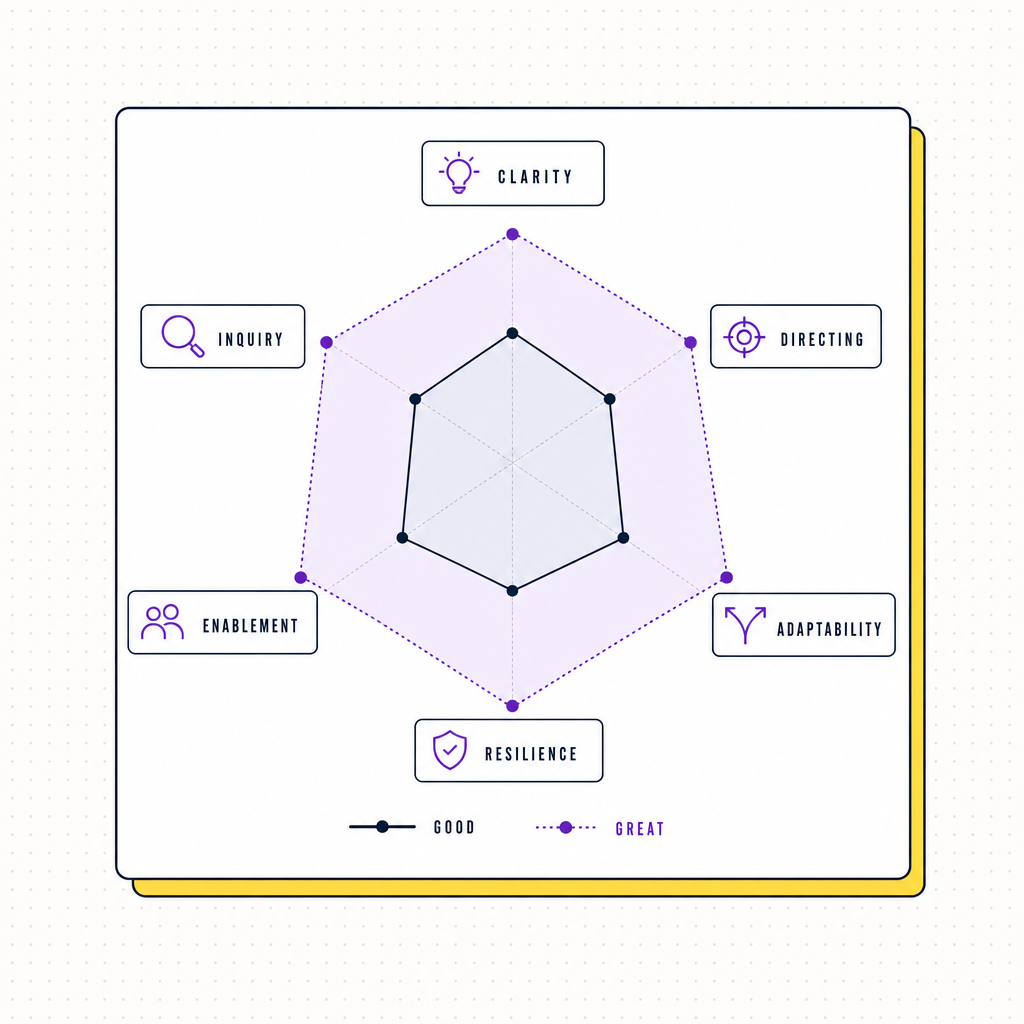
This is that map. It lays out facilitator skills across six dimensions, and for each one it shows what a competent facilitator does and what a great one does differently. The six dimensions are the same ones Team Building Bot scores in its Individual Communication Profile: clarity, inquiry, directing, adaptability, resilience, and enablement. If you want the wider craft these sit inside, the meeting facilitation pillar guide covers the patterns and pitfalls in full. This post is the skills map.
The short answer
A good facilitator keeps time, manages the whiteboard, and follows the agenda. A great one does all that and then does the harder thing: protects an equitable process so the room’s best thinking actually surfaces. The gap shows up across six observable dimensions. A good facilitator gives clear instructions; a great one structures the whole conversation so people know where they are. A good facilitator asks questions; a great one runs a high question-to-statement ratio and resists solving the problem for the group. A good facilitator stays neutral; a great one practises what researchers call proactive neutrality, actively balancing participation rather than sitting back.
The research points one way. The single biggest predictor of a facilitator’s value is not how well they perform, it is how well they distribute participation and keep the group safe enough to disagree. Everything below is built on that.
What a skills map gives you that a checklist does not
Most “facilitation skills” articles hand you a flat list: be a good listener, stay neutral, manage time, ask open questions. The list is not wrong, it is just unscored. It tells you the skills exist without telling you what better looks like.
A map fixes that by treating each skill as a dimension you can move along, from competent to expert. The clearest model for the underlying shift comes from organisational psychologist Roger Schwarz, who contrasts two mindsets that drive everything a facilitator does. In the unilateral control mindset, a facilitator assumes they understand the situation and others who see it differently are simply wrong; disagreement is a threat to manage. In the mutual learning mindset, the facilitator assumes everyone holds partial, valid information, and disagreement is the most useful thing in the room (Schwarz, Smart Leaders, Smarter Teams, 2013). The move from good to great is, underneath, the move from the first mindset to the second. The six dimensions are where you can see it happening.
The six dimensions, good vs great
Clarity: structuring the conversation, not just the slides
Clarity at the competent level means clean instructions and a legible agenda. People know what the activity is and how long they have. Clarity at the expert level means the group always knows where they are in the larger arc: what was just decided, what is open, what comes next. SessionLab frames good facilitation as a “dance of improvisation and structure”, and clarity is the structure half. The expert keeps a running spine of the conversation in their head and narrates it out loud, so the room never quietly fragments into three side-debates.
The tell is what happens after a long tangent. A good facilitator notices the time. A great one names where the group has drifted, summarises the live thread, and offers the room a clean choice about whether to follow the tangent or park it.
Inquiry: asking instead of telling
Inquiry is the dimension most separating good from great, and the one with the most evidence behind it. Expert facilitators ask far more than they tell, often aiming for something like a three-to-one question-to-statement ratio, which lowers defensiveness and pulls problem-solving back to the group rather than the front of the room.
Active listening is the validated core of this. In a controlled experiment by Weger and colleagues with 115 participants, speakers who received active-listening responses, paraphrasing and clarifying questions, felt significantly more understood and rated the listener as more socially attractive and trustworthy than those who got simple acknowledgements or unsolicited advice (Weger et al., International Journal of Listening, 2014). The competent facilitator nods and says “good point”. The great one reflects the point back accurately enough that the speaker says “yes, exactly”, then asks the question that moves it forward.
Directing: steering without taking over
Directing is the skill of moving a group through a process while keeping ownership with them. Good facilitators set ground rules and hold the agenda. Great ones set the boundaries early and then suppress their own ideas hard, because every opinion the facilitator volunteers quietly tilts the room. Roffey Park’s facilitation model is blunt about this: actively withholding your own content is what prevents accidental manipulation of the group.
This is where the neutrality question gets interesting. Strict, distant neutrality turns out to be the weaker option. A study of design teams found that facilitators who stayed impartial on the content but actively intervened on the process, disrupting dominant voices and rebalancing participation rather than sitting back, had a significantly greater positive effect on team trust and psychological safety than facilitators who stayed aloof (Cambridge Design Science, 2024). Researchers call this proactive neutrality, a balance of impartiality on the answer and equidistance toward the people. Great directing is active.
Adaptability: reading the room and abandoning the plan
A competent facilitator runs the plan. A great one senses when the plan has stopped serving the group and changes it mid-session without losing the thread. SessionLab describes the expert’s defining move as the willingness to “abandon the script and improvise when the group requires a different intervention”. The agenda is a hypothesis, not a contract.
Adaptability is observable in small moments. When energy drops, the great facilitator switches format before the room checks out, not after. When a topic turns out to matter more than expected, they give it room and renegotiate the rest of the time out loud. The competent facilitator, by contrast, tends to push through the planned sequence because it is the plan.
Resilience: staying composed when it gets tense
Resilience is composure under conflict and pressure, and it is what lets a facilitator treat disagreement as fuel rather than a fire to put out. The mutual-learning facilitator sees a clash of views as the richest moment in the meeting; the unilateral-control one sees a threat to manage and rushes to smooth it over, which is how good ideas die quietly.
The expert move under tension is to validate before reframing. Reframing, helping a group see a complaint from a more constructive angle, is powerful, but applied too fast it can leave people feeling dismissed, an effect documented in work on individuals with low self-esteem (Marigold et al., 2014). Great facilitators acknowledge the legitimate logic and emotion behind a frustration first, which de-escalates the moment, and only then pivot the group toward a way forward. Composure is not staying calm while ignoring the heat. It is staying calm while engaging it.
Enablement: drawing out the room and building ownership
Enablement is the dimension that most directly drives the outcome the research cares about: even participation. Left alone, groups skew badly. People with higher status, dominant personalities, or more extraverted styles take the floor, while quieter, more anxious, or more junior members withdraw, and the group loses access to information only the quiet people hold.
A great facilitator engineers against that. They use turn-taking structures, surface input from the chat in virtual sessions, and deliberately invite the people who have not spoken. The point is not fairness for its own sake. When participation equalises, groups carry lower cognitive load, draw on a wider pool of ideas, and reach higher-quality decisions. Enablement is also where ownership is built: when people have genuinely contributed, they commit to what the group decided. The competent facilitator asks “any other thoughts?” to a silent room and moves on. The great one notices who has not spoken and makes a specific, low-pressure opening for them.
Here is the map in one view.
| Dimension | A good facilitator | A great facilitator |
|---|---|---|
| Clarity | Gives clean instructions and a clear agenda | Keeps the room oriented in the larger arc, narrating where the conversation is |
| Inquiry | Asks open questions | Runs a high question ratio and reflects points back accurately before moving them on |
| Directing | Sets ground rules, holds the agenda | Suppresses own ideas, intervenes on process, stays impartial on content |
| Adaptability | Runs the plan well | Abandons the plan when it stops serving the group, out loud |
| Resilience | Stays calm, smooths conflict over | Validates first, then reframes; treats disagreement as fuel |
| Enablement | Invites general contributions | Engineers even participation and draws out the quiet voices by name |
What the evidence says actually moves the needle
Strip away the personality and the through-line of the research is participation and safety, not performance.
Psychological safety, the shared belief that a team is safe for interpersonal risk-taking, is the bedrock the rest sits on (Edmondson, Harvard Business School). Facilitation is one of the main levers for building and repairing it. In a study of academic medical faculty, a facilitation-heavy intervention raised mean psychological-safety scores from 5.6 to 6.1 on a seven-point scale (p = 0.005), with skilled facilitation credited for enabling vulnerable sharing and repairing fractured trust (mentor.unm.edu). Voltage Control, summarising widely cited Gallup figures, links high psychological safety to a 27% reduction in turnover and a 12% lift in productivity, though those headline numbers come through a single source here rather than independent confirmation.
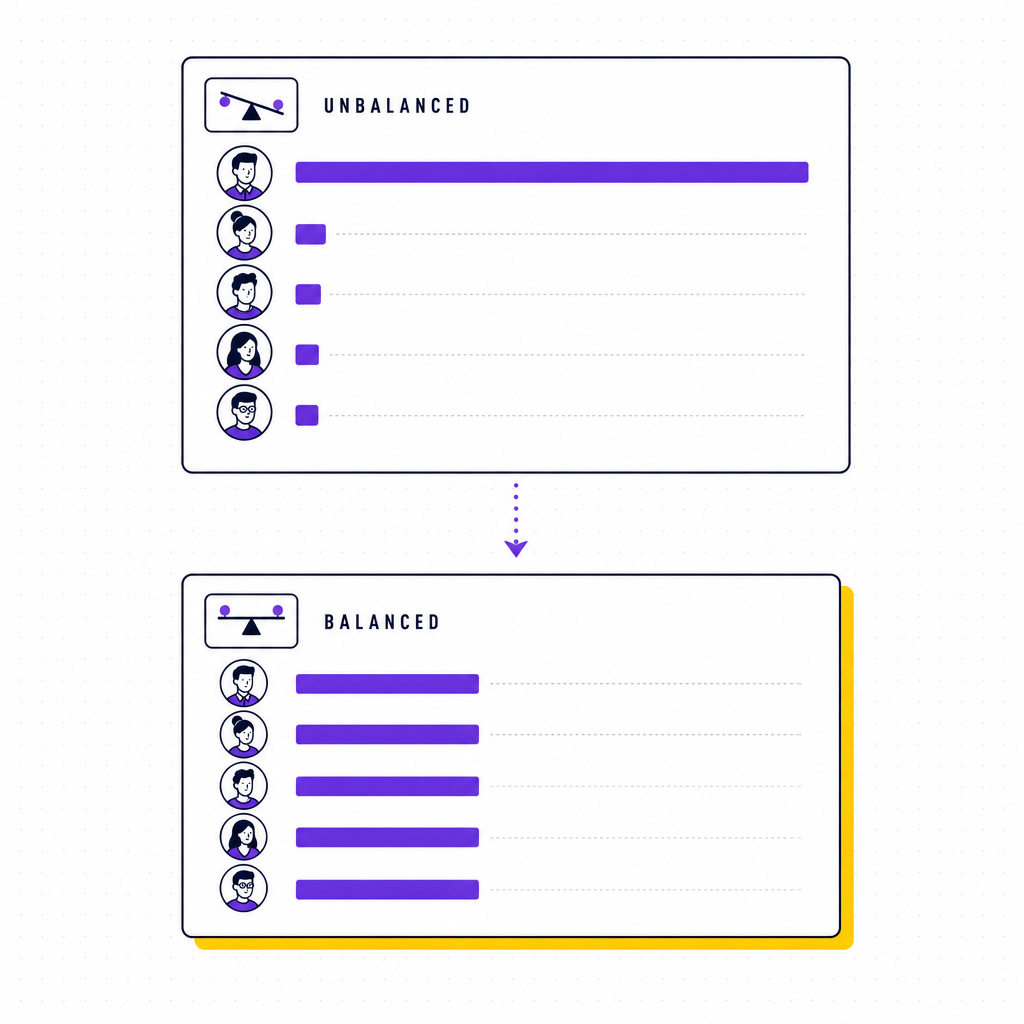
The mechanism underneath is participation equality, often measured as how evenly speaking time is distributed. Counselling and meeting-analytics research suggests a healthy facilitator talk-time ratio sits somewhere between 40% and 60%, leaning toward maximising participant speech in generative sessions. The exact figure is context-dependent, but the direction is consistent: the less airtime the facilitator takes and the more evenly the rest is shared, the better the group does.
How facilitation is changing: hybrid and AI
Two shifts have reshaped the job in the last couple of years.
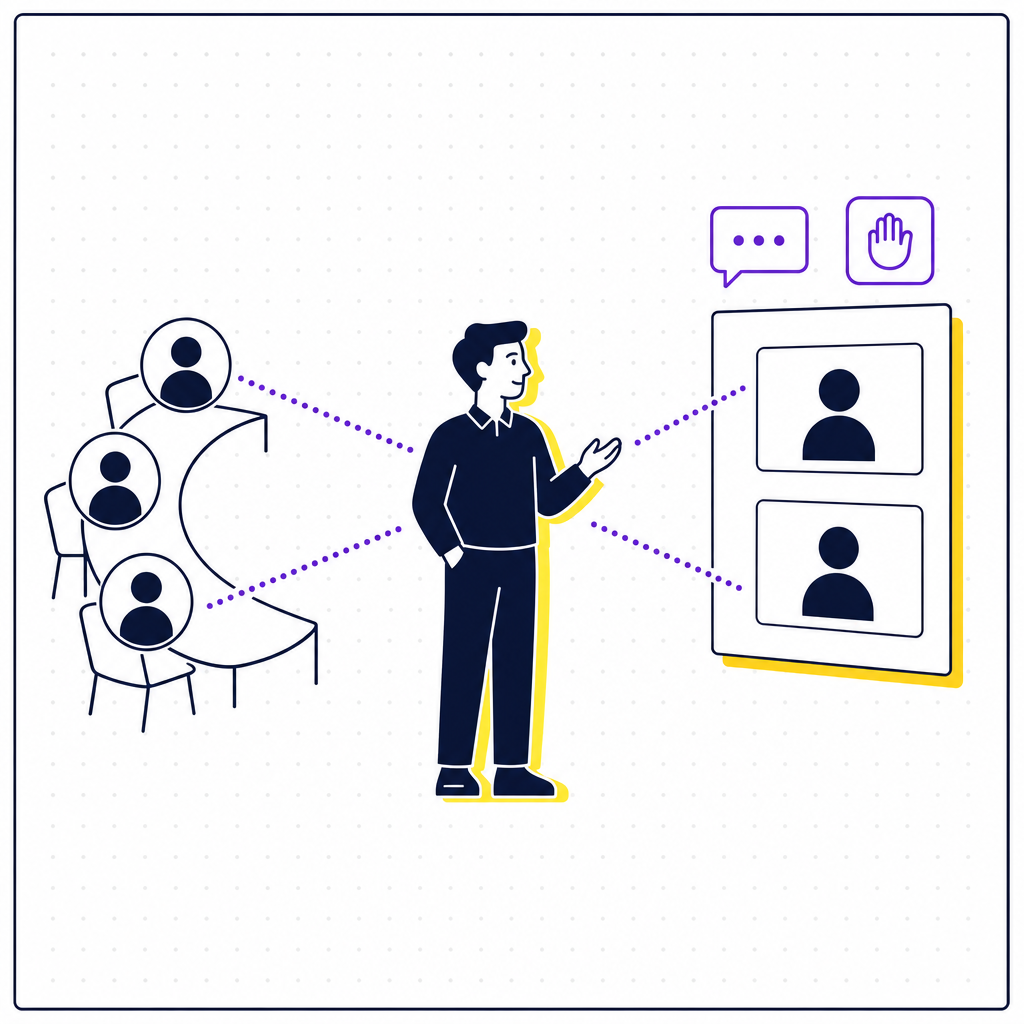
The first is permanent hybrid work, which has made facilitation a more technical craft. A great facilitator now actively engineers meeting equity so remote participants are not second-class to the people in the room: acknowledging remote hands first, monitoring the chat continuously, and using shared digital boards so everyone contributes on the same surface. The skill is no longer just running the room. It is running two rooms at once and refusing to let one dominate.
The second is AI moving into the meeting itself. Tools have split into passive notetakers, which transcribe and summarise, and more agentic platforms that suggest methods, balance agenda energy, and synthesise discussion in real time. The consistent finding is that AI removes administrative friction but does not replace the human. In a large experiment with 879 participants, large language models acting as real-time text facilitators increased the volume of information shared and how included people felt, yet did not reliably improve the objective quality of the group’s final decisions (arXiv, 2025). AI can steer a conversation. It still struggles to generate the human buy-in that turns a discussion into a decision people own.
How to map and measure facilitation skills
For anyone developing facilitators, an L&D lead, an internal trainer, an HR team, a coach, the practical question is how to assess this without falling back on gut feel.
The honest starting point is that most measurement is still too shallow. Evaluation has historically stopped at Level 1 of the Kirkpatrick model, participant satisfaction, the “smile sheet”. The field’s own data shows the gap: while a large majority of facilitators reflect on participant satisfaction, fewer than a third track longer-term behaviour change and under a fifth evaluate with the goal of proving impact (SessionLab, State of Facilitation 2025; edufellowship.com). Satisfaction tells you the room enjoyed itself. It does not tell you whether participation was even or whether conflict was handled well.
The way forward is observable behavioural evidence. Reviewing recorded sessions, or using analytics, lets you score the specific things this map is built on: the open-to-closed question ratio, how evenly talk-time was distributed, how often the facilitator jumped to a solution before the group did, whether conflict was reframed or smoothed over. That turns a vague judgement about someone’s “presence” into a precise development plan tied to named behaviours.
Organisations scaling this tend to follow a maturity curve, from ad-hoc individuals facilitating in isolation, through pockets of shared templates, to a standardised central capability, and finally to facilitation treated as a core leadership competency (SessionLab’s facilitation maturity model). Mapping the skills is the prerequisite for moving up it. You cannot develop what you have not named, and you cannot prove progress on what you have not measured.
This is the gap Team Building Bot was built for. It joins your online sessions and scores how each participant communicates across the same six dimensions in this map, then shows the result as an Individual Communication Profile with concrete examples pulled from the transcript. Used on yourself, it turns “I think that went well” into evidence about your own clarity, inquiry, and enablement, which is the raw material every development conversation needs.
FAQ
What are the most important facilitator skills?
The skill with the most evidence behind it is enabling even participation: drawing out quieter members and stopping dominant voices from monopolising, because that is what gives a group access to its full pool of information. Inquiry, asking far more than you tell and listening actively, is a close second. Both matter more than presentation polish.
What is the difference between a good facilitator and a great one?
A good facilitator manages the mechanics well: time, agenda, instructions. A great one protects an equitable process so the group’s best thinking surfaces, practising what researchers call proactive neutrality, staying impartial on the content while actively intervening to balance participation. The shift underneath is from a control mindset to a mutual-learning one.
Can facilitation skills be measured?
Yes, through observable behaviour rather than satisfaction surveys. You can score the question-to-statement ratio, talk-time distribution, how often the facilitator solved problems for the group, and how conflict was handled, all from a recording or live analytics. That is far more useful for development than a post-session “smile sheet”.
Will AI replace human facilitators?
Not on current evidence. AI tools remove administrative load and can increase how much gets shared, but experiments show they do not reliably improve the quality of a group’s decisions or generate the human buy-in needed for genuine consensus. The likely future is AI handling notes and analytics while humans handle safety, conflict, and ownership.
How do I get better at facilitation?
Pick one dimension from the map and work it deliberately. The best starting point for most people is inquiry: deliberately raise your question-to-statement ratio and practise reflecting a point back before you respond to it. Then get evidence on whether it is working, from a colleague’s observation or a recording, rather than relying on how the session felt.
Sources
- Schwarz, R. Smart Leaders, Smarter Teams: How You and Your Team Get Unstuck to Get Results (Unilateral Control vs Mutual Learning). ResearchGate summary · Schwarz Associates · applied analysis (UPC)
- Weger, H. et al. (2014). The relative effectiveness of active listening in initial interactions. International Journal of Listening. Tandfonline · open copy (UMN)
- Proactive neutrality and the facilitation paradox. Pro-active neutrality (ResearchGate) · The Art of Facilitation: Building Trust (ASME)
- Facilitator neutrality experiment on design teams. Cambridge Design Science (2024)
- SessionLab facilitation guidance and improvisation framing. Facilitation skills · High-impact facilitation guide · Scaling facilitation / maturity model · State of Facilitation 2025
- Roffey Park facilitation model. What are facilitation skills · Practical facilitation skills
- Psychological safety and facilitation. Voltage Control (Gallup figures, psychological safety) · academic medical faculty intervention, UNM
- Participation equality and group decision quality. participation equality (PMC) · meeting effectiveness (Leadership IQ) · hidden-profile meta-analysis
- Talk-time ratio evidence. counsellor talk-time (Kutztown) · PMC
- Reframing and validation. reframing technique (ResearchGate) · cognitive restructuring (PositivePsychology) · Marigold et al. discussion
- Hybrid meeting equity. meeting equity in hybrid spaces (Digicom) · video-conferencing technology (Vibe)
- AI-assisted facilitation. best AI-driven workshop tools 2026 (Metodic) · AI meeting assistants 2026 (Tana) · LLM facilitators experiment (arXiv)
- Measuring facilitation and training impact. facilitation impact gap (Edufellowship) · measuring training effectiveness (Docebo) · Kirkpatrick levels (AIHR)
- From novice to expert facilitation. implementation facilitation skills (ResearchGate) · facilitation certification ROI (Voltage Control)
More on Meeting Facilitation
- arrow_forward 7 Sprint Retrospective Ideas for Non-Engineering Teams (2026)
- arrow_forward Social Facilitation at Work: When an Audience Helps or Hurts
- arrow_forward 8 Group Facilitation Skills Every Trainer Needs in 2026
- arrow_forward 10 Team Meeting Agenda Templates That Drive Decisions (2026)
- arrow_forward 55 Icebreaker Questions for Team Meetings (Tagged by Personality)
- menu_book Meeting Facilitation: Skills, Patterns, and Pitfalls Pillar
See your facilitation skills on a map, not a smile sheet
Team Building Bot joins your online sessions and scores how each person communicates across six dimensions: clarity, inquiry, directing, adaptability, resilience, and enablement. Use it to see your own facilitation in the same frame. Free during beta.
No spam, no credit card. Unsubscribe any time.