Social Facilitation at Work: When an Audience Helps or Hurts
Social facilitation explains why being watched speeds up easy work and wrecks hard work. The research, plus how to stage meetings around it.
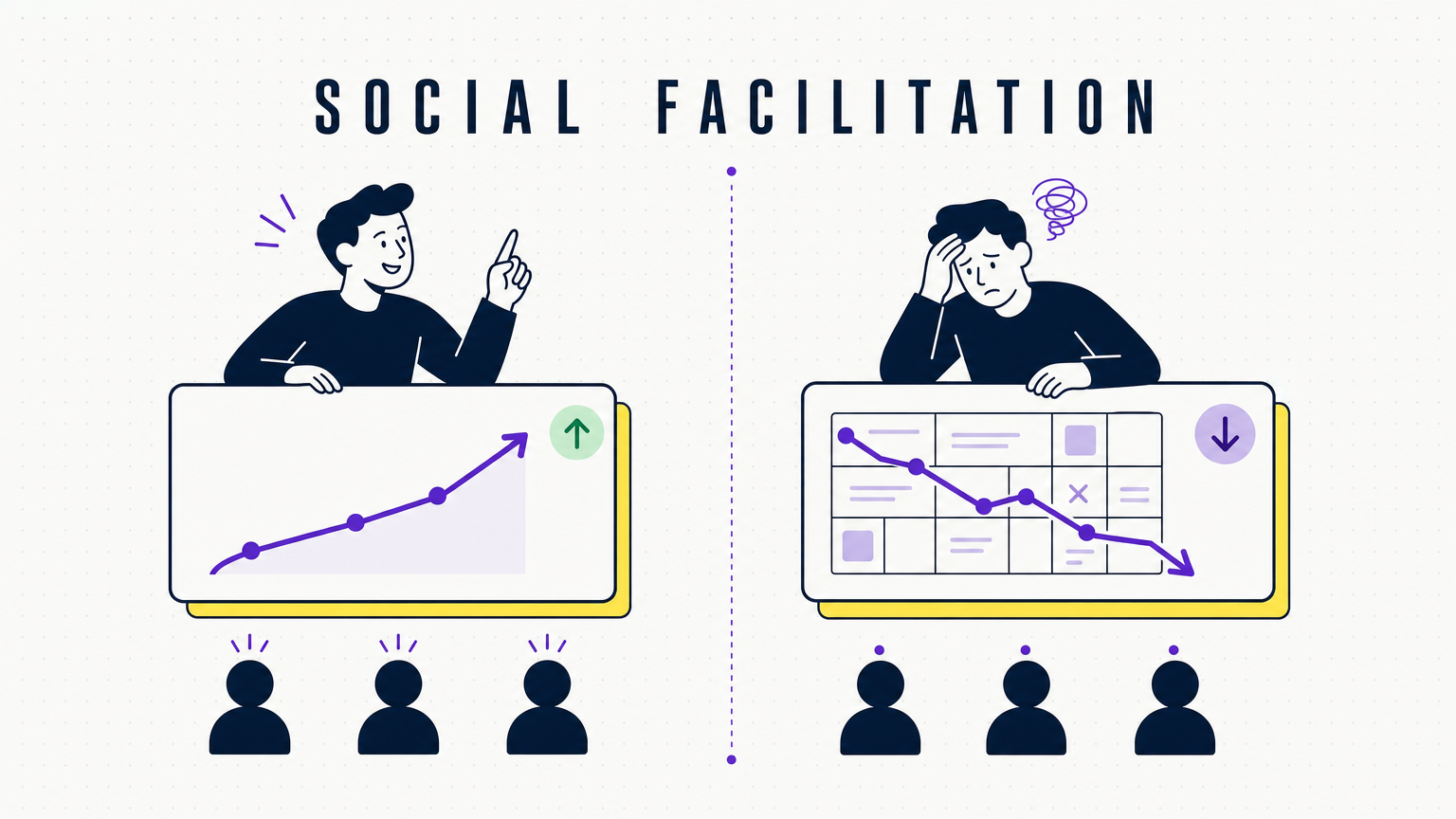
Ask someone to count backwards from a hundred in front of a crowd and they will fly through it. Ask them to learn a new spreadsheet formula while three colleagues watch over their shoulder and they will fumble something they could do alone in seconds. Same person, same audience, opposite result. That split is the whole of social facilitation, and most meetings are built as if it did not exist.
Social facilitation is the effect that the presence of other people has on how well you perform a task. For over a century the research has pointed to one stubborn pattern: an audience sharpens performance on things you already do well, and degrades it on things you are still working out. The presence is the same. What changes is the task.
This guide sits under our pillar on meeting facilitation skills and patterns. Read that for the broader craft; read this for the one piece of psychology that decides whether putting people in a room together helps them or holds them back.
The short answer
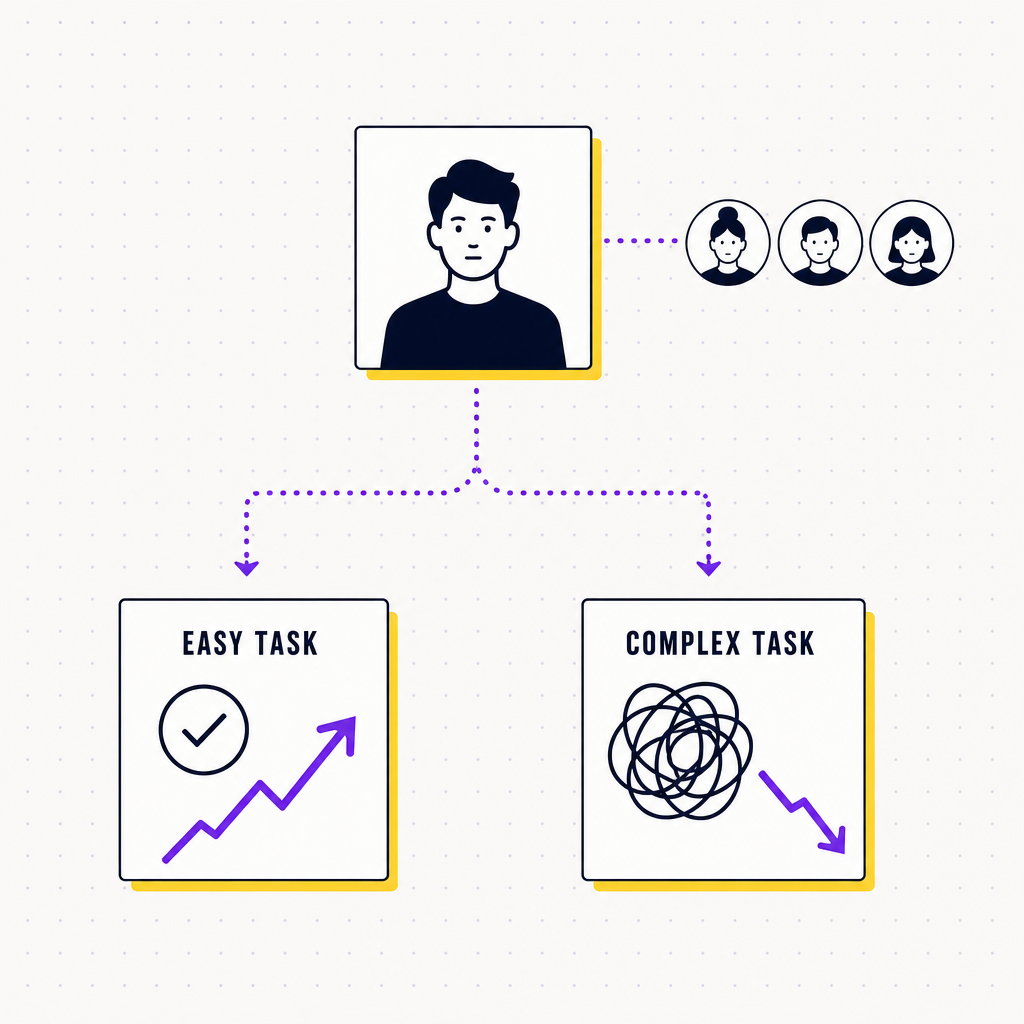
Social facilitation means the mere presence of others changes your performance, and the direction depends on the task. On simple, well-learned, or routine work, being watched speeds people up and can make them more accurate. On complex, novel, or not-yet-mastered work, the same presence creates arousal and self-consciousness that crowd out thinking, so performance drops. Robert Zajonc’s 1965 explanation is that an audience raises arousal, and arousal strengthens whatever response is already dominant: the right one when the task is easy, the wrong one when the task is hard.
| Task type | What presence does | What a facilitator should do |
|---|---|---|
| Simple, well-learned | Boosts speed and accuracy | Use co-action: live work, peer demos, shared rooms |
| Complex, novel, still-learning | Raises anxiety, harms performance | Give privacy: solo drafting, cameras-off deep work |
| Idea generation | Group settings suppress output | Generate alone first, combine and judge together |
| Routine status updates | Keeps attention and accountability | Keep people present and identifiable |
What social facilitation actually is
The social facilitation definition that holds up is narrow on purpose: it is the change in individual performance caused by the presence of others, whether those others are an audience watching you or co-actors doing the same task beside you. It is about doing your own task near people, not about working together on a shared one. That boundary is what separates it from two effects it gets muddled with.
Social loafing is the opposite direction of travel. In social facilitation you are still individually on the hook, and the audience makes you try harder. In social loafing your effort is pooled into a group output where no single contribution can be seen, so people ease off (Khan Academy; eLearning Industry). The deciding variable is identifiability. When people can be evaluated as individuals, presence facilitates. When they vanish into the crowd, presence invites coasting. That single distinction explains why a town hall and a breakout room produce such different energy from the same people.
Social inhibition is not a separate force but the downside half of the same effect: the performance drop that presence causes on hard or unlearned tasks (Simply Psychology). Social facilitation and social inhibition are two outcomes of one mechanism, sorted by task difficulty.
For social facilitation examples, the everyday ones are easy to spot once you know the pattern. An experienced presenter lifts their game in front of a packed room. A new hire freezes when asked to debug live in a screen-share. Runners post faster times in a pack than alone on the same course. A skilled chef plates faster during a busy service, while an apprentice drops things under the same pressure.
The research, from cyclists to cockroaches
Social facilitation is the oldest finding in social psychology. In 1898 Norman Triplett noticed that cyclists rode faster when racing others than against the clock, and ran a lab study with children winding fishing reels that is usually called the field’s first experiment (Wikipedia: Norman Triplett). Modern reanalysis is blunt that Triplett’s own numbers were weaker than the textbooks claim, and that not every child sped up, so the story is better treated as the origin of the question than as proof of the answer (ResearchGate: what did Triplett really find).
The answer came much later. Decades of contradictory results, some studies showing presence helped and others showing it hurt, were reconciled by Robert Zajonc in 1965. His drive theory argued that the presence of others is physiologically arousing, and that arousal strengthens the dominant response, the thing you are most likely to do on that task. On an easy task the dominant response is correct, so presence helps. On a hard task the dominant response is usually wrong, so presence amplifies the error (The Decision Lab; Simply Psychology). It is the cleanest idea in the area, and it is why an audience can look like a performance drug one minute and a poison the next.
Zajonc pushed the logic to its limit with a 1969 study using cockroaches. The insects ran a simple straight runway faster with other roaches watching, and ran a complex maze slower under the same audience (Wikipedia: social facilitation). Because cockroaches do not worry what other cockroaches think of them, the result suggested mere presence alone could drive the effect, with no need for self-image to be involved.
Two refinements followed, and both still matter at work. Nickolas Cottrell argued in 1968 that it is not mere presence but evaluation apprehension, the expectation of being judged, that does most of the work in people; a blindfolded, inattentive audience facilitates far less than an attentive one (The Decision Lab). Robert Baron’s 1986 distraction-conflict account added that an audience splits your attention between the task and the people, and that attentional conflict is what raises arousal (Simply Psychology). Whether the trigger is being judged or being distracted, the practical upshot is the same: the more a task demands your full working memory, the worse an audience makes it.
How strong is the effect overall? The definitive answer is Bond and Titus’s 1983 meta-analysis, which pooled 241 studies covering roughly 24,000 participants (Semantic Scholar; PubMed). It confirmed the task-complexity pattern: presence improved speed and accuracy on simple tasks and impaired accuracy on complex ones. It also found the effect is real but modest, and that presence explained only a small share of the variance in performance, a useful caution against overclaiming. A 2022 meta-analysis on physical and motor tasks reached the same directional conclusion in a modern sample, so the core pattern has held across nearly a century (ResearchGate: moving in the presence of others).
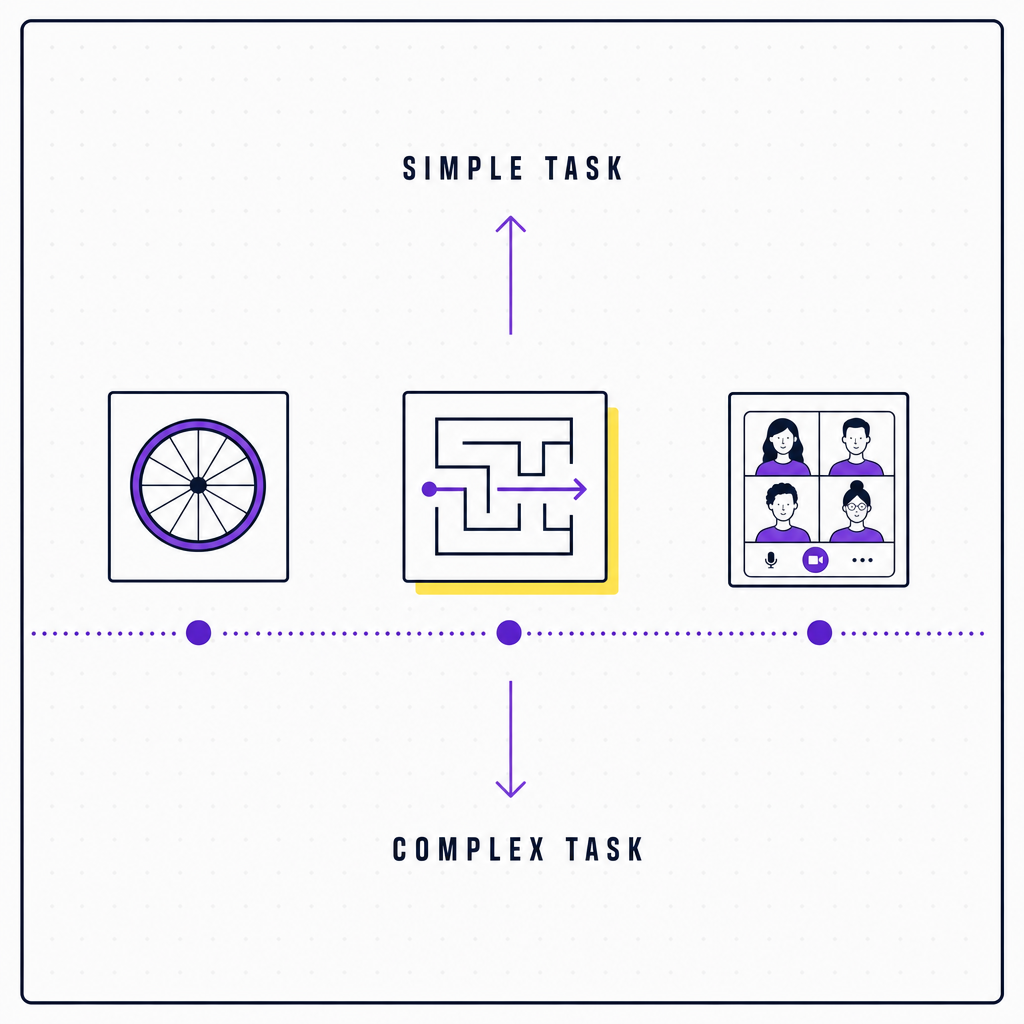
Why it flips: the task-complexity rule
The single rule worth memorising is that task complexity decides the sign of the effect. A task is “simple” here if the correct response is already your dominant one, through practice or sheer familiarity. It is “complex” if you are still working out what the correct response is. That is why the same activity flips as a person learns it. Tying your shoes is complex for a four-year-old and simple for an adult, and an audience helps the adult and hobbles the child, a contrast Markus demonstrated experimentally back in 1978.
People also differ in how strongly they feel it. A 2007 meta-analysis on individual differences found that the trait most tied to a strong social facilitation response is the degree to which someone is oriented toward how others see them, so the same audience that energises one colleague can paralyse another (ResearchGate: individual differences in the social facilitation effect). Treating a team as a single nervous system that all responds to presence the same way is a mistake.
This is the part most meeting design gets wrong. Managers default to “let’s get everyone in a room and work it out together,” which is exactly the worst setup for the complex, novel thinking that those meetings usually exist to do. Presence is a tool with a sharp edge. Pointed at well-drilled execution it cuts well. Pointed at fragile early-stage thinking it does damage.
Social facilitation on video calls and under monitoring
The audience has changed shape. For knowledge workers it is now a grid of faces on a video call and, increasingly, software counting their keystrokes. Both are forms of presence, and both follow the same task-complexity rule.
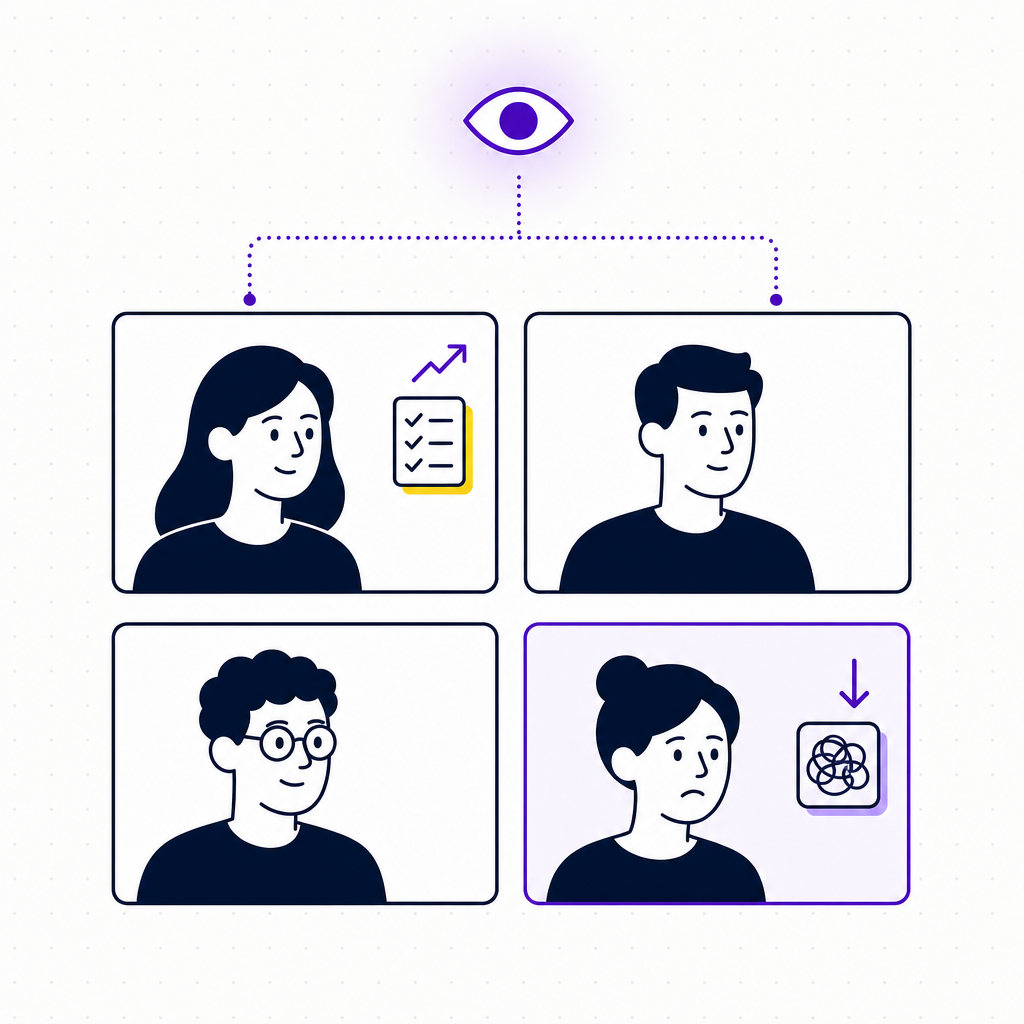
On video calls, the camera is an audience whether or not anyone is really watching. Stanford research on what its authors named “Zoom fatigue” traces part of the exhaustion to constant self-view and the feeling of being observed, a low-grade evaluation apprehension running all day (Stanford VHIL). Recent experimental work comparing mere presence and audience effects during videoconferencing finds that being on camera measurably shifts performance, in line with the offline pattern rather than against it (ResearchGate: deconstructing mere presence during videoconferencing). An always-on camera norm is, in effect, forcing constant social facilitation on people regardless of whether their current task wants it.
Electronic performance monitoring is the most consequential modern version, because it makes the audience permanent. The deep-research brief reports that as of 2024 roughly 80% of large US employers use some form of monitoring on remote staff, turning social facilitation from an occasional event into a constant state (Cyberpsychology; Semantic Scholar PDF). The research split is predictable. On routine, high-volume tasks, monitoring can lift throughput in skilled workers. On complex knowledge work it tends to raise anxiety, eat working memory, and trigger reactance, which is social inhibition by another name (Frontiers in Psychology; Annual Review of Organizational Psychology). How workers read the monitoring matters too: framed as developmental and fair, it can support performance; framed as punitive surveillance, it corrodes trust and tanks the very creative work the employer is paying for (ResearchGate: EPM and job performance).
What this means for facilitators, HR, and L&D
Once you accept that presence is task-specific, the design rules write themselves. Match the social setting to the cognitive demand instead of defaulting to “everyone, together, now.”
Separate the learning phase from the performance phase. When people are learning something genuinely new and hard, give them privacy. A live demo or a watched first attempt at an unmastered skill triggers the wrong dominant response and teaches the room that struggling is dangerous. Once the skill is practised to the point of being automatic, an audience becomes useful: peer review, live shadowing, and public demonstration all add helpful arousal to work that is now well-learned.
Stop brainstorming out loud as your default. The evidence against open group brainstorming is decades old and still ignored: groups generate fewer and lower-quality ideas than the same people working alone, mostly because of production blocking and the fear of being judged (The Decision Lab on brainstorming; the brainstorming myth (PDF)). Have people generate ideas privately and silently first, then bring them together to combine, build on, and choose. The group session is for evaluation and commitment, not for the fragile act of having ideas.
Use camera norms as a dial, not a rule. For hard, analytical discussion, let people turn cameras off to drop the evaluative load and free up working memory. Turn them back on for relationship-building, decisions, and routine updates, where presence keeps attention and connection up. An always-on policy quietly imposes social inhibition on exactly the work that needs deep focus.
Break big rooms into small ones. A large meeting reduces identifiability and invites social loafing, which is why town halls go quiet. Small breakout groups restore the sense of being individually accountable, which brings back the productive edge of presence (why town halls fall flat).
The hard part is not the rules, it is seeing which way the effect is running in your own sessions. The facilitator steering a conversation is the worst-placed person to notice that one capable colleague has gone silent under the group’s gaze while another is performing for it. This is the gap Team Building Bot is built for. It joins your online sessions, listens for who spoke, who held back, and where the energy turned, and produces a Team Dynamics Map you can act on. You can see what those reports look like on the reports overview, and the companion guide on group facilitation skills covers the in-the-moment moves for drawing quiet people back in.
FAQ
What is social facilitation? Social facilitation is the way the presence of other people changes your performance on a task. It improves performance on simple, well-learned tasks and worsens it on complex or unfamiliar ones. Robert Zajonc explained this in 1965 by arguing that an audience raises arousal, which strengthens whatever response is already dominant for that task.
What is an example of social facilitation? A practised presenter performing better in front of a full room is social facilitation helping. A new employee fumbling a task they could do alone, because colleagues are watching, is the same effect hurting. Runners going faster in a pack and skilled workers speeding up when observed are everyday examples of the same mechanism.
What is the difference between social facilitation and social loafing? In social facilitation you are performing an individual task and can be evaluated, so the presence of others makes you try harder. In social loafing your effort is pooled into a group result where your individual contribution cannot be seen, so you ease off. Identifiability is the deciding factor: visible effort facilitates, hidden effort loafs.
Who came up with social facilitation theory? Norman Triplett ran the first study in 1898, but the modern theory is Robert Zajonc’s 1965 drive theory, which links presence to arousal and the dominant response. Later refinements came from Nickolas Cottrell, who emphasised evaluation apprehension, and Robert Baron, whose distraction-conflict theory focused on divided attention.
Does social facilitation happen on video calls? Yes. A camera works as an audience even when no one is actively watching, and research on video meetings links part of the fatigue to constant self-view and the sense of being observed. The same task-complexity rule applies, so cameras-on tends to help routine work and hinder hard, focused thinking.
Sources
- Definition, social loafing and inhibition: Social facilitation (The Decision Lab) · Social facilitation (Simply Psychology) · Social facilitation (Wikipedia) · Social facilitation and social loafing (Khan Academy) · Social loafing vs social facilitation (eLearning Industry).
- Triplett 1898 and its reanalysis: Norman Triplett (Wikipedia) · What did Triplett really find (ResearchGate) · The truth about Triplett 1898 (ResearchGate).
- Zajonc drive theory, Cottrell, Baron, mere presence: Social facilitation (The Decision Lab) · Social facilitation (Simply Psychology) · Mere presence effects in humans, a review (ResearchGate).
- Bond and Titus 1983 meta-analysis (241 studies, ~24,000 participants): Bond & Titus (Semantic Scholar) · Bond & Titus (PubMed).
- Modern meta-analyses and individual differences: Moving in the presence of others, meta-analysis (ResearchGate) · Individual differences in the social facilitation effect (ResearchGate).
- Brainstorming, production blocking, and meeting design: Brainstorming (The Decision Lab) · The brainstorming myth (PDF) · Why town halls and webinars fall flat (Andi Roberts).
- Video calls and audience effects: Too tired to connect, Zoom fatigue (Stanford VHIL) · Deconstructing mere presence during videoconferencing (ResearchGate) · Hybrid meetings and workers’ state of mind (SAP).
- Electronic performance monitoring as continuous presence: Computer monitoring extends social facilitation (Rutgers) · EPM and remote work (Cyberpsychology) · EPM double-edged sword (Frontiers in Psychology) · EPM review (Annual Review of Organizational Psychology) · EPM and job performance, SIP perspective (ResearchGate).
- Practical L&D and facilitation framing: Social facilitation in a learning experience (Learning Everest) · Social facilitation for employers (Indeed) · Social facilitation (MasterClass).
More on Meeting Facilitation
- arrow_forward The Facilitator Skills Map: Good vs Great in 6 Dimensions
- arrow_forward 7 Sprint Retrospective Ideas for Non-Engineering Teams (2026)
- arrow_forward 8 Group Facilitation Skills Every Trainer Needs in 2026
- arrow_forward 10 Team Meeting Agenda Templates That Drive Decisions (2026)
- arrow_forward 55 Icebreaker Questions for Team Meetings (Tagged by Personality)
- menu_book Meeting Facilitation: Skills, Patterns, and Pitfalls Pillar
See who the room helped and who it shut down
Team Building Bot joins your online sessions, listens for who spoke, who held back, and where the energy turned, and produces a Team Dynamics Map you can facilitate against. Free during beta.
No spam, no credit card. Unsubscribe any time.