Assertive Communication: 30 Phrases That Work in 2026
30+ assertive communication phrases for saying no, giving feedback, and disagreeing at work, contrasted with passive and aggressive versions, plus the evidence.
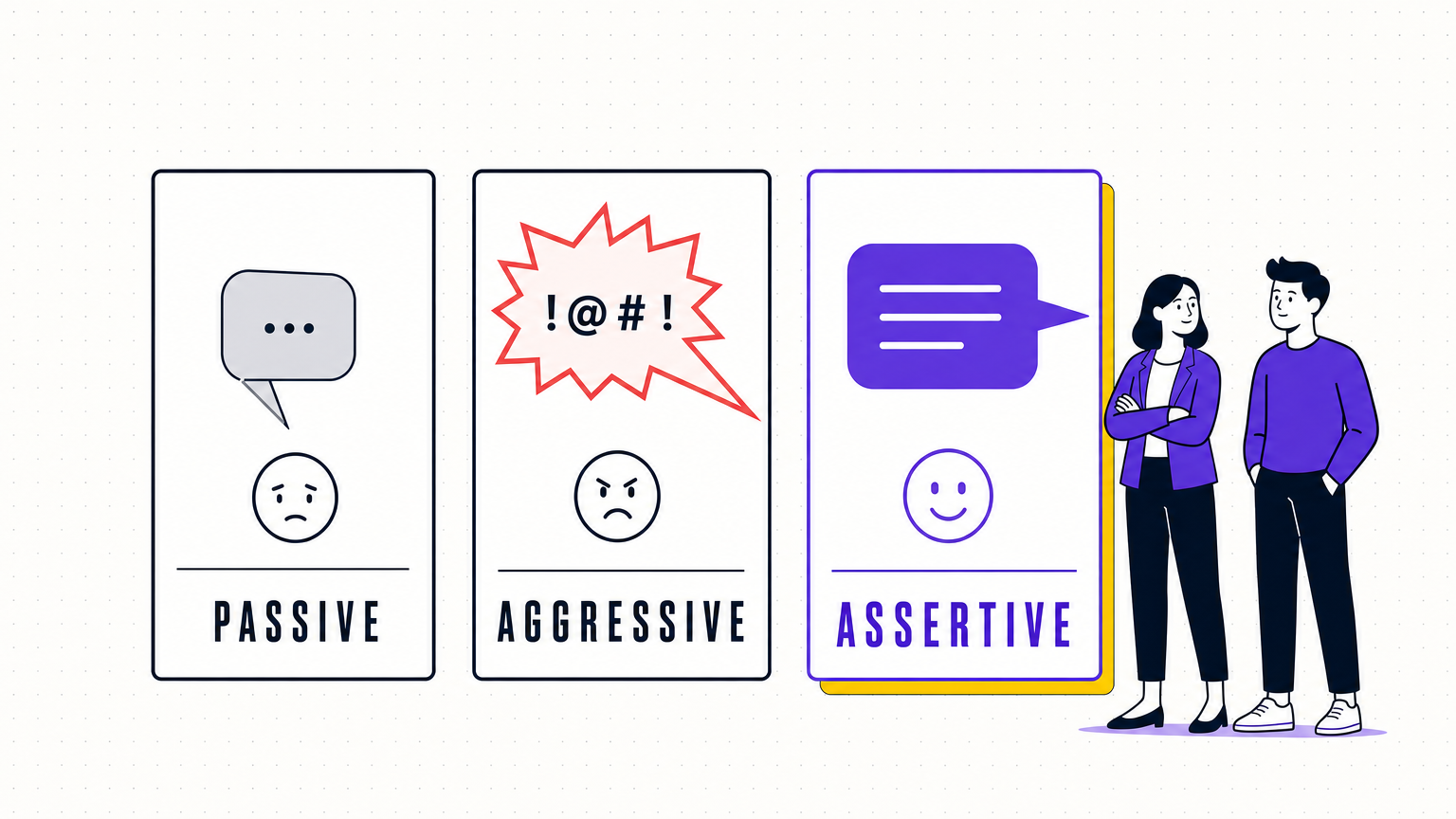
Most people do not lack opinions at work. They lack the sentence. They know the deadline is impossible, that the feedback is unfair, or that the plan has a hole in it, and then the moment arrives and out comes “yeah, sure, no problem.” Assertive communication is mostly the practice of having the right sentence ready before the pressure hits. This guide gives you the sentences, grouped by the situations where they are hardest to find.
Each scenario below shows the same message in three registers: the passive version that protects the relationship and loses the point, the aggressive version that wins the point and damages the relationship, and the assertive version that holds both. If you want the wider map of how people default to one style, start with our communication styles at work guide; this piece is the field kit of actual phrases.
The short answer
Assertive communication means stating your needs, limits, and views clearly and respectfully, while still treating the other person’s needs as real. It sits between passive communication, where you suppress your own position to avoid friction, and aggressive communication, where you push your position at the other person’s expense. Passive-aggressive communication is the hybrid that fails at both: the resistance is real but disguised, so nothing gets resolved and trust erodes anyway.
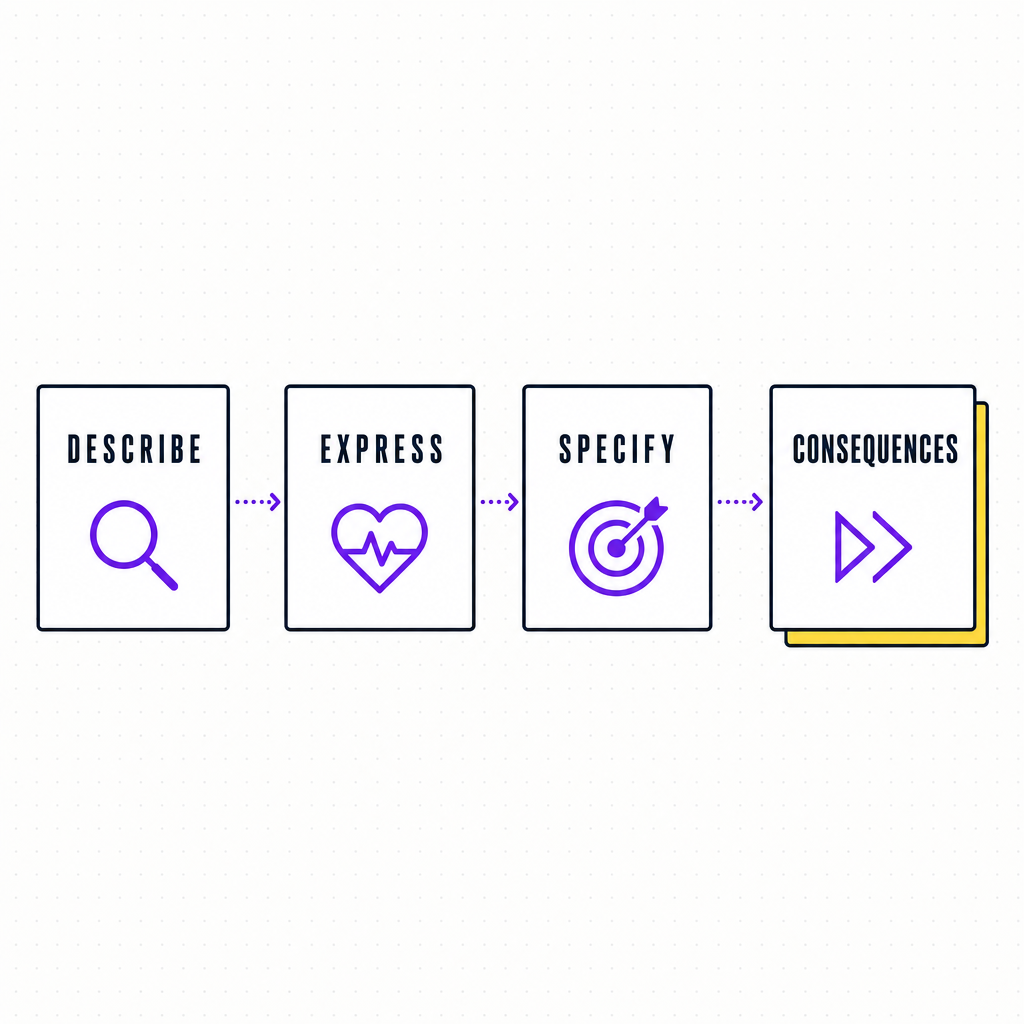
The practical core of assertiveness is the “I” statement and a small set of scripts. Instead of “you” language that lands as blame (“you always dump this on me”), you describe the situation, name your own reaction, and state what you need: “When the brief lands at 4pm for a 9am deadline, I can’t do my best work on it. I need a day’s notice.” This is the structure behind the widely taught DESC script (Describe, Express, Specify, Consequences), used in management training from Yale and others (Yale University, “Using DESC to Make Your Difficult Conversations More Effective,” 2025).
It is also trainable, not a fixed trait. A 2023 systematic review and meta-analysis of assertive communication training for nurses found that the share of cases where nurses spoke up about a medical error rose from 38% before training to 78% after, with a moderate pooled effect on speaking-up behaviour (Chen et al., Nurse Education Today, 2023; SMD 0.58, 95% CI 0.14 to 1.03). The phrases below are the raw material for that kind of shift.
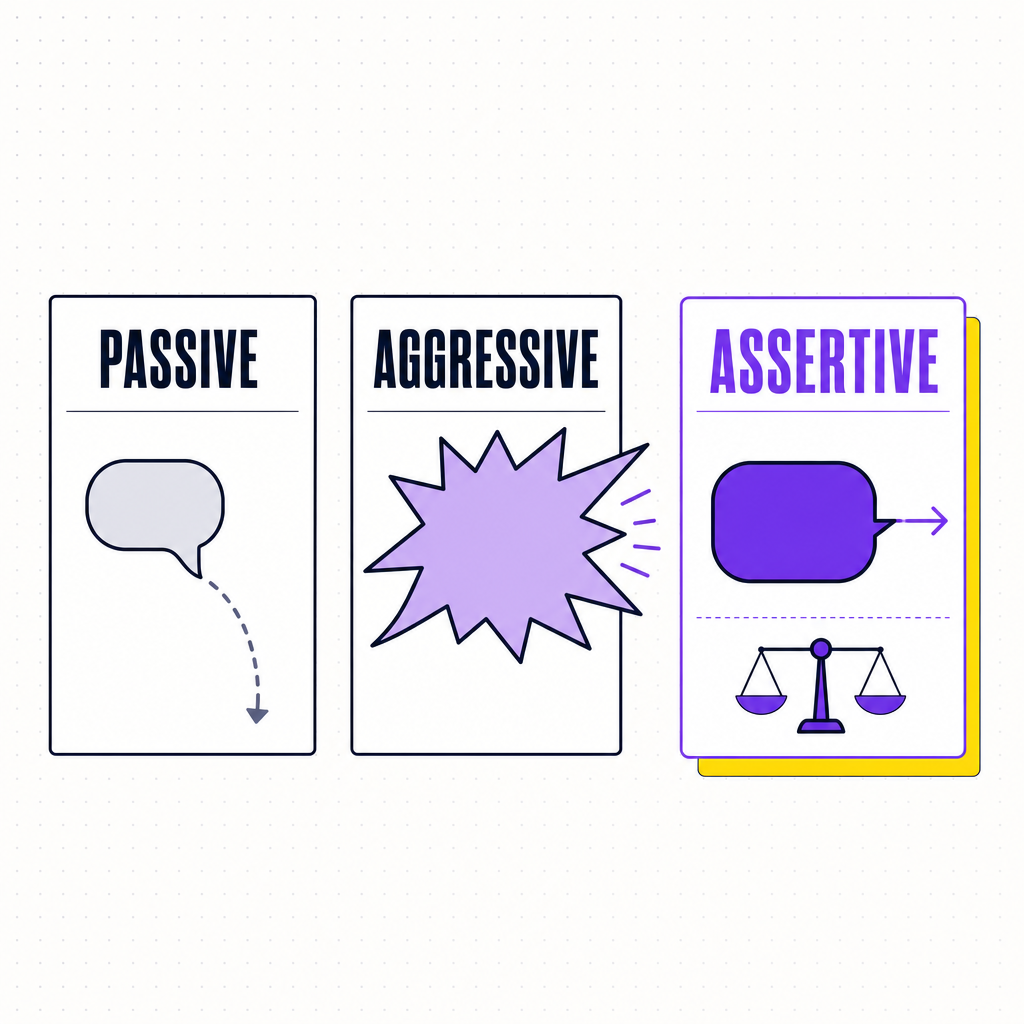
How the three registers actually sound
Before the scenario scripts, it helps to hear the registers side by side. The pattern repeats everywhere: passive hands over control, aggressive seizes it, assertive shares it.
| Register | What it protects | What it costs | Tell-tale phrasing |
|---|---|---|---|
| Passive | The relationship, short term | Your needs go unmet; resentment builds | ”It’s fine, whatever works for you.” |
| Aggressive | Your position | The relationship and others’ input | ”This is wrong. We’re doing it my way.” |
| Passive-aggressive | Your pride | Clarity; the issue stays unresolved | ”Sure, if that’s what you think is best.” |
| Assertive | Both, where possible | Short-term discomfort | ”I see it differently. Here’s why.” |
Two habits separate the assertive column from the rest. The first is owning the sentence with “I” rather than “you,” which keeps the focus on your position instead of the other person’s character. The second is staying specific: a clear request (“I need a day’s notice”) gives someone something to act on, where a vague complaint (“this is unsustainable”) just raises the temperature. Keep those two in mind and the scenario scripts below mostly write themselves.
1. Saying no to extra work
Declining is where most people leak the most authority. The passive yes protects the moment and quietly overloads you; a month later you are the bottleneck and nobody knows why. Assertive declining names the constraint and, where you can, offers a path.
| Situation | Passive | Aggressive | Assertive |
|---|---|---|---|
| Asked to take on another project | ”Um, I guess I can try to fit it in." | "Are you serious? I’m already drowning." | "I can’t take this on without dropping something. Which of my current priorities should move?” |
| A favour outside your role | ”Okay, sure.” (then misses your own work) | “That’s not my job." | "I’m not able to help with this one. Have you tried the ops channel?” |
| Last-minute weekend request | (silently works the weekend) | “I have a life, you know." | "I’m offline this weekend. I can make this my first task Monday morning.” |
Useful phrases to keep ready:
- “I want to say yes, and to do that I need to move a deadline. Can we?”
- “My plate is full this week. The earliest I can start is Thursday.”
- “No, not this time. I’d rather decline than do it badly.”
The trade-off offer (“which priority should move?”) is the move managers respect most, because it hands the prioritisation decision back to the person who actually owns it.
2. Asking for help or clarification
Asking for help reads as weakness only when you apologise for it. Done assertively, it reads as someone who is managing their own work well enough to know what they are missing.
| Situation | Passive | Aggressive | Assertive |
|---|---|---|---|
| Stuck on a task | (struggles in silence for two days) | “Nobody told me how this works." | "I’ve spent an hour on this and I’m stuck on the API auth step. Can you point me in the right direction?” |
| Unclear brief | ”I’ll figure it out.” (builds the wrong thing) | “This brief makes no sense." | "Before I start, I want to check I’ve understood. Are we optimising for speed or accuracy here?” |
| Need more time | (works through the night) | “This timeline is impossible." | "To hit the quality bar we agreed, I need two more days. Can we move the review to Wednesday?” |
Useful phrases:
- “Can I borrow ten minutes of your thinking on this?”
- “I want to get this right the first time, so let me confirm the scope.”
- “What would ‘good’ look like to you here?”
Naming what you have already tried (“I’ve spent an hour on the auth step”) turns a vague help request into a precise one, and it signals that you are asking because you respect the other person’s time, not because you skipped the effort.
3. Giving critical feedback
Feedback is where the passive and aggressive failure modes are most expensive. The passive manager softens until the message disappears; the aggressive one delivers it so the person hears only the threat. The assertive version separates the behaviour from the person and stays specific enough to act on.
| Situation | Passive | Aggressive | Assertive |
|---|---|---|---|
| Missed deadline, again | ”No worries, these things happen." | "You’re always late. It’s a pattern." | "The last two deliverables came in after the deadline without a heads-up. What’s getting in the way, and how can we fix it?” |
| Sloppy work | (fixes it silently, says nothing) | “Did you even proofread this?" | "Slides 4 and 9 still have last quarter’s numbers. Can you update those before it goes out?” |
| Dominating meetings | (lets it continue) | “You talk over everyone." | "I noticed a few people didn’t get to finish their points today. Can we make space for them next time?” |
The reliable structure here is the DESC script: describe the specific behaviour, express the effect, specify the change you want, and name the consequence or benefit (Yale University, 2025; In Equilibrium, “The DESC Model for Assertiveness”). Leading with observable specifics rather than a character verdict is what lets the other person stay in problem-solving mode instead of defence.
4. Receiving feedback or pushback
The flip side matters just as much. People who take feedback badly stop receiving it, which is its own career risk. Assertive receiving means staying open without collapsing into agreement you do not mean.
| Situation | Passive | Aggressive | Assertive |
|---|---|---|---|
| Criticism you disagree with | ”You’re right, I’m sorry.” (you don’t agree) | “That’s completely unfair." | "I hear that it landed badly. My read of it was different. Can I walk you through my reasoning?” |
| Vague criticism | ”Okay, I’ll do better." | "What’s that supposed to mean?" | "I want to act on this. Can you give me a specific example so I know what to change?” |
| Public criticism | (absorbs it, stews) | “We are not doing this here." | "I’d like to dig into this properly. Can we take it offline after the call?” |
Useful phrases:
- “Thank you for telling me. Let me sit with it and come back to you.”
- “That’s fair on the timing. I see the deadline differently, though.”
- “Help me understand what you’d have done instead.”
The “broken record” technique helps when someone keeps pushing past a clear answer: you calmly repeat your position in slightly different words rather than escalating or caving (MindTools, “How to Be Assertive”). “I understand the urgency, and I still can’t commit to Friday” works better the third time than a louder version of the first.
5. Setting boundaries
Boundaries fail when they are implied rather than stated. People are not mind-readers, and the resentment of an unspoken boundary is invisible to everyone but you. Assertive boundary-setting names the line and the reason once, clearly.
| Situation | Passive | Aggressive | Assertive |
|---|---|---|---|
| After-hours messages | (replies at 11pm every night) | “Stop messaging me after work." | "I switch off notifications after 6pm and pick things up in the morning. If it’s a genuine emergency, call me.” |
| Constant interruptions | (loses focus, says nothing) | “Can you not see I’m busy?" | "I’m heads-down until noon. Can we talk at 1, or is this urgent?” |
| Scope creep | ”I suppose I can add that too." | "That wasn’t in the agreement." | "That’s outside what we scoped. I’m happy to add it as a follow-up piece of work. Shall I quote for it?” |
Useful phrases:
- “I’m protecting Friday mornings for deep work. Can we find another slot?”
- “I can do X or Y this week, not both. Which matters more?”
- “I’d rather give you a real answer tomorrow than a rushed one now.”
A boundary stated as a standing rule (“I switch off after 6pm”) is easier to hold than one negotiated case by case, because you are describing how you work rather than rejecting this particular person’s request.
6. Disagreeing in a meeting
Public disagreement is the highest-stakes register because the audience changes the maths. The passive move is to stay quiet and raise it afterwards in the corridor, which is where decisions go to rot. Assertive disagreement makes the objection visible while keeping it about the idea.
| Situation | Passive | Aggressive | Assertive |
|---|---|---|---|
| You think the plan is flawed | (says nothing, vents later) | “This will never work." | "I want to push on this before we commit. What happens if the supplier slips again?” |
| Talked over | (gives up the point) | “Let me finish." | "I didn’t get to finish that thought. Give me thirty seconds to land it.” |
| Group rushing a decision | (goes along with it) | “We’re being reckless." | "Before we lock this in, can we name the one assumption that, if wrong, breaks the plan?” |
Useful phrases:
- “I see it differently, and I might be missing something. Here’s my concern.”
- “Can I offer a counter-view?”
- “I’m not against this. I want to stress-test it first.”
Framing disagreement as a question (“what happens if the supplier slips?”) rather than a verdict invites the room to reason with you instead of defending the original idea. It is also the single behaviour most associated with psychological safety: teams perform better when people can voice a dissenting view without it costing them socially.
Where assertiveness gets complicated
Most phrase lists stop at the scripts. The honest version has to add a caveat, because the same assertive sentence does not land the same way for everyone, and pretending otherwise sets people up to fail.
The first complication is the double bind facing women. A woman who communicates in the deferential register is often read as warm but not leadership material; the same woman using the direct, agentic phrasing in this guide is more likely to be labelled “aggressive,” “bossy,” or “abrasive” than a man saying the identical words (Catalyst, “The Double-Bind Dilemma for Women in Leadership,” 2024). Coaching women to “just be more direct” without also training the managers who evaluate them is half a solution at best.
The second is culture. The blunt, explicit style prized in low-context cultures such as the United States, Germany, and Scandinavia can read as rude or disruptive in high-context cultures such as Japan, China, and much of Latin America and the Middle East, where group harmony and indirectness carry the meaning (Hall’s high-context and low-context framework; Vestd, “High-Context vs Low-Context Cultures,” 2024). A direct “no” that signals honesty in one office signals hostility in another. The critique of “professional” communication norms makes the same point closer to home: standards that treat one cultural style as the neutral default quietly penalise everyone else (Gray, “The Bias of Professionalism Standards,” Stanford Social Innovation Review).
None of this means the scripts are wrong. It means delivery has to flex, and that the organisation, not just the individual, owns the outcome. The goal is an environment where clarity of thought is expected but a range of delivery styles is respected, rather than one where a single register is mandated and everyone else is marked down.
Why this matters for L&D and managers
For anyone responsible for how a team communicates, assertiveness is not a soft nicety; it is the mechanism by which problems surface early. The nurse meta-analysis above is striking precisely because the speaking-up it measured was about catching medical errors before they reached a patient (Chen et al., 2023). The same dynamic, lower stakes, plays out in every team: the missed risk someone saw but did not raise, the bad assumption nobody questioned, the quiet quitter who stopped offering ideas.
The research on self-assertive efficacy, an individual’s belief that speaking up will be heard and will matter, links it to actual advocacy behaviour at work, which suggests training has to build the belief and the environment together, not just hand out scripts (researchgate.net, “Self-assertive efficacy and workplace advocacy behavior,” 2022). One-hour e-learning modules rarely move that belief. What moves it is repeated, observed practice in real situations, plus managers who respond well when someone does speak up.
That is the gap we built Team Building Bot to close. It is hard to coach a behaviour you cannot see, and most of this behaviour happens in meetings the L&D team never attends. If you can see who takes the airtime, who gets interrupted, and who defaults to the passive register, you can coach the specific person on the specific habit, instead of running another generic workshop and hoping.
Frequently asked questions
What is assertive communication, in one sentence?
It is expressing your needs, views, and limits clearly and respectfully while still treating the other person’s needs as legitimate. It sits between passive communication, which suppresses your own position, and aggressive communication, which overrides the other person’s.
What is the difference between assertive and aggressive communication?
Both are direct, so they are easy to confuse. The difference is whose needs are on the table. Assertive communication states your position while leaving room for the other person’s (“I see it differently, here’s why”); aggressive communication advances your position at their expense, often through blame, volume, or “you” language (“you’re wrong, we’re doing it my way”). Same directness, opposite respect.
Can you actually learn to be assertive, or is it a personality trait?
You can learn it. A 2023 systematic review and meta-analysis found assertive communication training roughly doubled the rate at which nurses spoke up about medical errors, from 38% to 78% of cases (Chen et al., Nurse Education Today, 2023). Assertiveness draws on temperament, but the scripts and the underlying skill are trainable with practice.
What is the DESC script?
DESC stands for Describe, Express, Specify, Consequences. You describe the specific behaviour or situation, express how it affects you or the work, specify the change you want, and name the consequence or benefit. It is a widely taught structure for difficult conversations because it keeps feedback concrete and forward-looking (Yale University, 2025).
Does assertive communication work the same in remote and hybrid teams?
Not quite. In text-based channels the absence of tone and facial cues means a perfectly assertive message can read as cold or aggressive, so assertive remote communication leans on explicit framing (“quick thought, not a blocker”) and on moving a spiralling text disagreement to a call early. Remote settings also make the passive register easier to hide in, since staying muted with the camera off is frictionless.
The one habit to start with
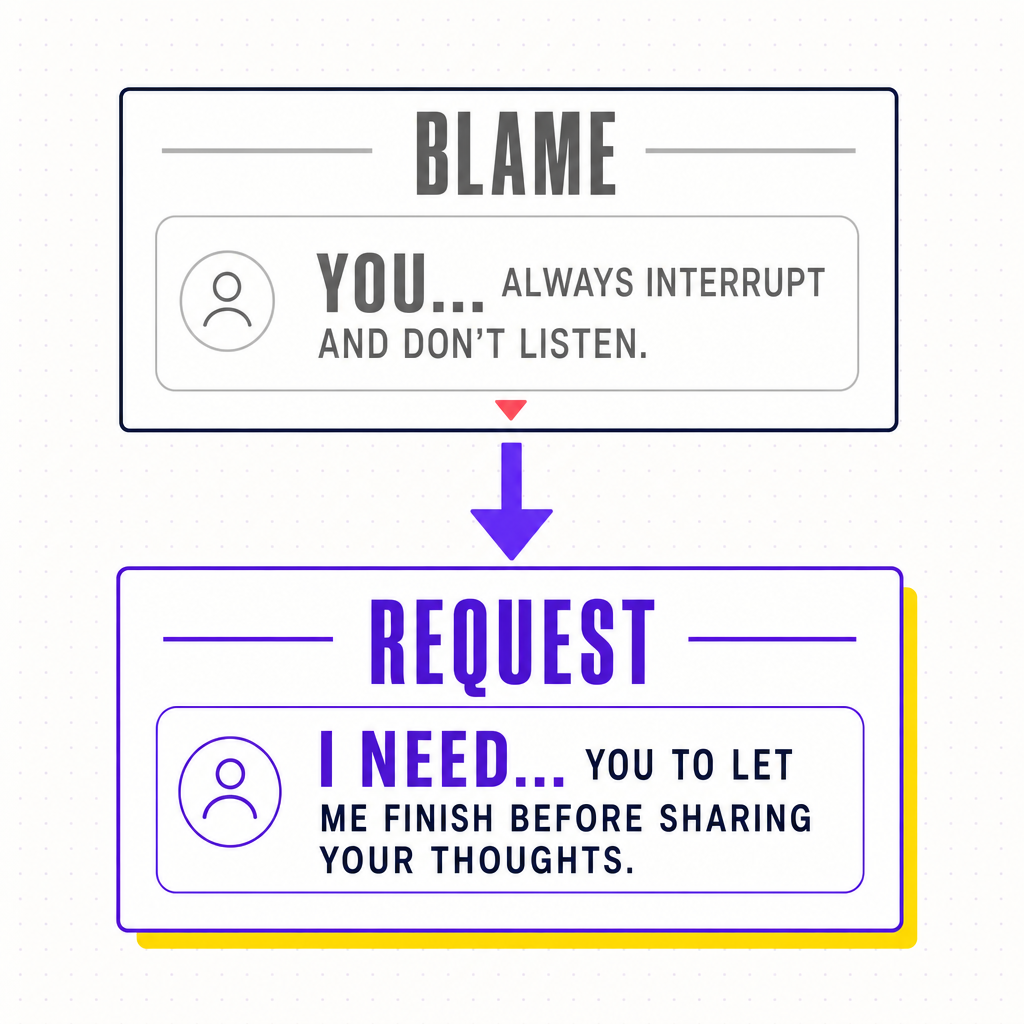
If you change one thing, make it the swap from “you” to “I” plus a specific request. “You never give me enough notice” becomes “I need a day’s notice to do this well.” That single move converts most aggressive sentences into assertive ones and most passive silences into stated needs. The thirty phrases above are just that habit applied to the moments where it is hardest to remember.
For the wider picture of how communication styles shape a team, see our communication styles at work guide, and for the trust habits that make assertiveness land, our piece on interpersonal communication at work.
Sources
- Chen, H-W. et al. “Assertive communication training for nurses to speak up in cases of medical errors: A systematic review and meta-analysis.” Nurse Education Today, 2023. https://pubmed.ncbi.nlm.nih.gov/37121073/
- Yale University. “Advice for Managers: Using DESC to Make Your Difficult Conversations More Effective.” 2025. https://your.yale.edu/sites/default/files/2025-03/adviformanagers_usingdesctomakeyourdifficultconversations.pdf
- In Equilibrium. “The DESC Model for Assertiveness.” https://www.in-equilibrium.co.uk/the-desc-model-for-assertiveness/
- MindTools. “How to Be Assertive: Asking for What You Want Firmly and Fairly.” https://www.mindtools.com/amjhdie/assertiveness/
- Centre for Clinical Interventions. “Assertive Communication” (information sheet). https://www.cci.health.wa.gov.au/~/media/CCI/Mental-Health-Professionals/Interpersonal/Interpersonal---Information-Sheets/Interpersonal-Information-Sheet---03---Assertive-Communication.pdf
- Niagara Institute. “Assertive vs Aggressive Communication.” https://www.niagarainstitute.com/blog/assertive-vs-aggressive-communication/
- “Self-assertive efficacy and workplace advocacy behavior: A social cognitive analysis.” 2022. https://www.researchgate.net/publication/364597227_Self-assertive_efficacy_and_workplace_advocacy_behavior_A_social_cognitive_analysis
- Catalyst. “Infographic: The Double-Bind Dilemma for Women in Leadership.” 2024. https://www.catalyst.org/insights/2024/infographic-the-double-bind-dilemma-for-women-in-leadership
- Gray, A. “The Bias of Professionalism Standards.” Stanford Social Innovation Review. https://ssir.org/articles/entry/the_bias_of_professionalism_standards
- Vestd. “High-Context vs Low-Context Cultures: How Communication Style Shapes Global Teams.” 2024. https://www.vestd.com/blog/high-context-vs-low-context-cultures-how-communication-style-shapes-global-teams
- Ria. “High-Context vs Low-Context Cultures.” https://www.riamoneytransfer.com/en/blog/high-context-vs-low-context-cultures-countries-communication/
- BCG. “Psychological Safety Levels the Playing Field for Employees.” 2024. https://www.bcg.com/publications/2024/psychological-safety-levels-playing-field-for-employees
- “Breaking Ceilings: Debate Training Promotes Leadership Emergence by Increasing Assertiveness.” https://www.researchgate.net/publication/388291790_Breaking_Ceilings_Debate_Training_Promotes_Leadership_Emergence_by_Increasing_Assertiveness
More on Communication Styles
- arrow_forward Talking-Time Imbalance in Meetings: What Quiet Tells You
- arrow_forward 8 Warning Signs of Team Communication Breakdown in 2026
- arrow_forward Nonviolent Communication at Work: Conflict Scripts for 2026
- arrow_forward Nonverbal Communication in Online Meetings: What Survives the Screen
- arrow_forward Interpersonal Communication at Work: 7 Habits of Trusted Colleagues
- menu_book Communication Styles at Work: The Complete 2026 Guide Pillar
See who actually speaks up in your meetings, and who goes quiet
Team Building Bot joins your online sessions and builds an Individual Communication Profile for each person: how much airtime they take, how they handle disagreement, and whether they default to passive, aggressive, or assertive. Free during beta.
No spam, no credit card. Unsubscribe any time.