Communication Styles at Work: The Complete 2026 Guide
The two frameworks behind workplace communication styles, how teams misread each other, and how to flex, backed by 2024-2026 evidence.
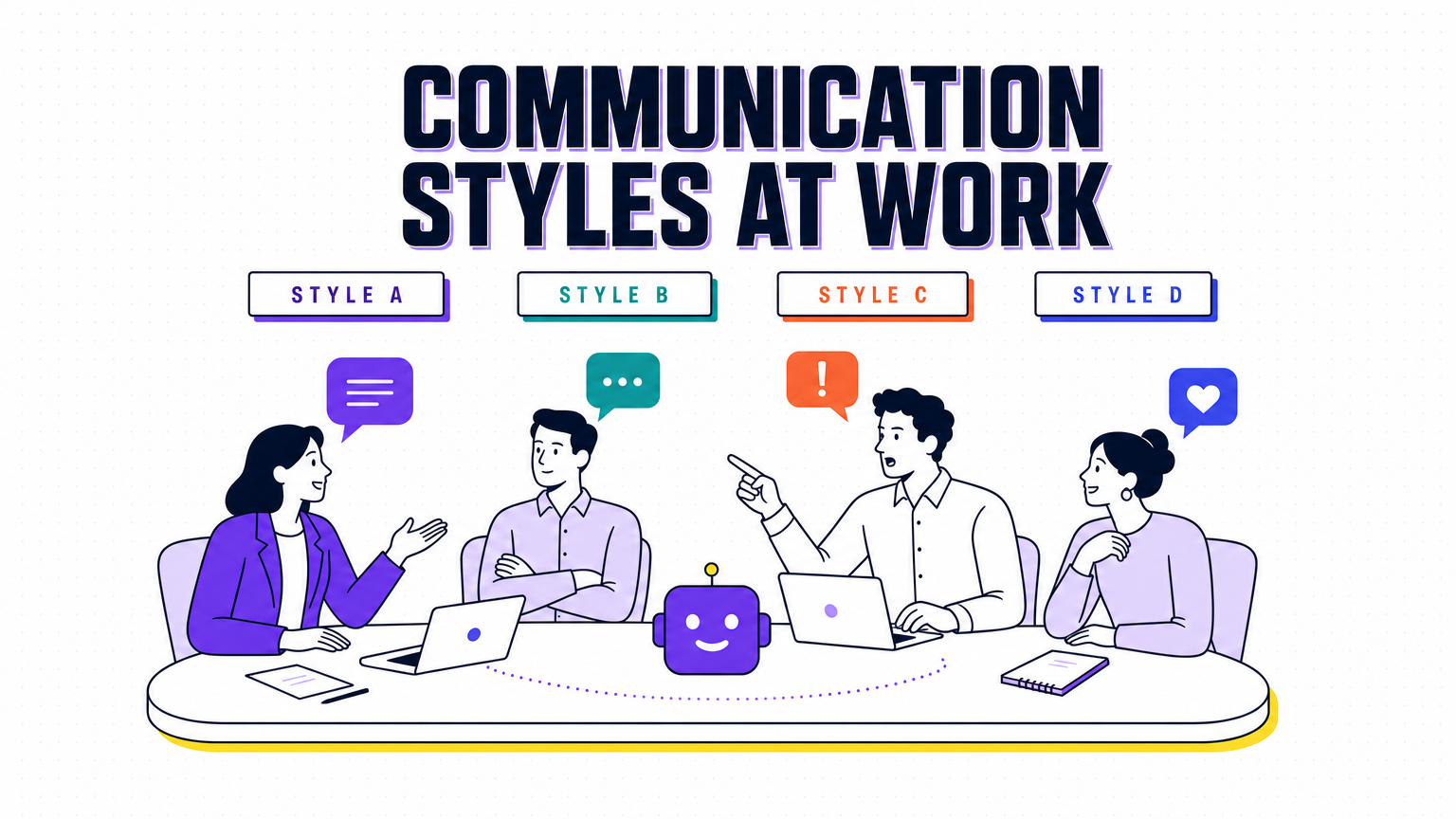
Two people can sit in the same meeting, hear the same proposal, and walk out with opposite read-outs of what just happened. One thought the discussion was decisive and direct. The other thought it was a pile-on. Neither is lying. They are running different communication styles, and most workplace friction starts exactly there.
This guide maps workplace communication styles using the two frameworks that actually matter at work: the assertiveness model, which describes how forcefully someone advocates for themselves, and Mark Murphy’s cognitive model, which describes how someone prefers to process and exchange information. It covers what the evidence says, how the styles collide in real meetings, how to flex without faking, and why this has become a measurable business cost rather than a soft-skills nicety. Team Building Bot scores these same patterns in its Individual Communication Profile, so the practical lens here is the one we build into the product.
The short answer
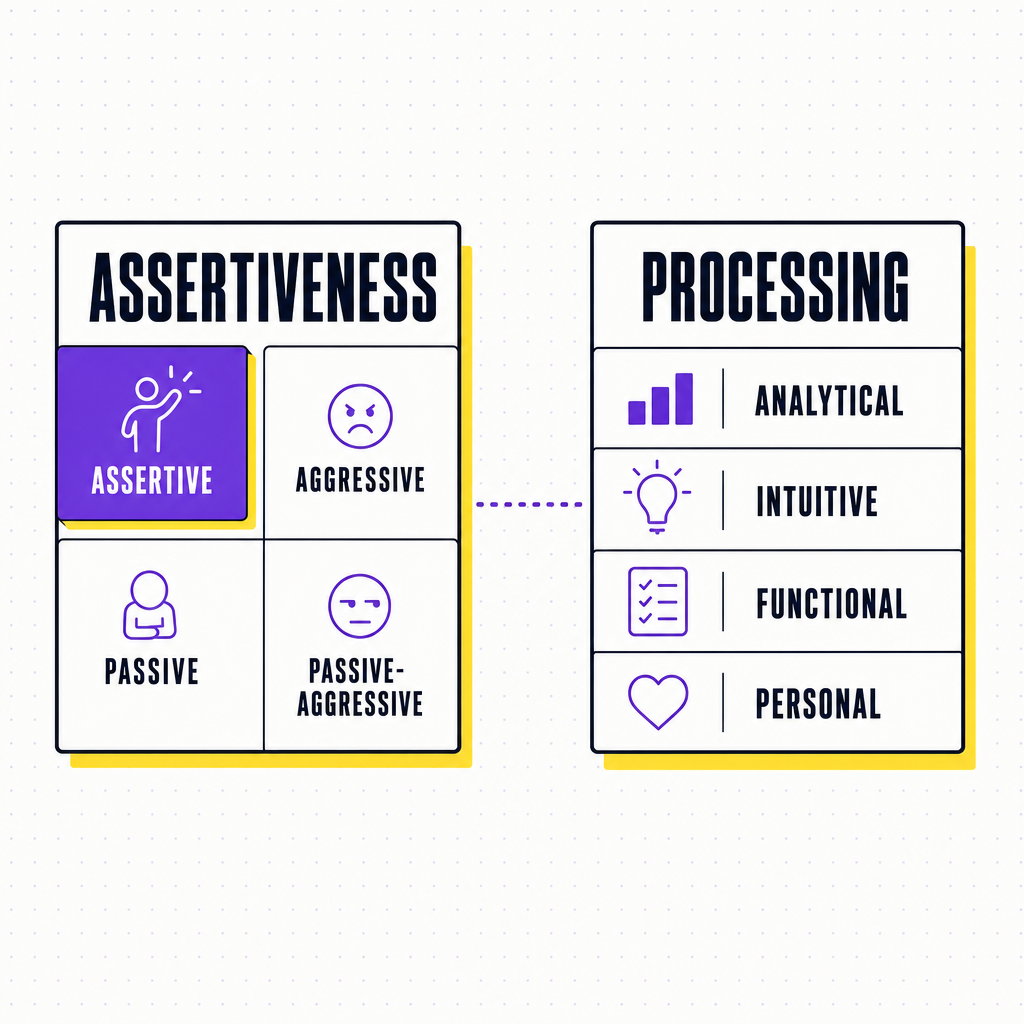
There is no single accepted list of communication styles, but two frameworks cover most of what teams need. The first sorts people by assertiveness into four styles: assertive, aggressive, passive, and passive-aggressive. Only one of those, assertive, is healthy; the other three are what happens when self-advocacy is too high, too low, or pushed underground. The second framework, popularised by Mark Murphy of Leadership IQ, sorts people by how they process information into four cognitive styles: analytical, intuitive, functional, and personal.
The styles are not personality cages. People shift them by context, culture, and power, and the research is clear that flexing your style to the room is a learnable skill rather than a fixed trait. Getting it wrong is expensive. Grammarly and The Harris Poll’s 2024 State of Business Communication report estimates poor communication costs U.S. businesses around $1.2 trillion a year, with per-employee losses in the tens of thousands. If you only remember one thing: communication style is malleable and measurable, so treat it as a competency you can train, not a horoscope.
What “communication style” actually means
A communication style is the pattern of choices someone defaults to when they share information and respond to others: how directly they state a need, how much they prioritise data over relationship, how they handle disagreement, and what they do under pressure. It is a tendency, not a rule.
Two things make the term slippery. First, the popular articles mix two different questions into one list. “Assertive” answers how forcefully you advocate. “Analytical” answers how you like to process information. Those are separate axes, and a person has a position on both at once. You can be an assertive analytical or a passive analytical, and they behave very differently. Second, style is contextual. The same engineer can be blunt and assertive with peers and go quiet and passive with a senior director in the room. That is code-switching, and it is normal.
So the useful framing is not “what is my one style” but “what do I default to, on each axis, and with whom”. The rest of this guide keeps the two axes separate on purpose.
The honest caveat up front: these typologies are heuristics, not diagnoses. Linguists and organisational psychologists warn against treating a four-box model as a fixed psychological fact, because real communication is fluid and heavily shaped by power and culture. Use the labels to build mutual understanding, not to file colleagues into permanent drawers.
The four assertiveness styles
The first framework asks one question: when you have a need or a disagreement, how do you handle it? Most lists describe four answers, and only one of them works well.
An assertive communicator states views and needs clearly while respecting other people’s. In a meeting they speak in a normal conversational tone, hold steady eye contact, keep an open posture, and use “I” statements that own the position: “I disagree, because the data points the other way.” And they validate the opposing view before they push back. This is the target style, and the one most communication training is trying to build.
An aggressive communicator wins the room at other people’s expense. They dominate airtime, interrupt, raise their volume, and use rigid or invasive body language. The objective is dominance, and the cost is the team’s psychological safety. People stop volunteering the inconvenient information the group actually needs.
A passive communicator withdraws. They avoid eye contact, speak softly, agree with the consensus while privately disagreeing, and fail to advocate for their own area. Colleagues often read this as disengagement or lack of expertise, and the team loses input it needed. People around a passive communicator frequently report feeling frustrated, or vaguely guilty, without quite knowing why.
A passive-aggressive communicator routes resistance underground. They appear to agree, then express the disagreement indirectly: through delay, sarcasm, “forgetting”, or selective silence. This is the most corrosive style because the conflict never surfaces where it can be resolved, and it has found a comfortable new home in remote work, which we come back to below.
The clinical and training literature is consistent that assertiveness is the learnable middle ground between aggression and passivity, and that assertiveness training measurably moves people toward it. The practical tell in a live discussion is simple: assertive people advocate and listen, aggressive people advocate and steamroll, passive people listen and disappear, and passive-aggressive people nod and sabotage.
The four cognitive styles (Murphy’s model)
The second framework asks a different question: how does your brain prefer to take in and hand out information? Mark Murphy’s widely used model splits this into four styles.
Analytical communicators want hard data and specific language. They distrust vague phrasing like “most” or “soon” and they are happiest with numbers, sources, and detail. Push a big vision at them with no figures and they read it as reckless.
Intuitive communicators want the big picture fast. They prefer to skip the step-by-step and get to the destination, and they get impatient with too much process. Hand them a detailed sequential plan and they feel micromanaged.
Functional communicators want the process, the timeline, and the plan. They think in ordered steps and worry about what could go wrong, so they ask about sequencing and risk. To an intuitive they can look slow; to the team they are often the reason the project actually ships.
Personal communicators want the human side. They care about how decisions land on people, they value relationship and rapport, and they listen for emotional tone. To an analytical they can seem “touchy-feely”; in reality they are tracking the morale signal everyone else is ignoring.
Most people lead with one or two of these and can stretch to the others with effort. The model’s value is not the labels but the prediction: it tells you, in advance, what each colleague will trust and what will make them tune out.
How these styles connect to DISC and the Big Five
If the four-style models feel familiar, that is because they overlap with the assessments many teams already use. DISC, the workplace behavioural model, maps almost directly onto the assertiveness and cognitive axes: high-D “Dominance” looks like the assertive-to-aggressive end, high-S “Steadiness” leans passive and personal, high-C “Conscientiousness” tracks the analytical and functional styles, and high-I “Influence” tracks the personal and intuitive ones.
The deeper foundation is the Big Five, the trait model with the strongest research backing of any personality framework. Trait extraversion underlies how much airtime and assertiveness someone defaults to. Trait agreeableness shapes whether disagreement comes out directly or gets suppressed into passivity. Trait conscientiousness sits under the analytical and functional preference for data and process. If you want the comparison in full, our guide to Big Five vs MBTI vs DISC lays out which frameworks are validated and which are not. The short version: communication-style labels are useful shorthand, but they sit on top of traits that the Big Five measures more rigorously.
What the evidence says (and where it is thin)
The strongest finding in this whole area is about quality versus quantity. In a 2018 meta-analysis, Marlow and colleagues separated communication frequency (how much teams talk) from communication quality (how clear, relevant, and well-elaborated the talk is). Quality had a much stronger link to actual team performance than frequency did. High-frequency communication, by both objective and self-report measures, had the weakest relationship of all. The lesson for any team drowning in Slack pings: more messages is not more communication, and can actively hurt by burying signal in noise. The same study found the communication-to-performance link is stronger in familiar, face-to-face teams than in new or virtual ones, because digital channels strip out the clarifying nonverbal cues.
On development, the coaching literature is encouraging but qualified. Rigorous meta-analyses, including Theeboom and colleagues in 2014 and Jones and colleagues in 2016, find that workplace and executive coaching produce moderate improvements across skills, attitudes, and performance, with individual behavioural change landing around a d of 0.5. That is a real, useful effect. The qualification, argued forcefully by Murphy and Leadership IQ among others, is that awareness does not automatically become behaviour. Coaching reliably raises self-awareness; far fewer studies show it moving hard business metrics. The fix they propose is operationalised insight: concrete behavioural triggers and decision rules a leader executes under pressure, not just a better understanding of their own style.
Where the evidence is weakest is the headline business statistics. Figures like “poor communication costs $10,000 to $55,000 per employee” or “strong-communication firms see 47% higher shareholder returns” come from vendor and survey reports rather than peer-reviewed research, and several of the most-quoted numbers trace back to a single survey. They are directionally useful if you name the source, but they are not the same class of evidence as a meta-analysis. Treat the academic findings as load-bearing and the survey figures as supporting colour.
How the styles collide in real meetings
Style differences do the most damage live, because each style trusts different signals and reads the others through its own lens. The clashes are rarely about malice. They are mismatched expectations about what counts as a good contribution.
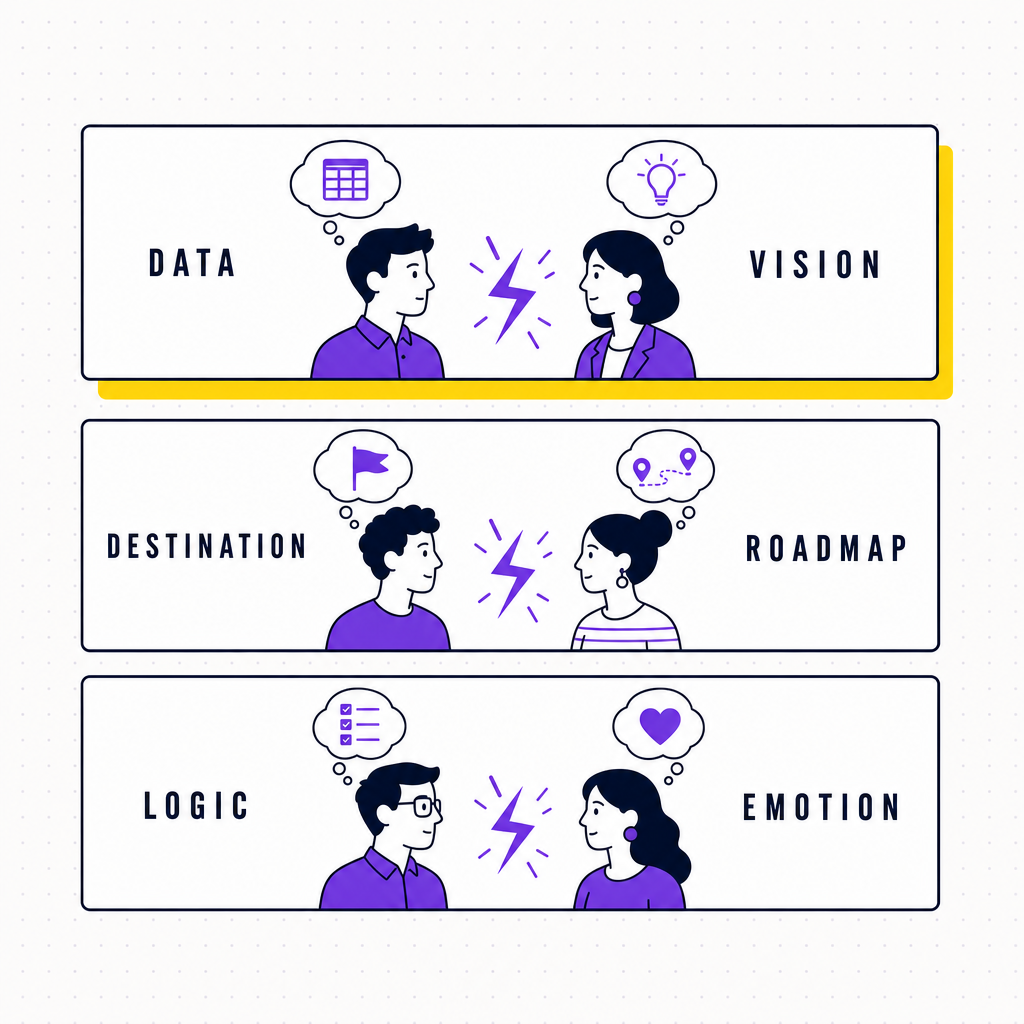
When an analytical meets an intuitive, the fight is data versus vision. The analytical sees someone presenting a future with no spreadsheet and reads it as reckless. The intuitive sees someone demanding three more weeks of analysis and reads it as pedantic foot-dragging. The strategy stalls while the team argues about evidence thresholds.
When an intuitive meets a functional, it is destination versus roadmap. The intuitive wants to leap to the outcome; the functional insists on the sequence. The intuitive feels micromanaged, the functional feels the plan is being treated as optional, and the timeline quietly slips because nobody owns the middle steps.
When an analytical meets a personal, it is logic versus emotion. The analytical wants objective facts and dismisses the morale conversation as soft. The personal communicator experiences that as cold and a little callous, and stops raising the qualitative warning signs. The team loses its early-warning system on culture right when it needs it.
Layer the assertiveness axis on top and it gets sharper. An aggressive intuitive will bulldoze a passive functional into agreeing to a timeline that was never realistic. An assertive personal communicator will surface a morale problem an aggressive analytical has been steamrolling for a month. The point is that two axes interact, so the same cognitive clash plays out very differently depending on who is willing to push.
How to flex your style without faking it
Flexing, sometimes called code-switching, is the deliberate adjustment of your default style to match what the other person can actually hear. It is not manipulation and it is not abandoning your own view. It is packaging the same substance in the format the listener trusts.
The adjustments are specific. Presenting to an intuitive, lead with the bottom line and move the process detail to an appendix. Engaging an analytical, send documentation in advance, open with the hard numbers, and drop the emotional storytelling. Working with a functional, bring a structured plan with clear sequencing and honest timelines. Talking to a personal communicator, spend the first few minutes on rapport and on the human impact of the decision before you get to execution.
For a mixed room, facilitators use what Murphy calls multipathing: structuring the same presentation so all four styles get what they need. Open with the headline for the intuitives, back it with data for the analyticals, lay out the steps for the functionals, and name the people impact for the personals. It takes longer to prepare and it prevents most of the misreads above.
Two structured frameworks help keep assertiveness from tipping into aggression. The LASER approach (Listen, Acknowledge, Speak, Engage, Resolve) gives problem-solving conversations a reliable shape. Word-picture feedback, sorting behaviour into “needs work”, “good work”, and “great work”, replaces vague judgement with observable standards that satisfy analytical and functional thinkers. Underneath all of it sits one habit: self-awareness. Assertive and aggressive communicators have to learn to pause and make room, while passive communicators have to be actively coached to use their voice. None of that happens without first knowing your own default, which is the hard part most teams skip.
What changed in 2024-2026: remote, async, and digital incivility
The move to hybrid and remote work has rewritten where communication styles play out. By 2024 and 2025, roughly 39% of the U.S. full-time workforce was working hybrid or fully remote, and some global surveys put the hybrid figure above half. That split forced a hard distinction between synchronous communication (live video and in-person) and asynchronous communication (email, Slack, Teams, shared docs).
The first response to remote work was to cram the old office into video calls, and it backfired. Drawing on the Microsoft Work Trend Index, secondary reports put the average employee at around 11.3 hours a week in meetings, with communication tools eating a large share of the workday and leaving a minority for focused work. A frequently quoted figure holds that roughly seven in ten of these meetings are seen as ineffective, and a meaningful share of workers say most of their meetings should have been a written update. This is the “Zoom theatre” problem: teams digitised the worst parts of office life rather than the autonomy remote work was supposed to buy.
The better answer is async-first culture, and it happens to suit cognitive styles well. Asynchronous channels let analyticals review the data on their own clock, let functionals map the workflow without real-time pressure, and reduce the anxiety of instant demand. The catch is that async is also where passive-aggressive behaviour thrives. The medium gives plausible deniability, so resistance shows up as delayed replies, feigned confusion, selective silence, and sarcastic doc comments. This “digital incivility” is now a studied phenomenon, and the audit trail does not deter it. Surveys report that over half of employees feel anxious about misreading digital messages, and a similar share say they lose time trying to decode the real intent behind a vague or passive-aggressive note.
There is a generational wrinkle too. A 2025 mixed-methods study by Chuah and Ch’ng in Jurnal Komunikasi found that among Gen Z workers, those defaulting to passive or passive-aggressive styles showed markedly more “free-riding” in group work, while assertive communicators free-rode far less. The digital barrier plus a tendency to avoid direct confrontation lowers immediate accountability. The authors’ recommendation is structure: explicit norms for responsiveness and contribution rather than relying on goodwill.
Why this matters for L&D, HR, and managers
For anyone responsible for capability, the case for treating communication style as a trainable competency is now a financial one, not a wellbeing one. The same survey data that should be read cautiously is still pointing in a consistent direction: poor communication drains productivity, erodes trust, and pushes people toward the door, while organisations that communicate well retain more of their staff and report stronger performance. Given that replacing an employee runs to roughly 1.5 to 2 times their salary, even a modest reduction in communication-driven turnover pays for a training programme several times over.
The strategic problem inside L&D is measurement, not belief. A 2025 GP Strategies report found that nearly all L&D respondents agreed on the need to quantify learning impact, but only about a third had budgets aligned to that goal. The recommended shift is from efficiency metrics (completion rates, satisfaction scores) to outcome metrics (turnover, sales-cycle length, error rates) that tie behaviour change to numbers the C-suite already watches. Coaching a team out of analytical-versus-intuitive deadlock, or a manager out of an aggressive habit, is exactly the kind of intervention that shows up in those numbers if you are measuring the right things.
Generative AI is starting to sit inside this loop. In 2025 surveys, a majority of knowledge workers said AI tools helped them avoid miscommunications, and a 2025 study by Passmore, Tee, and Rutschmann found an AI coaching agent reached competencies comparable to an ICF Associate Certified Coach on skills like paraphrasing and active listening, though that result rests on a single early study. The realistic near-term use is AI as a communication co-pilot: translating a dense analysis into a one-line headline for the intuitives, or turning a vague ask into a structured plan for the functionals.
The thread running through all of it is that you cannot develop what you have not named, and you cannot prove progress on what you have not measured. Most communication training still relies on a self-report survey taken once, which tells you how people think they communicate, not how they actually do. Watching real behaviour, the question-to-statement ratio, who gets interrupted, whose input gets ignored, is what turns “be a better communicator” into a specific, observable plan. That is the gap Team Building Bot was built to close: it joins your online sessions and scores how each person communicates across these styles, then returns an Individual Communication Profile with examples pulled straight from the transcript.
FAQ
What are the four main communication styles at work?
The most common four-style model sorts people by assertiveness: assertive, aggressive, passive, and passive-aggressive. Assertive is the healthy target, where you state your needs clearly while respecting others. The other three are versions of self-advocacy gone wrong: too forceful, too withdrawn, or driven underground into indirect resistance.
What is the difference between the assertiveness styles and Murphy’s four styles?
They answer different questions. The assertiveness model (assertive, aggressive, passive, passive-aggressive) describes how forcefully you advocate for yourself and handle conflict. Mark Murphy’s model (analytical, intuitive, functional, personal) describes how you prefer to process information. A person has a position on both at once, so an assertive analytical and a passive analytical behave very differently.
Can you change your communication style?
Yes. Communication style is a learnable habit, not a fixed trait. Assertiveness training has a solid evidence base for moving people away from passive or aggressive defaults, and most people can flex their cognitive style with deliberate practice. The hard part is self-awareness: you have to know your default before you can adjust it to the room.
Which communication style is best?
For self-advocacy, assertive is best, because it is the only one of the four that gets your view across without damaging the relationship or suppressing the conflict. Among Murphy’s cognitive styles, none is better than another; they are preferences, and high-performing teams need all four. The skill is flexing your delivery to match the listener.
How do communication styles cause conflict in meetings?
Most style conflict comes from mismatched expectations about what counts as a good contribution. An analytical reads an intuitive’s vision as reckless for lacking data, while the intuitive reads the analytical’s caution as foot-dragging. Layer on assertiveness, and an aggressive communicator can bulldoze a passive one into agreeing to something neither of them can deliver.
How does remote work affect communication styles?
Remote and asynchronous work amplifies both the best and worst tendencies. Async channels suit analytical and functional thinkers who want time to process, but they also give passive-aggressive behaviour plausible deniability through delays, silence, and decoded-intent guessing games. Research also links passive styles to more free-riding in remote group work, which is why explicit norms matter more, not less.
How can managers measure communication styles objectively?
Through observed behaviour rather than self-report surveys. You can track the question-to-statement ratio, how evenly talk-time is distributed, who gets interrupted, and whose input is acted on, all from a recording or live analytics. That turns a vague impression of someone’s “style” into specific, observable behaviours you can coach against.
Sources
- Marlow, S. L., Lacerenza, C. N., et al. (2018). Does team communication represent a one-size-fits-all approach? A meta-analysis of team communication and performance. Organizational Behavior and Human Decision Processes. UCSD InSTEP copy
- Murphy, M. / Leadership IQ. The four communication styles (Analytical, Intuitive, Functional, Personal) and operationalised behaviour change. Executive coaching landscape · Murphy in Forbes (2026) · training library
- Four communication styles, applied overviews. Predictive Index · Clemson (Pearce) · SNHU · Learndrive
- Assertiveness model (assertive / aggressive / passive / passive-aggressive) and meeting behaviours. National Training · Edenred examples · Pumble · Pitt State Career Dev
- Passive-aggressive communication. Liane Davey · Hoffman Counselling · Simpplr
- Flexing / code-switching and cultural context (E.T. Hall high vs low context). Engineer Inclusion · Misunderstanding in intercultural comms (UV) · Medium (SWLH) · Personos
- Academic critique of typologies and power/social-reproduction perspective. Taylor & Francis (Oxford Review of Education, 2025) · Frontiers in Psychology (2024)
- Coaching effectiveness meta-analyses and systematic reviews (Theeboom 2014, Jones 2016, post-pandemic review; Passmore, Tee & Rutschmann AI-coaching study). Oxford (Passmore et al.) · PMC review · Post-pandemic systematic review (ResearchGate)
- Gen Z, communication styles, and free-riding. Chuah & Ch’ng (2025), Jurnal Komunikasi. ResearchGate · UNIMAS PDF
- Synchronous vs asynchronous, “Zoom theatre”, async-first. Coveo · Skedda (cites Microsoft Work Trend Index) · Medium (Zoom theatre) · Cerkl
- Digital incivility and remote toxic behaviour. Cyber incivility systematic review (ResearchGate) · Psychology Today
- Business-impact and ROI survey data (read as survey/vendor data, not peer-reviewed). Grammarly + Harris Poll 2024 State of Business Communication · Quantified.ai · Reward Gateway · High5 · Simon & Simon · Zoom
- Retention and turnover impact. Staffbase 2025 · Ragan
- L&D measurement and outcome metrics. GP Strategies 2025 report · iseazy L&D metrics · eLearning Industry · Hemsley Fraser 2025 impact survey
Posts in this series
- arrow_forward Talking-Time Imbalance in Meetings: What Quiet Tells You
- arrow_forward 8 Warning Signs of Team Communication Breakdown in 2026
- arrow_forward Nonviolent Communication at Work: Conflict Scripts for 2026
- arrow_forward Nonverbal Communication in Online Meetings: What Survives the Screen
- arrow_forward Assertive Communication: 30 Phrases That Work in 2026
- arrow_forward Interpersonal Communication at Work: 7 Habits of Trusted Colleagues
See your team's communication styles, not just a survey score
Team Building Bot joins your online sessions and builds an Individual Communication Profile for each person: how assertive they are, how they process information, and where they clash with the room. Free during beta.
No spam, no credit card. Unsubscribe any time.