Nonviolent Communication at Work: Conflict Scripts for 2026
Nonviolent communication for workplace conflict: the four steps, ready-to-use scripts for feedback and friction, plus what the evidence says and its limits.
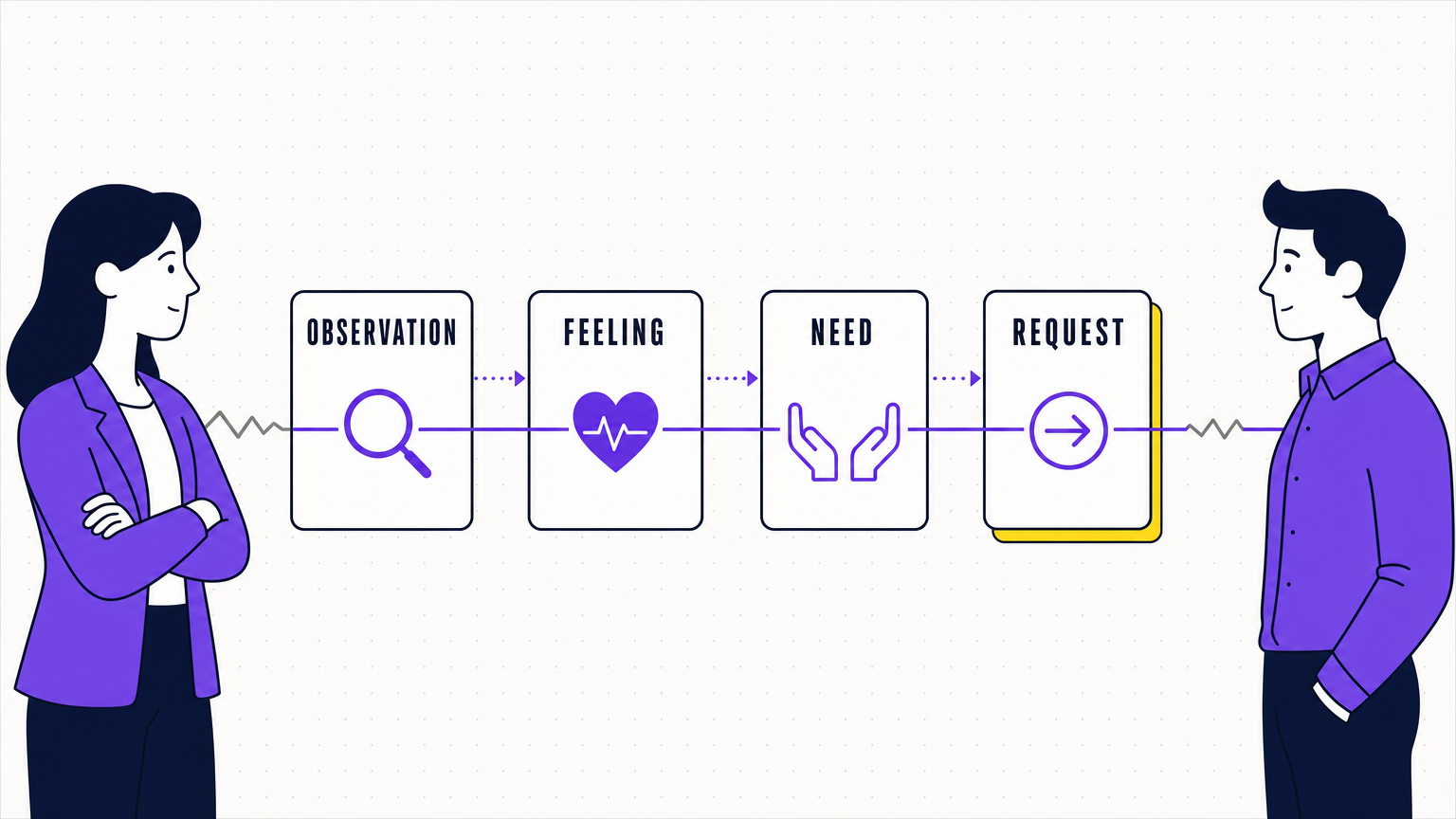
Two engineers miss a handoff, a deadline slips, and the Slack thread that follows does more damage than the missed deadline ever could. The work problem was small. The conversation about it was the expensive part. Nonviolent communication is a method for having that second conversation without the wreckage, and most of it comes down to four moves you can learn in an afternoon and spend years getting good at.
This guide translates Marshall Rosenberg’s framework into the conversations that actually go wrong at work: performance feedback, peer disagreements, cross-team friction, hearing criticism without flinching, and pushing back on scope. You get the four steps, a set of before-and-after scripts, the evidence for whether any of this works, and an honest account of where it stops working. If you want the wider map of how people default to different styles, start with our communication styles at work guide; this piece is the conflict-specific tool kit.
The short answer
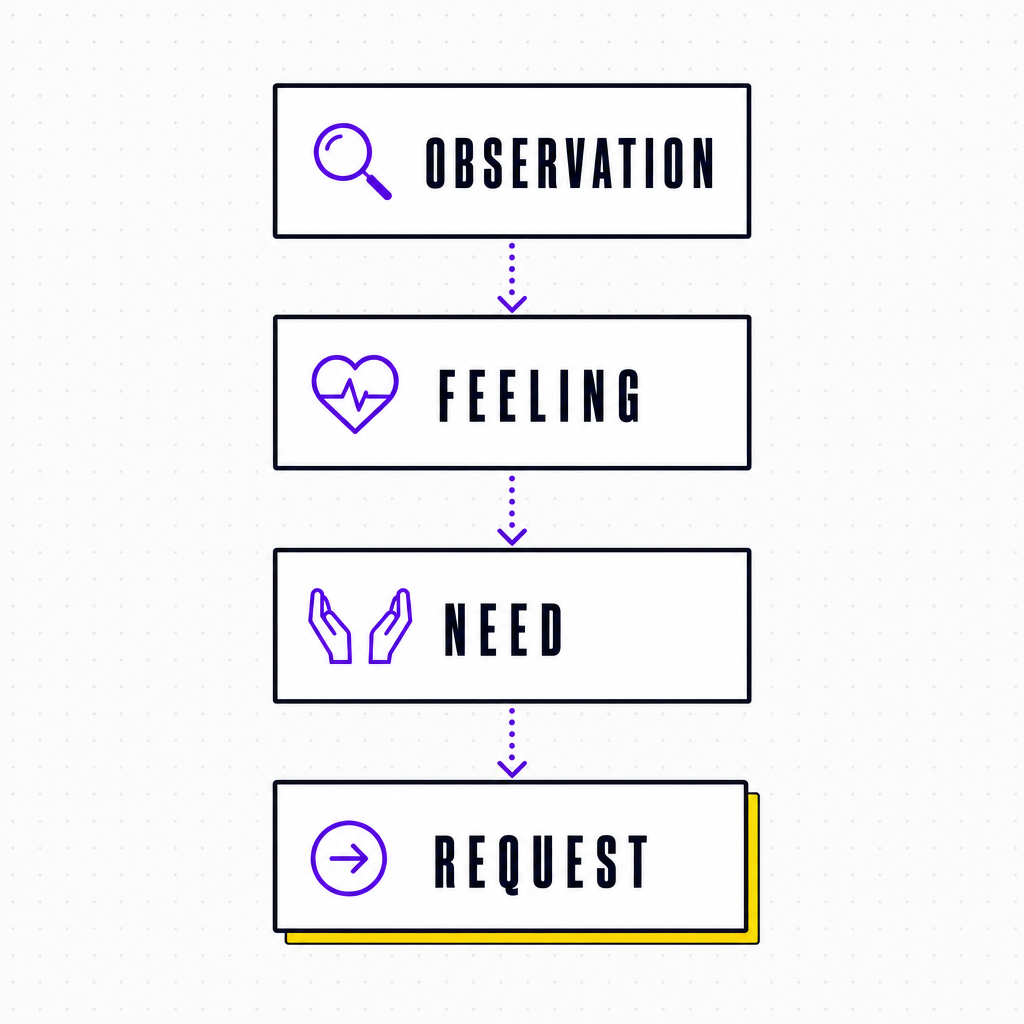
Nonviolent communication, often shortened to NVC, is a four-step model for raising hard things without blame: you state an observation, name a feeling, connect it to a need, and make a clear request. Rosenberg’s shorthand is observation, feeling, need, request, sometimes abbreviated OFNR. The point of the sequence is to separate two things that normal conflict fuses together: what happened, and what you made it mean. “You’re careless with deadlines” fuses them. “The last two handoffs came in after the cut-off, and I’m worried because I need predictable timing to plan my week” pulls them apart.
The model is trainable and the gains are real, but modest and mostly measured outside corporate settings. A randomised controlled trial with 312 French medical students found NVC training produced a small, lasting rise in empathy (Epinat-Duclos et al., International Journal of Medical Education, 2021). A quasi-experimental study of nursing students found larger gains in communication competence and empathic ability (Sung and Kweon, Nursing Reports, 2022). NVC will not fix a broken org chart or an impossible workload, and used clumsily it can tip into scripted, tone-policing language that makes people trust you less. Treat it as a skill with a clear use case, not a personality upgrade.
What nonviolent communication actually is
Rosenberg, a clinical psychologist, developed NVC in the 1960s and set it out in his book Nonviolent Communication: A Language of Life. He used two animal images that still get taught: jackal language, which judges, labels, and demands, and giraffe language, named for the long-necked animal with the largest heart of any land mammal, which describes and connects. Most workplace conflict runs on jackal by default. NVC is the deliberate switch to giraffe under pressure.
The method rests on four distinctions, and getting each one right is most of the work.
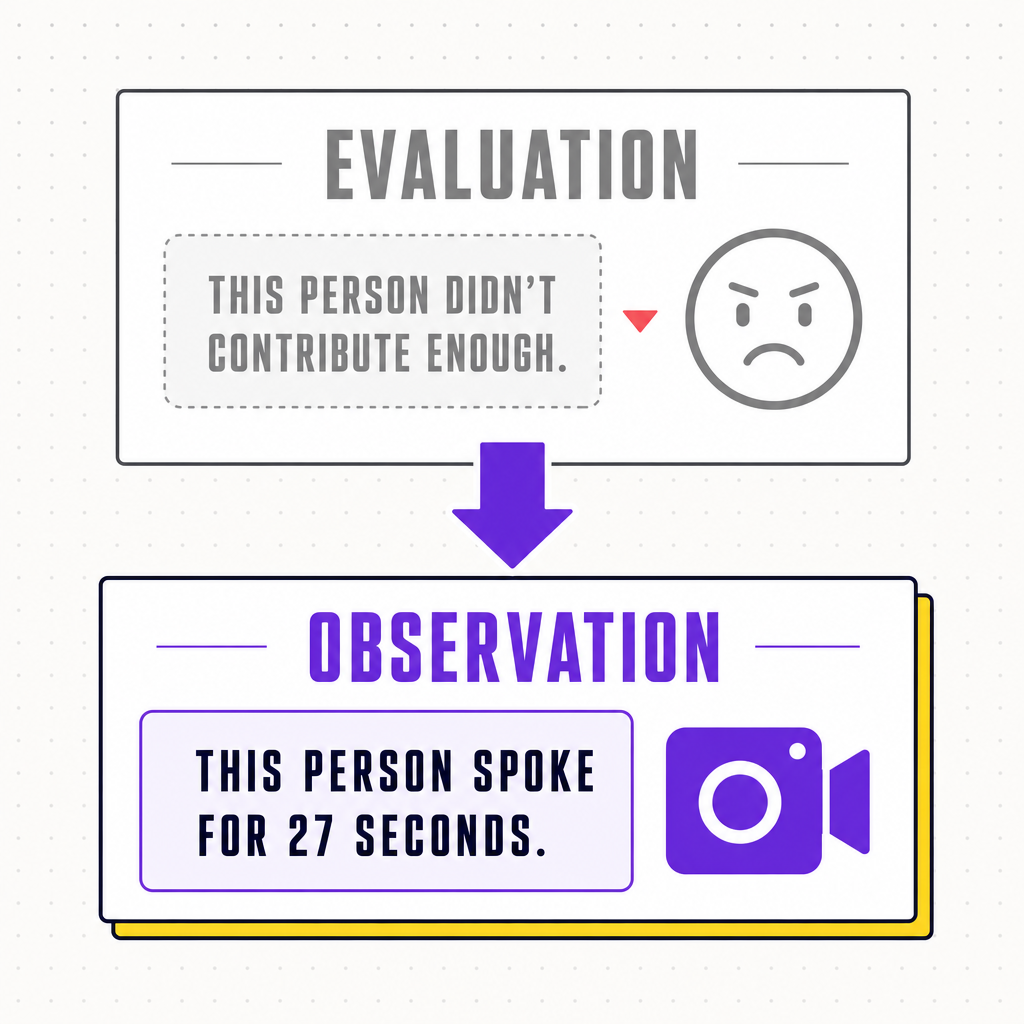
The first is observation versus evaluation. An observation is what a camera would record. An evaluation is your read on it. “You were dismissive in the review” is an evaluation that invites argument about whether you are right. “You replied to three of my points with ‘we already decided that’” is an observation that is hard to dispute. Rosenberg called the ability to observe without evaluating the highest form of human intelligence, and at work it is the step people skip most.
The second is feeling versus thought. “I feel that you don’t respect my time” is a thought wearing a feeling’s clothes; the actual content is an accusation. A real feeling is “I feel frustrated” or “I feel anxious.” The tell is that you cannot insert a thought-disguised-as-feeling without naming the other person. Genuine feelings point inward.
The third is needs versus strategies. Underneath every feeling sits a universal human need: respect, clarity, autonomy, rest, fairness, competence. Needs are shared by everyone and rarely in conflict. Strategies are the specific ways we try to meet them, and strategies collide constantly. “I need you to answer within the hour” is a strategy. The need underneath might be reliability or reassurance, and once that is on the table there are usually several strategies that work. NVC trainers keep a needs list handy precisely because naming the need accurately is so much harder than naming the strategy.
The fourth is request versus demand. A request leaves the other person genuinely free to say no without punishment. A demand does not, and people can feel the difference instantly even when the words are polite. The test is simple: if “no” would make you retaliate or sulk, you made a demand and dressed it as a request.
The four steps, translated for work
Strip away the language-of-the-giraffe framing and the formula is one sentence with four slots:
When [observation], I feel [feeling], because I need [need]. Would you be willing to [request]?
That sentence is the backbone, but reciting it verbatim is the fastest way to sound like a hostage reading a statement. Real use is looser. You might lead with the request, fold the need into a half-sentence, or drop the feeling entirely when the relationship is formal. The skill is holding the four distinctions in your head, not hitting the template. Here is the same difficult message built two ways.
| Step | Jackal version (default) | Giraffe version (NVC) |
|---|---|---|
| Observation | ”You’re always late with your part." | "The design files arrived Thursday for a Wednesday deadline, twice this sprint.” |
| Feeling | (skipped, replaced by blame) | “I felt stressed scrambling to catch up.” |
| Need | (assumed, never stated) | “I need predictable timing to plan my own work.” |
| Request | ”Sort it out." | "Could we agree a hand-off time that works for both of us?” |
The jackal column is faster and feels satisfying. It also reliably produces defensiveness, because the other person hears a verdict on their character and defends the character rather than fixing the timing. The giraffe column is slower and asks more of you in the moment, and it tends to keep the conversation on the actual problem.
Five workplace conflicts, rewritten in NVC
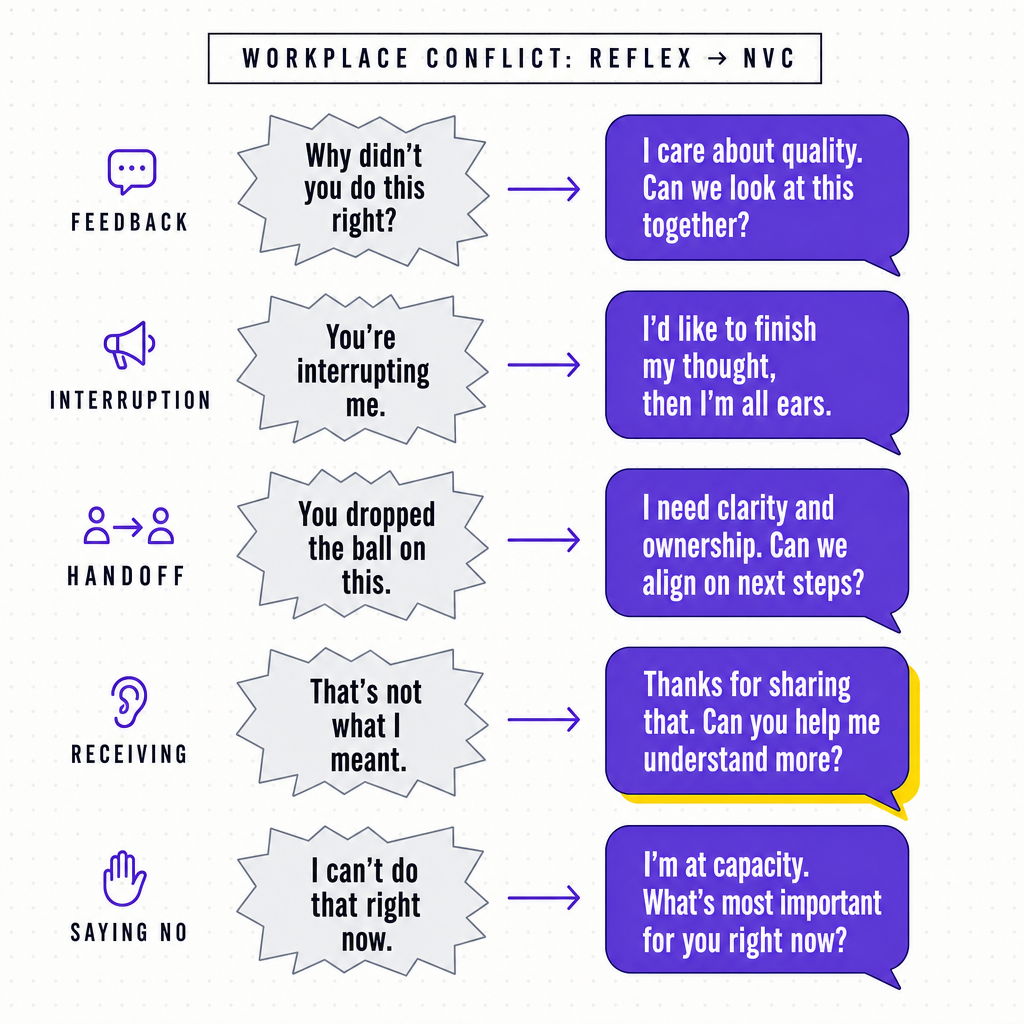
Frameworks are easy to nod at and hard to use when adrenaline hits. Below are five recurring conflicts with the reflex version and the NVC version side by side. They are starting points, not lines to memorise.
1. Giving performance feedback to a report
The reflex is to summarise a pattern as a trait, which lands as a character judgement and triggers defence.
Reflex: “Your analysis this quarter has been sloppy and rushed.”
NVC: “On the last two reports, the figures in the summary didn’t match the appendix. When that happens I worry, because the leadership team relies on these to make calls. Can we walk through your checking process and see where it’s breaking?”
The move is to replace “sloppy” with the two specific mismatches, name your concern rather than their flaw, and make the request collaborative. The small-improvements model for nonviolent feedback uses exactly this shape: observation, your feeling, the unmet need, then a willing-to question (Small Improvements, “Nonviolent Feedback,” n.d.).
2. Disagreeing with a peer who keeps interrupting
Reflex: “You never let me finish a sentence in these meetings.”
NVC: “I noticed I got cut off three times before I reached my point just now. I’m finding it hard to contribute, because I need to actually land an idea before we move on. Could you let me finish, and I’ll do the same for you?”
“Never” is the jackal tell; it is an evaluation the other person can dispute by finding one counterexample. “Three times in this meeting” is an observation they cannot.
3. Cross-team friction over a missed handoff
Reflex: “Marketing always drops the ball on launch assets.”
NVC: “The launch assets came in the morning of go-live for the last two releases. It puts our team in a scramble, and we need a buffer to test properly. Could the two leads agree a lock date earlier in the cycle?”
Whole-team blame (“marketing always”) is the hardest habit to drop and the most corrosive, because it indicts people who were not in the room. Naming the two specific releases keeps it about a fixable process rather than a tribe.
4. Receiving harsh feedback without firing back
NVC is not only for speaking. Rosenberg’s harder discipline is hearing a jackal message and translating it before you react. Someone snaps “this deck is a mess and we present in an hour.” Internally, you separate their evaluation (“a mess”) from the likely need underneath (“they need confidence we’re ready”). Out loud: “Sounds like you’re worried we’re not ready to present. Which slides feel riskiest, and I’ll fix those first?” You acknowledged the need without accepting the insult, and you moved straight to the request. This self-empathy step, hearing the need behind the attack, is the part most people find hardest and the part that protects you from escalating.
5. Pushing back on scope or saying no
Reflex: a resentful yes now, a missed deadline later. Or a flat “that’s not my job.”
NVC: “If I take the audit on top of the migration, one of them slips, and I need to be straight with you about which. I’d rather do one well than both badly. Which is the priority this week?”
You named the real constraint as an observation, owned your need for quality over volume, and handed back a clear request. No is easier to hear when it comes with a reason and an alternative, which is the same logic behind assertive communication phrases more broadly.
What the evidence actually says
NVC has a real research base, but it is thinner and more healthcare-skewed than its popularity suggests, and being honest about that is part of using it well.
The strongest single study is a randomised controlled trial: Epinat-Duclos and colleagues trained 312 third-year French medical students and measured empathy on the Jefferson Scale. The NVC group rose by 0.95 points against no change in controls (95% CI 0.17 to 1.73, p < 0.05), and the gain still held three months later (Epinat-Duclos et al., International Journal of Medical Education, 2021). That is a small, durable effect on a self-reported scale, and notably the same study found no movement on implicit cognitive measures of perspective-taking. NVC seems to shift how people relate, not their raw cognitive empathy.
A quasi-experimental study found bigger numbers in a smaller sample. Sung and Kweon ran a six-session NVC programme with 62 South Korean nursing students and reported significant gains in empathic ability, communication competence, interpersonal relationships, and self-esteem, all at p < 0.001 (Sung and Kweon, Nursing Reports, 2022). The catch is the design: a pilot, no randomisation, students rather than working professionals, and self-report throughout.
The closest thing to a workplace test is a field study with practising health professionals by Wacker and Dziobek, whose title states the finding directly: NVC training was associated with reduced empathic distress and social stressors at work (Wacker and Dziobek, field study with health professionals, 2018). And a 2025 scoping review of negative behaviours among nurses, covering 18 studies and roughly 8,500 participants, lists nonviolent communication among the interventions that show promise, while flagging that inconsistent terminology across studies makes it impossible to compare effect sizes cleanly (Santos et al., Healthcare, 2025). That review also captures why any of this matters: some of the studies it covers found as many as a quarter of nurses reporting daily bullying.
Read together, the picture is consistent but bounded. NVC reliably nudges empathy and communication competence upward in healthcare and education settings, the effects are usually small to moderate, randomised evidence is scarce, and almost none of it comes from corporate teams. If a training vendor quotes you a transformation, the data does not back that word.
Common mistakes that make NVC backfire
The framework fails in predictable ways, and every one of them comes from doing the form without the intent.
The robotic recitation is the most common. Said word for word, “When you do X, I feel Y, because I need Z,” reads as a technique being applied to someone, and people resent being handled. Hold the four distinctions, then talk like yourself.
The fake observation is subtler. “When you’re being unprofessional” is an evaluation smuggled into the observation slot. If the other person could argue with your description, it is not yet an observation. Get it down to what the camera saw.
The weaponised feeling turns the model into blame with better grammar. “I feel disrespected when you talk over me” sounds like NVC but “disrespected” is a judgement about the other person’s behaviour, not a feeling. The real feeling is closer to frustrated or small.
The dressed-up demand is the one that erodes trust quietly. If your “would you be willing to” still carries a threat when they say no, they will feel it, and your nice words will read as manipulation. A request you cannot accept a no to is a demand.
The last mistake is the most important and the least discussed: tone-policing through NVC. Used by the more powerful person in a conversation, the framework can become a way to fault someone for how they raised a problem instead of engaging with the problem. NVC’s own community has written about this risk, including work on adapting the model to account for privilege and power rather than ignoring it (Rosenberg, “NVC for power transformation,” n.d.; acesonline.net, anti-racist NVC, 2023). If you are the manager telling an upset report to rephrase, you are probably doing it wrong.
Where nonviolent communication stops working
NVC operates on the conversation, and not every workplace problem lives in the conversation. When friction comes from impossible workloads, broken compensation, chronic understaffing, or a genuinely unsafe culture, applying NVC to the resulting tension treats a symptom and leaves the cause running. As the research on workplace NVC notes, communication training works best alongside structural change, not as a substitute for it. A perfectly phrased observation does not create headcount.
Power asymmetry is the second limit. The model assumes both people can speak freely and say no, which is rarely true between a director and a junior. Below a certain level of psychological safety, asking someone to name their feelings and needs to a person who controls their next review is not safe, it is exposing. NVC works on the foundation that psychological safety provides; it cannot manufacture that foundation on its own.
Culture is the third. The model was built in a low-context, individualist, emotionally explicit setting, and its instruction to name your feelings plainly does not transfer cleanly to cultures where directness about emotion reads as immature or where harmony is the higher value. The four distinctions travel well. The expressive style around them needs local adjustment.
Frequently asked questions
What are the four steps of nonviolent communication?
Observation, feeling, need, and request, sometimes abbreviated OFNR. You state what objectively happened without judgement, name the feeling it raised in you, connect that feeling to an underlying universal need, and make a specific request the other person is free to decline. The order matters less than keeping each step distinct from its common impostor, such as observation from evaluation and feeling from thought.
What is a simple example of nonviolent communication at work?
Instead of “you’re always late with your part,” you would say: “The files arrived after the deadline on the last two sprints. I felt stressed catching up, because I need predictable timing to plan my work. Could we agree a hand-off time that works for both of us?” The reflex version judges a person; the NVC version describes specific events and makes a concrete, optional request.
Does nonviolent communication actually work?
The evidence is positive but modest and mostly from healthcare and education. A randomised controlled trial with French medical students found a small, lasting rise in empathy after NVC training (Epinat-Duclos et al., 2021), and a nursing-student study found larger gains in communication competence (Sung and Kweon, 2022). Rigorous corporate studies are scarce, so treat NVC as a worthwhile skill with bounded, well-evidenced benefits rather than a guaranteed fix.
How is NVC different from assertive communication?
They overlap but emphasise different things. Assertive communication centres on stating your own needs and limits clearly and respectfully. NVC adds a structured focus on the other person’s underlying needs and on separating observation from judgement, with the explicit goal of keeping connection during conflict. In practice many people blend the two; see our guide to assertive communication phrases for the complementary skill set.
Can nonviolent communication be used by managers giving feedback?
Yes, and feedback is one of its best fits, as long as the manager avoids using it to police how reports speak. Replace trait judgements (“sloppy work”) with specific observations, name your own concern instead of their flaw, and make the next step a shared question. The risk to watch is power: from a position of authority, an insistence on NVC-perfect phrasing can shut down a legitimate complaint rather than resolve it.
Where to start
If you change one habit, make it the first distinction: catch yourself turning an event into a verdict, and say the event instead. “Careless” becomes “the figures didn’t match.” “Dismissive” becomes “you replied with ‘we already decided.’” That single swap, from evaluation to observation, defuses more workplace conflict than the rest of the model combined, because it gives the other person something to fix instead of something to defend.
For the wider picture of how communication styles shape a team, see our communication styles at work guide, and for the structured questions that surface tension before it hardens, our piece on the best debrief questions and templates.
Sources
- Epinat-Duclos, J. et al. “Does nonviolent communication education improve empathy in French medical students?” International Journal of Medical Education, 2021. https://pubmed.ncbi.nlm.nih.gov/34716989/
- Sung, J. and Kweon, Y. “Effects of a Nonviolent Communication-Based Empathy Education Program for Nursing Students: A Quasi-Experimental Pilot Study.” Nursing Reports, 2022. https://pmc.ncbi.nlm.nih.gov/articles/PMC9680223/
- Wacker, R. and Dziobek, I. “Preventing Empathic Distress and Social Stressors at Work Through Nonviolent Communication Training: A Field Study With Health Professionals.” 2018. https://www.researchgate.net/publication/311679401_Preventing_Empathic_Distress_and_Social_Stressors_at_Work_Through_Nonviolent_Communication_Training_A_Field_Study_With_Health_Professionals
- Santos, N. et al. “Unveiling the Dark Side of Negative Behaviors Among Nurses and Their Implications in Workforce Well-Being and Patient Care: A Scoping Review.” Healthcare, 2025. https://pmc.ncbi.nlm.nih.gov/articles/PMC12386168/
- Wacker, R. and Dziobek, I. “Preventing Empathic Distress and Social Stressors at Work Through Nonviolent Communication Training” (record). Semantic Scholar. https://www.semanticscholar.org/paper/Preventing-Empathic-Distress-and-Social-Stressors-A-Wacker-Dziobek/da99a6de6c722b3967b5168d5112f89ae08d115b
- Small Improvements. “Nonviolent Feedback.” https://www.small-improvements.com/blog/nonviolent-feedback/
- PositivePsychology.com. “Nonviolent Communication (NVC).” https://positivepsychology.com/non-violent-communication/
- ReqTest. “Giving Feedback Using Nonviolent Communication.” https://reqtest.com/en/knowledgebase/giving-feedback-using-nonviolent-communication/
- Lepaya. “Try the Language of the Giraffe: Nonviolent Communication.” https://www.lepaya.com/blog/try-the-language-of-the-giraffe-nonviolent-communication
- ProAction International. “Nonviolent Communication Best Practices at Work.” https://blog.proactioninternational.com/en/nonviolent-communication-best-practices-at-work
- University of California Office of the President (Ombuds). “NVC Model: Requesting Change.” https://www.ucop.edu/ombuds/_files/nvc-model-requesting-change-remove.pdf
- The Workplace Therapist. “NVC Conversation Examples” (PDF). https://theworkplacetherapist.com.au/wp-content/uploads/2025/04/NVC-conversation-examples.pdf
- Rosenberg, M. “NVC for Power Transformation.” Center for Nonviolent Communication. https://www.nonviolentcommunication.com/wp-content/uploads/2020/12/NVC-for-power-transformation.pdf
- “Anti-Racist Skills Development with Non-Violent Communication and Privileged and Subjugated Tasks Models.” ACES Online, 2023. https://acesonline.net/wp-content/uploads/2023/04/TPB-v1_iss1-Anti-Racist-Skills-Development-with-Non-Violent-Communication-and-Privileged-and-Subjugated-Tasks-Models.pdf
More on Communication Styles
- arrow_forward Talking-Time Imbalance in Meetings: What Quiet Tells You
- arrow_forward 8 Warning Signs of Team Communication Breakdown in 2026
- arrow_forward Nonverbal Communication in Online Meetings: What Survives the Screen
- arrow_forward Assertive Communication: 30 Phrases That Work in 2026
- arrow_forward Interpersonal Communication at Work: 7 Habits of Trusted Colleagues
- menu_book Communication Styles at Work: The Complete 2026 Guide Pillar
See where your team's conversations actually break down
Team Building Bot joins your online sessions and builds an Individual Communication Profile for each person: how they handle disagreement, whether they blame or describe, and where friction turns into damage. Free during beta.
No spam, no credit card. Unsubscribe any time.