Interpersonal Communication at Work: 7 Habits of Trusted Colleagues
Seven research-backed habits that make colleagues trusted at work, from specific naming to follow-through, with transcript examples and the evidence.
Think about the colleague you trust most. Odds are it is not the smartest person you work with, or the loudest in the meeting. It is the one whose words you can act on without double-checking, who tells you the awkward thing early, and who does what they said they would. That is interpersonal communication doing its job, and almost none of it is talent. It is a short list of habits, and they can be learned.
This guide breaks down seven of those habits. Each one is observable, each is grounded in research from group psychology and organisational science, and each comes with a short before-and-after example so you can hear the difference. If you want the wider map of how people default to different styles, start with our communication styles at work guide; this piece is about the concrete moves that build trust inside any style.
The short answer
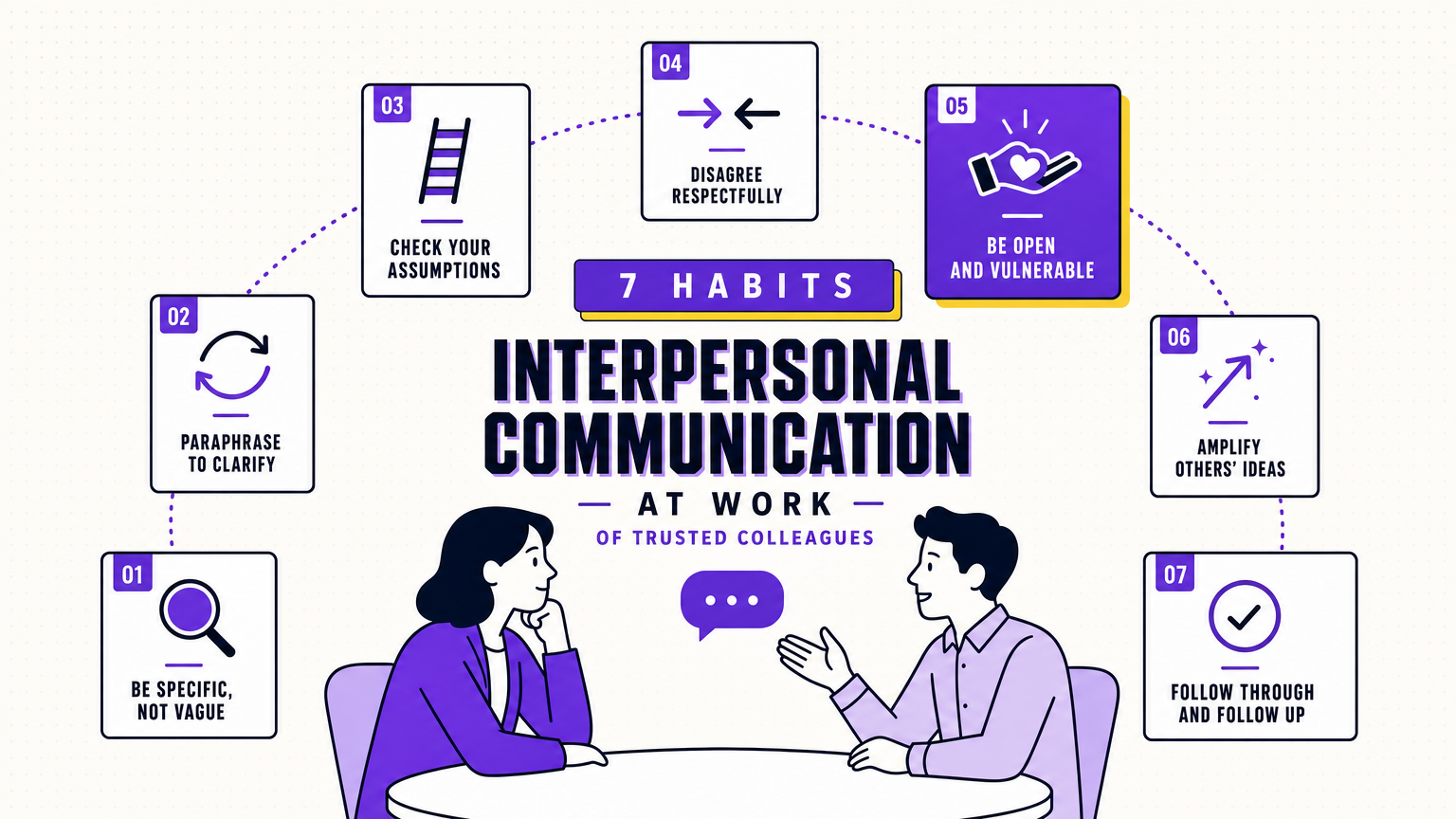
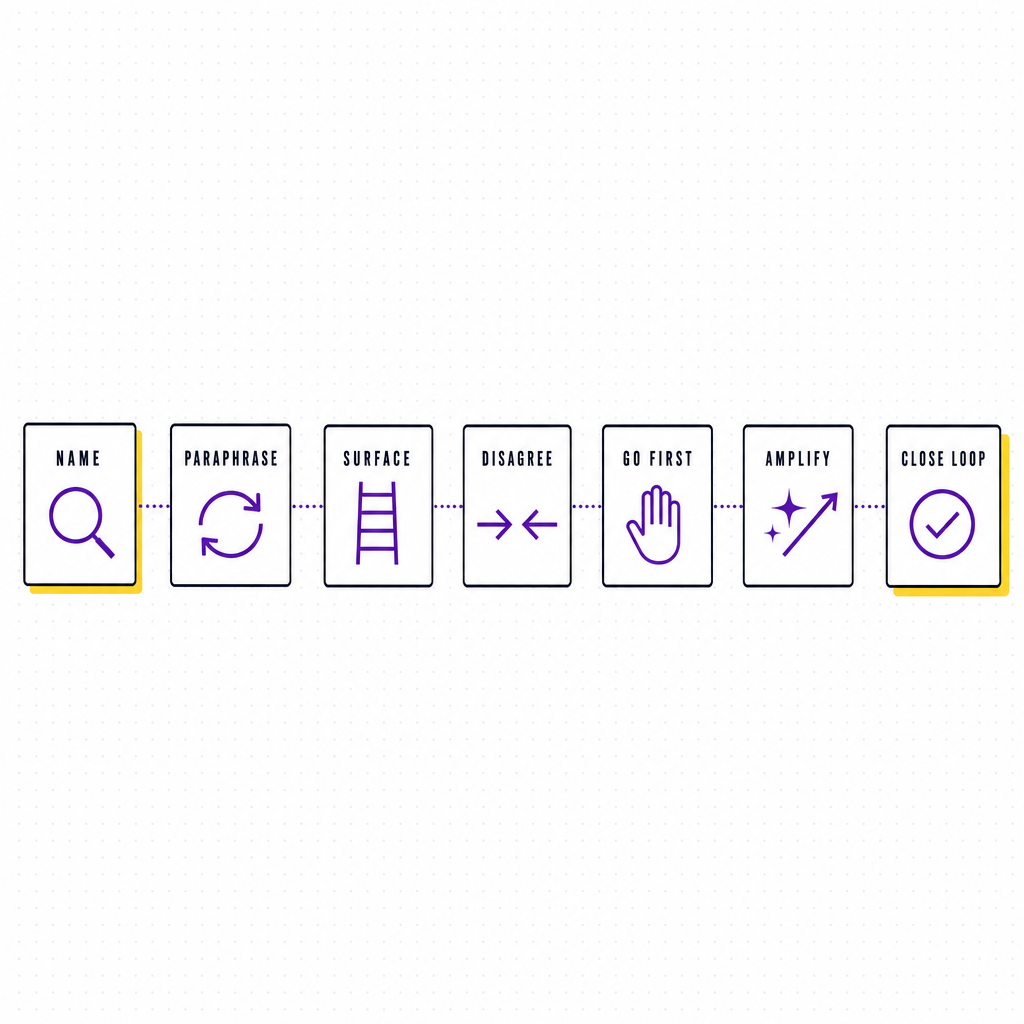
Interpersonal communication is the exchange of information, meaning, and feeling between people, and at work it is mostly judged by behaviour rather than fluency. The colleagues teams trust tend to share seven habits: they name things specifically, they paraphrase to confirm understanding, they surface their assumptions out loud, they disagree on the work without attacking the person, they go first with uncertainty, they amplify other people’s good news, and they close the loop on what they promised.
None of these is charisma. Robert Bales showed back in the 1950s that group interaction splits into task acts and socio-emotional acts, and that healthy teams need both (Bales, Interaction Process Analysis, 1950). The seven habits below are simply the task and socio-emotional moves that research keeps linking to trust, learning, and performance. The good news for any L&D or HR reader: every one of them is a trainable behaviour, not a personality trait.
1. Name things specifically
Vague language is the quiet tax on team trust. “We need to improve the onboarding soon” gives the listener nothing to hold. “Onboarding takes new hires nine days to first commit, and I want it under three by Q3” gives them a target, a number, and a deadline. Specific naming is the difference between a colleague who sounds busy and one you can actually plan around.
The mechanism here is the ladder of inference, popularised by Chris Argyris and widely taught through Peter Senge’s work. We climb from raw data to private conclusions in a fraction of a second, and most workplace friction comes from two people acting on conclusions they never traced back to the facts (Harvard Business School Online, “The Ladder of Inference,” 2024). Naming the specific data, not the conclusion, lets the other person check your reasoning instead of guessing at it.
Vague: “The deck needs work before Friday.” Specific: “Slides 4 and 9 have last quarter’s numbers, and the ask on slide 12 isn’t clear. Can you fix those two things before Friday?”
For a manager or facilitator, the coachable cue is easy to spot. When someone uses a hedge word like “most,” “soon,” or “better,” ask “say more, what exactly?” The habit you are building is replacing impressions with observable specifics.
2. Paraphrase before you respond
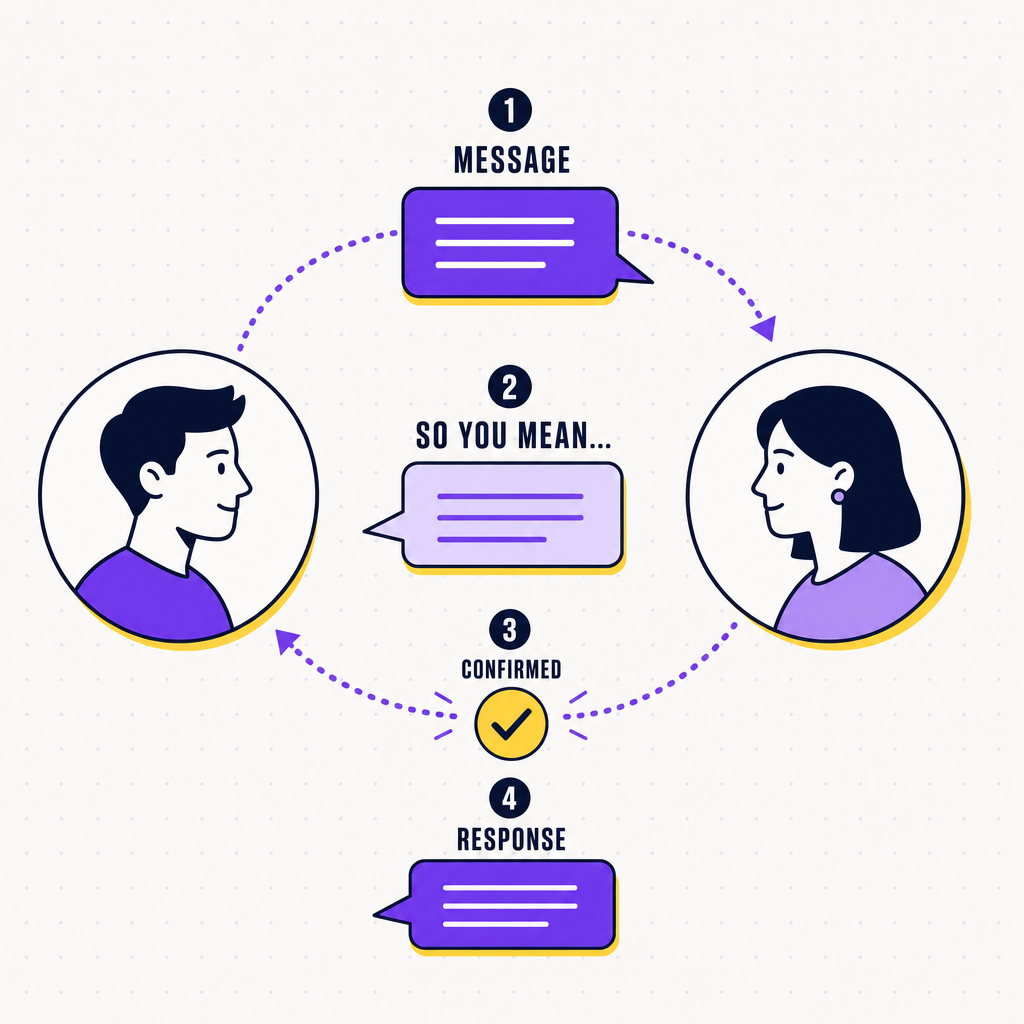
Reflective paraphrasing means saying back what you heard, in your own words, before you add your own point. It sounds almost too simple to matter, yet Carl Rogers and Richard Farson named active listening as a core skill of effective relationships precisely because so few people do it under pressure (Rogers and Farson, “Active Listening,” 1957). Most of us listen to reply, not to understand.
The evidence that this is teachable is solid. A listening-training field study by Itzchakov and colleagues, published in Human Resource Management in 2022, found that training employees to listen well had measurable downstream effects on the people they spoke to, including lower social anxiety and higher psychological safety. Paraphrasing is the most visible part of that skill, because it forces you to process the message rather than wait for your turn.
Without: “No, that won’t work, here’s what we should do instead.” With: “So your worry is that the migration breaks reporting for the finance team mid-quarter. Have I got that right? If so, here’s an option.”
The paraphrase does two things at once. It catches misunderstandings while they are cheap, and it tells the speaker they were actually heard, which is what lowers their guard. A 2024 study in the International Journal of Listening on supportive paraphrasing found that the quality of the paraphrase, not just its presence, predicted whether the speaker felt understood.
3. Surface your assumptions out loud
The most useful sentence in a tense meeting is often “here’s the assumption I’m making.” Trusted colleagues make their reasoning visible instead of presenting conclusions as facts. This is the ladder of inference again, run in reverse: rather than climbing silently to a conclusion, you narrate a rung or two so others can spot where you and they diverge.
Why it builds trust is straightforward. When you say “I’m assuming the client signed off on scope, am I wrong?” you give people permission to correct you cheaply, and you model that being wrong is survivable. That is the soil psychological safety grows in. Amy Edmondson’s foundational 1999 study in Administrative Science Quarterly found that team psychological safety predicted learning behaviour, which in turn predicted team performance, across real organisational teams. Surfacing assumptions is one of the smallest, most repeatable ways an individual contributor seeds that safety without any authority to mandate it.
Hidden: “We can’t ship Thursday.” Surfaced: “I’m assuming QA needs the full two days, which is why Thursday feels tight. If they can do a one-day pass, I’d change my mind.”
The second version invites a fact that might dissolve the disagreement entirely. The first just plants a flag.
4. Disagree on the work, not the person
Plenty of advice treats all conflict as bad. The research is more precise, and more useful. Karen Jehn’s 1995 work distinguished task conflict, disagreement about the work itself, from relationship conflict, friction about personalities and emotions (Jehn, Administrative Science Quarterly, 1995). The two behave very differently, and conflating them is why so many teams either fight badly or go silent.
The most-cited evidence comes from De Dreu and Weingart’s 2003 meta-analysis in the Journal of Applied Psychology, which pooled dozens of studies and found that relationship conflict was strongly and negatively associated with both team performance and member satisfaction. Task conflict was also negatively associated overall, which surprised people who had assumed “healthy debate” was free. The practical reading is not “avoid conflict,” it is “keep disagreement firmly on the work, and never let it slide into the personal, because the personal version is the expensive one.”
Calibrated disagreement is the skill of staying on the task side of that line. You critique the plan, you name the trade-off, and you keep the person’s competence and intent out of it.
Personal: “That’s a naive estimate, you always lowball QA.” Calibrated: “I think that estimate is missing the QA cycle. If I add it, we’re at three weeks, not two. What am I getting wrong?”
John Gottman’s relationship research offers a memorable rule of thumb here: stable couples maintained roughly five positive interactions for every negative one during conflict, the so-called 5:1 ratio (Gottman, 1994). Be careful with this number at work, though. The marriage finding is well supported, but the popular “positivity ratio” that tried to set an exact workplace tipping point was mathematically discredited (Brown, Sokal and Friedman, American Psychologist, 2013). Treat 5:1 as a direction, not a formula: critique lands better when it sits inside a relationship with far more credit than debit.
5. Go first with uncertainty
Vulnerability-first communication means being the one who admits the gap, asks the obvious question, or says “I don’t know” before anyone else risks it. It is the move that makes a room safe for everyone else to be honest. Social penetration theory, developed by Altman and Taylor in 1973, describes how relationships deepen through gradual, reciprocated self-disclosure: you reveal a little, the other person matches it, and trust accrues in layers.
At work the most powerful version is admitting uncertainty or error, because it directly attacks the fear that keeps teams quiet. When a senior person says “honestly, I’m not sure this is the right call, talk me out of it,” they spend a little status to buy the team a lot of candour. This is the behavioural engine behind Edmondson’s psychological safety: safety is not declared, it is demonstrated by whoever goes first.
Guarded: “I’ve reviewed it and we’re proceeding as planned.” Vulnerable-first: “I’ve reviewed it and I’m about 70% sure. The part I’m least confident on is the pricing assumption. Push on that for me.”
One caveat worth naming, because the research does. Self-disclosure builds trust when it is appropriate and reciprocated, but oversharing or disclosing the wrong thing to the wrong audience can backfire, as a Wharton line of research on “when sharing hurts” shows. Vulnerability-first is a calibrated move, not a confessional.
6. Amplify other people’s good news
Trust is not only built in hard moments. How you respond when a colleague shares something good turns out to matter just as much. Shelly Gable’s research on active-constructive responding identifies four ways people react to good news: actively and constructively (engaged, asking more), passively and constructively (a flat “nice”), actively and destructively (finding the downside), or passively and destructively (ignoring it). Only the first reliably strengthens the relationship.
In a team, active-constructive responding looks like genuine, specific curiosity when someone reports a win. It costs seconds and it compounds. The colleague learns that good news is safe to share with you, which is exactly the person others route information to.
Passive: “Cool, nice one.” (back to laptop) Active-constructive: “You closed the Henderson account? How did you turn the procurement objection around? That’s the one we always get stuck on.”
This habit is easy to undervalue because it does not feel like “communication skills” in the conflict-management sense. It is the socio-emotional half of Bales’s model in action, and it is what makes the rest of the list land. People take feedback and disagreement far better from someone who has visibly celebrated their wins.
7. Close the loop
The last habit is the least glamorous and possibly the most important: do what you said, and tell people when it is done. Reliability is the part of trust that the other six habits cash out into. You can name things specifically and listen beautifully, but if your commitments evaporate, none of it survives.
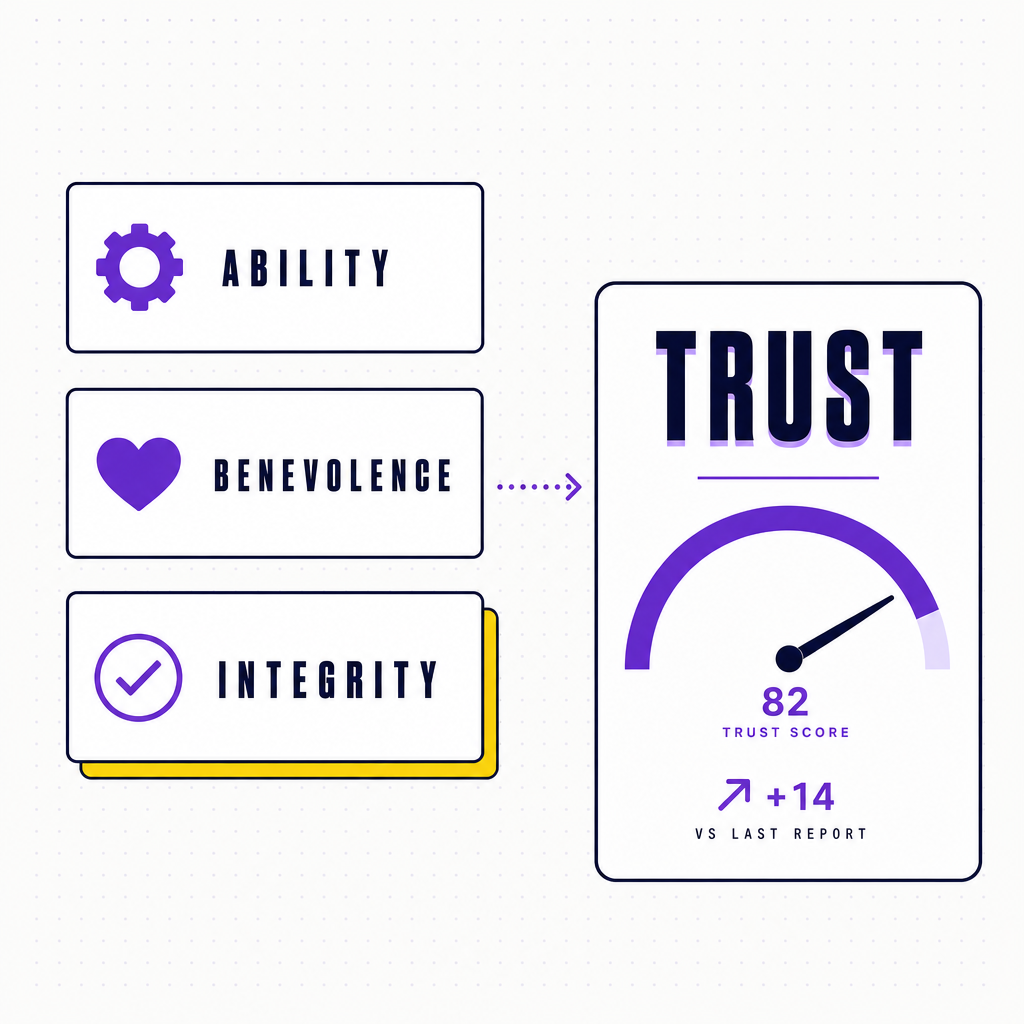
The clearest model of why comes from Mayer, Davis and Schoorman’s 1995 framework in the Academy of Management Review, still the most cited model of organisational trust. They argued that we judge trustworthiness on three factors: ability, benevolence, and integrity. Closing the loop is integrity made visible. It is the running record that your word predicts your action, which is what lets colleagues plan around you without anxiety.
Open loop: silence after “I’ll look into it.” Closed loop: “Followed up with legal like I said, they need two more days. New ETA Wednesday, I’ll confirm by 4pm that day.”
Closing the loop also includes the small async courtesies that hold remote teams together: a quick “got it, on it” so the sender is not left wondering, and a clear handoff when you pass something on. In hybrid work, where the casual signals of an office are gone, this explicit acknowledgement does the rapport-building that a nod across a desk used to.
What this means for hybrid and remote teams
Every habit above gets harder over video, which is why they are worth training deliberately now. Video calls strip out much of the non-verbal channel, and recent work has started to quantify the cost. A 2025 study from Flinders University found that signalling collaborative intent over video depends on a precise gaze sequence, looking at the shared object, making eye contact, then returning to the object, and that the timing is what lets the brain read the exchange as cooperative. On a flat 2D call, those micro-signals degrade, so the explicit habits, paraphrasing, surfacing assumptions, closing the loop, have to carry more of the load that body language used to.
This is also why the habits are now a budget line, not a nicety. The Josh Bersin Company put the corporate learning market at around $360 billion, with organisations spending well over $1,400 per employee a year, and the spend is shifting toward “enduring” human skills as technical ones churn. For L&D and HR, the question has moved from whether to train interpersonal communication to how to measure it.
How to coach and measure these habits
The honest problem is that communication is hard to quantify, and self-report is the weakest signal because people rate their own communication generously. Three approaches do better. The first is 360-degree feedback, which triangulates how someone actually lands across peers, reports, and managers rather than how they think they land. The second is validated instruments such as the Thomas-Kilmann Conflict Mode Instrument for default conflict style, used as a coaching starting point rather than a verdict. The third, and most direct, is behavioural observation: watching for the actual moves, the paraphrase, the surfaced assumption, the closed loop, in real sessions.
That last approach is what Team Building Bot is built for. Instead of a survey score, it sits in your online sessions and builds an Individual Communication Profile from observed behaviour: how much airtime each person takes, how they handle disagreement, where they build trust and where they lose it. For a facilitator or coach, it turns these seven habits from a poster on the wall into something you can actually point at and develop.
Frequently asked questions
What are interpersonal communication skills?
Interpersonal communication skills are the behaviours people use to exchange information, meaning, and emotion with each other effectively. At work they include active and reflective listening, paraphrasing, assertiveness, perspective-taking, handling disagreement, appropriate self-disclosure, and reliable follow-through. They are distinct from broader communication styles, which describe a person’s default tendencies; skills are the specific, trainable moves anyone can practise within their style.
What is the difference between interpersonal communication and communication styles?
Communication style describes how you tend to behave by default, for example assertive versus passive, or analytical versus intuitive. Interpersonal communication skills are the concrete behaviours, like paraphrasing or surfacing assumptions, that you can improve regardless of your style. Two people with very different styles can both build trust if they practise the same underlying habits.
Can interpersonal communication actually be taught, or is it personality?
It can be taught. A 2022 listening-training study in Human Resource Management found that training measurably changed how employees listened and improved psychological safety for the people they spoke to. Decades of assertiveness and active-listening research point the same way: these are skills that respond to deliberate practice, not fixed traits.
Which habit matters most for trust?
Closing the loop, doing what you said and confirming when it is done, is the one that the others depend on. Mayer, Davis and Schoorman’s 1995 trust model frames it as the integrity signal: a track record that your word predicts your action. The listening and disagreement habits build goodwill, but unreliability quietly cancels all of it.
How do you measure interpersonal communication at work?
Avoid self-report alone, since people overrate their own communication. Use 360-degree feedback to triangulate across peers and managers, validated instruments like the Thomas-Kilmann inventory as coaching starting points, and behavioural observation of real sessions to see the habits in action. Behavioural observation is the most direct signal because it tracks what people do, not what they say they do.
The takeaway
Trusted communicators are not born fluent. They run a repeatable set of habits: name things specifically, paraphrase before responding, surface assumptions, disagree on the work and not the person, go first with uncertainty, amplify others’ wins, and close the loop. Each is backed by research, each is visible in a single meeting, and each is trainable. Pick the one your team leaks trust on most and practise it for a fortnight. That beats any personality test.
More on Communication Styles
- arrow_forward Talking-Time Imbalance in Meetings: What Quiet Tells You
- arrow_forward 8 Warning Signs of Team Communication Breakdown in 2026
- arrow_forward Nonviolent Communication at Work: Conflict Scripts for 2026
- arrow_forward Nonverbal Communication in Online Meetings: What Survives the Screen
- arrow_forward Assertive Communication: 30 Phrases That Work in 2026
- menu_book Communication Styles at Work: The Complete 2026 Guide Pillar
See how each person actually communicates, not how they think they do
Team Building Bot joins your online sessions and builds an Individual Communication Profile for each person: how much airtime they take, how they handle disagreement, and where they build or lose trust with the room. Free during beta.
No spam, no credit card. Unsubscribe any time.