8 Warning Signs of Team Communication Breakdown in 2026
Eight early, observable signs your team's communication is breaking down, from lopsided turn-taking to vanishing dissent, with the evidence and the fixes.
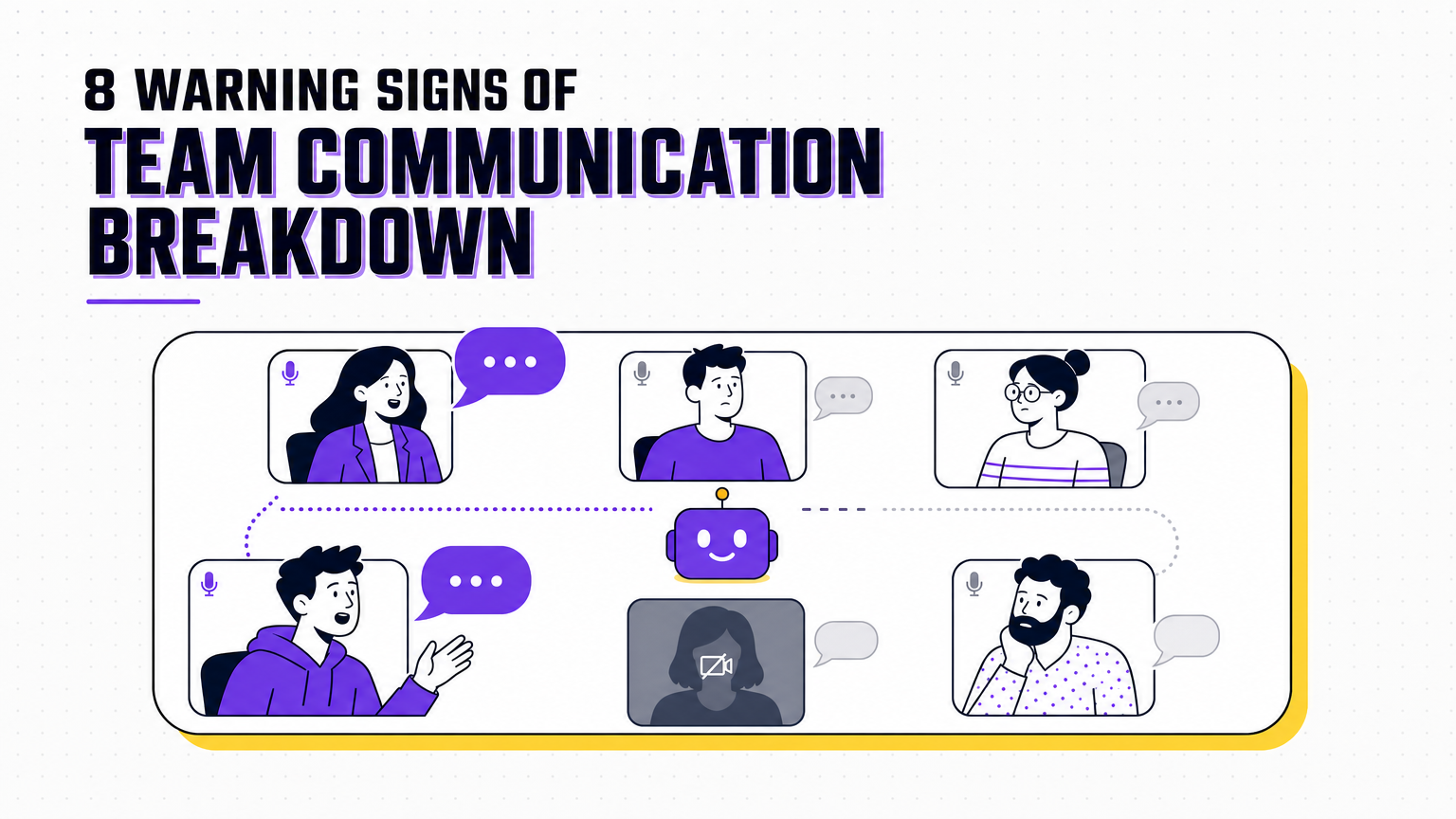
A team rarely announces that its communication is failing. There is no meeting where someone says the words. Instead the signal arrives quietly: a person who used to push back now agrees with everything, a thread that used to spark replies sits dead for two days, a decision gets made in a side channel that half the team never saw. By the time the symptoms are loud enough to name, the project is usually already behind.
This is a guide to catching that drift early. Below are eight observable signs that team communication is breaking down, each one grounded in research on how groups actually talk, and each tied to a signal you can watch for in your own meetings. It sits inside our wider communication styles at work guide, which covers how individual styles collide in the first place. Here the focus is narrower: not why people miscommunicate, but how to tell when a whole team has started to.
The short answer
A communication breakdown is the point where information stops flowing well enough for a team to coordinate, decide, and trust each other. It is not the same as conflict. Healthy teams argue. The danger sign is the opposite of argument: silence, fast agreement, and a slow narrowing of who speaks and what gets said.
The earliest signs are behavioural, not emotional. Turn-taking gets lopsided. Dissent thins out. People start hedging and asking permission to disagree. Side conversations between peers dry up so everything routes through the manager. Clarifying questions disappear, and the same words start meaning different things to different people, which shows up later as rework. The cost is not soft. Grammarly and The Harris Poll’s State of Business Communication report put the price of poor communication at roughly $1.2 trillion a year across US businesses, and a 2024 survey by Project.co found 44% of companies reporting projects delayed or failed because of it. Watch the behaviour, and you can act months before the budget does.
What counts as a breakdown, and what does not
It helps to separate two things people lump together. Friction is a team disagreeing, openly, about ideas. Breakdown is a team losing the ability to surface disagreement at all. The first is a feature of high-performing groups. The second is what replaces it when trust erodes.
That distinction matters because the usual advice, “reduce conflict,” can make a breakdown worse. A team that has gone quiet looks calm. Meetings end on time, everyone nods, no one fights. A manager optimising for harmony will read that as success right up to the moment a deadline is missed and it turns out three people had private doubts they never voiced. The undiscussable problem, as MIT Sloan Management Review described it in 2019, is the issue everyone knows about and no one will name. Its presence is a breakdown sign even though the surface looks peaceful.
So the question is not “is my team fighting.” It is “can my team disagree out loud, and is the right information reaching the right people in time.” The eight signs below are the observable answers to that question.
1. Turn-taking goes lopsided
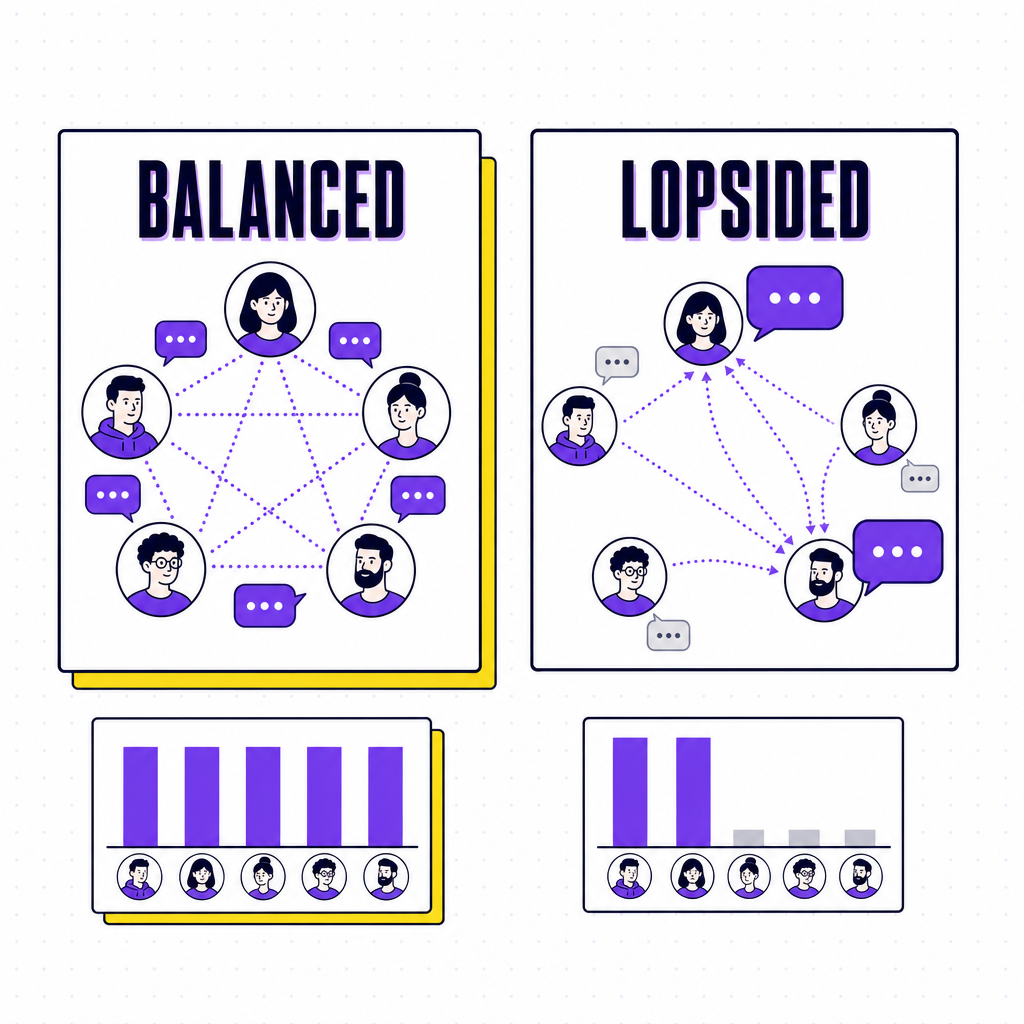
In a healthy discussion, airtime spreads out. People take roughly equal turns, and conversation moves around the room rather than bouncing between two voices. When that balance tips, so that one or two people dominate and the rest go quiet, it is one of the most reliable early signals of trouble.
The evidence here is unusually strong. Anita Woolley and colleagues, writing in Science in 2010, found that a group’s collective intelligence, its ability to perform well across varied tasks, depended less on the average IQ of its members than on two things: social sensitivity and the equality of conversational turn-taking. Teams where a few people dominated scored lower, regardless of how smart those individuals were. Alex Pentland’s work at the MIT Human Dynamics Lab, summarised in Harvard Business Review in 2012, reached a parallel conclusion using wearable sensors: the patterns of communication, including how evenly people participated, predicted team performance better than intelligence, personality, or the content of discussion.
What to watch for: across your last three meetings, did one or two people, often including you, consume most of the talk time while others said almost nothing? If you are the leader and you are speaking more than about a fifth of the time, that is worth noticing on its own.
2. Dissent disappears
A team that reaches consensus instantly, without anyone raising an objection or asking an awkward question, is not aligned. It has usually stopped being willing to disagree. Irving Janis named this pattern groupthink in the early 1970s, and the mechanism has held up: when the cost of dissent feels higher than the cost of a bad decision, people stop dissenting, and the group loses its main error-correction system.
The tell is the speed and smoothness of agreement. Real alignment has texture. Someone qualifies, someone pushes on an edge case, someone asks what happens if the assumption is wrong. When proposals sail through untouched, meeting after meeting, the team is either bored, checked out, or afraid, and all three are breakdown states.
What to watch for: when did someone last challenge an idea in a meeting, and what happened to them afterwards? If you cannot remember the last real objection, that is the sign.
3. Hedging and permission-seeking climb
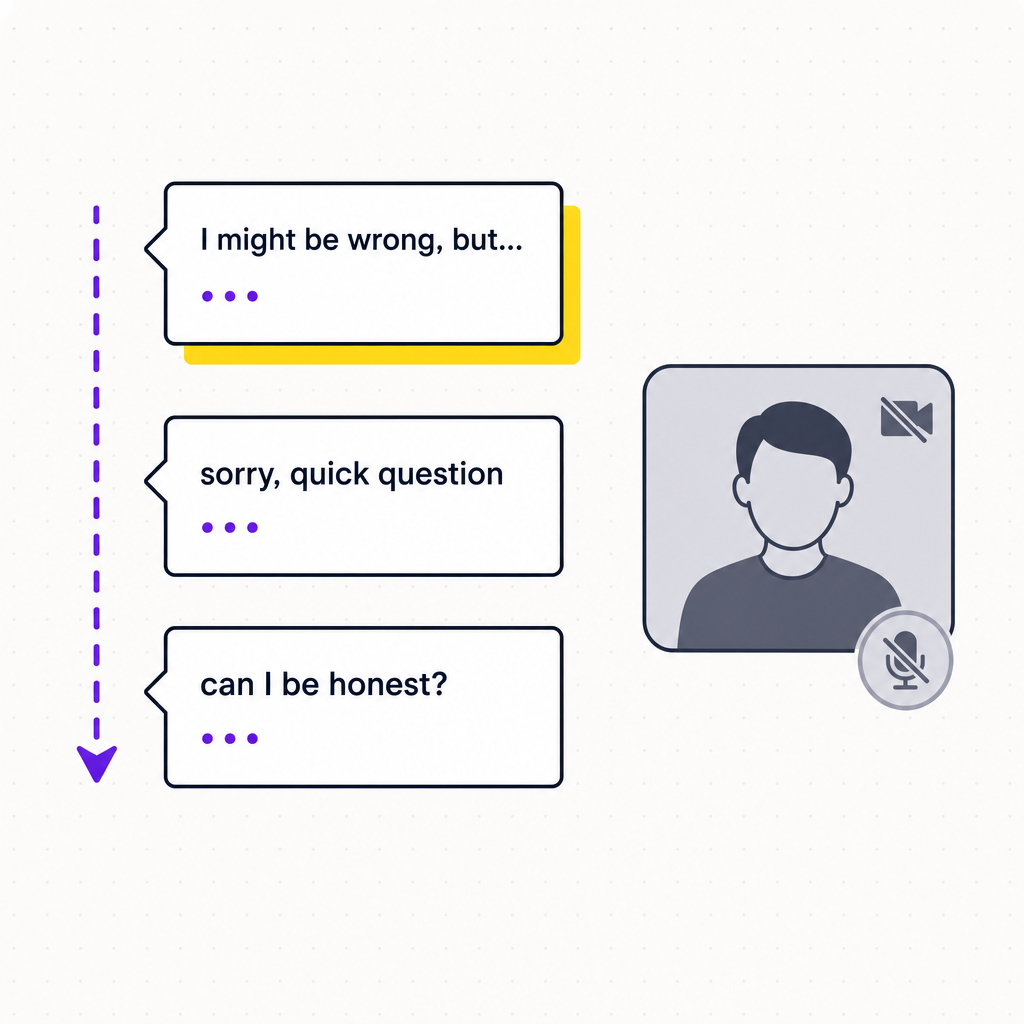
Listen to how people frame what they say, not just what they say. As psychological safety erodes, the language shifts. You hear more qualifiers (“I might be wrong, but”), more pre-emptive apologies (“sorry, quick question”), and more requests for permission to speak plainly (“can I be honest here?”). People are managing the risk of speaking before they speak.
Amy Edmondson’s research on psychological safety, beginning with her 1999 study in Administrative Science Quarterly, established that teams perform better when members believe they can take interpersonal risks, admitting a mistake, asking a naive question, disagreeing with a senior person, without being punished. When that belief weakens, the hedging is the audible symptom. The words around the message get defensive even when the message itself is routine.
What to watch for: a rise in tentative framing, especially from people who used to be direct. The content may be fine. The packaging is the warning.
4. Peer-to-peer talk dries up
Healthy teams have a web of communication: people talk to each other directly, not only to the boss. When that web collapses into a hub-and-spoke shape, where everything routes through the manager and there are no side conversations between team members, horizontal trust is thinning.
Pentland’s sensor studies found that the best teams combined energy and engagement inside the group with exploration outside it, and that the worst warning sign was a team where members only communicated upward. Direct peer-to-peer exchange, including the informal kind, was a marker of a group that actually functioned as a team rather than a set of individuals reporting to a common manager.
What to watch for: are decisions and information moving sideways between colleagues, or does every thread have you in the middle? A manager who has become the only connection between team members is looking at a network that has already started to fail.
5. Questions stop getting asked
Clarifying questions are a sign of engagement. People who care about getting something right ask what “done” means, who owns the next step, and what happens if a dependency slips. When the questions stop, it usually means people have either disengaged or decided that asking is not worth the friction.
This connects to how meetings are run. Steven Rogelberg, in The Surprising Science of Meetings (2019), argues that the best meetings are framed as questions to be answered rather than topics to be presented, precisely because that structure demands participation. A meeting that has degraded into one-way presentation, with no questions at the end, is often a meeting where the audience has quietly stopped contributing.
What to watch for: the silent end of a meeting. If you ask “any questions?” and get nothing, week after week, that is not clarity. It is more often disengagement wearing clarity’s clothes.
6. The same words start meaning different things
When a team is communicating well, shared terms stay shared. When it is breaking down, words like “done,” “quality,” “soon,” and “strategic” quietly fork into private definitions, and nobody notices until work built on one definition collides with work built on another. The visible result is rework: tasks redone because two people understood the brief differently.
The cost of this is large and measurable. Beyond the macro $1.2 trillion figure, the underlying survey data attributes a meaningful share of lost productivity to employees clarifying unclear directives and redoing work, and ties communication failure directly to delayed projects, damaged client relationships, and lost customers. Semantic drift is one of the main engines behind those numbers, because it produces errors that look like individual mistakes rather than a shared communication fault.
What to watch for: recurring confusion about scope or definitions, and a rising rate of work that has to be redone. If “I thought you meant” is becoming a catchphrase, the team’s shared vocabulary is fragmenting.
7. People withdraw and go quiet
Withdrawal is the most direct sign and the easiest to rationalise away. Cameras stay off. Replies get shorter and slower. The person who used to think out loud now only speaks when asked a direct question. Each instance has an innocent explanation, which is exactly why the pattern is easy to miss.
Remote and hybrid work has sharpened this. The friction of speaking up is higher over video, and the cues that used to invite someone in, a glance, a lean forward, a pause, are flattened or lost. A 2025 EEG study of operators working over a remote link found that audiovisual delays past roughly 400 milliseconds saturated attention-related brain activity, which gives a physiological hint at why laggy, effortful video calls drain people and push them toward silence. The mechanism in a meeting room is different, but the direction is the same: when participating costs more, people participate less.
What to watch for: a sustained drop in voluntary contribution from someone who used to offer it, especially paired with slower response times in your written channels.
8. Decisions happen where half the team cannot see them
The last sign is structural. In a breaking-down team, decisions migrate to places only some people can reach: a hallway, a DM, a call that the remote half of the team was not on. The result is information asymmetry, where part of the team is operating on current decisions and part is operating on stale ones, without either group knowing.
This is the hybrid era’s signature failure. When the real source of truth lives in synchronous, in-person moments that are never written down, remote and async colleagues are structurally excluded from the decision network, no matter how good the intentions. The fix is not more meetings. It is making the record of what was decided accessible after the fact, so that being in the room is not a precondition for knowing what happened.
What to watch for: people acting on out-of-date decisions, or asking about choices that were “already made” in a forum they had no access to. That gap is a breakdown you can close with documentation rather than diagnosis.
A manager’s quick checklist
If you want a faster scan, run your team against these questions. Each maps to one of the signs above.
| Signal | The question to ask | What a “yes” suggests |
|---|---|---|
| Turn-taking | Did one or two voices dominate the last three meetings? | Collective intelligence is dropping |
| Dissent | When did someone last challenge an idea out loud? | Groupthink or fear is setting in |
| Hedging | Is tentative, permission-seeking language rising? | Psychological safety is eroding |
| Peer-to-peer | Does every thread route through you? | Horizontal trust is thinning |
| Questions | Do meetings end in silence, not clarification? | Engagement has dropped |
| Shared meaning | Is rework rising from “I thought you meant”? | The team’s vocabulary is fragmenting |
| Withdrawal | Has a regular contributor gone quiet? | Disengagement, often remote-driven |
| Decision visibility | Are people acting on stale decisions? | The async half is being excluded |
None of these requires special tools to notice. They require paying attention to the shape of the conversation, not only its content.
How to act once you see the signs
The interventions that work share a logic: they redesign the conversation rather than lecturing people about it. Three are well supported.
First, restructure meetings to force balanced participation. Rogelberg’s research points to small mechanical changes that work, such as capping attendance to people who genuinely need to be there, framing the agenda as questions, rotating who leads, and using brief silent writing before open discussion so the loudest voice does not anchor the room. Equalising airtime is not a courtesy. Based on the collective-intelligence findings, it is how a group gets smarter.
Second, make the undiscussable discussable. When someone raises a vague concern, resist the urge to translate it into your own assumption. Ask what they actually saw or heard that led them there. This keeps the team operating on observable evidence rather than inference, and it signals that naming a problem is safe, which is the foundation psychological safety rests on.
Third, write decisions down where everyone can find them. In a hybrid team, a durable, accessible record of what was decided and why is the single best defence against the information asymmetry in sign eight. It turns “you had to be there” into “you can read it.”
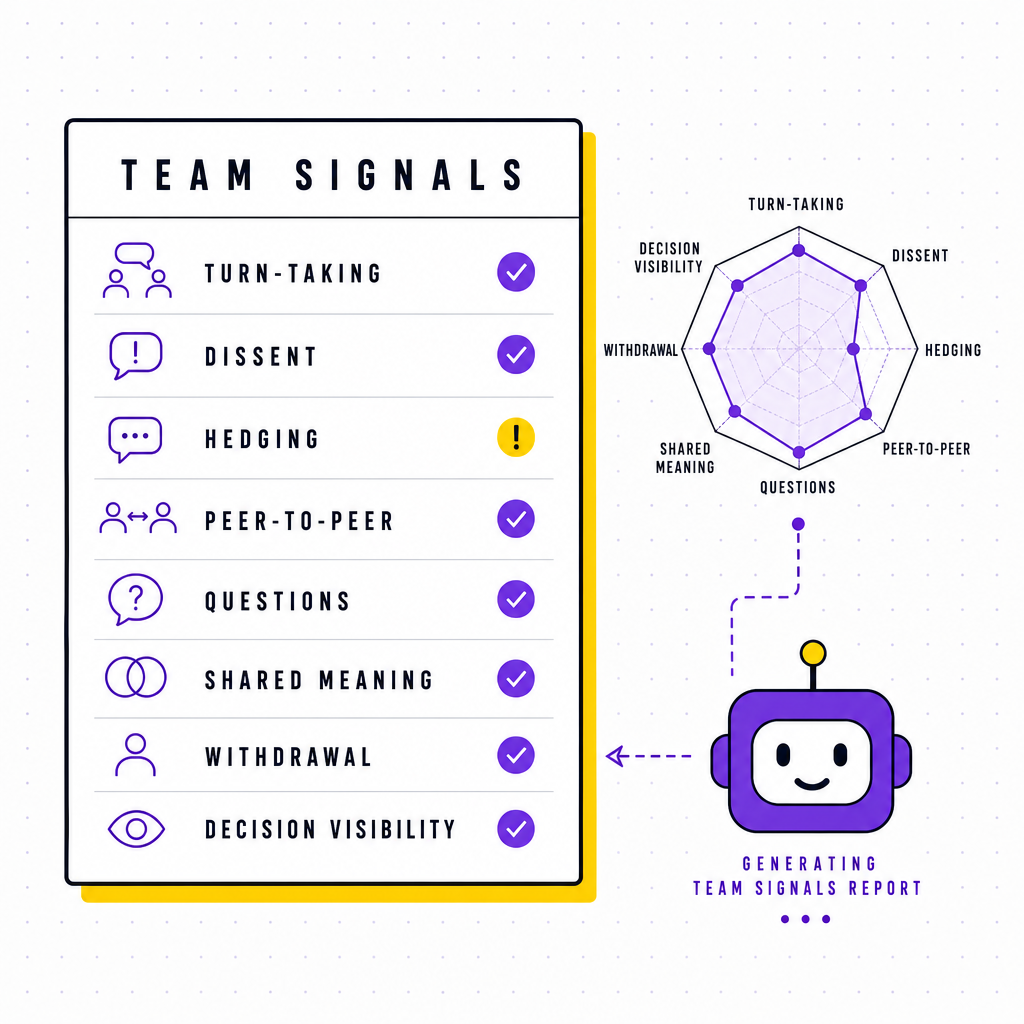
The hard part is not the fixes. It is seeing the signs early enough to use them, because the early stage of a breakdown is quiet by definition. That is the gap Team Building Bot is built to close: it joins your online sessions and tracks the signals above, who spoke, who went quiet, where the room stopped pushing back, and turns them into a Key Moments report you read after the meeting instead of guessing at months later.
Frequently asked questions
What are the signs of a communication breakdown in a team?
The earliest signs are behavioural rather than emotional: airtime concentrates in one or two people, dissent and clarifying questions disappear, hedging and permission-seeking language rises, peer-to-peer conversation collapses so everything routes through the manager, the same words start meaning different things (showing up as rework), regular contributors go quiet, and decisions get made where part of the team cannot see them. A breakdown often looks calm on the surface, which is why these signals matter more than visible conflict.
What is the difference between healthy conflict and a communication breakdown?
Healthy conflict is a team disagreeing openly about ideas, and research links it to better decisions. A breakdown is the loss of the ability to surface disagreement at all. A team in breakdown can look harmonious, with meetings ending on time and everyone nodding, while real doubts go unspoken. The test is whether people can disagree out loud without paying a price, not whether the room is quiet.
How much does poor communication actually cost a business?
Grammarly and The Harris Poll’s State of Business Communication report estimate poor communication costs US businesses around $1.2 trillion a year, with per-employee losses in the tens of thousands. A 2024 Project.co survey found 44% of companies reporting delayed or failed projects due to communication problems, alongside damaged client relationships and lost customers. The losses come largely from rework, lost context, and decisions made on incomplete information.
How can managers detect communication problems early?
Watch the shape of the conversation, not just its content. Track who is talking and who has gone silent, notice when dissent and questions stop appearing, listen for a rise in hedged language, and check whether decisions are reaching everyone. Running your last three meetings against a simple checklist, covering turn-taking, dissent, hedging, peer-to-peer flow, questions, shared meaning, withdrawal, and decision visibility, surfaces most problems before they reach a deadline.
What is the best way to avoid communication breakdown on a remote team?
Reduce the friction of speaking up and remove the structural exclusion of remote colleagues. Frame meetings as questions, use silent written input before open discussion so quieter voices register, and above all write decisions down in an accessible place so being in the room is never a precondition for knowing what was decided. Information asymmetry is the defining failure of hybrid teams, and durable documentation is the most direct fix.
Where to start
Pick one sign and watch for it this week. Turn-taking is the easiest to start with, because it is visible in every meeting and it predicts so much else: in your next three sessions, just notice who speaks and who does not. If two voices carry the room, you have found your first lever, and equalising it tends to pull the other signals along with it.
For the wider picture of how individual styles create these clashes in the first place, see our communication styles at work guide. For the meeting mechanics that prevent breakdown, our piece on meeting facilitation skills and patterns goes deeper on the fixes.
Sources
- Woolley, A. W., Chabris, C. F., Pentland, A., Hashmi, N., and Malone, T. W. “Evidence for a Collective Intelligence Factor in the Performance of Human Groups.” Science, 2010. https://www.marinusvanijzendoorn.nl/wp-content/uploads/2018/01/Woolley-et-al-2010-Science-Collective-IQ.pdf
- Woolley, A. W. et al. “Evidence of a Collective Intelligence Factor in the Performance of Human Groups” (record). ResearchGate. https://www.researchgate.net/publication/47369848_Evidence_of_a_Collective_Intelligence_Factor_in_the_Performance_of_Human_Groups
- Pentland, A. “The New Science of Building Great Teams.” Harvard Business Review, 2012 (summary and analysis). https://www.quickbase.com/blog/new-research-communication-in-an-effective-team
- Pentland, A. “The New Science of Building Great Teams” (analysis). RocheMartin. https://www.rochemartin.com/blog/teams-matter-more-than-ever-claims-massive-study
- Edmondson, A. C. “Psychological Safety and Learning Behavior in Work Teams” (research overview). Harvard Business School Working Knowledge. https://www.library.hbs.edu/working-knowledge/four-steps-to-build-the-psychological-safety-that-high-performing-teams-need-today
- Edmondson, A. C. Psychological safety publications. https://amycedmondson.com/category/psychological-safety/
- “Erosion of Psychological Safety at Workplace: Strategic Interventions to Address the Issue.” ResearchGate, 2024. https://www.researchgate.net/publication/387127143_Erosion_of_Psychological_safety_at_workplace_Strategic_interventions_to_address_the_issue
- Rogelberg, S. G. The Surprising Science of Meetings (research summary). https://www.nceda.org/wp-content/uploads/2020/04/The-Surprising-Science-of-Meetings.pdf
- Rogelberg, S. G. “The Surprising Science of Meetings.” StevenRogelberg.com. https://www.stevenrogelberg.com/the-surprising-science-of-meetings
- “How to Run Great Meetings” (Rogelberg interview). APA Monitor on Psychology, 2016. https://www.apa.org/monitor/2016/12/great-meetings
- “It’s Time to Tackle Your Team’s Undiscussables.” MIT Sloan Management Review, 2019 (announcement). https://www.prnewswire.com/news-releases/new-mit-sloan-management-review-research-article-reveals-an-overlooked-root-cause-of-toxic-culture-and-poor-team-performance-undiscussables-300915132.html
- “It’s Time to Tackle Your Team’s Undiscussables” (summary). getAbstract. https://www.getabstract.com/en/summary/its-time-to-tackle-your-teams-undiscussables/37732
- “How to Prevent Groupthink in Decision Making.” UpRaise. https://upraise.io/blog/how-to-prevent-groupthink-in-decision-making/
- “Groupthink in the Workplace.” Wellhub. https://wellhub.com/en-us/blog/organizational-development/groupthink-in-the-workplace/
- “What Poor Communication Really Costs Your Business.” Zokri. https://zokri.com/what-poor-communication-really-costs-your-business/
- “The Cost of Miscommunication in the Workplace.” Talaera. https://www.talaera.com/corporate-training/cost-of-miscommunication-in-the-workplace/
- “Communication Statistics 2024.” Project.co. https://project.co/communication-statistics-results-2024/
- “Workplace Communication Statistics 2024.” aaask. https://aaask.com/workplace-communication-statistics-2024/
- “The Cost of Poor Workplace Communication.” UC Today. https://www.uctoday.com/unified-communications/cost-of-poor-workplace-communication/
- “Investigating the Neurocognitive Effects of Communication Delay” (EEG study). arXiv, 2025. https://arxiv.org/abs/2508.18074
- “Common Communication Breakdowns at Work and How to Fix Them.” Sign for Work. https://www.signforwork.org.au/common-communication-breakdowns-at-work-and-how-to-fix-them/
- “Hybrid Work Communication Tools.” TimeChamp. https://www.timechamp.io/blogs/hybrid-work-communication-tools
- “Remote Work Communication Statistics.” SpeakWise. https://speakwiseapp.com/blog/remote-work-communication-statistics
More on Communication Styles
- arrow_forward Talking-Time Imbalance in Meetings: What Quiet Tells You
- arrow_forward Nonviolent Communication at Work: Conflict Scripts for 2026
- arrow_forward Nonverbal Communication in Online Meetings: What Survives the Screen
- arrow_forward Assertive Communication: 30 Phrases That Work in 2026
- arrow_forward Interpersonal Communication at Work: 7 Habits of Trusted Colleagues
- menu_book Communication Styles at Work: The Complete 2026 Guide Pillar
Spot the warning signs before they cost you a project
Team Building Bot sits in your online sessions and tracks the signals on this page: who is talking, who has gone quiet, and where the room stopped pushing back. You get a Key Moments report after every session. Free during beta.
No spam, no credit card. Unsubscribe any time.