Psychological Safety at Work: The Complete Guide
What psychological safety really means, the research behind it, what it looks like in a real meeting, and the leader behaviours that build it.
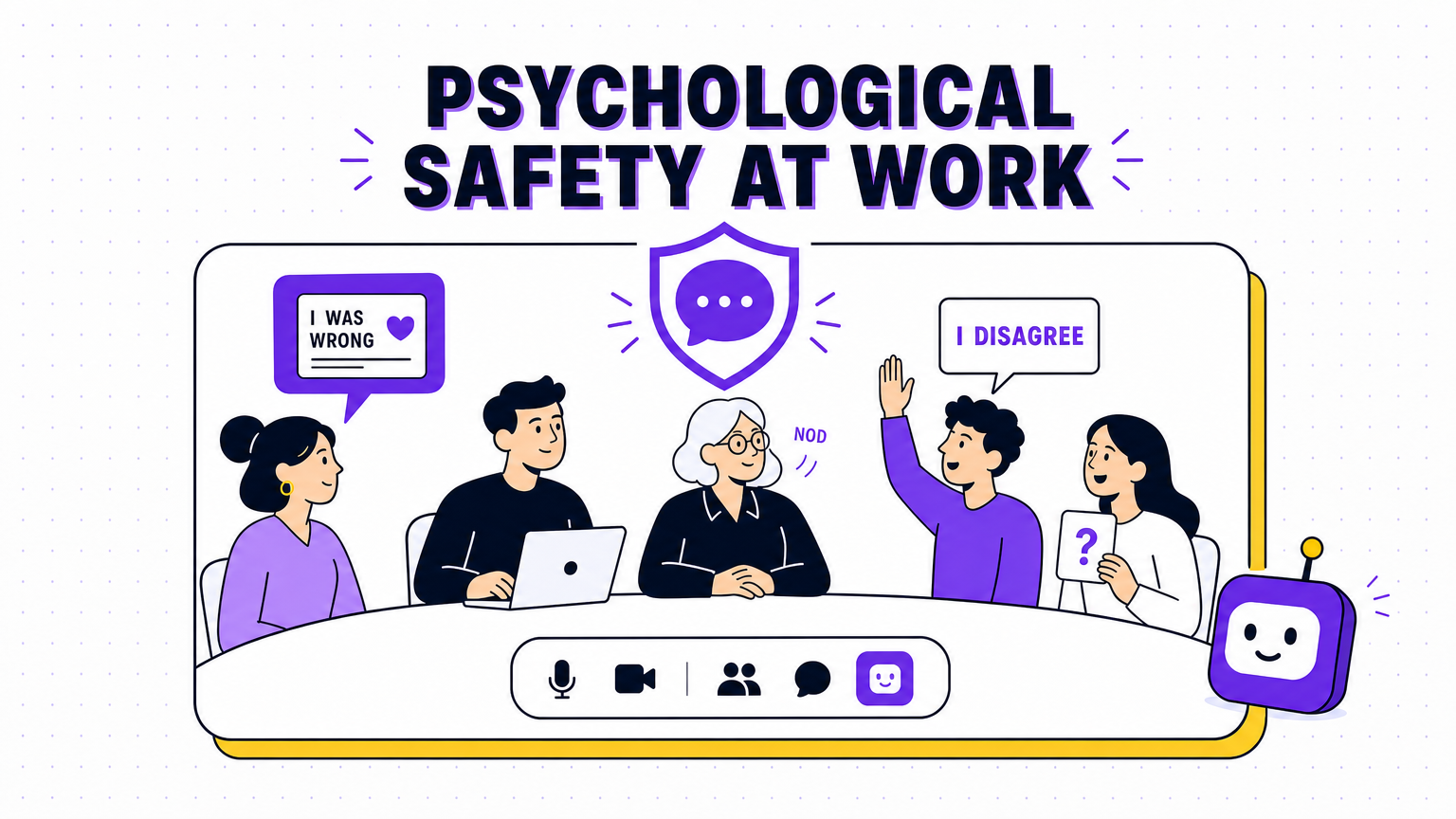
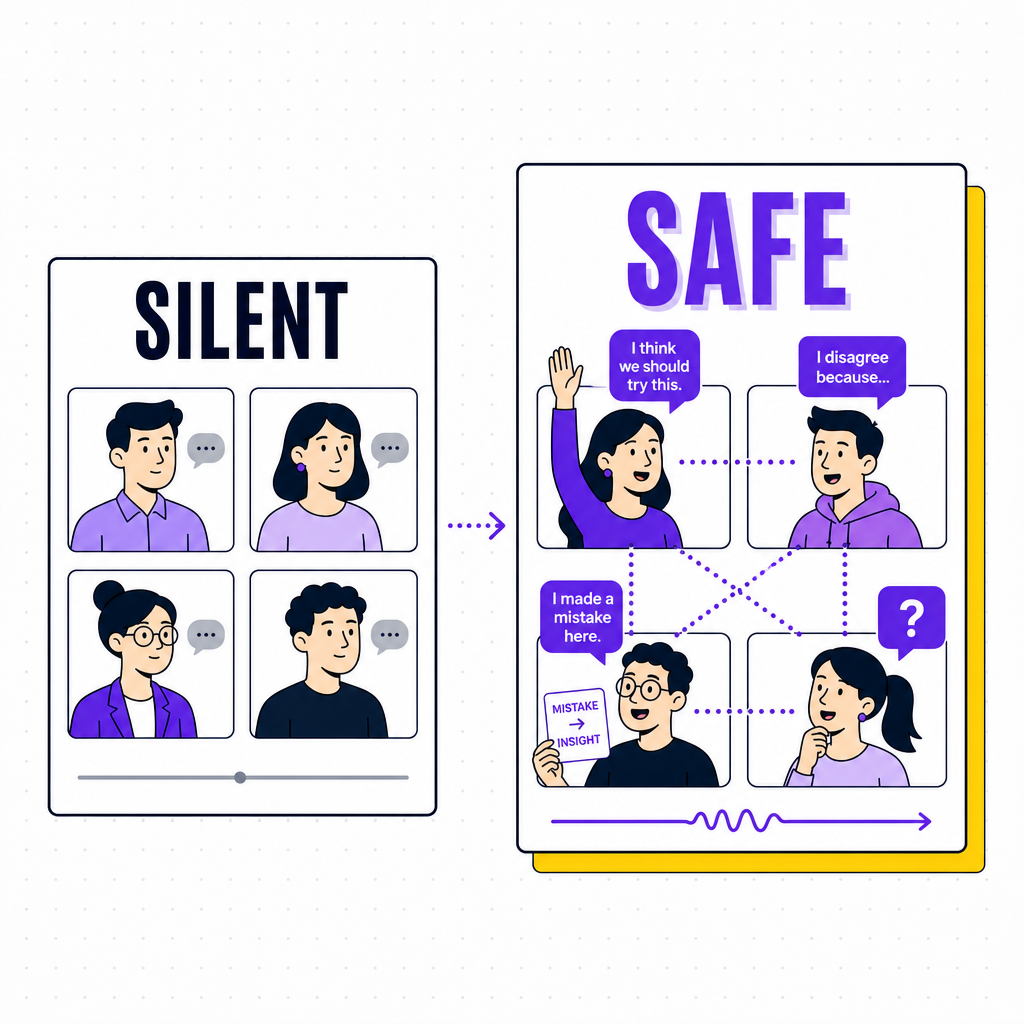
Most teams that look calm are not safe. They are quiet. Nobody challenges the plan, nobody admits the deadline is slipping, and the meeting ends on time with everyone nodding. Then the project misses, and in the post-mortem it turns out three people saw the problem coming and none of them said so out loud. That gap, between what people know and what they are willing to say in the room, is what psychological safety measures.
This is the pillar guide for our work on psychological safety. It covers what the term actually means, what the peer-reviewed evidence says, what safety looks like in a real meeting transcript, how to read it without running a survey, and the specific leader behaviours that move it. The cluster posts below go deeper on individual pieces; this page is the map.
The short answer
Psychological safety is a shared belief among the members of a team that the team is safe for interpersonal risk-taking. The phrase and the definition come from Amy Edmondson, a professor at Harvard Business School, in her 1999 study in Administrative Science Quarterly. In a psychologically safe team, people believe they can ask a question, admit a mistake, disagree with the boss or float a half-formed idea without being humiliated, punished or quietly marked down for it.
It is worth being precise about what that does and does not mean, because the term gets stretched. Psychological safety is not about being comfortable, and it is not about being nice. Edmondson is explicit that safe teams often have more candid conflict, not less, because people are willing to say the hard thing. Safety is what makes high standards survivable: you can hold people to a demanding bar and still have them tell you the truth about where the work is failing. Remove the safety and the standards just teach people to hide.
The reason this matters to anyone running teams is that the willingness to speak up is the bottleneck on almost everything else a group does well: catching errors before they ship, learning from failure, surfacing a better option, raising a risk early. A team can have the talent and still underperform it, because the information that would have helped never reached the table.
What psychological safety is not
Three confusions cause most of the damage, so they are worth naming directly.
It is not the same as trust. Trust is something between two people, about whether you can rely on a specific colleague. Psychological safety is a property of the group, about whether the climate as a whole makes speaking up feel survivable. You can trust an individual teammate and still stay silent in the wider meeting, because the room, not the person, sets the cost of candour.
It is not comfort. A safe team is not one where everyone agrees and nobody feels the heat of a hard conversation. It is one where the discomfort of disagreement is bearable because nobody expects to be punished for it. Mistaking safety for comfort produces the worst version of a team: pleasant, agreeable and quietly avoiding every difficult subject.
It is not lowered standards. This is the objection leaders raise most often, that safety means coddling. The evidence points the other way. Safety and accountability are separate dials. The teams that learn fastest run both high at once: stretch goals plus the freedom to say when the goal is at risk.
What the evidence actually says
Psychological safety is one of the better-supported ideas in organisational research, with three decades of work behind it.
The foundation is Edmondson’s 1999 study. Working across 51 teams in a manufacturing company, she found that psychological safety predicted team learning behaviour, things like seeking feedback, discussing errors and experimenting, and that learning behaviour in turn predicted team performance. The mechanism mattered: safety did not boost results directly, it did so by changing what teams were willing to do together, especially around mistakes.
The idea reached a wider audience through Google. Its internal research effort, Project Aristotle, studied roughly 180 of its own teams to find out what separated the effective ones from the rest. The headline result, published through Google’s re:Work and widely reported, was that of all the variables they tested, psychological safety was the single most important dynamic underpinning a high-performing team. It outranked who was on the team, which surprised the researchers who had expected talent and skills to dominate.
The broadest evidence comes from meta-analysis. A 2017 review in Personnel Psychology by Frazier and colleagues pooled dozens of independent samples and confirmed the pattern across organisations and countries: psychological safety is consistently associated with information sharing, learning behaviour, task performance and work engagement, and it is driven by things like supportive leadership and well-designed work rather than by personality alone. The relationship is not a one-company artefact; it shows up repeatedly across the literature.
One more study sits alongside these because it explains the mechanism in meetings. Anita Woolley, Thomas Malone and colleagues, writing in Science in 2010, studied 192 groups and found a measurable factor they called collective intelligence that predicted group performance across many tasks. It correlated only weakly with members’ average IQ. What it tracked was social sensitivity and the equality of conversational turn-taking, how evenly people got to speak. Psychological safety is a large part of what lets that turn-taking stay even, which is why we treat it and talking-time imbalance as two views of the same underlying thing.
What it looks like in a real meeting
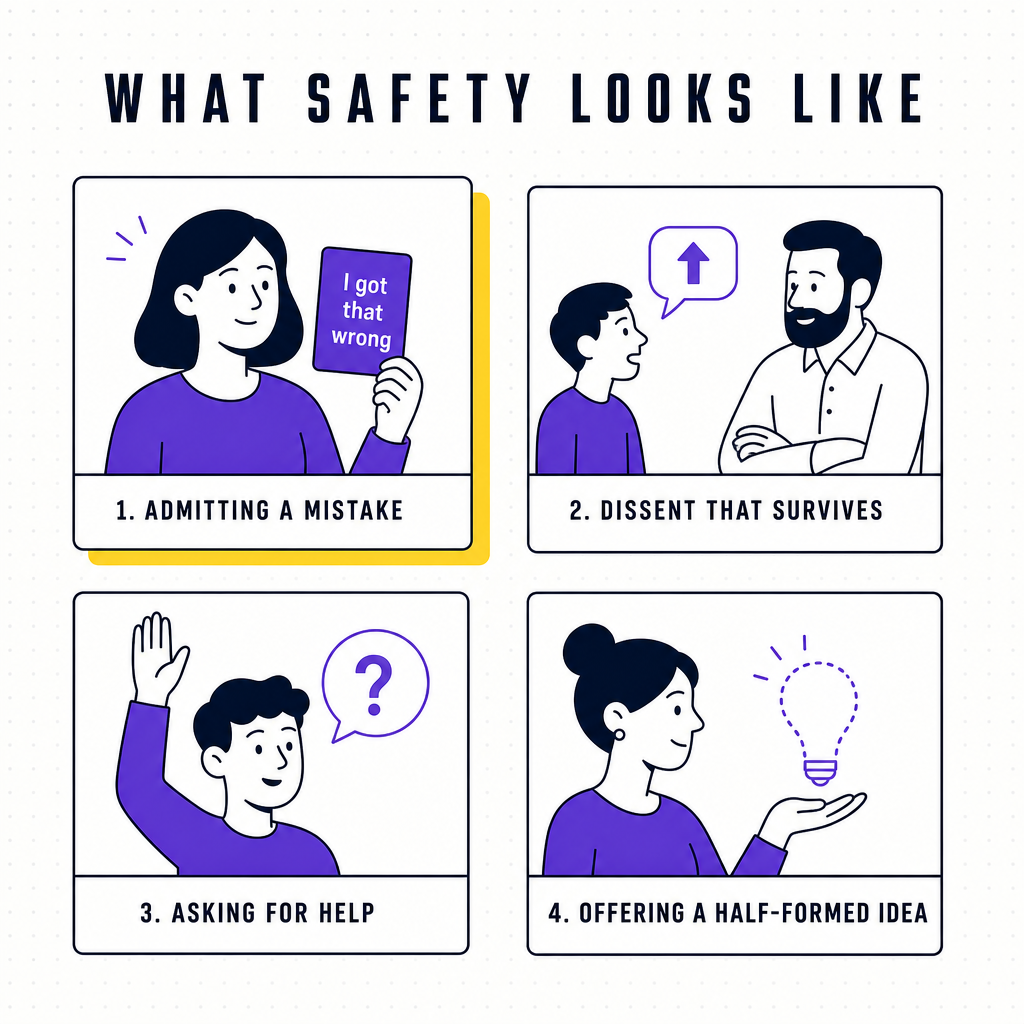
The most useful shift for a facilitator is to stop treating psychological safety as a feeling and start treating it as a set of observable behaviours. You cannot see a belief, but you can see what people do when the belief is present. A few signals are reliable.
People admit mistakes and near-misses out loud. In a safe team, someone will say “I got that wrong” or “we nearly shipped a bad number last week” without being dragged to it. In an unsafe one, errors only surface when they can no longer be hidden, which is always too late to learn cheaply.
People disagree with more senior colleagues and survive it. The clearest tell is a junior person pushing back on the most senior person in the room, and the senior person engaging rather than shutting it down. If dissent only ever flows downward, the room is not safe, it is hierarchical.
People ask for help and ask basic questions. Requests like “can someone walk me through this” or “what does that acronym mean” are small acts of exposure. When they happen freely, the social cost of looking unprepared is low. When the room goes silent rather than risk a naive question, the cost is high.
People offer half-formed ideas. Innovation depends on saying the thing that might be wrong. A team that only voices fully polished, defensible positions has already lost most of its creative range to self-censorship.
The opposite signals are just as readable, and we cover them in depth in our guide to team communication breakdown warning signs: airtime concentrating in two or three voices, disagreement vanishing, the real conversation moving to private channels after the meeting ends.
How to measure it without a survey
The standard instrument is Edmondson’s seven-item survey, which asks team members to rate statements such as whether it is safe to take a risk on the team, whether mistakes are held against people, and whether it is difficult to ask others for help. It is well validated and worth running periodically. It also has two limits: people answer surveys carefully when the subject is whether it is safe to be candid, and a quarterly score tells you little about the meeting you are running today.
That is why the behavioural read matters. Several things can be observed in a single session without anyone filling in a form. The distribution of speaking time across participants tells you whether voice is shared or captured by a few. The frequency of questions, especially questions that admit not knowing something, signals how low the cost of exposure is. Whether anyone disagrees with the most senior person present, and what happens next, is close to a direct test. And the rate of error or problem disclosure, people naming things that went wrong rather than only things that went well, shows whether the team treats failure as data or as a threat.
None of these is conclusive alone. Together, watched over a few meetings, they give a far more current picture than an annual survey can. This is also where software has started to help: meeting analytics can now measure turn-taking and participation automatically, which turns a vague impression that “Sara never speaks in the leadership call” into something you can actually see and act on.
The leader behaviours that build it
Psychological safety is not weather. It is built, mostly by the person with the most authority in the room, through a few repeatable behaviours. Edmondson’s own work and the practitioner literature converge on the same short list.
Frame the work as a learning problem, not just an execution problem. When a leader says the path is genuinely uncertain and the team will have to figure it out together, mistakes become expected information rather than failures of competence. When the leader signals that the answer is already known and the job is just to deliver it, every deviation reads as incompetence and people hide them.
Acknowledge your own fallibility. A leader who says “I don’t have all the answers here” or “I was wrong about that” lowers the cost of everyone else doing the same. Going first is the lever, because the team calibrates the real rules from what the boss does, not from what the values poster says.
Invite input actively, and structurally. An open-door policy is passive and easy to ignore. Asking a direct question, “what are we missing here, where could this go wrong”, and then genuinely engaging with the answer, makes dissent a requested contribution rather than an act of insubordination. Structured turns, written rounds and explicit asks for the counter-argument all widen participation beyond the loudest voices.
Respond well to bad news. This is the moment that sets the climate. When someone brings a mistake or a missed deadline and the leader responds with blame or visible anger, the whole team learns instantly that honesty is dangerous. When the leader stays steady and asks what the team can learn, candour survives. A blame-free after-action review is one of the most direct ways to practise this in a structure, because it keeps the focus on what the system can learn rather than who to scapegoat.
Timothy Clark’s four stages
A useful staged model comes from Timothy Clark, who frames psychological safety as four needs a team has to satisfy in order, each unlocking riskier and more valuable behaviour.
| Stage | Name | What it lets people do |
|---|---|---|
| 1 | Inclusion safety | Feel accepted and part of the group, without fear of being excluded for who they are. |
| 2 | Learner safety | Ask questions, give and receive feedback, and make small mistakes while learning. |
| 3 | Contributor safety | Use their skills and judgement to do real work without being micromanaged. |
| 4 | Challenger safety | Question the status quo and push back on leadership without fear of retaliation. |
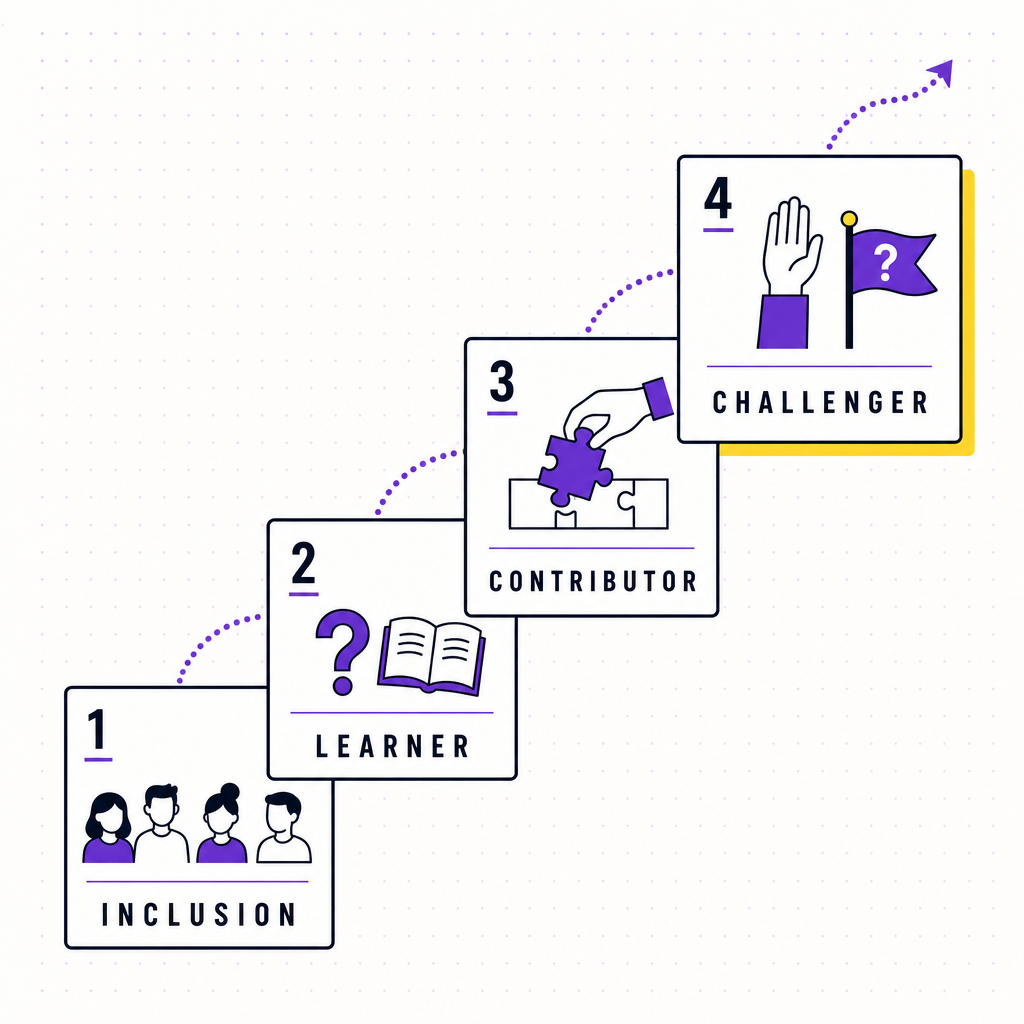
The order is the point. A team that has not established basic inclusion will not suddenly produce people willing to challenge the boss. Pushing for stage four behaviour before the earlier stages are in place tends to backfire, which is also why forcing deep personal disclosure in a team-building exercise before any trust exists usually makes things worse, not better.
Psychological safety in remote and hybrid meetings
The move to hybrid and remote work changed the texture of psychological safety, and the research of the last two years is starting to map how.
The most cited finding concerns cameras. A study by Gabriel and colleagues, published in the Journal of Applied Psychology, tracked 103 employees over four weeks and found that being on camera all day was significantly more fatiguing than being off it, and that this fatigue was linked to lower engagement and less voice in meetings. The effect fell hardest on women and newer employees, who carry more of the self-presentation load. The practical implication runs against the early corporate instinct: mandating cameras-on to force engagement can quietly silence the people who already feel least safe. Letting cameras off for routine calls, and reserving them for the high-stakes conversations where reading the room genuinely matters, tends to protect voice better. We go deeper on this in nonverbal communication in online meetings.
Two other remote dynamics are worth watching. Video latency disrupts the natural rhythm of turn-taking, so people hold back rather than risk talking over a colleague, which flattens the conversational equality that collective intelligence depends on. And the parallel text chat cuts both ways: it gives quieter and second-language participants a lower-risk channel to contribute, but unmanaged it can fracture into exclusionary backchannels that undermine whoever is speaking. The fix in both cases is explicit norms and active facilitation, not the technology itself.
Why this matters for L&D, HR and coaches
For the people who buy and run team development, psychological safety has moved from a soft-skills nice-to-have to something closer to the operating system of a team. The gap between the talent an organisation hires and the output it actually gets is largely a team-dynamics gap, and safety is the biggest single lever on it.
That has a practical consequence for how you spend a training budget. Upskilling individuals in isolation does little if they return to a climate where speaking up is unsafe. The work that pays off more is on the conditions of the team itself: how the leader frames uncertainty, how the team handles a mistake, whether the meeting structure shares voice or concentrates it. Those are coachable, and crucially they are observable, which means you can show whether an intervention actually changed behaviour rather than just whether people enjoyed the workshop.
There is a newer angle too. As teams adopt AI tools, the willingness to admit “I don’t understand this yet” and to share what is and is not working becomes the rate-limiter on adoption. In a fearful culture people hide their confusion and quietly avoid the new tools; in a safe one they experiment in the open and learn faster. Whatever the next capability shift is, the team that can talk honestly about not knowing will absorb it first.
The honest caveat is the same one that applies to all of this. Psychological safety cannot be mandated, measured into existence, or installed in a half-day offsite. It is built slowly through how leaders behave in the small moments, the mistake admitted, the dissent welcomed, the bad news met with curiosity, and it can be lost in a single sharp reaction. The work is patient, but the payoff is a team that tells you the truth in time to act on it.
Frequently asked questions
What is psychological safety at work?
Psychological safety is a shared belief within a team that it is safe to take interpersonal risks, such as asking a question, admitting a mistake, disagreeing or proposing an untested idea, without fear of being embarrassed, punished or penalised. The concept was defined by Harvard’s Amy Edmondson in 1999. It is a property of the team climate rather than of any one relationship, and it is what allows the information people hold privately to reach the group in time to be useful.
Is psychological safety the same as being nice or comfortable?
No. Psychologically safe teams often have more open disagreement, not less, because people are willing to raise hard issues. Safety is not the absence of discomfort; it is the confidence that the discomfort of a difficult conversation will not be punished. It also sits alongside high standards rather than replacing them. The strongest teams combine demanding goals with the freedom to say honestly when those goals are at risk.
How do you measure psychological safety?
The standard tool is Amy Edmondson’s seven-item survey, which asks team members to rate statements about whether mistakes are held against them, whether it is safe to take risks, and whether they can ask for help. Surveys are useful but limited, because people answer cautiously and a periodic score lags real behaviour. Behavioural signals give a more current read: how evenly speaking time is shared, how often people ask questions or admit not knowing something, whether anyone disagrees with the most senior person, and how readily the team discloses errors.
What are the four stages of psychological safety?
The four stages come from Timothy Clark: inclusion safety (feeling accepted in the group), learner safety (feeling safe to ask questions and make mistakes while learning), contributor safety (feeling safe to do real work and use your judgement), and challenger safety (feeling safe to question the status quo and push back on leadership). They build in order, and a team rarely reaches the later stages without the earlier ones in place.
How can a leader build psychological safety?
Through a few repeatable behaviours: framing the work as a learning problem where the path is uncertain, openly acknowledging their own mistakes and limits, actively inviting input and dissent rather than relying on an open-door policy, and responding to bad news with curiosity instead of blame. The moment someone brings a problem is the one that sets the climate, because the whole team learns from how the leader reacts whether candour is safe.
Where to start
Pick your next team meeting and watch one thing: what happens when someone disagrees, or when something has gone wrong. Does the disagreement get engaged with or shut down? Does the mistake get named early or surface late? Those moments tell you more about your team’s psychological safety than any survey, and the leader behaviours above are where you start to move it.
From here, the cluster goes deeper. For the conversational mechanics, see talking-time imbalance in meetings. For the early warning signs that safety is eroding, team communication breakdown warning signs. For practising blame-free reflection in a structure, how to run an after-action review.
Sources
- Edmondson, A. C. “Psychological Safety and Learning Behavior in Work Teams.” Administrative Science Quarterly, 1999. https://web.mit.edu/curhan/www/docs/Articles/15341_Readings/Organizational_Learning_and_Change/Edmondson_1999_Psychological_safety.pdf
- Edmondson, A. C. “Psychological Safety and Learning Behavior in Work Teams” (record). Semantic Scholar. https://www.semanticscholar.org/paper/Psychological-Safety-and-Learning-Behavior-in-Work-Edmondson/d650984aa6931afc01caa2537c789aea92ace487
- Edmondson, A. C. Faculty research record. Harvard Business School. https://www.hbs.edu/faculty/Pages/item.aspx?num=2959
- Frazier, M. L., Fainshmidt, S., Klinger, R. L., Pezeshkan, A., and Vracheva, V. “Psychological Safety: A Meta-Analytic Review and Extension.” Personnel Psychology, 2017 (record). ResearchGate. https://www.researchgate.net/publication/305488140_Psychological_Safety_A_Meta-Analytic_Review_And_Extension
- “Psychological Safety: A Meta-Analytic Review and Extension” (record). EconBiz. https://www.econbiz.de/Record/psychological-safety-a-meta-analytic-review-and-extension-frazier-lance/10011706195
- Woolley, A. W., Chabris, C. F., Pentland, A., Hashmi, N., and Malone, T. W. “Evidence for a Collective Intelligence Factor in the Performance of Human Groups.” Science, 2010. https://www.marinusvanijzendoorn.nl/wp-content/uploads/2018/01/Woolley-et-al-2010-Science-Collective-IQ.pdf
- Woolley, A. W. et al. “Evidence for a Collective Intelligence Factor in the Performance of Human Groups” (record). PubMed. https://pubmed.ncbi.nlm.nih.gov/20929725/
- “Project Aristotle: Google’s data-driven insights on high-performing teams.” Aristotle Performance. https://www.aristotleperformance.com/post/project-aristotle-google-s-data-driven-insights-on-high-performing-teams
- “Google’s Project Aristotle.” Psych Safety. https://psychsafety.com/googles-project-aristotle/
- “Project Aristotle explained.” Fearless Organization Scan. https://fearlessorganizationscan.com/project-aristotle-explained
- “High-performing teams: a scientific summary” (evidence review). CIPD, 2023. https://www.cipd.org/globalassets/media/knowledge/knowledge-hub/evidence-reviews/2023-pdfs/8388-high-performing-teams-scientific-summary-may23.pdf
- “Seven behaviours that damage psychological safety.” Psych Safety. https://psychsafety.com/seven-behaviours-damage-psychological-safety/
- “How to measure psychological safety.” Psych Safety. https://psychsafety.com/measure-psychological-safety/
- “Measuring psychological safety in healthcare teams: developing an observational measure to complement survey methods” (record). ResearchGate. https://www.researchgate.net/publication/343293149_Measuring_psychological_safety_in_healthcare_teams_Developing_an_observational_measure_to_complement_survey_methods
- “Measuring what matters: the role of psychological safety metrics in HR.” myHRfuture. https://www.myhrfuture.com/blog/measuring-what-matters-the-role-of-psychological-safety-metrics-in-hr
- “The 4 stages of psychological safety” (Timothy Clark model, applied). LeaderFactor. https://www.leaderfactor.com/learn/project-aristotle-psychological-safety
- “Feedback and psychological safety” (Clark four-stage model). Deep Impact. https://deepimpactonline.com/feedback-and-psychological-safety/
- “Psychological safety vs comfort.” TeamMood. https://blog.teammood.com/psychological-safety-vs-comfort
- “When psychological safety gets misused at work.” Benchmark Consulting. https://benchmark-consulting.com.ph/when-psychological-safety-gets-misused-at-work/
- “Camera on or off: the psychology of virtual meeting fatigue” (Gabriel et al., Journal of Applied Psychology). Wellable. https://www.wellable.co/blog/camera-on-or-camera-off-the-psychology-of-virtual-meeting-fatigue/
- “Less camera time, less fatigue: study of virtual meetings finds.” Safety+Health Magazine. https://www.safetyandhealthmagazine.com/21763-less-camera-time-less-fatigue-study-of-virtual-meetings-finds/
- “What happens to psychological safety when going remote” (record). ResearchGate. https://www.researchgate.net/publication/366159266_What_Happens_to_Psychological_Safety_When_Going_Remote
- “Zooming in on psychological safety in virtual teams.” The Decision Lab. https://thedecisionlab.com/insights/hr/zooming-in-on-psychological-safety-in-virtual-team
- “The promise and peril of parallel chat in video meetings for work” (record). ResearchGate. https://www.researchgate.net/publication/351427534_The_promise_and_peril_of_parallel_chat_in_video_meetings_for_work
- “Three simple exercises to build psychological safety in your team.” Psych Safety. https://psychsafety.com/three-simple-exercises-to-build-psychological-safety-in-your-team/
- “Psychological safety” (facilitation library). SessionLab. https://www.sessionlab.com/library/psychological-safety
See where your team actually feels safe to speak
Team Building Bot sits in your online sessions and reports on the behaviours that signal psychological safety: who spoke, who went quiet, where disagreement surfaced and where it stalled. You get a Pressure Response and Team Dynamics report after each session instead of guessing. Free during beta.
No spam, no credit card. Unsubscribe any time.